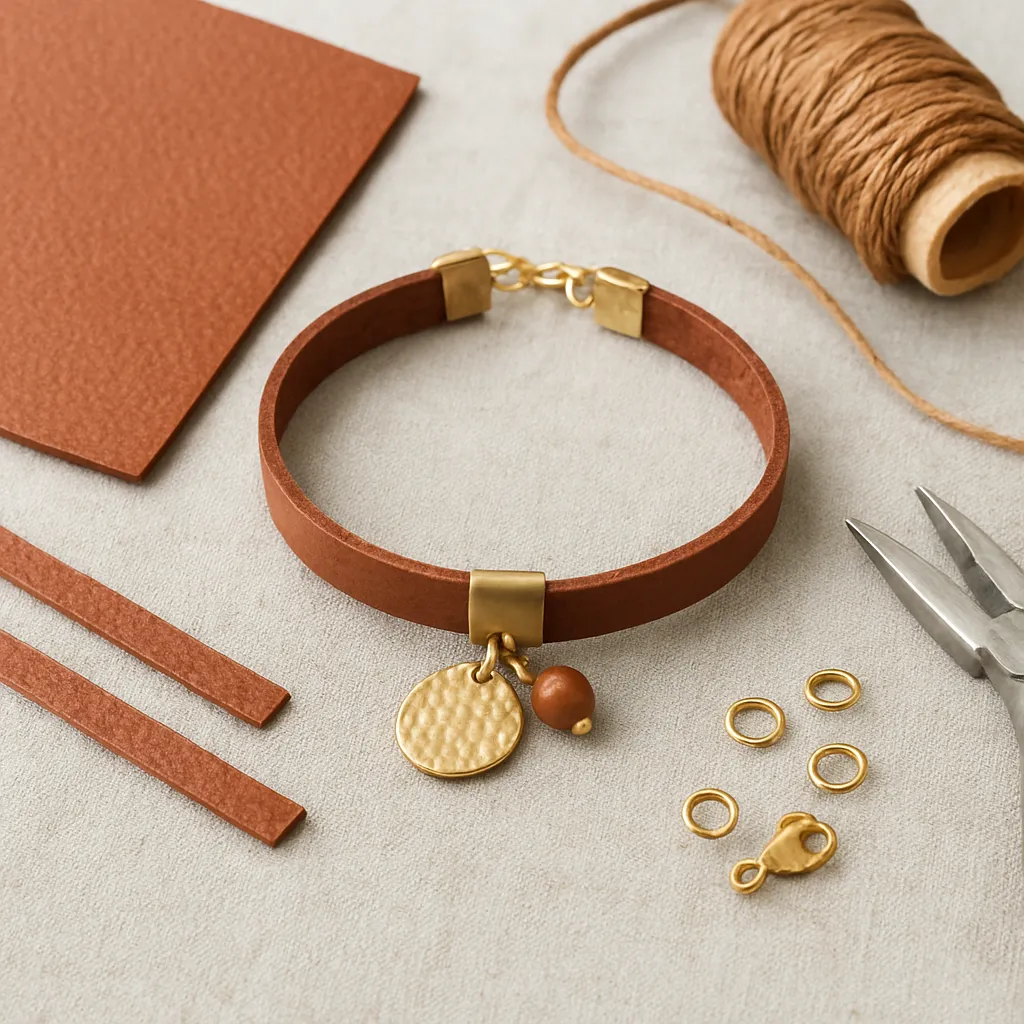
Faux leather has evolved from a mere substitute to a creative staple in modern jewelry-making. Lightweight, color-saturated, and easy to shape, it opens up a world of expressive forms—from featherlight statement earrings to sculptural cuffs—without the weight, cost, or maintenance demands of many traditional materials. Crafters appreciate its predictable handling, consistent thickness, and broad surface finishes that range from matte and rubbery to glossy and embossed. Whether you’re a metalworker looking to soften a collection with supple elements or a fiber artist seeking crisp silhouettes that hold their edge, faux leather is a flexible bridge between structure and comfort. This guide walks you through materials, tools, foundational techniques, advanced finishes, and design strategies that help you turn sheets of faux leather into memorable wearables.
What Faux Leather Is—and Why It Works for Jewelry
Faux leather, often made from polyurethane (PU) or polyvinyl chloride (PVC) layered over a fabric or microfiber backing, mimics the look and feel of animal leather while offering more predictable manufacturing tolerances. It’s produced in a wide range of thicknesses (commonly 0.5–2.0 mm for jewelry-friendly weights), stiffness levels, and surface treatments—think pebbled, suede-like microfiber, metallic, patent, iridescent, or textured reptile patterns. That consistency is crucial for small-scale wearable pieces, where millimeters matter for comfort and balance.
Compared to animal leather, faux leather generally resists moisture better, does not patina the same way, and can be cut with fewer fibers or fuzz pulling at the edges. It accepts heat embossing and foil transfers, tolerates many adhesives, and can be die-cut or machine-cut with precise repeatability. In jewelry, these properties support repeat production, intricate geometries, and color-forward collections.
Two qualities stand out for makers: material durability—resistance to cracking at bends, colorfastness, and abrasion performance—and design versatility, meaning how well it pairs with metal findings, beads, textiles, and resin. Faux leather’s low weight invites oversized silhouettes without dragging lobes or rolling on the wrist, and the material can be laminated, layered, braided, or sculpted to create dimensionality that would be heavy in metal or glass.
Choosing the Right Material for Your Project
Faux leather comes in multiple constructions, each suiting different jewelry techniques:
- PU on microfiber: Soft hand, good drape, and less plastic feel; great for layered earrings, tassels, and braided wraps.
- PU on woven cloth: Slightly stiffer with stable edges; useful for crisp geometric shapes and inlays.
- PVC-coated fabrics: High gloss and water resistance; ideal for shiny accents and patent looks but can be stiffer.
- Microfiber “suede”: A non-woven, velvety surface that behaves like split leather; perfect for knotting, fringe, and soft cuffs.
- Plant-based composites (e.g., cork, apple “leather,” pineapple fiber blends): Aesthetic appeal and perceived eco benefits; assess longevity and finish compatibility for the piece type.
Evaluate these characteristics before purchase:
- Thickness: 0.8–1.2 mm is sweet-spot for most earrings and pendants; 1.2–1.8 mm for cuffs; 0.5–0.8 mm for overlays and applique.
- Backer type: Woven backers resist stretch; microfiber backers offer plush edges; paper-like backers may delaminate under stress.
- Surface finish: Matte hides scuffs; glossy shows fingerprints but looks striking; metallics may crack if bent repeatedly.
- Colorfastness: Rub a white cloth on a sample; dye transfer indicates problems for light clothing and skin.
- Edge behavior: Test-snip; some constructions fuzz, others cut clean; this influences your edge-finishing approach.
- Comfort and safety: Pair components with nickel-free findings and skin-friendly glues; PU-based faux leathers are often more skin-comfortable than stiff PVCs.
Essential Tools and Supplies
Faux leather is approachable with common craft tools, yet it benefits from a few specialized additions:
- Cutting: Sharp shears, craft knives with fresh blades, rotary cutters with small-diameter wheels, and dies. For intricate shapes or production, consider digital cutters or laser-cutting (with safe materials—never cut PVC with a laser).
- Punching: Precision hole punches (1–4 mm), oval punches for slots, and stitching chisels if you’ll sew through layers.
- Measuring and layout: Grid rulers, wing dividers, and templates for accurate pattern-making. Low-tack tape and silver pencils or chalk for marking on dark surfaces.
- Bonding: Contact cements rated for synthetics, flexible PVA, double-sided tapes, and UV-curing gels appropriate for faux leather. Not all adhesives play well with coatings—test first.
- Stitching: Leather needles (if hand-sewing), polyester threads, and thimbles. Use longer stitch lengths to avoid perforation lines that tear.
- Setting: Mini anvils, setters for rivets, snaps, grommets, and crystal prongs—collectively your jewelry hardware.
- Edges: Fine files, micro-sanding sponges (400–1000 grit), edge paints, edge sealer pens, and heat tools to manage fuzz and seal cuts.
Safety note: Ventilate when using solvents or heat-transfer films. Keep blades sharp—ragged edges come more from dull blades than from the material itself.
Preparing and Cutting Faux Leather
Preparation improves precision and finished appearance:
- Flatten the material: Store sheets flat under weights or gently warm and press between parchment to relax curl memory.
- Assess stretch: Woven-backed sheets stretch less; align the longest dimension of earrings with the grain to reduce droop.
- Transfer marks lightly: Use light chalk or removable markers; deep scoring can weaken the surface layer.
- Test cuts: Make a small curve and a small inside corner; inspect edges for fray, lift, or white stress lines.
For straight cuts, a metal ruler and rotary cutter deliver clean lines. For curves, sharp shears work if you keep the sheet steady and move the tool. Punch holes from the “good” side with a sharp punch; twist minimally to avoid flared edges. When die-cutting, sandwich with a shim for consistently crisp edges. For digital cutters, mirror designs as needed and use a strong mat; do multiple light passes instead of one heavy pass to avoid drag lines on the surface film.
Bonding, Stitching, and Structural Techniques
Bonding: A light coat of contact cement on both pieces, flashed off until tacky, creates a strong join. For delicate earrings, double-sided industrial tapes avoid fumes and speed assembly. UV gels can dome small surfaces or lock inlays under a glossy coat—just ensure the faux leather tolerates the cure heat. Always test for discoloration or rippling, especially on foils and patent finishes.
Stitching: Hand-stitching with pricked holes or machine stitching with a Teflon foot adds decorative lines and increases structural integrity. Keep stitch length longer (3–4 mm) and tension moderate; set too short and you’ll perforate a tear path. Consider polyester topstitch thread for visible contrast. If edges are sandwiched, clip corners diagonally before turning for reduced bulk.
Rivets, snaps, and grommets: Mechanical fasteners distribute stress and add sparkle. Use washers or backing discs when setting into thin faux leather. For earring hang points, a small rivet can outlast a hole-punched slot. Chicago screws allow disassembly for repair or interchangeability—great for modular bracelets and pendants.
Forming and sculpting: Gentle heat (from a heat gun on low or warm water) softens many PU faux leathers enough to curve them around dowels. Hold until cool to set a curve for cuffs or dimensional petals. Avoid overheating, which can warp coatings.
Braiding, weaving, and tassels: Thin strips cut consistently make clean braids; back with a second color for reversible designs. For tassels, bind the head with wire or a narrow strip of the same material; seal cut ends with edge paint or a brief touch of heat to prevent fuzz.
Edge Management and Surface Finishes
Crisp edges elevate faux leather from “crafty” to boutique. After cutting, lightly sand edges to remove step lines, then apply edge paint or sealer in thin coats, drying between layers, and burnish gently with a canvas scrap. Match or contrast edge color to the face—contrasting edges accentuate geometry and thickness.
Embossing and foil: Heat-set foil and metallic leafing look striking on matte surfaces. Use low-temp adhesives designed for foils or a hot-stamp pen. Test scrap for shine uniformity and adhesion strength.
Screen and block printing: Water-based inks formulated for synthetics adhere well; heat-set per manufacturer guidelines. Stencils yield repeatable motifs across a collection.
Inlays and overlays: Cut negative space from a base sheet and fit contrasting pieces for marquetry-like effects. Secure with thin layers of glue and press under weight for flatness. Finish with a sealing coat or UV gel to lock edges flush.
Findings and Skin Comfort
Choose findings that balance the piece while ensuring comfort. For earrings, small jump rings plus wire-wrapped loops create articulation and reduce torque on the faux leather. Opt for stainless steel, titanium, or niobium ear wires for hypoallergenic wear, especially on styles that sit close to skin. For cuffs, use magnetic clasps with safety catches or adjustable buckles; for pendants, low-profile bails keep focus on the piece while securing cord or chain.
When attaching findings to faux leather, avoid oversize holes that can elongate; reinforce with a small washer, another faux leather disc, or a dab of flexible glue. For cords and straps, fold the end over a finding bar and stitch or rivet; for flat pendants, consider glued-on bails backed with a rivet hidden under a decorative plaque.
Sample Projects to Build Skills
Featherweight Layered Earrings
Cut two teardrops each from contrasting faux leather (e.g., matte black and holographic silver). Punch a 1.5 mm hole at the narrow end. Bond the smaller teardrop atop the larger with thin contact cement, aligning holes. Sand edges lightly, then edge-paint in black to unify the stack. Add a 4 mm jump ring and attach to ear wires. Optional: heat-curve the bottom third over a dowel for movement. These earrings demonstrate stack alignment, clean punching, and color contrast without bulk.
Modular Cuff with Interchangeable Tiles
Cut a 1.6 mm thick faux leather strap to wrist size plus overlap. Edge-finish and punch a row of evenly spaced holes at the centerline. Create small square tiles from thin faux leather with contrasting textures, back them with stiffener, and punch matching holes. Mount tiles with Chicago screws so they can be swapped seasonally. This project practices measuring, hole indexing, and mixing surface textures in a cohesive system.
Bib Necklace with Negative Space
Draft a crescent with internal cutouts like petals or geometric windows. Bond a second sheet behind it to create a two-tone reverse. Drill small holes along the end tabs, set eyelets, and connect to chain with jump rings. Seal edges for a polished contour. The silhouette’s large footprint remains comfortable because the material is light, allowing dramatic scale without strain.
Design Strategy: Color, Texture, and Scale
A successful faux leather collection balances visual interest with wearability. Play with scale: tiny earrings can feel substantial when layered with high-contrast textures; large pendants can feel airy when perforated with negative space. Pair matte and gloss, metallic and suede-like, smooth and embossed to avoid flatness. Use color theory intentionally—analogous schemes (e.g., teal–blue–indigo) read sophisticated, while complementary pops (e.g., coral against olive) add energy. Keep palettes consistent across pieces to create mix-and-match capsule collections.
Consider silhouette thickness as a design element. A 1.2 mm edge has presence; emphasize it with a contrasting edge paint. Equally, layering three thinner sheets can create a “strata” effect visible from the side. Negative space not only reduces weight; it frames the wearer’s skin and clothing color as part of the composition.
Common Pitfalls and How to Avoid Them
- Edge fuzz or delamination: Sand lightly, wipe dust, then seal with edge paint. If the backer sheds, apply a thin fabric stabilizer or bond a backing sheet.
- Adhesive bleed-through: Use minimal glue and spread evenly; switch to a film adhesive or double-sided tape on thin materials. Some adhesives swell foils—test first.
- Cracking on bends: Choose PU over brittle finishes, round inner corners, and warm pieces before forming.
- Holes elongating over time: Reinforce with rivets, eyelets, or backing washers; size holes to findings closely.
- Skin irritation: Use nickel-safe components and hypoallergenic metals in contact points; seal backs where dye transfer is possible.
- Uneven symmetry: Cut mirrored pairs together with stacked sheets or use precise templates. Keep a master template set labeled by size.
Edge-Finishing Mastery
Edge work is worth its own emphasis. After initial sanding, apply a thin coat of edge paint using a fine brush or roller pen. Let dry fully, then sand with 800–1000 grit. Repeat two to three times, finishing with a light burnish using canvas or a slicker at low heat. For glossy finishes, a final clear coat can add depth and match high-shine surfaces. If you prefer a minimalist look, a quick seal with satin edge sealer maintains the clean-cut graphic line without heavy buildup. Effective edge-finishing not only improves feel against the skin but visually elevates even the simplest shapes.
Advanced Techniques and Mixed Media
Heat-transfer vinyl (HTV) layering: Add crisp graphics to faux leather bases. Pre-press to remove moisture and set a short, low-temp fuse cycle to avoid warping. Combine metallic HTV with matte faux leather for modern contrast.
Resin domes and encapsulation: For small charms, faux leather inlays can sit under shallow domes of UV resin, protecting prints or foils. Seal edges first to prevent micro-bubbles from wicking into the resin.
Embroidery and beading: Pierce with stitching chisels and back the piece to capture thread ends cleanly. Beads along an edge add drape and shimmer; reinforce with a hidden secondary layer.
Laser engraving: With compatible, non-chlorinated materials, engraving produces crisp patterns and registration marks for assembly. Pair etched patterns with painted edges and inlay techniques for boutique finishes that scale well in small batches.
Comfort, Balance, and Wear Testing
Even light materials can feel awkward if weight distribution and articulation are off. For earrings, test dangle balance by hanging prototypes on a stand; adjust the jump ring location to keep pieces forward-facing. For cuffs, ensure inner edges are smooth and slightly radiused; a scratchy edge can make a stunning piece unwearable. Trial wear for a day to assess rubbing points, dye transfer, and durability of finishes. Collect feedback while you can still make design tweaks.
Production Tips for Small Studios
- Batch processes: Cut, sand, and edge-paint in batches to ensure color consistency and reduce setup time.
- Templates: Keep acrylic or 3D-printed templates with registration holes for multi-layer designs.
- Quality control: Establish pass/fail criteria for edge smoothness, bond strength, hole roundness, and hardware alignment.
- Documentation: Track source lots, thickness, and finish codes; note preferred blade settings or press times for each material.
Caring for Faux Leather Jewelry
Care practices extend life and presentation quality. Wipe surfaces after wear with a soft, slightly damp cloth, then dry thoroughly. Avoid harsh solvents, perfumes, and hair sprays; these can dull finishes or lift adhesives. Store pieces flat or hanging individually to prevent creases and scuffs. Include care cards for clients to set expectations and reduce returns. Thoughtful maintenance is as much about presentation as longevity.
Ethical and Environmental Considerations
The ethics of faux leather involve trade-offs. While it avoids animal products, many formulations rely on petrochemicals and can shed microplastics over time. On the other hand, long-lasting pieces that displace heavier or short-lived accessories can be a net positive. Seek suppliers who disclose chemical compliance (e.g., REACH, RoHS) and consider plant-based composites when suitable. Design for repair—replaceable findings, modular components, and re-edgeable cuts—to extend a piece’s useful life, thereby improving overall sustainability.
Costs, Pricing, and Presentation
One attraction of faux leather is material efficiency: small offcuts become studs, inlay tiles, or charm layers. Price projects by factoring sheet yield, finish steps, and minutes per operation rather than only raw material cost. Present collections on contrasting display cards that protect edges; consider color-blocked backers to emphasize your palette. Packaging should prevent bending and moisture exposure without adding excessive bulk or plastic.
Safety and Skin-Safe Practices
Work in a ventilated area when using solvents or heat films. Wear cut-resistant gloves while trimming small radii. Verify all metal findings are nickel compliant for earrings and items in close skin contact. If you sell internationally, align with regional labeling standards. Keep a test log: adhesives used, cure times, and any observed discoloration after accelerated wear tests. This record helps you replicate wins and avoid repeat issues in future batches.
From Prototype to Signature Style
Begin by mastering a few base forms—clean teardrops, precise crescents, and well-finished cuffs—then experiment with textures, foils, and riveted accents. Over time, you’ll identify hallmark moves: a signature edge color, a preferred inlay geometry, or a hybrid of metal and soft elements that clients recognize as yours. Because faux leather is forgiving, it rewards iterative exploration; the more you refine cutting paths, finishing sequences, and attachment strategies, the more confident and elevated your pieces become.
Glossary of Useful Concepts
- Backer: Fabric or microfiber layer laminated to the surface film; impacts drape and edge behavior.
- Burnish: To smooth and lightly polish edges via friction, heat, or liquid agents.
- Chicago screw: Two-part screw post useful for modular or repairable joints.
- Contact cement: Solvent-based adhesive applied to both surfaces, bonded when tack-dry.
- Eyelet/grommet: Metal reinforcement for holes, improving wear resistance and appearance.
- HTV: Heat-transfer vinyl; adds graphics to faux leather with heat and pressure.
- Inlay: Fitting a contrasting piece into a cutout opening for a flush surface.
- Stabilizer: Interfacing or film adding stiffness or preventing stretch.
Quick Start Checklist
- Select a jewelry-suitable faux leather: 0.8–1.2 mm PU with microfiber backer.
- Prepare tools: sharp rotary cutter, hole punches, edge paint, jump rings, and nickel-safe ear wires.
- Make a template: ensure symmetry and hole placement alignment.
- Test on scraps: cut, punch, edge-seal, and try your finish stack.
- Assemble with minimal glue and smart mechanical fasteners.
- Wear test and refine: adjust edge color, balance points, and finish durability.
Why Faux Leather Belongs in Your Bench Toolkit
For makers seeking expressive forms without heavy tooling or weight, faux leather is a strategic material. It scales from single-artist studios to small batch production, plays well with metals, beads, and textiles, and welcomes both graphic minimalism and layered maximalism. With attention to clean cuts, thoughtful attachment, and careful finishing, you can craft pieces that feel as refined as they look. Embrace the material’s strengths—predictable thickness, broad surface possibilities, and efficient processing—and you’ll unlock a jewelry vocabulary that’s lightweight, bold, and enduring.
