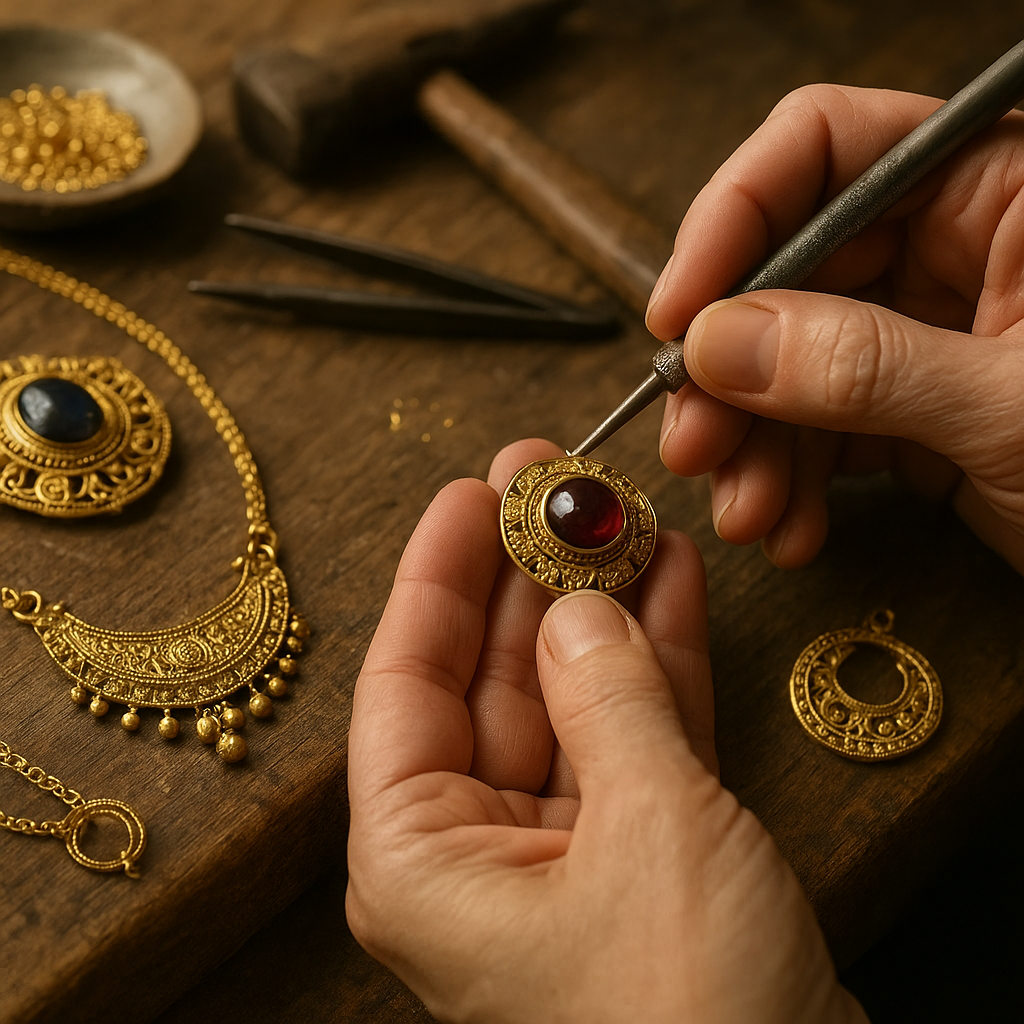
A clasped pendant can carry centuries of memory, a ring can echo the architecture of empires, and a bracelet can move like a fragment of living history around the wrist. Crafting jewelry inspired by historical eras is more than style-harvesting; it is a tactile study of materials, tools, and beliefs across time. The maker’s bench becomes a kind of laboratory where chemistry meets folklore and technique meets narrative. This approach to Handicraft rewards patience, close looking, and a willingness to translate museum vitrines into wearable pieces that feel both faithful and freshly alive.
From Research to Bench: Building a Historically Informed Practice
Begin by choosing one or two periods to study deeply instead of sampling a dozen at once. A focused lens—say, Ancient Egypt and Art Deco—helps you understand what truly defined each era: the metal colors, surface textures, stone cuts, clasp mechanisms, and narrative motifs. Keep a sketchbook alongside a reference folder with printouts from museum collections and auction archives. Note proportions and construction details: Are bezels tall or low? Are jump rings soldered shut? How are hinges formed?
Authentic details often hide in plain sight. For example, Greek and Etruscan pieces reveal a disciplined geometry and subtle asymmetries, while medieval objects privilege symbolic legibility over strict symmetry. Read object descriptions for clues about workshop practices and, where possible, study high-resolution photos that reveal file marks and solder seams. When you source vintage components, record their provenance so you can credit origins ethically and avoid unintentionally passing modern reproductions as antique.
Practical research includes building “swatch sheets” of metal finishes and solder tests. Create small plaques labeled with the torch settings, fluxes, pickles, abrasives, and final polishes you used. Over time, these become your private encyclopedia of finishes that mimic sand-cast bronze, softly burnished gold, or soot-darkened silver without resorting to shortcuts.
Metals, Stones, and the Palette of Time
Different eras favored different metals and metallurgical choices. Egyptians used gold and electrum with inlays of turquoise, lapis lazuli, and carnelian. Greeks and Etruscans chased excellence in high-karat gold, while Romans worked confidently with bronze, silver, and gold, often setting engraved gems and coin portraits. The Middle Ages leaned on silver and gilt-silver; the Renaissance revived colored stones and amplified contrast with enamel; the Georgian and Victorian periods embraced rose-cut diamonds, garnets, pearls, jet, and richly symbolic memorial materials.
Understanding metal behavior is crucial. A metal’s hardness, workability, and color shift with each alloy. High-karat gold flows differently under the hammer than a 14k blend; coin silver and sterling solder at different temperatures; bronze and brass demand attention to zinc fumes and pickling. When you emulate a period look, choose metals and solders that let you shape and join with control while achieving the target hue under polish or patination.
Stone selection also carries era-specific meaning. Cabochons suit ancient and medieval aesthetics, while table cuts, rose cuts, and old mine cuts read “early modern” to Victorian. Crisp, high-saturation gems and black-on-color contrasts speak to Art Deco. Uncut crystals or a single well-polished pebble can conjure pre-classical simplicity. Remember that settings themselves are part of the story: tall bezels, closed backs with foil, and crimped collets each anchor a piece in time.
Surface finishing seals the impression. A thoughtfully managed patina can make new work feel seasoned without pretending to be old. Liver of sulfur on silver, heat flashes on copper, and selective burnishing create depth. Resist the temptation to over-darken crevices—historical pieces reveal light-touch finishes that accentuate relief without smothering form.
Signature Techniques Across Eras
Techniques are the grammar of historical jewelry. Mastering even one or two can transform your work from generic vintage-inspired to convincingly era-evocative.
- Granulation: A hallmark of Etruscan and later revival styles, this involves fusing tiny gold granules to a base without visible solder. Success depends on close temperature control, a fine flux or organic binder, and immaculate metal preparation.
- Lost-wax casting: Used since antiquity, it captures organic forms and subtle textures. For Roman-style rings and Egyptian amulets, carve in wax using simple blades and heated tools, then cast into bronze, silver, or gold.
- Repoussé and chasing: Sheet metal is raised from the back (repoussé) and refined from the front (chasing) over pitch. Medieval brooches, Renaissance panels, and Baroque cartouches benefit from these low-relief sculptural methods.
- Filigree: Twisted or plain wires arranged into lace-like patterns, often soldered over a frame. This technique blooms in Byzantine and Georgian aesthetics and rewards precision and patience.
- Enameling: Cloisonné, champlevé, and basse-taille link color to metal in Byzantine, Renaissance, and Art Nouveau pieces. Each method has distinct preparation steps and kiln behaviors.
- Chain-weaving and link construction: From Viking knit and loop-in-loop chains to Victorian book chains, hand-built links turn a simple pendant into a time-traveling object.
Motifs, Symbols, and Narrative
Motifs connect personal jewelry to communal memory. Ancient Egypt’s scarabs and lotuses testify to rebirth and solar order. Greek laurel wreaths and meanders signal victory and continuity; Roman eagles and portrait coins proclaim civic identity. Medieval motifs—crosses, trefoils, bestiaries—speak to spiritual geography. Renaissance and Baroque acanthus leaves, shells, and scrolls revel in movement; Georgian and Victorian snakes, hearts, anchors, and eyes weave romance and mourning. Art Nouveau’s irises, dragonflies, and whiplash lines celebrate nature’s fluidity; Art Deco distills speed and light into stepped geometry, sunbursts, and radiant fans.
When you borrow historic iconography, make deliberate choices. Avoid sacred or culturally restricted symbols unless you have scholarly clarity and community consent. Let motifs serve your story rather than becoming mere ornament. A single engraved laurel on the back of a signet can speak more eloquently than a crowded face.
Designing for Comfort and Longevity
Historical character should not compromise comfort. Weight distribution, clasp reliability, ring balance, and backing materials matter. Georgian-style collets may need low-profile revisions; medieval brooch pins may need stabilized catch plates for modern fabrics. In earrings, spread weight laterally to reduce swing torque. In cuffs, leave spring room without over-hardening the metal.
Treat wearability as applied ergonomics. Hidden counterweights, tapered shanks, and rounded interior edges make heritage designs feel effortless. Test prototypes on actual garments and hands, not just mannequins, to ensure movement and drape align with contemporary life.
Era Spotlights and Bench Notes
Ancient Egypt
Palette: high-karat gold/electrum, turquoise, lapis, carnelian. Techniques: inlay, cloison construction, lost-wax for amulets. Forms: broad collars with repeated units, protective amulets near closures. Findings: simple S-hooks and ribbon ties can read as period-correct; modern lobster clasps can be hidden inside cylindrical terminals.
Classical Greece and Rome
Palette: yellow golds, silver, bronze; garnet, pearls, agate, intaglios. Techniques: granulation, loop-in-loop chains, cast ring bezels with engraved gems. Forms: wreaths, amphora charms, coin pendants. Consider using cast coins from legally obtained replicas, clearly disclosed.
Medieval and Byzantine
Palette: gilt-silver, niello, enamel, garnet in cloison settings. Techniques: repoussé icons, filigree borders, cabochon collets, riveted constructions. Forms: disk brooches, reliquary pendants, linked panels with crosses and stars.
Renaissance to Baroque
Palette: rich gold, enamel color fields, pearls as dangling elements. Techniques: sculptural repoussé, chased scrolls, enamel over textured bases. Forms: portrait lockets, ornate drop earrings, ribbon-bow pendants.
Georgian and Victorian
Palette: rose and yellow gold, silver-topped settings, jet, garnet, seed pearls, turquoise. Techniques: closed-back foiled settings, hairwork, micro-mosaics, intricate clasps. Forms: mourning lockets with glass panels, serpentine rings, book chains.
Art Nouveau and Art Deco
Palette: soft gradients versus crisp contrasts. Techniques: plique-à-jour and basse-taille enamel for Nouveau; machine-precise geometry, calibré stones, stepped forms for Deco. Forms: sinuous brooches, geometric bracelets, fan motifs, sunbursts, skyscraper silhouettes.
Project Blueprints: Four Historically Inflected Pieces
1) Egyptian-Inspired Carnelian Amulet Necklace
- Materials: 18k or 22k-colored metal (or gilt brass for studies), oval carnelian cabochon, fine silver for cloison frame strips, silk or leather cord.
- Tools: saw, files, torch, burnisher, bezel roller, soldering surface, forming blocks.
- Steps:
- Sketch a simple scarab-oval silhouette with a rectangular suspension tab inviting a textile cord.
- Raise walls around a base plate to form a tall bezel; solder carefully to preserve crisp corners.
- Seat the carnelian snugly and burnish the bezel. Add a back engraving of a lotus bud for private symbolism.
- Fabricate an S-hook clasp and cylindrical endcaps for the cord; insert and glue cord ends, peen closed gently.
- Finish with fine abrasive papers and a warm satin polish that evokes ancient burnishing.
2) Etruscan Revival Granulated Earrings
- Materials: 18k gold (or a high-karat-looking practice alloy), small gold granules, cone forms.
- Tools: charcoal block, fine tweezers, pitch for light shaping, torch with pinpoint flame.
- Steps:
- Form shallow domes and a central boss on each dome; pre-polish lightly.
- Mix a thin organic glue (tragacanth or gum arabic) to position granules in rosettes and borders.
- Dry thoroughly. Bring pieces to fusing temperature so granules bond by diffusion without visible solder.
- Solder ear wires behind the upper domes, balancing drop length against lobe curvature.
- Clean, then apply a restrained matte finish to highlight granule shadows.
3) Medieval Repoussé Brooch
- Materials: 0.6–0.8 mm silver sheet, sturdy pin stem wire, optional gem cabochon.
- Tools: pitch bowl, chasing tools, liners, planishers, saw, files, torch.
- Steps:
- Trace a circular disk; scribe a cross or star pattern. Mount in pitch, warm slightly.
- From the back, push broad forms with domed punches; from the front, refine with liners and planishers.
- Solder a hinge and catch built as a continuous plate to protect fabric, aligning the pin with the brooch’s diameter.
- Add a central bezel if desired; set a garnet or glass cabochon to echo period color.
- Patinate selectively; brighten high spots to evoke hand-worn relief.
4) Art Deco Panel Bracelet
- Materials: sterling silver or white gold lookalike, black onyx/hematite panels or enamel, geometric connectors.
- Tools: saw, files, jigs for symmetry, soldering tools, polishing buffs.
- Steps:
- Design repeating stepped panels with crisp negative spaces. Maintain strict bilateral symmetry.
- Cut and assemble panels with minimal visible solder; incorporate tongue-and-groove clasp as a disguised central link.
- Add calibré stone strips or enamel channels; test hinge freedom so bracelet conforms to the wrist without gapping.
- Finish to a bright polish on planes, leaving micro-satin on recessed steps for tonal contrast.
Finishes, Color, and Aging with Integrity
Light is the jeweler’s final tool. Historical surface language includes satin burnish, pumice matte, mirror planes, and selectively darkened recesses. For silver, liver of sulfur or polysulfide gels let you dial tones from straw to deep graphite. Brass and bronze accept heat-bloomed browns and controlled greens; wax-seal anything reactive to stabilize color on skin-contact zones. Consider keum-boo (gold foil diffusion on fine silver) to emulate heavily gilded effects without full plating.
Avoid crude shortcuts. Artificial dirt caked in crevices or over-polishing that erases edges undermines believability. Let wear-prone areas be smoother and brighter, and shelter texture in recesses. That dialogue between fresh and aged is where historical feeling comes to life.
Ethics, Cultural Respect, and the Maker’s Voice
Historical inspiration carries responsibility. Many motifs are shared human heritage; others are sacred emblems tied to living communities. Study deeply, credit your sources, and be transparent in labeling. Use your own narratives instead of reinscribing claims to conquest or exoticism. If you draw from Indigenous or religious symbols, seek guidance or choose adjacent, non-sacred patterns that honor form without misusing meaning.
Material ethics matter too: recycled metals, vintage gems, and verified supply chains reduce harm. Transparency fosters authenticity, and buyers increasingly value it alongside beauty. Tell the story of your process and decisions—the test pieces, the compromises, the solutions—so the finished work reads as both learned and personal.
Marks, Documentation, and Future Care
Keep a build log: dates, solders used, metals and sources, stone treatments, and finishing methods. Photographs of stages help with repairs and conservation. When selling, include care cards: how to clean enamel, which cloths to avoid, and how to store chain styles that kink.
If your jurisdiction requires it, stamp your maker’s mark and any required hallmark. This practice situates your work in a lineage of traceable craftsmanship and supports future authentication. Even when not required, a discrete signature reinforces authorship and accountability.
Toolkits and Workshop Safety
You can do extraordinary historical work with a modest kit: a quality jeweler’s saw, files, needle files, burnishers, a torch with good flame control, a pitch bowl for chasing, a reliable flex shaft or pendant motor, and a basic assortment of abrasives. Build jigs—simple L-shaped fences, distance gauges, symmetry templates—to speed repeatability without sacrificing hand nuance.
Safety notes: Ventilation is non-negotiable when soldering or enameling. Use eye protection, tie back hair, and keep a class ABC fire extinguisher close. Handle acids and pickles with care; neutralize and dispose responsibly. For bronze or brass work, avoid overheating to reduce zinc fumes; for silver, quench and pickle with tongs, not steel tweezers, to prevent contamination.
Pricing, Storytelling, and Teaching the Eye
Historical technique is slow by design. Price for time and for the years you invested in learning. Share the making story with clients: the wax studies, the failed granule fuses, the hours of chasing. This narrative isn’t a marketing trick; it is part of the object’s value. Offer small “study” pieces at approachable prices—charm-scale experiments in enamel, tiny repoussé medallions—so collectors can follow your learning arc.
Train your eye by repeated, mindful looking. Visit museums, examine auction catalogs, and compare reproductions to originals. You will learn to see the language of a file stroke, the slight bulge of a hand-formed bezel, the geometry of historic stone cuts. That sensitivity elevates every choice at the bench.
Era Cues at a Glance
- Egyptian: high-karat gold hues, inlay color blocks, amuletic logic near closures.
- Greek/Etruscan: restrained geometry, granulation, loop-in-loop chains, laurel and palmette motifs.
- Roman: coin portraits, intaglios, robust rings with architectural shoulders.
- Byzantine/Medieval: filigree borders, cloison garnets, reliquary logic, niello contrasts.
- Renaissance/Baroque: sculpted scrolls, enamel color fields, dangling pearls.
- Georgian/Victorian: closed-back foils, hairwork, serpent iconography, book chains and lockets.
- Art Nouveau: organic lines, plique-à-jour, figurative nature, whiplash curves.
- Art Deco: stepped planes, black-and-white contrast, calibré cuts, architectural symmetry.
Evolving Tradition: Making Yesterday Speak to Today
The goal is not replication so perfect that it impersonates an antique, but recreation that lets historic grammar shape a new sentence. Let an Egyptian color palette meet a Deco geometry, or a medieval repoussé disk find modern minimal hardware. Respect materials, temper symbolism with care, and keep your bench honest: hand marks, minute irregularities, and evidence of time are not flaws but signatures of life.
When a bracelet moves like a miniature colonnade or a pendant breathes with enamel light, history stops being distant. It becomes a daily companion—warm from the skin, catching the eye, and reminding its wearer that craft, at its best, binds ages together one careful strike, one fused granule, one thoughtful clasp at a time.
