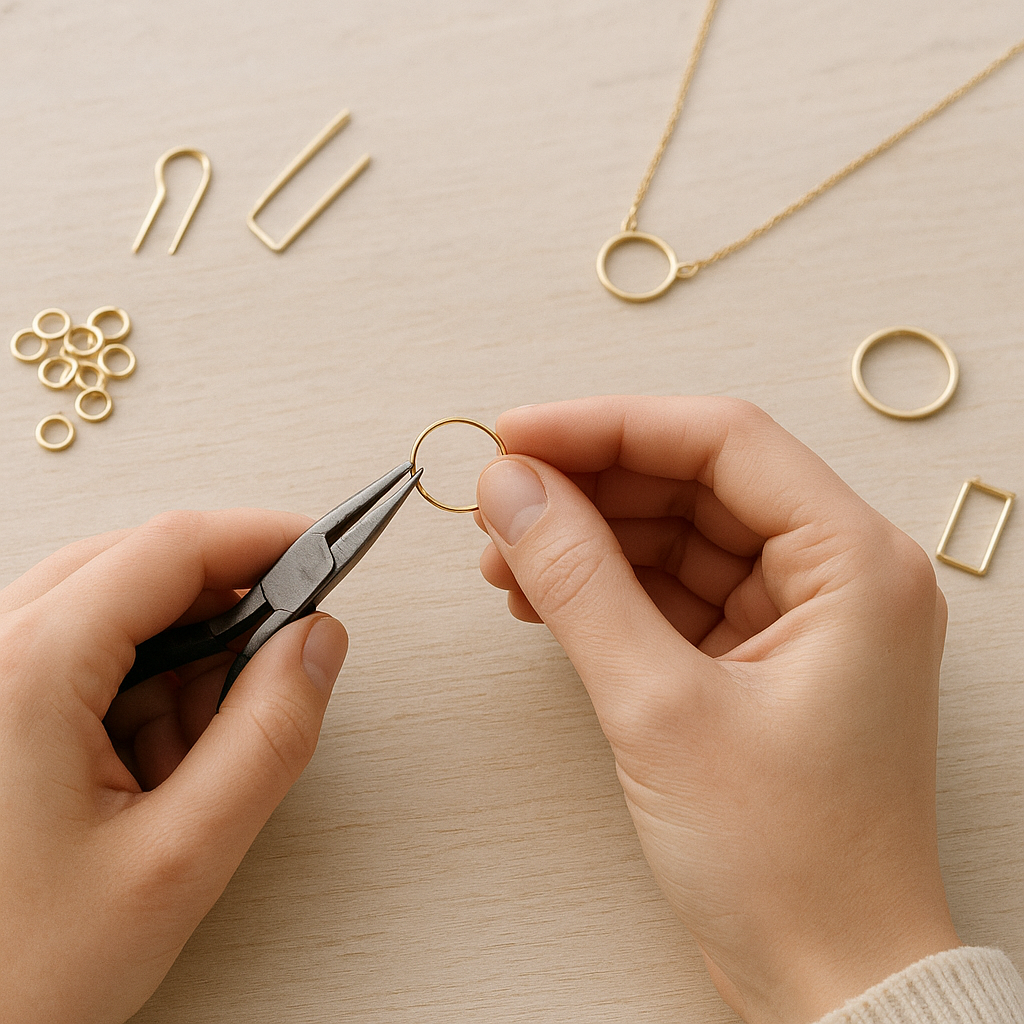
Handmade minimalist jewelry proves that the smallest gesture can carry the clearest voice. It asks the maker to choose deliberately—one curve, one edge, one finish—and then honor that choice with discipline and care. In the studio, clean lines are not simply an aesthetic; they are a method. Each file stroke reads like a sentence; each solder seam is a commitment. Through this lens, the craft becomes a study of restraint where form follows function, where a single plane can define a whole silhouette, and where the integrity of the process reveals true craftsmanship. To build pieces that feel inevitable, we tune our sense of proportion, study geometry, consider ergonomics, plan for durability, and finish with quiet refinement. Even the ethics of making participate: material choices, waste streams, and repairability connect the bench to broader sustainability. The result is what many simply call minimalism: work that breathes, welcomes wear, and ages with a subtle patina.
Why Minimalist Jewelry Works
Minimalist jewelry resonates because it clarifies intention. By limiting forms to essentials—lines, arcs, planes, and volumes—the maker foregrounds relationships: the thickness of a bar against the width of a chain, the radius of a curve against the span of a wrist, the sheen of a surface against the tone of a wearer’s skin. These relationships are amplified by subtraction; the fewer elements you use, the more each one matters.
Clean-lined pieces also fit a wide range of wardrobes and occasions. A square wire cuff can be formal with a suit or quiet with knitwear. A tiny tube-set stone can punctuate a T-shirt. The adaptability comes from neutrality: when a piece avoids overt decoration, it allows the wearer to complete the story.
From a maker’s perspective, the promise—and challenge—of minimalism is that there is nowhere to hide. Precision sells the whole illusion: straight lines must be straight; symmetries must be exact; surfaces must be thoughtfully finished. This is excellent training for any craftsperson, as it builds repeatable skill and a reliable eye.
Materials: Metals, Forms, and Why They Matter
Material choices shape both the making process and long-term wear. Although precious metals are common, minimalist work often benefits from metals that hold crisp edges and resist distortion.
Common metals
- Sterling silver (925): Workable, widely available, and easy to solder. It takes bright polishes and soft satin finishes. Downsides include tarnish in sulfur-rich environments and relative softness that can round sharp lines if thin.
- Argentium silver: Tarnish-resistant, fuses well, and holds finishes longer than sterling. Slightly different heating behavior; excellent for clean seams.
- Gold (14k, 18k): Dense, strong, and forgiving to polish. White, yellow, and rose tones offer palette flexibility. 18k retains edges better due to hardness and weight.
- Brass and bronze: Affordable for prototyping and production. Brass polishes bright; bronze offers deeper color. Both can be sealed to delay tarnish; ideal for learning precise filing and forming.
- Stainless steel and titanium: Tough, modern look, resilient in wear. They require specialized tools or methods (saw blades, abrasives) and often cold connections or TIG/laser welding instead of standard soldering.
- Platinum: Excellent wear and long-term stability. Expensive and requires specific tools; superb for ultra-clean edges and stone security.
Stock forms and why they’re useful
- Sheet: Defining planes and profiles with crisp edges—ideal for bars, plates, tabs, and geometric pendants. Thicker sheets (1.0–2.0 mm) read bold and resist warping.
- Wire: Round, square, rectangle, and half-round shapes. Square wire creates strong graphic lines; round wire softens silhouettes; rectangular wire provides directional stiffness for cuffs.
- Tube: Enables tube settings, spacers, and clean mechanical joints. Consistent wall thickness simplifies precision work.
Size and strength considerations
Minimalist jewelry gains credibility when it withstands daily wear. Under-built pieces fail early; overbuilt pieces feel clumsy. Some rules of thumb:
- Rings: For a flat band, ~1.6–2.0 mm thick and 2.0–4.0 mm wide creates durability without bulk. Keep inside comfort edges lightly eased.
- Cuffs: Rectangular wire 2.0 x 4.0 mm or 2.0 x 5.0 mm offers good spring and presence. Anneal and bend around a mandrel; avoid excessive work-hardening before final sizing.
- Pendants and bars: Sheet 1.0–1.5 mm resists bending in wear while holding a flat plane for clean light reflection.
- Earrings: Posts 0.8–1.0 mm diameter; hoops often 1.2–1.6 mm wire for strength without weight.
Tools and Bench Setup for Clean Lines
Clean lines begin with predictable tools. A modest bench can produce professional results if tuned and maintained.
- Saw frame and blades (2/0–6/0): Fine blades reduce kerf and minimize cleanup. Use consistent lubrication (beeswax) for smoother cuts.
- Bench pin: A stable, replaceable wooden interface lets you steer work and support delicate cuts.
- Files: Flat, half-round, needle files. Safe-edged files are vital to refine one surface without marring neighbors.
- Abrasives: Sandpaper from 320 to 2000 grit; sanding sticks provide flat reference surfaces.
- Measuring: Calipers, dividers, a machinist square, and a scribe for repeatable geometry.
- Forming tools: Ring and bracelet mandrels, nylon and rawhide hammers for shaping without stretching edges.
- Soldering: Torch (butane for small silver/gold, or propane/oxygen for larger), flux, solder grades (hard, medium, easy), third-hand tweezers, and a clean soldering surface.
- Pickle and neutralizer: Sodium bisulfate or citric acid pickle to clean oxides; baking soda bath to neutralize.
- Polishing: Flex shaft or rotary tool, radial bristle discs, felt wheels, Tripoli and rouge compounds, plus a matte wheel or Scotch-Brite for satin.
- Safety: Magnification (loupe or visor), eye protection, dust extraction or mask, good lighting, and ventilation for fumes.
Design Principles for Minimalist Clarity
Minimalist design is a balancing act between intention and restraint. Consider these principles while sketching and prototyping:
- Hierarchy: Choose one idea to lead. If your idea is a crisp rectangle, let every other element support it—chain thickness, jump ring orientation, clasp size.
- Alignment: Holes, edges, and joins must align on both axes. Misalignment is more visible when ornament is absent.
- Repetition: Echo a dimension—repeat a 2 mm thickness across bar, jump rings, and clasp. The repetition creates cohesion.
- Scale and weight: A fine chain with a heavy pendant looks accidental; a substantial chain with a whisper-thin bar reads awkward. Harmonize mass and visual weight.
- Proportional systems: Explore the golden ratio or simple integer ratios (1:2, 2:3) to decide bar length to width, or pendant drop to chain length. This develops a natural sense of proportion.
- Negative space: Keep openings deliberate—distance between parallel bars, gap in an open ring, or air between pendant and collarbone.
- Tactility: Fingers find edges the eyes miss; run your hands over surfaces to locate burrs before finish.
Fundamental Hand Techniques for Clean Lines
Accurate layout and sawing
Mark with a scribe and square rather than pencil. Drill pilot holes with a center punch to prevent wander. Saw with even strokes; let the blade do the work. Minimize overcutting corners; leave a hair’s breadth for files to bring the line in perfectly.
Filing and planarity
Use the largest file possible for a surface; long files create naturally flat planes. Establish a reference face first and check against a small square. For internal corners, employ a safe-edge file. Finish file work with progressive grits, always sanding in one direction per grit and turning the work between grits to ensure you remove previous scratches.
Soldering with invisible seams
Clean metal equals clean solder. Fit joins tight enough to hold by friction; gaps cause pits and excess solder. Use hard solder for first operations, then medium and easy as needed. Heat the larger mass and allow solder to flow toward the heat. Quench and pickle only when color returns; over-quenching hot metal can shock it.
Cold connections for non-precious or heat-sensitive work
Rivets (flush or tube) and miniature screws maintain sharp detail without heat. For minimalist pieces, flush rivets read as intentional dots that mirror stone settings or clasp details. Always countersink slightly to seat flush and preserve a clean profile.
Surfaces: From Mirror to Satin to Brushed
Surface finish defines how a piece reads across a room. A mirror polish reflects surroundings, turning a bar into a living strip of light; a satin finish absorbs glare and emphasizes form. Choose a finish that reinforces the design intent.
- Mirror: Work up to 2000 grit and then polish with Tripoli and rouge. Inspect under angled light. Mirror is unforgiving; it reveals dips and waves.
- Satin: Use a fine abrasive wheel or Scotch-Brite along a single direction. Directional satin can lengthen a bar visually.
- Matte: Bead blasting or very fine abrasive pads create a quiet matte that’s excellent for everyday wear.
- Selective finishing: Contrast finishes—mirror on edges and satin on faces—accentuates line quality without adding ornament.
Minimal Stone Settings Without Visual Noise
Minimalist settings favor security with minimal mass. The goal is for the stone to sit as if born from the metal, not perched above it.
- Flush (gypsy) setting: Drill, taper with a setting bur, seat the stone level, then burnish the rim until it rolls over the girdle. Best for small diamonds or sapphires, as they handle pressure. The result is a perfect dot of light.
- Tube setting: Cut a seat inside a tube, solder the tube into a bar or plate, then set the stone by burnishing the rim. Works beautifully in a bar pendant as a single focal point.
- Low-profile bezel: Thin wall bezel hugging the stone, filed to match the plane of a ring or pendant. Keep walls low to preserve clean lines.
Step-by-Step: Four Archetypal Minimalist Pieces
1) A straight bar pendant on a fine chain
- Cut: From 1.2 mm sheet, saw a bar 35 mm x 3 mm. File faces true and edges square.
- Drill: Two holes 2 mm from ends, centered vertically, sized to accept 0.8–1.0 mm jump rings. Deburr with a countersink.
- Finish: Decide on satin vs mirror. If mirror, take time to remove every scratch before polishing.
- Assemble: Solder closed jump rings to prevent failure. Choose a chain that matches bar thickness visually.
2) An open rectangle cuff
- Stock: Rectangular wire 2 x 5 mm, length based on wrist circumference minus gap (usually 25–30 mm gap).
- Form: Anneal, bend around bracelet mandrel, keeping faces parallel. Check the rectangular profile is consistent along length.
- Edges: Ease only the inside edges slightly for comfort; leave the outside planes crisp for graphic impact.
- Finish: Directional satin along the length enhances the linearity.
3) Perfect-circle hoop earrings
- Wire: 1.2–1.4 mm round wire. Form on a mandrel; file the ends square.
- Mechanism: Solder a short post of 0.9 mm wire to one end; drill a tiny catch on the opposite end for the post to snap into. Alternatively, use hinged findings but keep them minimal.
- Polish: Hoops accentuate circularity; check from multiple angles to ensure true roundness before finishing.
4) A low-profile flat band ring
- Measure: Determine finger size and calculate blank length: inner circumference plus thickness compensation.
- Cut and bend: Saw a strip 3 mm wide, 1.8 mm thick. Bend into a D-shape, bring ends flush and square, then solder with hard solder.
- True and finish: Round on a mandrel, file seam invisible, then apply a crisp edge with a light chamfer inside for comfort.
Ergonomics, Comfort, and Long-Term Wear
Comfort is critical: a piece that pinches or rotates ends up in a drawer. Balance weight so pendants hang flat; widen ring bands for larger fingers to distribute pressure; keep earrings under a comfort weight for lobes. Edges that look sharp should feel skin-friendly; achieve this by micro-chamfering the underside while keeping visible lines crisp. Building for serviceability also helps longevity: design clasps that can be replaced, specify stones that are secure, and allow access for polishing and repairs.
Chains, Clasps, and Connectors That Don’t Distract
Hardware should complete the sentence, not interrupt it. A few guidelines:
- Chain choice: Cable chains read as neutral; box chains feel modern; snake chains emphasize flow. Match wire/plate thickness to chain gauge.
- Clasps: Lobster clasps are reliable and discreet; spring rings are smaller but harder to use. Hook-and-eye and toggles can be minimal if proportioned well.
- Jump rings: Solder closed for security. Align the seam with chain direction to hide it.
- Endings: Use slim end caps or neatly filed wire loops; keep transitions seamless.
Sustainability and Responsible Practice
Minimalism’s ethic pairs naturally with responsible sourcing and long service life. Use recycled silver or gold when possible and ask suppliers about traceability. Consider lab-grown diamonds or transparent gemstone supply chains. Replace harsh chemicals with citric acid pickle and water-based fluxes when feasible. Save all scrap and filings for refining. Design for repair: replaceable clasps, accessible settings, and finishes that can be renewed. Packaging can be minimal and recyclable while still feeling premium—uncoated paperboard, cotton or linen pouches, and absent plastic windows align with the values of sustainability already noted above.
Finishing Discipline: The Last 10 Percent
In minimal work, the last 10 percent delivers 90 percent of perceived quality. Control light: inspect under raking illumination to reveal scratches. When sanding, track your grits meticulously; never jump more than two steps. Clean the piece between media to avoid cross-contamination. Separate buffs for Tripoli and rouge, labeled and stored in bags, prevent dulling. For satin, commit to one direction and guard it during assembly by masking adjacent surfaces. The edge-bead that appears when you polish too aggressively can be avoided by maintaining flat contact and fresh abrasives.
Common Mistakes and How to Avoid Them
- Rounded corners where they should be square: Use a file with a hard backer; reestablish the plane before finishing.
- Visible solder floods: Solder sparingly, with perfect fit. Wick away excess with a clean pick while the solder is molten.
- Wavy planes: Check against a flat reference after each stage; use sanding sticks instead of soft-backed papers.
- Mismatched pairs: For earrings, fabricate both pieces simultaneously, using the same measurements and fixtures.
- Over-polishing edges: Tape off edges or use a lighter touch; consider pre-polishing before final filing of edges to maintain definition.
- Chain-bar imbalance: If the bar flips, add a second attachment point or reduce bar thickness/length to shift the center of gravity.
Advanced Approaches: When Hand and Tech Collaborate
Handicraft thrives alongside selective technology. CAD and 3D printing in wax or resin allow exact symmetry and repeatability for geometric silhouettes, which you can cast and then finish by hand. Laser welding closes seams without flooding solder, perfect for stainless or for repairs near stones. Waterjet or laser cutting yields repeatable blanks from sheet; hand filing then restores the tactile qualities that keep the work human. This hybrid approach lets you scale production while preserving the bench-made integrity that customers value.
Batch Production Without Losing Soul
Minimalist lines are ideal for small-batch production. Build jigs: a drilling jig guarantees consistent hole placement; a bending jig standardizes cuff radii. Process in stages—cut all blanks, drill all holes, file all faces, then solder, then finish—so your muscle memory stabilizes and quality increases. Keep a master sample for every design and compare each piece to it at checkpoints. Record dimensions and finishing recipes, including abrasives and compounds, so future batches remain consistent.
Pricing, Hallmarking, and Presentation
Transparent pricing builds trust. Track material costs by weight, add labor at an hourly rate appropriate for your market, include overhead (consumables, studio time, packaging), then apply a margin that sustains your business. Hallmarking and metal fineness stamps communicate legitimacy; place them discreetly on the back of a bar or inside a band where they won’t interrupt the visual calm. For presentation, keep photography simple: diffused natural light, a neutral background, and a composition that shows scale and thickness. A single styled image can live alongside a technical close-up that proves finish quality.
Care, Maintenance, and the Beauty of Wear
Minimalist jewelry gathers character through wear: micro-scratches on a satin surface tell a story, and a silver piece deepens in tone. Provide care cards with each piece: advise storing in individual pouches with anti-tarnish strips, removing jewelry before pools or cleaning, and wiping with a polishing cloth after wear. Offer refinishing services that restore original sheen or deliberately embrace the softened history of use. A thoughtfully aged patina can become part of the design language, especially on brass or bronze sealed with microcrystalline wax.
Case Studies in Clean-Line Design
The offset circle pendant
A 20 mm circle with the chain passing through an off-center slot changes reading from static to dynamic. The asymmetry is controlled by exact slot width—just larger than the chain gauge—to prevent binding. Satin on the face, polished on the rim gives a crisp outline.
The seam-forward cuff
Instead of hiding the solder seam, align it with a deliberately filed micro-reveal. The line becomes a single intentional detail—subtle, architectural, and honest about construction.
The negative-space ring
An open band with a fixed gap echoes the finger’s curve. The gap size remains constant around the circumference, achieved by practicing consistent bending and using calipers to verify spacing before final polish.
Building a Signature Within Simplicity
With fewer elements, your voice must ring clear. Choose one or two constants: edge treatment, thickness family, or a recurring dimension. Perhaps every piece in a collection shares 2.5 mm faces, or every edge carries a faint micro-bevel. Maybe your closures are always integrated rather than appended. A consistent vocabulary makes your collection legible and collectible.
Learning Roadmap for the Minimalist Maker
- Week 1–2: Sawing and filing drills—straight lines, perfect squares and circles cut from sheet, and consistency exercises.
- Week 3–4: Soldering bootcamp—simple butt joints, L joints, and seamless rings; practice heat control and flow direction.
- Week 5–6: Finishing mastery—grit discipline, mirror and satin, and selective finishing.
- Week 7–8: Stone basics—flush and tube settings on scrap before moving to finished pieces.
- Ongoing: Design iterations—build the same form in three scales and two thicknesses; evaluate wearability and visual balance.
Quality Control Checklist Before You Ship
- All edges intentional: outside crisp, inside comfortable.
- Seams invisible or deliberately featured.
- Finish consistent across all faces with no stray compound residues.
- Chain-to-pendant interface aligns without twist.
- Clasps operate smoothly; jump rings fully closed and soldered.
- Settings secure; stones level and clean.
- Sizing verified with mandrels and calipers.
Philosophy: The Joy of Doing Less, Better
At its best, minimalist jewelry-making is not about deprivation; it is about focus. Every reduction amplifies what remains. A single edge can carry emotion when it is true, a single radius can feel inevitable when it is right. This is where the bench meets the body: the arc that hugs a wrist, the plane that catches a whisper of light, the quiet weight that reassures the wearer of a piece’s presence. By committing to clarity—through careful design, skillful making, and respectful material choices—the maker crafts objects that calm the eye and accompany a life with poise. And as these objects circulate, they model a way of working that prizes attention, stewardship, and the enduring pleasure of things made well.
