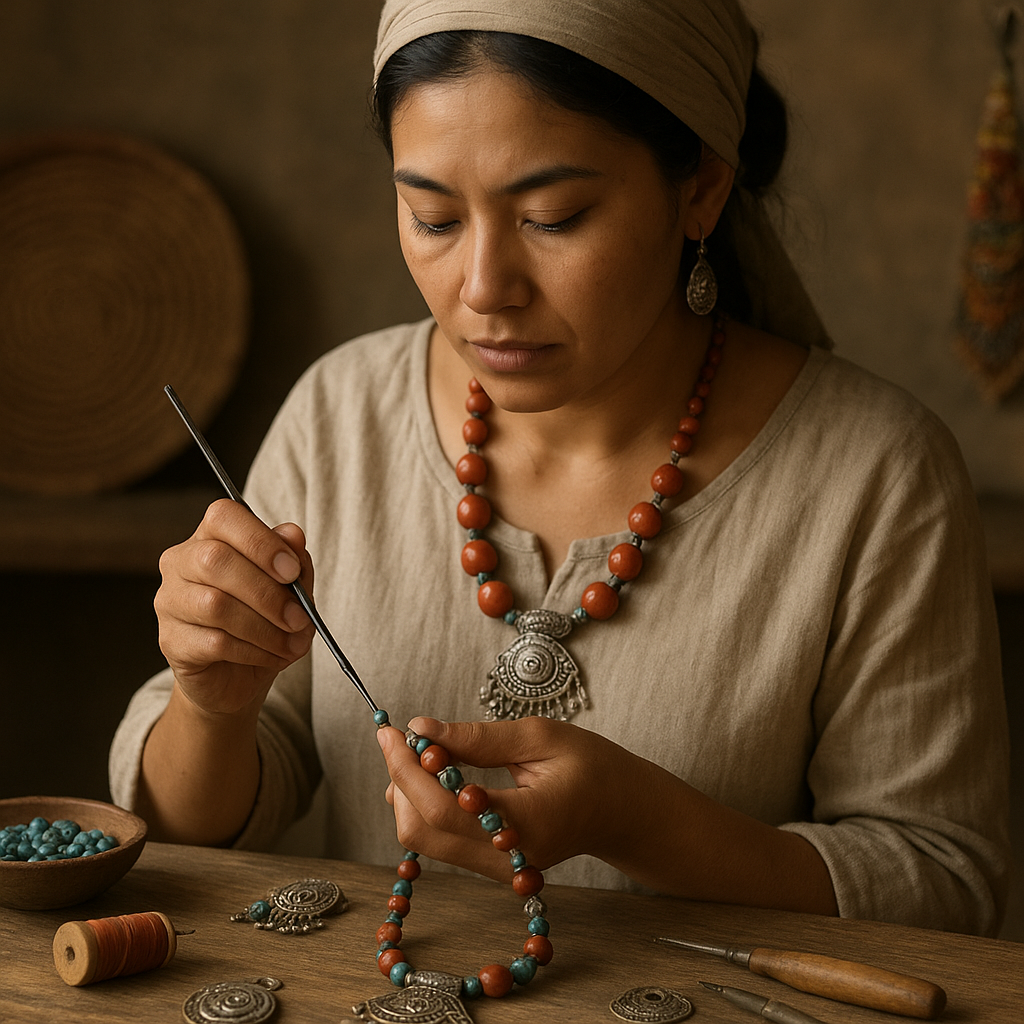
Jewelry that honors culture is more than an accessory; it is a small, wearable archive of memory, place, and belonging. Each clasp or bead can carry rituals, migrations, seasonal cycles, and ancestral languages, renewing living traditions every time a piece is worn, gifted, or repaired. In the realm of handicraft, where touch and time set the pace, makers translate community knowledge into forms that move with the body. When thoughtfully designed, such pieces keep heritage alive while inviting contemporary expression, joining tactile finesse with enduring craftsmanship and layered symbolism.
Why Cultural Elements Matter in Handcrafted Jewelry
Across continents, jewelry serves as an intimate encyclopedia. Pendants track trade routes; knots encode blessings; pigments and patinas reveal ecology; alloys and weaving patterns signal milestones in a life. Cultural elements matter because they map relationships: between people and their ecosystems, sacred and everyday time, self and community. In many societies, a necklace announces rites of passage, a bracelet wards off misfortune, a brooch marks status or kinship. The act of making—warming metal, spinning fiber, cutting shell—becomes part of the story a wearer carries into the world.
For handicraft makers, attuning to these meanings avoids generic pastiche and enables design choices that are deliberate rather than decorative. A single motif can be a compressed archive: a koru spiral evoking ferns and renewal; a sankofa bird gesturing back to fetch wisdom from the past; a woven chevron recalling river currents or migration. The maker’s job is to mediate material, technique, and meaning so the piece sings in both historical and present-tense voices.
Research and Respect: Foundations of Ethical Design
Responsible design begins long before the bench or loom. Learn the context of motifs and materials: where they emerged, how they are used, who safeguards them, and which uses are reserved, restricted, or sacred. Many communities consider specific patterns or objects to be ceremonial; they may require permission, compensation, or community oversight. Building relationships—through studio visits, co-creation, and fair pay—enables work that balances inspiration with accountability.
Respect also shows in rigorous sourcing. Document materials, processes, and cultural attributions with the same care as measurements and finish. A maker’s commitment to authenticity lives in process notes and conversations as much as in the finished piece. When in doubt, ask: Who benefits from this design? Who is named? Who decides? Clarity about consent and credit prevents harm and keeps traditional knowledge in the hands of its stewards. Where appropriate, formal agreements and revenue sharing can sustain living knowledge through long-term collaboration.
Materials With Memory: Metals, Minerals, and Organics
Each material carries geologic and cultural time. Selecting supplies with care strengthens a design’s narrative and ensures comfort and longevity.
- Metals: High-carat gold signifies durability and warmth in many cultures; copper and bronze link to early metallurgies and to healing and protective associations; sterling silver reflects light and is prized for clarity and resonance. Alloys vary by region: Mediterranean and Balkan communities often use deeply patinated silver; West African jewelers blend bronze and brass for luminous, sun-rich tones.
- Gemstones: Turquoise speaks to sky and water across the Southwest and Central Asia; coral captures sea journeys and vitality in Mediterranean adornment; jade embodies balance and longevity throughout East Asia and Mesoamerica; amber holds sun and ancient forests along the Baltic. Faceting styles, setting methods (e.g., kundan), and cabochon shapes each carry histories that can guide proportion and layout.
- Organic materials: Shell, bone, horn, tagua nut, seeds, and wood preserve the hum of living landscapes. Their densities and scents shape the wearer’s experience and shift with seasons and skin. Plant resins like lacquer and lac provide protection and color; natural dyes—indigo, madder, walnut—tie beadwork and cords to agriculture and trade.
- Glass and ceramic: Beads, from Venetian seed beads to West African powder-glass, encode trade histories, while ceramic inlays connect to earth and fire. Surface porosity matters: seal absorbent materials to resist sweat and perfume.
Material combinations should respect cultural logic: if a tradition pairs specific stones with rites or lifecycle events, reconsider casual mixing. Let density, temperature, and sound guide composition—think of how metal chimes against shell, or how woven fiber quiets the clink of glass.
Motifs and Meaning Across Regions
West and East Africa
Adinkra symbols in Ghana (e.g., sankofa, gyenyame) carry proverbs; Akan goldweights miniaturize economic and ethical principles. Tuareg silver emphasizes clean geometry and protective marks; Yoruba beadwork encodes rank and cosmology through chromatic order and bead size. Maasai collars read as social text, with rings and colors mapping age, marital status, and community roles.
South Asia
Filigree and kundan set thin gold foils around uncut stones, while meenakari enameling layers color like poetry. Paisley, a boteh teardrop, references cypress or seed; jali lattice recalls architecture and breath, threading air through metal. Threaded tassels and ghungroo bells bring sound as a design element, choreographing movement with ritual.
East Asia
Jade bi discs mirror heavens; knots and clouds promise continuity; bats symbolize happiness. In Japan, mokume-gane fuses metal layers into wood-grain; kumihimo braids once held armor plates and now hold pendants, merging strength with intricate order. In China, filigree and kingfisher feather inlay have crowned headpieces with sky hues for centuries.
Indigenous Americas
From Andean chakana crosses aligning with solstice light to Arctic scrimshaw on bone and ivory alternatives, forms often connect celestial practice with migration and animal kinship. Many motifs are communal intellectual property; permissions, joint authorship, and community benefit are essential, especially for sacred emblems and forms tied to ceremony.
Mediterranean and Middle East
Hamsa hands, pomegranates, and fish travel interfaith and interregional routes, signifying protection and plenty. Granulation in Etruscan-inspired work teaches patience and fire control. Arabesque scrolling writes the infinite across metal and enamel, balancing geometry with vegetal line.
Europe and the North
Celtic knotwork braids time and lineage; Baltic amber harvests ancient light; Sámi tin-thread embroidery pairs coiled pewter-silver wire with reindeer leather, with deep connections to herding lifeways. Scandinavian minimalism often hides complex heritage in refined forms, honoring restraint as much as ornament.
Hand Techniques that Carry Tradition
Techniques are languages: learn their grammar before improvising. Mastery shows in edges and interiors as much as in the face of a piece.
- Filigree and granulation: Twist fine wire, solder with minimal visible joins, and practice uniform bead fusion. The negative space is as important as the wire itself, creating lace from metal.
- Lost-wax casting: Carve wax to capture gesture, cast in investment, and refine with chasing to restore crispness. Use sprue placement to control metal flow and reduce porosity.
- Repoussé and chasing: Alternating hammering from back and front sculpts relief; trad lines often follow plant rhythms, so let curves breathe.
- Inlay and overlay: From turquoise and coral mosaics to niello and damascening, cut channels with consistent depth; undercut edges subtly to lock material without excessive adhesive.
- Cloisonné and champlevé enameling: Fire in layers, wash oxides, and plan color order; transparent enamels reward high-polish metal underlayers, while opaques conceal tool paths.
- Weaving and braiding: Bead loom work yields windowpane precision; off-loom peyote or brick stitch can curve gracefully. Kumihimo offers tensile strength with rhythmic beauty; macramé adds sculptural knots suited to cords and amulets.
- Carving organics: Stabilize porous materials, carve with respect for grain, and seal with natural finishes compatible with skin.
Choice of techniques should resonate with the culture informing the design—sometimes that means learning from community experts, sometimes adapting adjacent processes to honor intent without copying restricted forms.
Design Process: From Story to Form
- Research: Map references by date, place, and meaning; separate ceremonial from everyday forms; note scale relative to the body parts traditionally adorned.
- Intent: Define the piece’s role—blessing, memory-keeper, celebration, protest—so every material choice supports function.
- Sketch and prototype: Move quickly between flat sketches and maquettes; test weight, swing, and sound. A prototype reveals whether a sacred motif shrinks respectfully or demands full scale.
- Ergonomics: Check edge radii, clasp operability, and hair/garment snags. Comfort communicates care.
- Modularity: Design components that reconfigure for varying contexts—festive, daily, formal—echoing traditions that expand or contract for life stages.
- Closure and connection: Hidden stories often live in the back-of-neck or wrist underside; make those spaces precise and meaningful, not merely functional.
Keep a design journal: note light conditions while working, torch tip sizes, humidity’s effect on thread, tumbler media choices, and polishing sequences. Such records protect your future self and invite iterative refinement.
Case Studies: Respectful Fusion
Imagine a contemporary pendant that partners with a weaving cooperative to reinterpret a river motif. The metal frame echoes the braid’s cadence; the thread palette follows ceremonial order approved by community elders; a percentage of sales funds apprenticeships. Another example: a ring using mokume-gane to evoke grain from a sacred forest, with wood elements substituted by responsibly sourced stabilizations and with community consultation about symbolic appropriateness. Or a bracelet built with Sámi-style tin-thread techniques produced under license and credit, documenting leather origin and method in the piece’s card.
What unites these cases is patient listening and long time horizons: co-design, revenue sharing, correct naming, and public education about origins and meanings. The result is not dilution but enrichment—work that bears lineage and innovation without confusion.
Surface, Color, and Finish
Surface modulates mood: high polish can signify celebration and status; matte speaks in whispers suitable for daily wear or mourning. Oxidation adds shadow to filigree; brushed finishes tame glare on planar forms. Be intentional with color symbolism: white may indicate purity in one region and mourning in another; red can invoke vitality, danger, or auspiciousness depending on context.
- Patinas: Liver of sulfur, cupric nitrate, heat color on titanium and niobium; seal with microcrystalline wax to stabilize hue.
- Enamel palettes: Plan translucents over patterned metal; opaque sections can anchor symbolic fields like sky, earth, or river bands.
- Natural dyes: Test crocking and sweat fastness; pre-mordant cellulose fibers; finish with shellac or plant resins when historically appropriate.
- Textile integration: Silk cords, tablet-woven bands, or indigo-dyed braids bring soft structure and echo regional garment traditions.
Texture invites touch. Hammer marks left visible can honor labor; scraped or scored lines recall agricultural tools or calligraphy. Contrast—polish next to matte, smooth next to rough—creates depth that is felt as much as seen.
Sustainability and Social Impact
Culture lives in ecological context. Responsible makers reduce harm by selecting recycled metals, participating in transparent supply chains, and paying living wages in studios and partner workshops. Certifications for mines and refiners, while evolving, offer tools to track origin and reduce labor abuses. At the bench, capture and recycle filings and dust; use safer pickles and non-cyanide plating solutions; optimize torch fuel and ventilation.
Design for repairability: overbuild hinges, stock spare beads, and document finish recipes for future touch-ups. Offer refurbishment rather than replacement. Consider modular systems where components can be re-strung or re-cast rather than discarded. These choices express sustainability not as trend but as enduring ethic.
Ethics of Cultural Exchange
Between inspiration and appropriation lies a line best navigated in community. Some guidelines:
- Ask before using motifs tied to ceremony; accept no as a complete answer.
- Name the culture, region, and teachers; credit on product pages and tags endures longer than a social post.
- Compensate fairly and share revenue when designs arise from community knowledge.
- Invest in training and infrastructure—tooling, safety equipment, or scholarships—within partner communities.
- Avoid stereotypes; favor specificity over generalization.
The goal is not merely to avoid harm; it is to produce work that strengthens cultural ecosystems and honors stewards of knowledge.
Packaging, Documentation, and Care
What surrounds the jewel finishes the experience. A small card can include language notes, maker names, materials, origin map, and care guidance—establishing provenance that stays with the piece. Packaging can echo motifs without mimicking restricted symbols: use color fields, textures, and regional fibers to create resonance while keeping the jewel central.
- Care instructions: Explain patina evolution, how to avoid chemical exposure, and safe cleaning methods for porous organics and dyed fibers.
- Storage: Suggest anti-tarnish wraps, humidity control for wood and bone, and separation to prevent scratching.
- Repair policy: Encourage owners to return items for rejuvenation; a repair log extends lifespan and deepens relationship.
Accompany the object with clear storytelling: essays, process images, or short audio notes can bridge studio and wearer, adding gentleness and context to every clasp.
Marketing With Care
Photography should balance clarity and respect. Show scale on a neutral body form without exoticizing dress. Let process images feature hands at work, tools, and materials with captions crediting teachers and partners. Avoid generic “ethnic” tags; use precise descriptors by region and technique. When presenting collaborative pieces, co-author the narrative and invoice; name communities prominently and often.
Pricing must include research time, licensing or permissions, materials, overhead, tool amortization, and fair wages. Limited series can protect intricate processes and ensure quality control. Consider repair and maintenance in warranty language—service builds trust and keeps work in circulation.
Maintenance and Afterlives
A well-made jewel should plan for future hands. Document alloys and solders; keep molds or waxes for essential components; store bead color numbers and dye recipes. Offer trade-in or redesign options for owners whose lives change; harvest stones and metals into new forms while preserving inscriptions or meaningful fragments. By respecting change as part of life, jewelry becomes companion rather than commodity.
Learning and Community
No single studio holds every skill. Apprenticeships, guilds, and cooperatives pass down embodied knowledge that books cannot fully capture—hammer angles, breath timing, heat color intuition. Museums and archives provide visual lineages; fieldwork places sound, smell, and social context back into design thinking. Seek mentors within traditions you hope to learn; compensate generously and credit publicly. Teaching reciprocally keeps the bench’s light alive for the next generation of artisans.
The Digital Hand: Tools Without Losing Touch
Digital sketching, CAD for fitting findings, 3D-printed formers for consistent braids, and laser-cut templates can support hand practices without flattening them. Mixed workflows—hand-carved master, cast multiples, hand-chased finishes—balance efficiency with nuance. Blockchain or tamper-evident cards can record origin and transfers, aiding community benefit agreements and heirs. Augmented try-ons ease custom commissions across distance. Yet the pulse of the work remains the maker’s senses—sound of the hammer, scent of shellac, temperature shift when solder flows.
Pathways From Tradition to Innovation
Innovation often looks like deep listening rather than novelty for its own sake. Some approaches:
- Scale shifts: Transform a miniature amulet into a brooch to preserve detail; expand a repeating border motif into a cuff’s primary surface.
- Material translation: Render carved wood motifs in chased metal, or bead a textile pattern with glass; preserve proportions to keep rhythm intact.
- Contextual hybrids: Pair a regional clasp with a global chain style to invite familiar wear while anchoring identity.
- Seasonal editions: Align releases with traditional calendars—harvest, monsoon, first snow—so narrative follows lived time.
These strategies weave continuity rather than rupture, honoring lineages while leaving room for the present to breathe.
Safety, Comfort, and Longevity
Comfort is an ethical issue. Smooth internal edges and balanced weight protect skin and posture. Nickel allergies and metal sensitivities require thoughtful alloy choices and barrier layers. Consider climate: humidity swells wood and threads; extreme dry can crack lacquer. Design redundancy into stringing paths and choose clasps operable by a single hand. A jewel that is easy to wear will be worn, and worn objects accrue meaning.
Closing Reflections: What a Jewel Can Hold
Creating jewelry with cultural and traditional elements asks for more than skill—it calls for patience, humility, and joy. The studio becomes a site where earth becomes form, where elders’ words return as curves and intervals, where time thickens into small, shining companions. When we work with care, we form bonds among material, maker, and wearer that carry dignity and delight. This work thrives when it is honest about origin, tender with memory, and open to growth—when it pursues authenticity through relationships and craftsmanship through practice, and when it holds space for heritage to continue living on the body, one clasp at a time.
