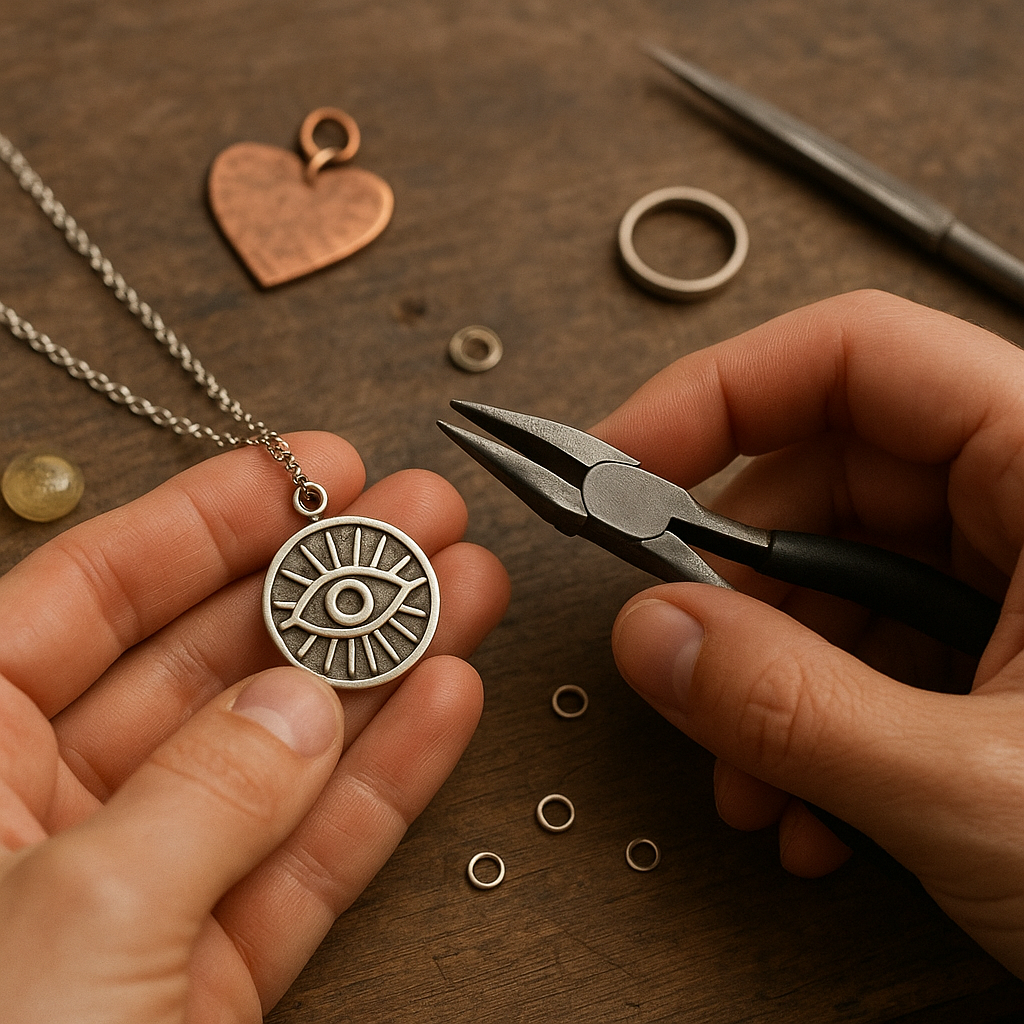
Jewelry can be more than ornament; it can serve as a portable archive of memory, belief, and promise. When a maker chooses to craft a pendant around a loved one’s handwriting, or a bracelet that uses birthstones to map a family’s story, the object shifts from decoration to message. This is where handicraft thrives: at the junction of thoughtful design and practiced hands. Creating symbolic jewelry with meaningful elements is not only about picking attractive materials; it is about choosing forms and gestures that speak to a life. The following guide explores how to design and handcraft pieces that carry stories, how to research and respect cultural signs, how to employ techniques that let the message shine, and how to ensure that message lasts.
The Language of Symbols in Handicraft Jewelry
Every culture has developed wearable signs of courage, gratitude, love, grief, protection, and transformation. Despite differences in time and place, the impulse to carry a token across thresholds—birth, coming-of-age, marriage, travel, mourning—appears constant. When we make jewelry that honors this impulse, we step into a lineage older than written language. The artisan does not merely choose shapes; the artisan arranges a vocabulary of forms, colors, textures, and materials to communicate. In this context, symbols are not abstractions but tools: they help the wearer remember, declare, or invoke.
A brief cultural survey
Amulets from ancient Egypt often paired the ankh (life) with lapis lazuli (royalty, protection). In West African traditions, metalwork and beadwork encode proverbs: a pair of twisted wires might stand for unity forged through adversity. The Japanese omamori charms embody specific wishes—safe travels, academic success—secured in embroidered pouches. Celtic knotwork ties endless lines into promises of continuity. Mexican milagros attach tiny metal hearts, arms, or eyes to jewelry and altars to request healing or give thanks. Indigenous North American artists carve fetishes whose animals carry nuanced teachings. These examples all emphasize locally grounded symbolism; the meanings have depth because they are nourished by long use within living communities.
Motifs and their meanings
- Knots: continuity, loyalty, the interlacing paths of life.
- Hands (Hamsa, Mano Figa): protection, blessing, defiance against misfortune.
- Eyes: vigilance, perception, watchfulness against harm.
- Seeds and pods: fertility, potential, patient growth.
- Feathers and wings: aspiration, spiritual ascent, messages carried.
- Keys and locks: guardianship of secrets, thresholds to new phases.
- Moons and stars: cycles of change, guidance, orientation in darkness.
- Animals: each with a complex field of qualities—owl for wisdom, fox for cunning, bear for strength.
- Spirals and labyrinths: return and renewal, the path through challenge to center.
- Vessels and circles: wholeness, containment, the sacred boundary.
Motifs are a starting point, but they gain power when the wearer’s story attaches to them. A whale tail may be an environmental pledge for one person and a family memory for another. Before committing to a motif, ask what message the owner wants the piece to carry, how public or private that message should be, and how the motif can be adapted to the body’s curves.
Colors and numbers
Colors and numbers can underscore the message. Three stones can stand for balance or a family of three. Seven small granules might recall seven years of recovery. Blue often reads as calm and protection, green as growth, red as vitality. If a culture ascribes particular power to a number or color, consult reliable sources and consider whether you are honoring rather than appropriating. The potency of these choices multiplies when they are intentional rather than accidental, allowing intention to shape the design from sketch to polish.
Materials with Meaning
Metal, stone, fiber, wood, glass, bone, shell, and clay each carry a history and a feel. Selecting materials for symbolic jewelry isn’t purely aesthetic; it also considers origin, touch, and maintenance. Gold resists tarnish and conveys sunlight and endurance. Silver reflects the moon’s cooler light and readily takes on the patina of use. Copper warms to the skin and suggests transformation; its color shifts as it reacts to the wearer’s life. Brass and bronze offer accessible strength and historical weight. When you choose a metal, you also choose a temperament—how it will age, how it accepts marks, how it holds a stone or pattern.
- Gemstones: Historically laden with associations—carnelian for courage, amethyst for calm, garnet for safe travel. Beyond lore, consider durability (Mohs hardness), clarity, and cut. A soft stone in a ring may abrade quickly; a talismanic cabochon tucked into a pendant can last generations.
- Organic elements: Pearls, wood, seeds, horn, and shell bring warmth and texture. They often need gentler care but can be powerful carriers of narrative, especially when sourced from meaningful places (a fallen branch from a family home) or events (shells found during a healing retreat).
- Glass and ceramics: From Roman glass to contemporary lampwork beads, transparent and opaque bodies can trap light, color, and inclusions that tell a story. Ceramic charms can be inscribed before firing to preserve writing permanently.
- Found objects: Buttons, keys, coins, and fragments of maps can become focal points, provided their scale suits the piece and their edges are made wearable. Archival-quality resins can encapsulate fragile items without damage.
Sourcing and ethics
When the message matters, the origin matters too. A piece meant to honor the earth rings hollow if its materials were mined in exploitative conditions. Artisans increasingly look to recycled metals, certified stones, and traceable supply chains. Documentation of provenance becomes part of the jewelry’s story: a handwritten note about where the silver came from, a stamp indicating recycled content, or a maker’s promise to repair the piece over time. These choices align the outer object with the inner message.
Techniques for Crafting Symbolic Pieces
Designing with narrative
Begin with a conversation or reflection: What should the piece remind the wearer of, or invite into their life? Write a few sentences. Sketch three variations that emphasize different aspects—shape, texture, negative space. Test scale with paper cutouts pinned to clothing. Identify the points where the story intersects the body: the sternum as a place of breath and voice, the wrist as a moving metronome of daily tasks, the ear as a site of listening. When you iterate designs, remember that clarity beats complexity; one clear message set in a beautiful structure will speak louder than a crowded arrangement.
Making methods
- Cold connections: Rivets, tabs, screws, and prongs allow you to combine materials that don’t tolerate heat—perfect for mixed-media talismans containing paper, wood, or fragile stones. Cold connections keep restoration options open and often leave visible hints of how the piece was made, which can enhance the storytelling.
- Soldering and brazing: For metals-only components, traditional torchwork provides strength and precision. Use hard solder early and softer solders later to avoid undoing previous joins. Keep heat sinks handy when working near stones or enamels.
- Lost-wax casting: Sculpt in wax to create organic forms—leaves, bones, knots—that capture gesture. Casting allows you to embed micro-motifs and produce small runs of a design while preserving hand-carved character.
- Metal clay: Silver or bronze clay can be impressed with handwriting, textiles, or botanical textures. After firing, the impressions become permanent, creating vivid personal surfaces without complex engraving.
- Wire techniques: Wire wrapping and weaving can cradle stones without drilling, and can encode patterns—three coils around each wrap to mark a triad, for example.
- Knotting and fiber: Silk knotting between beads protects them and adds tactile rhythm; macramé can structure adjustable, comfortable talismans for daily wear.
Surface symbolism
- Engraving and stamping: Hand engraving invites script, dates, or pictograms; steel stamps can establish repeatable motifs. Consider inside surfaces for private messages.
- Chasing and repoussé: These techniques sculpt metal from both sides, creating relief imagery that feels alive under fingertips.
- Enameling: Vitreous enamel fuses color onto metal, ideal for heraldic or abstract color fields tied to meaning.
- Patina: Liver of sulfur, ammonia, and natural tinctures can darken recesses or shift hue; seal selectively so high points polish with wear, revealing the passage of time.
- Inlay and marquetry: Stone, wood, or metal inlays form maps, constellations, or lines of verse coded into geometry.
- Micro-mosaics and resin: Tiny tesserae or embedded fragments (pressed flowers, sand from a beach) condense a place or moment into a wearable capsule.
Hidden symbols
Not every message needs to be public. Secret compartments, locket cavities, and hollow forms can hold notes, ashes, or herbs. A pattern of short and long beads can spell a name in Morse code. A hinge cut at a particular angle may echo a mountain range from a childhood home. These whispers are powerful; they make the jewelry a confidant. Such features also embody a key quality of a talisman: it serves its wearer first and foremost.
Ritual and Intention in Making and Wearing
Handicraft welcomes slow, deliberate gestures. Many makers find that incorporating small practices into their workflow strengthens focus and respect for the work. Cleaning the bench before starting, laying out tools in the order of use, or pausing to note what the piece is for can transform the studio into a place of purpose. A simple breath-count before lighting the torch can center hands and calm the mind. Whether spiritual or simply mindful, ritual can shape both process and result.
Wearers can also participate. Before gifting a piece, a client might speak a wish over it or carry it for a day to warm it with their scent and skin. Some traditions cleanse jewelry with smoke, salt, or moonlight. Others mark milestones—an annual polishing on a meaningful date, adding a bead for each accomplishment. Whatever the choice, what matters is coherence: the actions should align with the story the piece tells, and with the values of maker and wearer.
Designing for Comfort, Durability, and Care
A message only travels if the piece is worn. Comfort and durability are therefore ethical choices. File and round every edge that touches skin. Balance pendants so they hang flat. Choose chain weights that resist kinks. Test clasps with one hand and in low light; spring rings are fiddly, while hook-and-eye or magnetic clasps often serve better for daily wear. Plan for maintenance: can the cord be replaced? Can the stone be reset? Is there room to resize? Good engineering is a form of respect—it protects the story.
- Ergonomic scale: Sketches that look graceful on paper may overwhelm a small frame or disappear on a thick sweater. Make prototypes from paper or copper and try them in motion.
- Finish and texture: A satin finish hides scratches and feels velvety; a high polish celebrates light but shows wear quickly. Consider alternating textures to emphasize motifs.
- Care instructions: Provide clear guidance. Avoid ultrasonic cleaners for soft stones and organic materials. Recommend gentle soap, water, and a soft brush. Explain patina as a living finish that evolves.
- Repairability: Design with screws or rivets where possible. Offer a maintenance plan as part of the purchase; it deepens the relationship and extends the life of the piece.
From Commission to Heirloom: Storytelling and Documentation
When working on commissions, invite clients to share memories, places, and phrases that matter. Ask for objects—ticket stubs, handwriting samples, a pressed flower—that could inform the piece. Keep a project journal that records drafts, material sources, and dates. Photograph the making process. Include a certificate describing the narrative choices and care instructions, signed by both maker and client if appropriate. Such records not only enrich the experience but also embed the jewel in time, guiding future generations who inherit it. Documentation also helps preserve cultural context and prevents misinterpretation over decades.
A Guided Project: Creating a Protective Pendant
This project outlines a pendant that integrates personal meaning using accessible techniques. The result is a small shield form with a central stone, a stamped phrase on the back, and a hidden compartment for a tiny note.
Materials and tools
- Sheet silver or brass (0.8–1.0 mm) for front and back
- Cabochon stone (6–10 mm), chosen for color association
- Tube or bezel wire to fit the stone
- Wire for bail or jump rings
- Small section of thin-walled tubing for hinge and a tiny pin
- Solder (hard, medium, easy), flux, torch, pickle
- Files, saw, sandpaper, steel stamps for letters
- Rivets (optional), epoxy (if avoiding heat near fragile items)
- Chain or cord
Steps
- Sketch: Draw three shield silhouettes. Choose one that resonates and fits the chest comfortably. Decide on a one-word phrase for the back—perhaps a family motto or single verb.
- Cut and refine: Saw the front and back plates. File to matching shape. Lightly dome the front over a dapping block so it catches light and feels strong.
- Hinge: Create a tiny barrel hinge along the top edge—two knuckles on the front plate, one on the back. Maintain parallel alignment with a temporary pin through the tubes while soldering. Alternatively, design a friction-fit recess if a hinge feels advanced.
- Bezel: Form and solder a bezel or fit a length of tube for a tube-set stone. Place it slightly off-center to leave room for engraving.
- Message: Stamp or engrave the phrase on the back plate. Use a steel bench block and masking tape as a guide. Practice on scrap to align spacing and depth.
- Assembly: Solder the bezel to the front plate, then the bail or jump ring. Solder hinge knuckles cautiously, using heat sinks to protect the bezel. Clean in pickle and neutralize.
- Finish: Sand through grits to prepare for final finish. Apply patina to recesses if desired, polish high points. Test the hinge and secure with the final pin, peened at both ends.
- Set stone: Burnish the bezel carefully around the stone. Check that the stone is seated and secure.
- Secret: Write a tiny note, roll it, and tuck it inside. The hinge allows access for future changes; instruct the wearer how to open it safely.
- Stringing: Choose a chain or a cord in a color that amplifies the message. Knot or solder closed ends for security.
Safety and troubleshooting
- Ventilation: Flux and pickle vapors require fresh air. Wear eye protection and a particle mask when sanding.
- Heat management: Use third hands and heat sinks; do not solder with stones in place. Keep water near your bench for quenching and safety.
- Fit: If the hinge binds, ream gently with a broach. If the bezel wrinkles, anneal and start again with lighter, even pressure.
Sustainable Practice and Community
Symbolic jewelry gains integrity when its making respects people and planet. Use recycled metals when possible and seek vendors who disclose chain-of-custody for stones. Keep scrap sorted and reclaim it. Design to minimize waste—nest cutting patterns, plan for offcuts to become charms. Package with reusable or compostable materials, and print care cards on recycled paper. Offer repairs and refreshes; the best warranty is your willingness to keep the story alive. In this way, sustainability is not a marketing claim but a studio habit supported by daily choices.
Community deepens both knowledge and accountability. Join local guilds or online groups to share techniques and discuss cultural contexts. If you incorporate a symbol from a culture not your own, collaborate with artists from that culture, credit your sources, and consider revenue-sharing. Mentorships and apprenticeships pass on hand skills and ethical frameworks; they also preserve regional styles that make the world’s jewelry landscape rich.
Ethics of Symbols: Respect and Adaptation
Not every sign is available for free use. Some designs are sacred, and their casual appropriation can harm communities. Research diligently. Ask whether a symbol is open, closed, or context-dependent. If in doubt, design a new emblem that honors the underlying qualities without copying the protected form. The handmaker’s gift is agility: we can invent forms that communicate the same virtues while respecting boundaries. Honest attributions, transparent pricing, and thoughtful storytelling help the wearer understand what they carry.
Forms of Personalization
Personal touches root an object in a life. Handwritten inscriptions reproduce the emotional cadence of a loved one’s script. Coordinates of a birthplace, a date hidden in Roman numerals around an edge, or a gemstone constellation mapping a wedding night sky—these details transform a fine object into a living companion. Consider textures lifted from meaningful surfaces: rub a thin sheet of annealed metal over an old door’s carving to capture its pattern, then incorporate the plate into a locket. Laser or hand-engraved fingerprints and sound waves carry presence without literal imagery. Thoughtful personalization invites intimacy while preserving elegance.
Body, Movement, and Sound
Symbolic jewelry speaks not only through sight but through feel and sound. A pendant that taps softly against the chest can echo a heartbeat; a set of tiny dangles might chime when the wearer laughs. Movement can amplify meaning—a rotating bezel to mark decisions, a spinner ring as a calming tool, a locket that opens with a subtle tilt. Balance these effects so they comfort, not distract. Try pieces during daily tasks—typing, walking, reaching—to make sure the message feels good in motion.
Pricing and Value
Pricing symbolic jewelry requires clarity. You are not only selling metal and stones; you are investing hours in research, consultation, prototyping, and documentation. Break down costs, and consider a commission fee that covers interviews and story development. Provide options—simpler settings for tighter budgets, heirloom-level constructions for pieces intended to be passed down. Communicate lead times honestly. When clients understand what goes into the work, they perceive value in the long-term relationship, not just in the finished piece. This transparency honors both the client’s story and your craftsmanship.
Care Across Generations
If the goal is heirloom status, design with the future in mind. Use standard stone sizes so replacements are possible. Include a paper and digital packet with sketches, materials lists, and care instructions. Encourage owners to add their stories over time—notes about occasions when the piece was worn, repairs completed, stones added or replaced. Offer an annual inspection to tighten settings, refresh finishes, and check for wear. In this way, the jewel’s life accrues layers of use and memory like a well-loved book, its spine softened by many readings.
Digital Tools Supporting Handicraft
New technologies do not erase hand skills; they expand them. CAD allows you to test proportions, stone seats, and mechanical clearances. Laser engraving can reproduce delicate handwriting with astonishing fidelity. However, keep the human trace visible—file marks in hidden areas, a hand-formed bezel, the softened edge of a hand-polished surface—so the piece retains warmth. A hybrid approach lets you iterate quickly on a client’s idea while delivering the tactile reality only handwork can provide.
Closing Reflections
Creating symbolic jewelry asks the maker to listen deeply—to stories, to materials, to the body that will wear the piece. It invites patience and humility, because the most resonant designs often reveal themselves through dialogue and iteration. It also invites courage: to decline a symbol you cannot use respectfully, to price fairly, to say no to speed when care is required. In this practice, iconography becomes a living language, spoken through metal and fiber, rock and glass. When we pay attention to process and purpose, the finished object does more than sparkle. It steadies, reminds, and inspires.
Even the smallest decisions become opportunities to carry forward what matters. Choice of clasp can echo a connection once reforged; the number of beads can quietly mark years of sobriety; the shade of enamel can mirror a dawn that changed someone’s life. Hold these decisions gently. Craft the piece as if it were already a story someone will tell in fifty years, because that is the gift handicraft can give: a conversation across time, held between the fingers, shared across generations. In the end, jewelry that means something refuses to be mute. It speaks of care, place, and promise—wearable testimony shaped by hands that listen.
