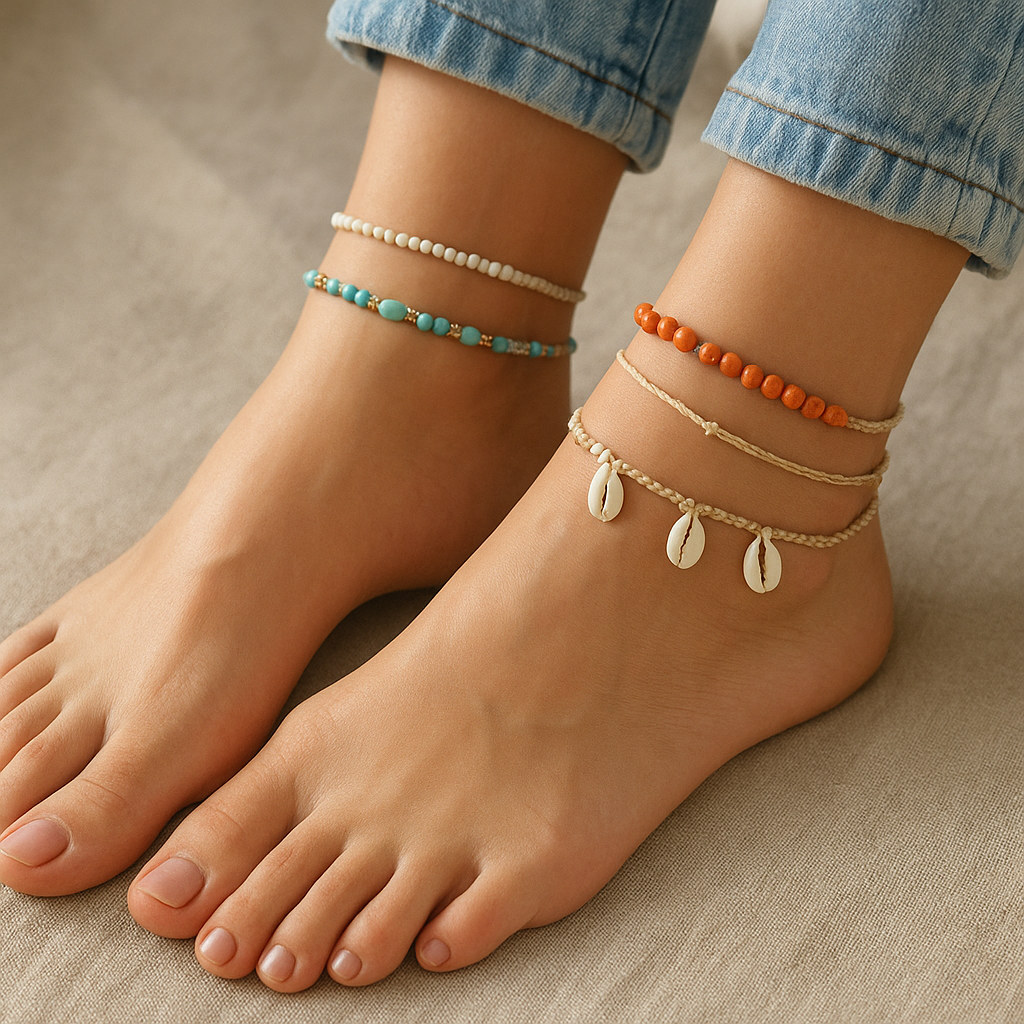
There is something quietly poetic about a small chain or cord circling the ankle: a whisper of movement, a glint of color, an intimate ornament that follows your stride. DIY anklets, born from global traditions and constantly reinvented by hobbyists and designers, sit at the sweet spot between wearable art and practical craftsmanship. They can be as subtle as a silk thread with a single seed bead or as dramatic as a layered cascade of charms. Best of all, making them yourself opens a world of personalization, allowing you to tailor fit, color, symbolism, and texture to your exact taste and lifestyle—across every season of the year.
The anatomy of a well-made ankle piece
Although anklets can look effortless, their success depends on thoughtful design decisions. Fit, drape, and movement must be considered alongside strength and skin comfort. Begin by measuring just above the ankle bone on the leg where you intend to wear the piece. Typical adult anklet lengths fall between 22–28 cm (8.5–11 in), with 25 cm (10 in) a functional average. Add a 2–4 cm extender to accommodate swelling on warm days or to switch between barefoot and shoe-dressed wear.
Weight distribution matters: keep the heaviest component—such as a shell, coin, or gemstone—anchored near the outside of the ankle so it can swing without catching on footwear. If you love charms, spread their mass to avoid the anklet rotating so the clasp slides to the front. Chain choice affects drape: curb and cable chains offer smooth contouring; figaro adds visual rhythm; satellite chain introduces spaced beads without bulk. When using cord, a fine 0.8–1 mm nylon or waxed polyester gives a delicate profile, while 1.5–2 mm leather or cotton offers a rustic statement.
Skin sensitivity is crucial. Choose hypoallergenic metals (surgical stainless steel 316L, titanium, niobium) or high-karat gold for sensitive wearers. For non-metal builds, microfiber suede, nylon cord, or smooth macramé in a flat braid minimizes friction. Test closures: a thin lobster clasp is secure and low-profile; a sliding knot is great for barefoot beachwear and requires no metal contact at all.
Finally, plan for durability. Do you shower, swim, or run in your jewelry? Will sand, salt, and sunscreen be frequent companions? The right cable, cord, or beading wire, plus smart finishing choices (crimps, wire guardians, reinforced knots), ensures your anklet thrives through daily motion and seasonal weather shifts.
Essential tools and materials
Your bench can be a kitchen table; your toolkit can fit inside a pencil case. Focus on a core set that covers cutting, forming, and finishing. Over time, add specialty items to refine results and speed up production.
- Cutters: flush cutters for wire and beading wire, thread snips for fibers.
- Pliers: chain-nose (flat inside), round-nose (for loops), and bent-nose (for tight spaces). A jump-ring tool ring can save your fingers.
- Needles: beading needles sizes 10–12; a flexible beading needle for seed beads.
- Measuring: soft tape measure, small ruler, and a caliper for bead hole sizes.
- Finishing: crimping pliers, lighter for melting nylon ends, fray-preventing glue (G-S Hypo Cement), and beeswax or thread conditioner.
As for materials, start with a versatile palette:
- Metals: stainless steel 316L, sterling silver (or Argentium for tarnish resistance), gold-fill, brass, copper. Use 22–18 gauge wire for wrapped loops; 24–22 gauge for charms; 20–18 gauge for jump rings.
- Chains: cable, curb, figaro, satellite, paperclip. Pick link sizes 2–4 mm for delicate anklets; 4–6 mm for statement looks.
- Stringing: 0.014–0.018 in beading wire for light to mid-weight beads; nylon-coated wire resists kinks. For knotting and macramé: S-lon or C-Lon 0.5–1 mm, waxed polyester cord, or silk (for a fine drape, though silk dislikes water).
- Cords: nylon, polyester, microfiber suede, leather. Nylon takes color well and resists water; leather patinas beautifully but can stiffen if repeatedly soaked.
- Beads and accents: glass seed beads (sizes 8/0–15/0), gemstone chips, pearls, shells, wood, polymer clay discs, enamel charms. Lightweight beads prevent constant rotation.
- Findings: lobster and spring-ring clasps, toggle clasps for boho charm, magnetic clasps for easy on/off (use safety chain if very active), crimp beads and covers, wire guardians, extenders, end caps, cord ends.
For skin-friendly results, avoid nickel-plated base metals. If using brass or copper, apply a jewelry-grade sealant to reduce skin transfer and oxidation. Keep a small box of silicone earring backs on hand—they slide over anklet charms to lock them in place for asymmetry control without permanent changes.
Core techniques you’ll use again and again
A handful of foundational techniques gives you freedom to design for any season, any style. Practice these on scrap cord or wire first.
Jump ring discipline
Open jump rings sideways—never pull them apart front-to-back—using two pairs of pliers. This preserves ring shape and strength. For active anklets, prefer 18–20 gauge rings and consider soldered or welded rings for the highest strength.
Crimping for stringing wire
- Thread a crimp bead onto the wire, then the clasp ring, then back through the crimp to form a small loop with a wire guardian if desired.
- Use the crimping pliers’ inner notch to fold the crimp into a C shape around the wires, then the outer notch to round it. Test with a firm tug.
- Trim the tail and hide it inside the first few beads, optionally adding a crimp cover for a smooth, bead-like finish.
Essential knots for corded anklets
- Lark’s Head: to mount charms on cord or to start macramé. Fold cord in half, slip loop through ring, pull tails through loop.
- Square Knot: the backbone of flat macramé. Alternate left and right half-knots around a central core to create a flat band.
- Surgeon’s Knot: similar to a square knot with an extra wrap for friction—ideal for slippery cords.
- Sliding Knot: create two opposing coils around the standing cord ends so the anklet becomes adjustable. Secure coils with a dot of glue and singe ends carefully.
Wrapped loops for secure charms
- Thread bead onto a 22–20 gauge headpin or wire, bend 90 degrees above the bead.
- Form a loop with round-nose pliers, then wrap the tail neatly 2–3 times down toward the bead.
- Trim and file end smooth. Attach with a jump ring to preserve mobility and reduce torque on the loop.
Bead weaving accents
Even a short ladder stitch or brick-stitched triangle can anchor the center of an anklet with high color impact and minimal weight. Reinforce pass-through stitches to withstand ankle movement and friction with footwear straps.
Micro-macramé and braiding
For cord-based anklets, micro-macramé produces crisp patterns. A simple three-strand braid gives a rustic look; a kumihimo disk can yield precise round or flat cords. Mix fiber and metal by adding seed beads onto the outer strands before each knot for a patterned edge.
Seasonal design playbook
Seasonality is more than color palettes—it’s proportion, weight, and the way an anklet interacts with shoes, socks, sand, and skin. Build a capsule collection that rotates with climate and wardrobe shifts so every piece remains intentional.
Spring: soft greens, first light
Think dew, sprouts, and lightly burnished metals. Pair mint glass with warm brass, or peridot chips with rose gold-fill for sparkle that matches lengthening days. Spring is prime for delicate chain-and-charm combos that won’t snag on transitional layers.
- Project: Dewdrop Chain Anklet
- Cut 25 cm of 2.5 mm cable chain. Add a 3 cm extender.
- Create three peridot or glass teardrop wrapped charms. Space them 2.5–3 cm apart along the outer half of the chain.
- Finish with a 9 mm lobster clasp. Test drape with sneakers and flats to ensure charms ride just above the shoe edge.
Summer: luminous, carefree, beach-friendly
Summer invites barefoot texture: shells, seeds, and splash-proof components. Favor lighter weights and secure finishes. Consider mixed-media anklets—braided nylon with a stainless steel charm—for freedom in water and sand.
- Project: Tidal Nylon Slider
- Cut two 35 cm lengths of 1 mm nylon cord in complementary colors.
- Thread a small stainless steel wave or shell charm to center. Tie overhand knots 1 cm from the charm to keep it in place.
- Join ends to form a loop, then craft a two-coil sliding knot with an extra wrap for grip. Melt cord ends and mushroom the tips.
- Add two 8/0 seed beads as end weights. This piece is both adjustable and waterproof when tied correctly.
Autumn: harvest tones, layered textures
As temperatures cool, anklets peek between ankle boots and cropped pants. Color stories turn to rust, ochre, plum, and forest green. Layer a beaded strand with a delicate chain to echo fallen leaves without bulk.
- Project: Orchard Layered Pair
- Strand A: 0.015 in beading wire with 3 mm matte carnelian, gold-filled spacer beads every fifth bead. Finish with crimps, covers, and a small lobster clasp.
- Strand B: 1.5 mm waxed cotton cord in olive, with a segment of macramé square knots at center and two copper bead accents. End with cord tips and jump rings.
- Connect both to a single multi-strand clasp or to separate clasps with a shared extender for adjustable layering.
Winter: minimal, luminous, resilient
Winter anklets benefit from smooth surfaces and compact forms that won’t catch on tights or socks. Choose bright metals for contrast or oxidized finishes for moody subtlety. A slim chain with a single stamped disc reads elegant under indoor lights.
- Project: Solstice Disc
- Stamp a 9–12 mm disc with a sunburst or snowflake. File and polish edges.
- Attach via a 4 mm jump ring to a 2 mm satellite chain, centering between two fixed beads to prevent sliding.
- Finish with a spring-ring clasp for a sleek profile. If worn over hosiery, size up by 0.5–1 cm.
Closures and adjustability that hold up
Closures can make or break user experience. Lobster clasps are reliable; pair with a 5–7 mm ring for easy clipping. Magnetic clasps enable single-handed fastening but need a light safety chain when running or dancing. For fiber builds, the sliding knot is the star: compact, comfortable, and repairable on the go. Add tiny silicone-lined beads to create a low-profile, no-knot slider. Where possible, include an extender to support swelling, layering with socks, or switching ankles.
Design language: minimal, bohemian, and sporty
Style vocabularies evolve, but a few archetypes persist. Minimal anklets rely on negative space—one charm, fine chain, perfect length. Bohemian compositions celebrate asymmetry and texture: stacked strands, mixed metals, leather cords, bells, and tassels. Sport-inspired variants feature sleek cords, matte hardware, and low snags. Move fluidly among these families as seasons demand: crisp minimalism in winter, breezy boho in summer, streamlined sport for travel days.
Comfort and movement science
Anklets articulate with one of the body’s most active joints. Consider gait: the anklet’s outer half travels farther with each step, so it’s the best home for charms. Balance components to prevent spinning. Smooth any cut wire ends and tuck thread tails for comfort. If you want zero rotation, create a slightly oval chain with micro-weight at the back (three tiny beads near the clasp) to counter-rotate and keep the focal point forward.
Eco-friendly making and meaningful sourcing
Handmade jewelry invites mindful resource choices, and anklets are perfect canvases for sustainability. Upcycle broken bracelets into anklets by adding an extender. Thrift chains and sanitize them, then re-plate or seal as needed. Collect sea glass responsibly and drill with a water-fed bit to avoid cracking. Swap plastic spacers for wood, bone (ethically sourced), or rattan. Favor recycled sterling silver or gold-fill, rPET cords, and dyes with low environmental impact. Packaging can be unbleached kraft envelopes, cotton bags, or repurposed fabric scraps sewn into tiny pouches.
Care, cleaning, and longevity
Different materials need different care cycles. Sterling silver appreciates occasional polishing with a treated cloth and storage in anti-tarnish bags. Stainless steel asks for little—just mild soap and water. Brass and copper can be brightened with a gentle citric bath, then sealed to slow re-oxidation. Nylon cord anklets can be rinsed, patted dry, and re-tightened. Keep adhesive-based joins away from intense heat and solvents. Rotate wear to reduce abrasion where anklets meet shoe edges or sand.
Troubleshooting common issues
- Anklet keeps rotating: rebalance charm weight, add micro-weight near clasp, or fix charm position between two beads.
- Crimps slipping: use the right size and quality crimp tubes (not beads), crimp in two steps, and test by tugging.
- Cord fraying: seal ends with heat and a tiny drop of glue; choose a tighter braid or switch to waxed cord.
- Color fading: prefer top-coated glass beads over painted acrylic; use UV-resistant cords for summer pieces.
- Skin irritation: move to hypoallergenic metals, smooth rough spots, and ensure a dry, clean anklet after workouts.
Water, sport, and travel: building for performance
For swimmers, surfers, and travelers, reduce corrosion points. Stainless 316L, titanium, and PVD-coated components excel; avoid plated base metals in saltwater. Nylon-coated beading wire resists kinks; waxed polyester endures sun and sand. Flat cords sit comfortably under straps and resist catching. Reinforce knots and choose low-profile charms. A spare paracord anklet with a mini whistle or reflective thread can be both stylish and practical on the trail—fashion meeting function with true versatility.
Color stories and symbolism
Intentional color elevates aesthetics and meaning. Blues calm and cool for summer seas; greens refresh for spring; warm ambers and reds glow for autumn; monochrome or metallics refine winter. For gemstone symbolism, consider aquamarine for clarity, carnelian for vitality, moonstone for intuition. Superstition and talismanic use are historic: an evil-eye charm or a tiny bell may carry personal significance. In gift-giving, birthstones align a piece with a specific moment in time.
Culture and etiquette
Anklets have deep roots across cultures—ghungroo in South Asia, shell and seed body ornaments in Pacific and African traditions, and sleek metal chains in Middle Eastern and Mediterranean fashion. Etiquette varies; some consider anklets playful, others treat them as formal jewelry. In professional settings, minimal designs that do not jingle are a safe bet. When referencing or reinterpreting motifs from living traditions, credit your inspiration and, when possible, source from artisans within that tradition.
Selling, gifting, and small-batch production
If your hobby becomes a microbusiness, systematize lengths (S: 22–23 cm, M: 24–25 cm, L: 26–27 cm) with extenders for flexibility. Photograph on a neutral background and on-ankle for scale. List materials and care instructions; declare nickel-free status and note water tolerance. Batch by color stories per season to reduce decision fatigue. For packaging, a small card describing the design’s inspiration adds emotional value and enhances the unboxing moment.
Five pattern recipes to master
- Minimalist Center Dot
- 2 mm satellite chain, 25 cm; single 4 mm gold-fill bead fixed at center between two 2 mm stoppers.
- Spring-ring clasp; 3 cm extender. Works year-round and layers seamlessly.
- Boho Fringe
- 2.5 mm cable chain, 24 cm. Add 7–9 wrapped-loop dangles alternating mini shells and gemstone chips along outer half.
- Lobster clasp; soldered jump rings for strength. Best for summer festivals.
- Micro-Macramé Chevron
- Four strands 0.5 mm nylon, 35 cm each. Chevron pattern over a 12 cm center with seed beads on outer cords.
- Sliding knot closure. Light, flexible, sandal-friendly.
- Beaded Gradient
- 0.015 in beading wire; ombré palette of matte glass beads from dark at ends to light at center.
- Crimp, cover, and add extender. Pair with autumn hues for warmth.
- Titanium Bareline
- 1.7 mm titanium rolo chain, 25 cm; single titanium disc precisely centered.
- Micro lobster clasp. Sweatproof and sleek for active wear.
Measuring like a pro
Use a flexible tape at the narrowest point above the ankle bone. Add 1–1.5 cm for a classic drape, or 2 cm if you want a looser fit. If gifting, include an extender to guarantee success. For layered stacks, vary lengths by 0.5–1 cm to prevent tangling and to reveal each design clearly.
Safety, testing, and wear trials
Before final delivery, tug-test every connection: jump rings, crimps, knots. Roll a scrap of hosiery over the ankle to spot snag points. Walk, jog in place, and flex the ankle; listen for noise if discretion matters. If your recipient is active or has sensitive skin, note hypoallergenic metals and quick-dry cords, and provide a care card for best results.
From one season to the next: transitioning designs
Transform a summer slider into a fall stacker by adding a chain companion. Move a shell charm onto a stamped metal disc for winter minimalism. Swap a cotton cord for waxed polyester before a rainy season. Design with modularity: detachable charms on lobster mini-clasps can leap between anklets and bracelets, multiplying looks without expanding the parts bin.
Material matchups that work
- Nylon cord + stainless hardware: beach-proof, modern profile.
- Waxed cotton + brass: earthy patina for autumn.
- Silk thread + gold-fill: refined, indoor-friendly elegance.
- Leather + copper: rustic and warm; seal copper if skin transfer is a concern.
- Seed beads + satellite chain: texture with minimal weight.
A quick primer on closures and findings
Crimp tubes outperform crimp beads for reliability. Wire guardians add a polished loop and reduce friction at the clasp. For cords, end caps with teeth grip leather; fold-over crimps hold flat fibers. Always size components to the thickness of your chain or cord—loose fits lead to wear and failure, while tight fits overstress materials.
Elevating the craft through finishing
Finishing is where handmade looks professional. File cut wire ends; round crimp covers evenly; align charm orientations so motifs face outward on the ankle. Add a tiny maker’s tag near the clasp to sign your work. Build color cohesion: repeat a metal tone three times (clasp, charm, spacer) and an accent color twice for visual harmony.
Why anklets remain irresistibly wearable
They are intimate yet visible, casual yet capable of ceremony. Anklets reward attention to proportion and movement more than any other jewelry form because the ankle is constantly in play. With a few refined habits—precise measurement, balanced weight, careful finishing—you can craft a seasonal rotation that stays fresh for years. The process is playful, meditative, and satisfying, and it turns simple supplies into tiny kinetic sculptures that travel everywhere your steps do.
Checklist: from idea to ankle
- Concept: choose season, palette, and mood.
- Measure: ankle circumference, desired drape, extender length.
- Select: hypoallergenic metals or soft cords based on lifestyle and climate.
- Build: follow secure joins and test after each assembly step.
- Finish: smooth, seal, and balance weight distribution.
- Style: layer intelligently; photograph for future reference; iterate for the next season.
Closing thoughts
With attention to fit, thoughtful material choice, and a few dependable methods, DIY anklets become a year-round canvas for expression. Let your seasonal surroundings guide color and texture; let your routines determine structure and closure; let memories and places inspire charms and motifs. Whether you are weaving fine seed beads for spring, knotting cords for summer, layering warmth for fall, or polishing metal minimalism for winter, you are shaping more than an accessory—you are crafting a wearable diary of movement and time.
Appendix: durability, comfort, and design at a glance
- Best all-weather pairings: nylon cord and 316L stainless; PVD-coated titanium for sweat resistance.
- Everyday comfort rules: keep focal weight outer-ankle; smooth all transitions; avoid bulky charms under straps.
- Design heuristics: repeat a metal tone thrice; cap chain link size to 3 mm for minimalism, 5 mm for statement looks.
- Versatile closures: lobster for reliability; sliding knot for adjustability; magnetic with safety chain for accessibility.
- Seasonal pivot: detachable charms and extenders convert one build into many looks.
As your toolkit grows, so does your confidence. Treat each project as a study in balance and movement, and soon your ankle will carry an evolving gallery of small-scale art—pieces that celebrate seasons, places, and the everyday joy of handwork, all supported by the quiet rigor of refined techniques, mindful materials, and the lasting values of handmade design.
