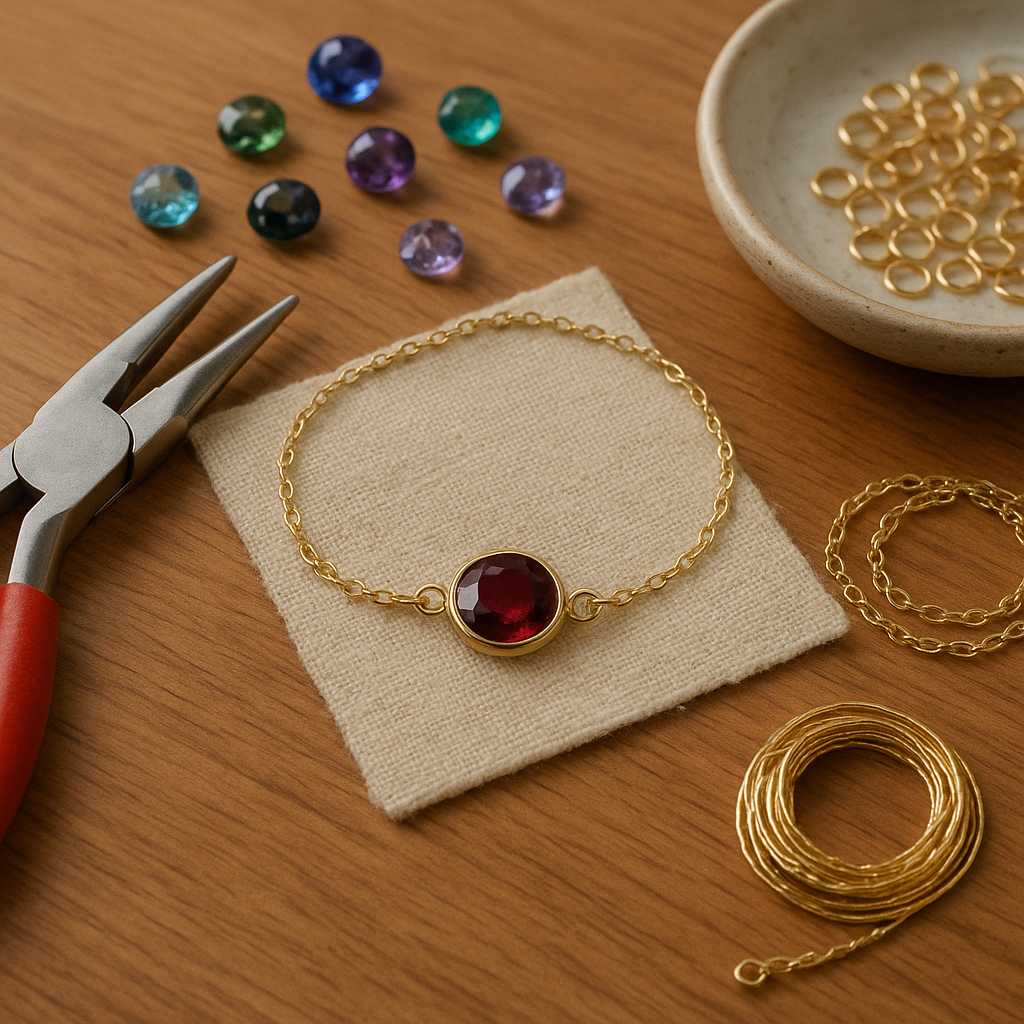
Few handmade gifts feel as intimate as a piece of jewelry set with the stone of someone’s birth month. It’s small enough to wear every day, meaningful enough to hold close, and tactile enough to remind the wearer they’re cared for. This guide brings together the artistry of the bench with the warmth of gift-giving, showing how to design, craft, and finish DIY birthstone jewelry that balances beauty, durability, and story. Whether you’re a curious beginner assembling your first pendant at the kitchen table or a seasoned maker refining technique at a dedicated bench, you’ll find practical methods, historical context, and design ideas to transform simple materials into heirloom-quality presents that people reach for year after year.
The allure and meaning of birthstone gifts
Long before gemstone charts were printed on postcards, cultures across the world linked stones to zodiac signs, months, and spiritual virtues. The modern system in many regions traces to the early 20th century, codified by jewelry trade associations to standardize gift-giving. That blend of folklore and industry created something unexpectedly powerful: a ready-made code for telling personal stories through color and mineral. Recipients often feel an instant connection to their stone, even if they didn’t know its historical lore. Handmade pieces amplify that connection; a maker’s careful hands turn a simple crystal into an object imbued with ritual and affection.
Here’s a concise month-to-stone reference, combining modern standards with widely accepted alternates. Use it as a palette rather than a rulebook, mixing and matching to fit taste, budget, and wearability:
- January: Garnet (deep red; alternates include rhodolite for raspberry hues and tsavorite for green)
- February: Amethyst (purple; can range from lilac to royal violet)
- March: Aquamarine (icy blue; alternate is bloodstone for a moody, earthy look)
- April: Diamond (clear brilliance; alternates include moissanite or white sapphire)
- May: Emerald (glowing green; alternate is green onyx for budget-friendly designs)
- June: Pearl or Alexandrite (pearl’s softness demands gentle settings; lab-grown alexandrite gives color-change magic)
- July: Ruby (red; spinel is a classic alternate with excellent durability)
- August: Peridot (apple green; alternates include spinel or sardonyx)
- September: Sapphire (blue; fancy sapphires in peach, teal, or yellow are wonderful)
- October: Opal or Tourmaline (opals show play-of-color; tourmaline spans a rainbow, including watermelon bi-color)
- November: Citrine or Topaz (golden to honey brown; London blue topaz offers deep teal)
- December: Turquoise, Tanzanite, or Zircon (cool blues; consider treated stones’ care needs)
Why do these stones make such compelling gifts? First, the symbolism is ready-made: each month carries associations of courage, wisdom, fidelity, or luck. Second, color memory is strong; recipients remember these hues in milestone photos and family traditions. Third, when you make the piece yourself, the narrative extends to your process—the tools you learned, the finish you chose, the way you matched stone shape to the wearer’s lifestyle. In a world of mass production, the patience of handwork and the intimacy of choosing a specific stone for a specific person give the jewelry its emotional ballast.
If you’re drawn to the tactile rhythm of sawing, filing, and polishing, DIY jewelry offers a satisfying way to practice slow craftsmanship. That ethos matters: you’re not just making a product, you’re shaping time and attention into something someone you love will carry on the body.
Materials, tools, and setting up your workspace
Good tools don’t have to be expensive; they do have to be appropriate. A basic kit for birthstone pieces usually includes a bench block, jeweler’s saw, assorted blades, half-round files, needle files, round/chain/flat-nose pliers, flush cutters, steel ruler, dividers, a ring mandrel, and a rawhide or nylon hammer. If you plan to do thermal joins, add a small butane torch, third hands, solder picks, tweezers, and a fire brick. For finishing, stock sandpaper from 320 up to 2000 grit, polishing compounds, and a sunshine cloth. For soft cords and stringing, pick up beading wire, silk or nylon thread, bead tips, crimp tubes, and a crimping tool. Always keep eye protection and a particulate mask on hand, and ventilate if you’ll heat metal or use adhesives.
On the materials side, decide whether your piece will house faceted stones or smooth domes. A smooth dome is called a cabochon, ideal for bezels and many beginner-friendly settings. Faceted stones are beautiful but often require precise settings like prongs or tube seats to showcase their light. Consider metal choice: sterling silver is versatile and cost-effective, gold-fill is durable for chain and findings, and solid gold (9k–18k) elevates special gifts. Brass and copper are warm and affordable, though they may need clear coatings to slow skin reaction. For beadwork, you’ll also choose between rondelles, chips, and calibrated sizes (e.g., 3 mm, 4 mm) that make patterning simple.
Don’t overlook stone ethics. Asking vendors about origin and cutting conditions is becoming standard practice. Reputable sellers will share details about provenance, treatments (e.g., heat for sapphire, oil for emerald), and whether stones are lab-grown. Lab-created options can be chemically identical to mined stones, often at lower cost and environmental impact, and are an excellent choice for daily-wear gifts.
Storage and organization matter for both safety and joy. Use labeled trays or compartment boxes for stones, and soft pouches for finished pieces. Keep small consumables—crimps, jump rings, solder snippets—in magnetic tins. A tidy bench saves time and reduces mistakes like scratching a polished gem with an errant bur.
Core techniques for handcrafted durable settings and stringing
Birthstone gifts must withstand real life: backpacks, office chairs, sweaters, showers. That means choosing techniques that hold stones securely and suit the recipient’s habits.
Wire-wrapping foundations
For pendants and simple rings, wire-wrapping is a flexible, solder-free entry point. Choose dead-soft or half-hard wire depending on the structure: dead-soft bends easily for complex wraps, half-hard retains shape for frames and prongs. A classic pendant uses a frame around a stone (cab or drilled) with a bail integrated into the design. The keys to a professional look are consistent tension, clean cuts, and tidy coil spacing. Practice on copper before moving to silver or gold-fill. For durability, avoid overly thin structural wire; 20–18 gauge frames paired with 26–24 gauge binding wire hit a good balance.
Stringing and knotting elegance
Beaded bracelets and necklaces shine for multi-birthstone “family” gifts. Crimping beading wire to a clasp is efficient, but silk-knotting offers a luxurious drape and protects delicate beads from rubbing. When designing patterns, use metal spacers to set off color and create rhythm. Always finish with guards or wire protectors at the clasp ends to minimize wear. For rings, consider tension bead stacking on memory wire for a quick win, but test comfort and sizing carefully.
Cold connections and bezels
Cold connections—rivets, tabs, screws—attach metal without heat, ideal for stones sensitive to temperature or adhesives. If you’re ready for simple stone settings, learn to create low-profile bezels. A bezel is a thin strip of metal that wraps a stone and is burnished over its shoulder to secure it. Pre-made bezel cups speed the process for calibrated stones. For custom shapes or asymmetrical cabs, cut your own from fine silver bezel strip, fit it tightly, solder (or rivet) the seam, attach to a backplate, and then seat the stone. The burnish should be decisive but gentle—think firm persuasion, not brute force. Keep the inner edge clean to avoid trapping grit against the stone.
Basic soldering joins for rings and pendants
Adding thermal joins opens a world of sturdy designs. With a small torch and a fire-safe setup, you can create jump rings, chain sections, and stone settings tailored to your gems. Practice heat control on scrap until you feel the moment solder flows. When forming stacking rings, measure ring size with a mandrel, add material for the joint, saw a flush seam, and join with easy or medium solder. Follow with pickling, filing, sanding, and polishing. If you plan to add a setting later, choose the appropriate solder sequence so earlier joins don’t open. This approach—hot work first, delicate operations last—keeps your workflow clean and secure. Note that some alloys heat differently; sterling conducts heat quickly, requiring even warm-up before soldering flows.
Resin, metal clay, and hybrid techniques
Low-temperature methods can encase tiny chips or crushed stones into bezels using two-part resin, creating galaxy-like surfaces. Metal clay allows sculpted textures that sinter into solid silver, with post-fire settings added afterward. Consider combining techniques—wire frames with resin inlays, or beaded chains supporting soldered pendants—for rich, layered looks without complexity bottlenecks.
Designing for meaning and everyday wear
Good gift design lives where symbolism meets comfort. Before you reach for tools, answer three questions: How will the recipient wear this? What is their color and metal preference? Which moment do you want the piece to mark?
- Lifestyle: For someone who types or lifts often, pick low-profile stones and snag-resistant settings. Pendants and stud earrings are easiest to live in, rings pose the most abrasion risk.
- Palette: Some people love saturated hues; others prefer neutrals. Aquamarine and white sapphire read subtle, ruby and emerald vibrate boldly. Mix neutral metal with one standout stone for balance.
- Message: A single birthstone speaks to identity, while a trio can represent partners and children. Consider adding secret engraving on the backplate or a hidden flush-set accent stone inside a ring band.
Elevate meaning with thoughtful personalization: stamped initials near the bezel rim; a micro tag on the chain with an anniversary date; or a pattern of spacer beads that counts out a lucky number. Pair stones with birth flowers or tiny charms (a leaf, a constellation disc) to weave a layered narrative without crowding the composition.
When composing multi-stone pieces, think like a painter. Contrast size and saturation, not just color. A small, intense sapphire flanked by pale moonstones creates depth; a large opal surrounded by tiny black spinels tightens focus. Use asymmetry deliberately, counterbalanced by repeating elements (e.g., matching end caps or mirrored chain lengths).
Projects by skill level
Beginner: A family birthstone bar necklace
String 3–7 small rondelles on a slender bar wire, spaced with micro seed beads. Create loops at each end with round-nose pliers and attach to a dainty chain. This design places loved ones’ stones close to the collarbone—visible yet refined. Choose hard-wearing stones (sapphire, spinel, topaz) for daily wear, and size the chain to sit between 16–18 inches. Finish with a lobster clasp and extender for adjustability.
Beginner: Wrapped-briolette earrings
Many month stones come as drilled teardrop briolettes. Use 26–28 gauge wire to wrap a neat cap around the top and form an ear wire loop. Keep wraps even and minimal to highlight translucency. Pairing two different birth months can symbolize a relationship without engraving.
Intermediate: Custom bezel-set cabochon ring
Choose a 6–10 mm round or oval cab—garnet, onyx, moonstone—then shape a fine silver bezel to fit. Solder the bezel seam, then solder to a silver backplate. Saw out the backplate contour and attach to a pre-made ring shank or fabricate your own. After finishing the metal, seat the stone and burnish the edge. This teaches measurement, heat control, and clean finishing, all with robust stone security.
Intermediate: Multi-birthstone stacking rings
Create three slender bands in different textures (hammered, brushed, high-polish). Add small tube settings for 2–3 mm stones representing family members. Tube settings protect tiny stones during daily wear and stack beautifully. Mix metals—two silver, one yellow gold—for subtle sophistication.
Advanced: Hinged locket with secret stone
Fabricate a shallow oval box with a friction-fit lid and a tiny hinge. Inside, flush-set a small stone matching the recipient’s month. Outside, engrave initials or a motif. The locket merges engineering and sentiment; it’s a showpiece of skill and a treasure-keeper in one.
Finishing, care, and presentation
Finishing work separates homemade from heirloom. Progress through abrasives logically—320, 600, 1000, 2000—then polish with compounds matched to metal (tripoli for cut, rouge for high shine). Consider a satin finish for pieces that will see wear; it hides micro-scratches and feels modern. For silver, a controlled darkening can add character; introduce a dark patina into recesses to make textures pop, then buff highlights for contrast.
Stones require tailored care. Opal, pearl, and turquoise are porous or soft; avoid ultrasonic cleaners, harsh chemicals, and prolonged water exposure. Diamonds, sapphire, and spinel tolerate more vigorous cleaning, but keep them away from chlorine bleach. Always mount sensitive stones after high-heat operations, and educate recipients with a small care card describing cleaning and storage.
Presentation turns a gift into a moment. Package jewelry in a small box with a fabric insert and a card telling the stone’s meaning and why you chose that particular shade or cut. Add a tiny vial holding offcuts or a sketch of your design plan so the recipient senses the journey from concept to finished piece. Great handicraft isn’t just the object—it’s the story arc you share.
Troubleshooting: common issues and practical fixes
- Loose stones in bezels: The bezel might be too tall or not fitted snugly. Shorten slightly, re-round, and ensure even burnishing around the highest point of the stone’s shoulder.
- Wire wraps unraveling: Use half-hard wire for structural wraps and tuck tail ends neatly. Finish coils with a gentle squeeze from flat pliers to lock them.
- Crimp failures: Use proper-sized crimp tubes (not beads) and a quality crimp tool; test by tugging before trimming tail wires.
- Solder seams visible: Improve fit before heat. A perfect mechanical fit needs less solder and polishes invisible. Sand and refinish to blend.
- Stone scratching: Keep polishing compounds, burs, and loose grit away from seated stones. Mask stone faces with low-tack tape when finishing nearby metal.
- Allergic reactions: Avoid nickel-bearing findings. Choose sterling, gold-fill, titanium, or niobium for ear wires and clasps.
Budgeting, sustainability, and value
Handmade doesn’t have to mean costly. A thoughtful budget splits spending among stone, metal, and findings while leaving room for packaging. If you’re making multiple gifts, buy stones in matched pairs or small parcels for volume pricing. Consider lab-grown options: diamond, sapphire, ruby, emerald, and alexandrite are widely available with excellent color and durability. For softer stones, stabilize (e.g., turquoise) or choose protective settings like bezels and halos.
Upcycling adds heart and reduces waste. Reform old chains, re-melt scrap silver into new components, or re-set heirloom stones into modern designs. Document the transformation with before-and-after photos—a powerful addition to your gift note. Eco-minded recipients will appreciate recycled metals and transparent sourcing; pair these with small-batch packaging like cotton pouches and paper boxes made from post-consumer fibers.
Inspiration: styles and aesthetics that suit different recipients
Style frames meaning. Minimalists often prefer a single small stone set on a whisper-thin chain, while maximalists embrace clusters and charms. Vintage lovers may gravitate toward milgrain edges and floral engraving; modernists lean clean lines and geometric forms. Bohemian looks mix textures, asymmetrical stones, and oxidized finishes; classic styles keep symmetry and luminous polish. If uncertain, glance at the recipient’s everyday accessories—watch metal, shoe hardware, glasses frames—to harmonize your metal choice and silhouette.
A few thematic ideas spark design play:
- Constellation discs: Tiny drill points and star-set grains map the recipient’s zodiac, with the birthstone at the brightest star.
- Journey necklaces: Three stones that graduate in size to symbolize past, present, future.
- Hidden initials: Negative space cutouts behind the stone cast letter-shaped shadows on the skin.
- Nature cues: Leaf-vein textures, water-drop bezels, or wave edges that echo a stone’s color story.
Safety, ergonomics, and workflow
Good making respects your body. Work at a comfortable bench height with a stool that supports your back. Use bench pin supports to stabilize sawing and reduce hand fatigue. Ventilate anytime you heat metal or mix adhesives, and keep water nearby for quenching metal—not stones. Store acids and patination solutions clearly labeled and away from reach. Practice fire safety: tie back hair, avoid loose sleeves, and keep a ceramic tile under any torch work at the kitchen table. Over time, a consistent workflow—design sketch, measure, cut, fit, join, finish, stone-set, clean—will reduce redo cycles and produce cleaner results.
Stone selection: durability, cut, and visual impact
Beyond color, evaluate durability using the Mohs scale and toughness. Sapphire, spinel, and diamond handle daily wear; opal and pearl ask for gentler settings. Cut affects brilliance and how a stone seats. Facets bounce light, but even a well-cut cab can glow beautifully if you polish the metal around it to reflect light into the stone. Calibrated sizes simplify sourcing pre-made settings; freeform cuts invite custom metalwork and a unique silhouette. For rings, smaller diameters sit lower and snag less; for pendants, larger stones carry well without comfort issues.
When examining stones, look at them in multiple lights—daylight, indoor LED, and shade—to catch color shifts. Check for chips along the girdle, pits on cap faces, and cracks that compromise integrity. If a stone has character inclusions you love, position them intentionally within the design so they read as features rather than flaws.
From sketch to heirloom: a repeatable process
Repeatable process makes custom work reliable, especially when gifting multiple people. Try this workflow:
- Brief: Write a simple intent—who the gift is for, the occasion, and one sentence about mood.
- Palette: Choose metal color and 1–3 stones based on month, skin tone, and wardrobe.
- Sketch: Produce three thumbnail variations; decide on the strongest composition.
- Mockup: Use paper or thin copper to test scale on the body; adjust proportions.
- Build: Cut, form, and join components in subassemblies before final assembly.
- Finish: Sand, polish, texture; set stones last.
- Quality check: Tug test chains, loupe seams, and run a silk cloth to feel for snags.
- Story: Write a short note about stone meaning and care instructions.
Care cards: what to include with every gift
A simple card increases the lifespan of your piece and shows professional courtesy:
- Stone name and month (e.g., Aquamarine, March); note if lab-grown or treated.
- Metal type (e.g., sterling silver) and plating notes if applicable.
- Cleaning: warm water and mild soap, soft brush; avoid harsh chemicals.
- Storage: separate pouch to prevent scratches; keep pearls/opal away from extreme dryness.
- Warranty or repair policy if you offer one.
Ethics and the future of meaningful jewelry
Transparency is reshaping the jewelry landscape. Makers today can trace stone supply chains more clearly, choose recycled metals, and favor cutting workshops with fair labor. Customers increasingly value that honesty, and gifting becomes more thoughtful when you can tell the story of a stone from mine or lab to bench to body. Your role as a craftsperson includes curating these choices and sharing them in a way that educates without preaching.
Technique deep-dive: clean bezels, smooth prongs, better burnish
To achieve tight bezels, file a perfectly vertical bezel wall and keep the interior free of solder spill. Chamfer the top inside edge slightly so metal folds over smoothly. When pressing, work symmetrically—north, south, east, west—then fill the arcs between. For prongs, start taller than you think you need and leave room to round the tips after securing the stone. A curved burnisher glides better than a sharp one; polish your tools so they don’t mar the metal. The goal is security without crushing the stone or leaving bite marks on the rim.
Sidebar: choosing the right stone shape
Round and oval shapes are forgiving for bezels and read classic. Pears and marquises add elegance but need careful alignment to avoid visual tilt. Cushions feel vintage; hexagons and kites feel modern. For mother’s jewelry with multiple children’s stones, mix shapes sparingly—one fancy shape surrounded by rounds keeps clarity. When in doubt, build harmony through repetition of either shape or spacing.
Packaging that doubles as keepsake
Reinforce meaning with packaging designed to be saved. A small linen envelope with a stitched initial, a card with an original sketch print, a tiny glassine sleeve for extra links—each element confirms that a human made this gift thoughtfully. If your recipient travels, include a compact jewelry pouch with compartments to prevent tangles and scratches.
Handmade confidence: practice routines and skill growth
Skill grows in deliberate cycles. Set aside short sessions to practice a single motion: sawing smooth curves, filing square edges, pulling consistent wire coils. Keep a scrap box of practice joints and note what worked. Photograph your setup so you can replicate good lighting and tool placement. A small win—like a perfectly round jump ring or a leveled bezel wall—builds the confidence to tackle more ambitious designs.
Why DIY birthstone pieces endure
When a gift is both personal and wearable, it accrues memory with every use. A pendant becomes part of morning ritual; a ring collects the day’s light; a bracelet sounds a tiny chime when someone reaches for a handshake. Those sensory cues deepen attachment. Add the symbolism of birthstones and the sincerity of handwork, and you get something that resists trends and outlasts seasons. It’s not the complexity of the piece that makes it special; it’s the fit between stone, story, and wearer.
A final checklist before you wrap
- Edges smooth, no burrs; chain links soldered or securely closed.
- Stone seats snug, no rattle; prongs evenly spaced and rounded.
- Finish coherent: high polish, brushed, or textured, applied consistently.
- Clasp easy to use; length appropriate; extender added if helpful.
- Care card and story note included; packaging protective yet pretty.
Tool and technique glossary for quick reference
- Burnisher: Hardened tool used to push bezel edges over a stone and to compress/shine metal.
- Pickle: Mild acid bath that removes oxides after heat work.
- Anneal: Heat metal to soften it for forming, then quench and pickle.
- Work-hardening: Metal stiffens with bending/hammering; plan forming order accordingly.
- Gauge: Wire thickness; lower numbers are thicker (e.g., 18 ga is thicker than 24 ga).
- Mandrel: Tapered or cylindrical form used to size rings, bracelets, or bezels.
The handmade path to meaningful jewelry is generous: it gives you a reason to learn, a rhythm to practice, and a way to honor someone with an object that carries their color and story. Keep your designs grounded in wearability, choose stones and metals thoughtfully, and invest in tidy joins and clean finishes. In time you’ll develop a signature style—perhaps a preference for minimal settings, for sculptural forms, or for intricate texturing—and each new gift will feel both familiar and uniquely tailored to its recipient. Above all, let your hands edit with intention. When you remove what’s unnecessary, what remains—stone, metal, light—does the quiet, daily work of celebration, close to the skin.
When you’re ready to expand, explore advanced setting methods, experiment with textured backplates that reflect light into stones, and consider documenting your builds from sketch to final polish. A simple photo strip and a note describing how you matched color to memory turns a lovely object into a deeply personal keepsake. As your repertoire grows—be it clean bezels, confident torchwork, or meticulous stringing—so will your ability to meet each recipient where they are, creating gifts that fit seamlessly into their lives and feel like they could only have come from you and your bench. Protect the soft stones, respect the hard ones, and keep learning; the rest is honest, joyful making.
And remember: your choices of metal and design are a frame for the star of the show—the gemstones themselves. Let their color and cut lead the way, choose techniques that suit your current skills, and don’t rush the steps that build security and shine. A clean joint, a well-formed bail, a neatly closed link—these small decisions accumulate into a piece that feels complete. Even the tiniest detail, from the curve of a jump ring to the angle of a bail, tells the wearer that attentive hands made this for them. With time, steady practice, and a love for the craft, each new piece will carry your evolving signature and the quiet promise of care.
As you close the box on your finished gift, take a moment to notice what you learned—perhaps a steadier saw stroke, a more controlled flame, or the way a satin finish transforms a surface. Those lessons fold into the next project: a pair of studs for a birthday, a renewal ring set, a charm bracelet collecting milestones. The handmade tradition lives in these continuities, where technique meets sentiment—where a gifter’s intention is translated into metal and stone, and the wearer feels it every time the piece catches light. This is the essence of jewelry as personalization, shaped by your hands, made to last.
When your workflow includes careful measuring, clean cuts, and mindful heat, the bridge between design and execution becomes shorter and sturdier. Soon, you may find yourself comfortably moving from a simple wire frame to a more complex construction, such as a cluster pendant with different stone shapes or a bracelet with articulated segments. The milestones of skill—learning controlled heat for soldering, forming elegant bezels, or mastering low-snag designs—open creative doors. Along the way, don’t forget to enjoy the textures, the soft ring of hammer on metal, the quiet gleam of a freshly polished edge, and the subtle depth of a well-applied surface finish like a cultivated patina. These are the pleasures that make the long tradition of jewelry handicraft a daily practice worth keeping.
