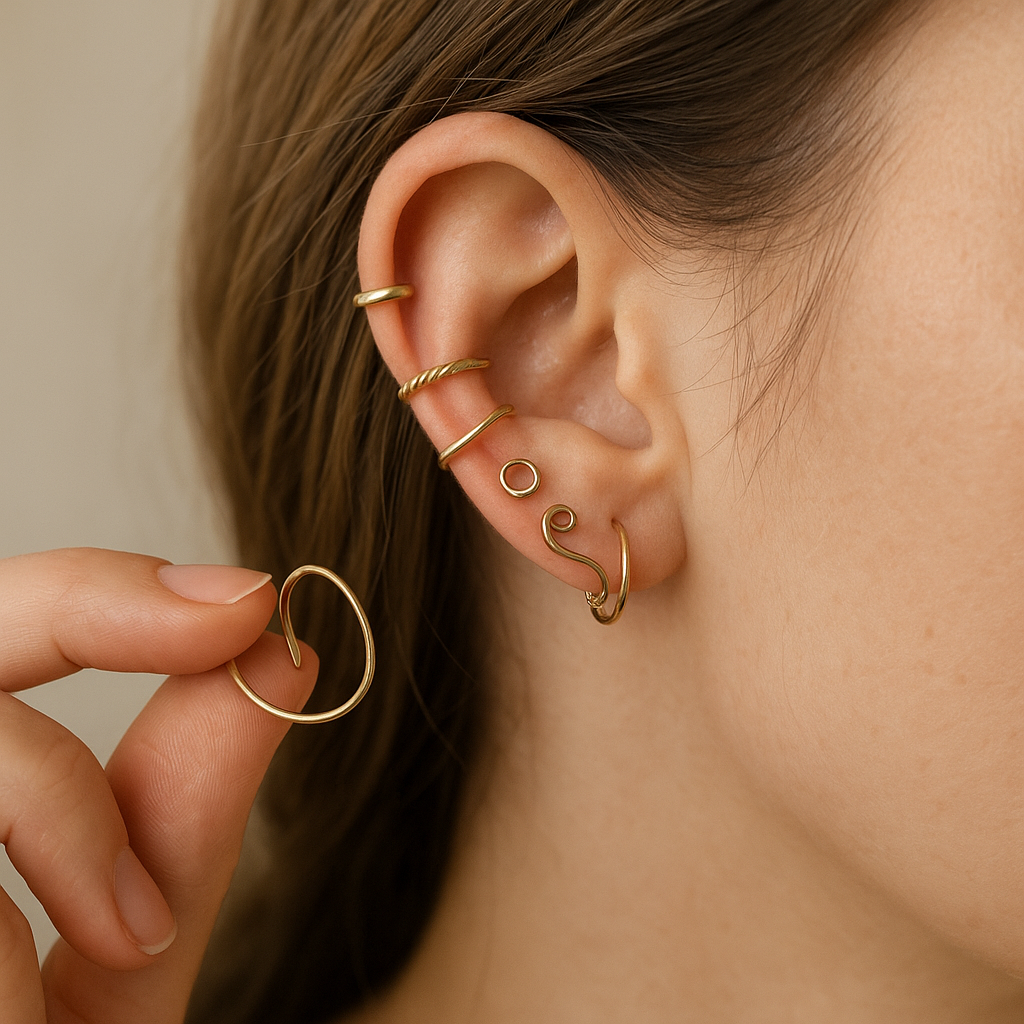
Ear cuffs have always felt a little bit magical: tiny sculptures that perch on the ear without a single puncture, an invitation to play with style, comfort, and ingenuity. Making them yourself elevates that magic into a personal practice—part wearable art, part study of the ear’s curves, and part celebration of hand skills. This guide explores the why and how of DIY ear cuffs, from essential tools and materials to classic and experimental builds, so you can craft pieces that sit securely, feel comfortable, and express your unique voice.
Understanding Ear Cuffs: Form, Fit, and Purpose
Unlike pierced earrings, ear cuffs rely on a gentle balance of spring tension and precise shaping to stay put on the cartilage. The ear is a landscape: ridges, hollows, subtle slopes, and varying thicknesses of tissue create natural “parking spots” where a cuff can nestle. Excellent fit means aligning a cuff’s pressure with a region of cartilage that resists wobble but doesn’t pinch.
To design successfully, consider three pillars: mechanics, comfort, and style. Mechanics dictate how your cuff grips; comfort focuses on contact points; style determines the silhouette and ornamentation. Think of each cuff as a ring that wraps a section of the ear—its open ends adjusted to embrace the cartilage lightly. The best cuffs distribute pressure across a broad enough area to avoid hotspots, while keeping the profile proportionate to the wearer’s ear.
It helps to visualize the ear in “zones.” Common cuff positions include the mid-helix (the outer rim), upper helix, and antihelix. The upper helix often tolerates slightly firmer spring tension, while the mid-helix benefits from smooth edges and a rounded interior curve. Remember that ears vary significantly from person to person; building prototypes is part of the craft.
Materials and Tools: Choosing the Right Ingredients
Wire is the backbone of most ear cuffs. Your selection affects workability, finish, and skin compatibility. Below are reliable options along with their personalities and use cases.
Popular Metals
- Sterling silver (925): Bright luster, work-hardens rapidly for secure spring. Comfortable weight and easy to polish.
- Fine silver (999): Softer and more ductile; great for intricate wraps. It work-hardens less than sterling, so plan for structural elements to be slightly thicker.
- Copper: Warm glow, affordable, excellent practice metal. Tends to oxidize; sealing or regular polishing helps.
- Brass: Golden look, stiffer than copper, takes textures well. Some people may experience skin reactions—consider sealing the surface.
- Aluminum: Lightweight, naturally bright, very soft. Good for beginners and larger sculptural cuffs with minimal weight.
- Gold-filled: Durable gold surface over a base metal; behaves similarly to brass in stiffness while offering a precious finish.
- Titanium or niobium: Light, strong, and often compatible with sensitive skin, though forming and finishing require more effort and specialized tools.
Wire thickness is crucial. In jewelry terms, thickness is often described by gauge. For ear cuffs, 18–22 AWG is common. Thicker wire (e.g., 18 AWG) provides strength and crisp lines; thinner wire (e.g., 22 AWG) excels in wrapping, spirals, and decorative overlays. For a minimal cuff, 18–20 AWG often hits the sweet spot: it’s sturdy yet still shapeable with hand tools.
Beads and Decorative Elements
- Seed beads, gemstone chips, pearls, or tiny faceted beads can add sparkle and color without bulk.
- Metal micro-tubes or heishi spacers create geometric rhythm and protect soft wire from wear at bends.
- Charms can dangle from chain links or a jump ring; keep them small and well balanced to avoid tugging.
Essential Tools
- Round-nose pliers for loops and curves.
- Chain-nose or flat-nose pliers for right angles and firm grips.
- Nylon-jaw pliers to re-straighten wire without marring the surface.
- Flush cutters for neat, tapered ends.
- Needle files and micro-sanding pads for smoothing cut ends and edges.
- Mandrels and forms: ring mandrel, stepped mandrel, wooden dowels, or even a smooth pen.
- Rawhide or nylon mallet for gentle work-hardening without leaving marks.
- Polishing cloths and microfiber for a clean, skin-friendly finish.
Optional Tools for Advanced Finishes
- Texturing hammers and metal stamps to add surface detail.
- Small butane torch for controlled annealing and certain patinas (if you choose metal that accommodates heat-based techniques).
- Tumbling polisher with stainless steel shot for uniform burnishing and gentle work-hardening.
Ergonomics and Sizing for a Comfortable Hold
A cuff that looks stunning but rubs or slips will stay in a drawer. You’ll want to consider ergonomics from the start: soft curves, smooth edges, and balanced pressure. Start by observing the wearer’s ear in profile. Note the helix thickness and where the rim is most defined. A simple paper strip can help you map curvature; wrap it lightly around the chosen zone and mark where it meets to suggest wire length.
As a rule of thumb, a basic C-shaped cuff uses 25–35 mm of wire for the loop plus extra for finishing—so cut a bit longer, then trim once you’ve test-bent the shape. The open ends should approach each other closely but not touch; a small gap (1–3 mm) lets the ear slide in sideways and then rotate the cuff into position. Curves should be smooth and uniform to avoid pressure points.
Comfort check: Run a fingertip inside and over the cuff, ensuring no burrs remain. If you feel a “catch,” the ear will feel it too. Proper smoothing is as important as the design.
Basic C-Shaped Ear Cuff: A Foundation Project
This classic form is an ideal starting point. Once mastered, it becomes a canvas for textures, beads, and layered wires.
Materials
- 18–20 AWG wire (sterling, brass, or copper recommended for beginners)
- Files, sanding pads, and polishing cloth
- Mandrel or dowel approximately 6–8 mm diameter
- Round-nose and chain-nose pliers
- Nylon-jaw pliers
- Rawhide or nylon mallet
Steps
- Cut 45–55 mm of wire. Deburr both ends with a file until silky smooth.
- Optionally pre-curve the wire gently with your fingers, then place it against your mandrel at the chosen diameter.
- Wrap the wire around the mandrel, forming an open circle. Aim for a clean C shape with parallel end segments.
- Use nylon-jaw pliers to refine the curve, keeping the interior surface smooth and round.
- Lightly tap with a mallet on the mandrel to “set” the curve and introduce spring. If the metal feels too stiff to shape, remove it and heat-treat appropriately based on the alloy you’re using (advanced option).
- Test-fit on the ear. If the cuff feels loose, reduce the gap or tighten the curve slightly. If it pinches, widen the gap or open the curve at the ends.
- Finish by polishing with a cloth. Optional: engrave or add a gentle hammer texture before final polish.
The result should slip onto the ear sideways over the helix, then rotate into place so the open gap rests along a thicker cartilaginous area. The cuff should feel present but not tight, like a light hug.
Spiral and Wrap Variations
Once you’ve made a basic cuff, try spirals that frame the ear’s contours. For a double spiral, start with a slightly longer length—60–80 mm in 20 AWG—and form a small loop at one end. Create a flattened spiral that will sit on the outer surface of the ear while the remaining wire forms the opposing curve to grip inside. Keep the interior side smooth and undecorated to prevent irritation, and place embellishments outward-facing.
Another approach is the helix runner: a cuff that subtly wraps up or down along the rim. This long silhouette works best with a lighter wire thickness and careful shaping on a stepped mandrel. You want a gentle pathway that follows the ear’s natural curve without snagging hair or eyewear. Adjust in small increments, fitting often.
Ear Climbers without Piercing
Ear climbers traditionally rely on a pierced post, but you can achieve a similar upward sweep using cuff logic. Start with a C-shaped base for grip and extend a slender arm that “climbs” along the helix. Balance is essential; the climbing arm should be thin and slightly flexible, contouring to the ear so it doesn’t catch. Compose it like a vine: a base that holds, a line that explores, and just enough adornment to keep the eye traveling upward.
Adding Chains, Charms, and Motion
Movement brings ear cuffs to life. Attach a fine chain to the outer face of the cuff with a tiny wrapped loop, and let it drape to a second, lighter cuff higher on the helix. This configuration keeps everything piercing-free while distributing weight. For charms, choose small pieces and test how they move as you tilt your head; the motion should be delicate, not distracting. Balance is art: your chain should never pull the base cuff out of alignment.
Wire-Wrapping Details: Securing Beads and Accents
To add a bead to a cuff, thread it on a thinner wire (e.g., 24–26 AWG), anchor the wire with a few tight coils around the main frame, position the bead, then secure with mirrored coils on the other side. Always tuck wire tails carefully into a groove or under a wrap, smoothing with a burnisher or the back of a spoon. For multiple beads, create a rhythm: large to small, opaque to translucent, stone to metal spacer, so the line flows rather than clumps.
If you love geometric motifs, try ladder wraps: two parallel frame wires bridged by small coils, forming a ladder. This creates visual width without adding thickness inside the cuff, preserving comfort.
Surface Finishes: Polished, Textured, or Aged
Finish transforms personality. High polish reads modern and bright; matte or brushed feels understated; hammered textures sparkle in daylight. If you like the romance of timeworn metal, experiment with patina to deepen recesses and highlight edges through polishing back the high points. Remember that any finish touching skin should be smooth; reserve aggressive textures for the outer face.
Sealing can reduce oxidation on copper or brass. Clear microcrystalline wax or lacquer designed for jewelry helps, though any coating may wear over time. For precious metals, a simple polish and good storage are often enough.
Comfort and Skin Considerations
Skin sensitivity varies. Some people do best with inert metals or medical-grade alloys. If you’re gifting or selling, note the materials plainly and offer options labeled as hypoallergenic, like niobium or certain grades of titanium. For copper or brass, a sealant layer can minimize reaction, but verify wearers know the coating may eventually need reapplication.
Edges matter: even the most beautiful cuff fails if it scratches. Spend time rounding, beveling, and smoothing. The inner radius should be soft; if your file leaves grooves, progress through finer grits and finish with a polishing cloth.
Advanced Forming: Heat, Hardening, and Spring
Metals behave like living materials: they soften when heated and stiffen as they are bent and worked. Strategic heat can relax stubborn wire or set the stage for fine shaping. Always match your heat methods to the alloy. After shaping, gentle work-hardening with a mallet or tumbler can add resilience without distorting the design.
For heat-colorable metals (like titanium and niobium), anodizing creates electric hues without dyes. For silver and copper alloys, controlled oxidation yields depth. Take notes on each experiment—your studio log becomes a roadmap to repeatable results.
Design Aesthetics and Storytelling
Every cuff tells a story: sleek minimal loop, botanical vine, celestial arc, architectural ladder. Strong aesthetics come from proportion, contrast, and rhythm. Proportion is the relationship between cuff width and ear size; contrast might be matte vs polished, smooth vs hammered; rhythm is the repeated accents—tiny coils or evenly spaced beads—that lead the eye. Consider how the cuff looks from multiple angles, including profile and three-quarter view; ears are sculptural forms, and your cuff is a co-sculptor.
Fit Testing, Micro-Adjustments, and Wear
A final fitting session saves headaches. The cuff should pass three tests: easy on/off, stable hold, and comfort over time. Ask the wearer to talk, smile, and tilt their head; watch for slippage. If it migrates, increase curvature slightly at a region that can bear pressure, rather than tightening the entire arc. Trim any decorative tail that grazes the cheek or hairline. For day-long comfort, weight is key—especially for ornate cuffs. Aluminum or fine silver cores can keep mass down while layered textures add visual punch.
Troubleshooting: Common Pitfalls and Fixes
- Slips off: Tighten the curve near the gap or reduce the gap width slightly. Consider adding a subtle inner “bump” that aligns with a natural fold.
- Pinches: Widen the curve at contact points; refine inner edges with finer abrasives; choose a slightly thinner wire or distribute pressure across a wider band.
- Catches hair: Tuck any open loops inward; file and burnish wire tails; simplify embellishments near the hairline.
- Uneven finish: Use progressive grits; buff consistently; consider tumbling for a uniform sheen.
- Metal fatigue: Avoid over-bending the same segment repeatedly. Plan bends before forming; when needed, re-soften metals appropriately to prevent cracking.
Care, Maintenance, and Longevity
Wipe cuffs after wear to remove skin oils. Store separately in soft pouches to prevent scratches. For silver, anti-tarnish strips and sealed storage slow oxidation. Refinish as needed: a quick polish, a fresh coat of sealant for copper/brass if used, and a check for loose wraps or beads. Thoughtful upkeep extends durability and keeps the design crisp.
Sustainable Crafting and Ethical Choices
Handmade jewelry can model thoughtful resource use. Opt for recycled metals, minimal packaging, and long-lived designs that invite repair rather than replacement. Scraps can be repurposed into tiny charms or melted (where facilities allow). Incorporating sustainability into your practice also means designing with timeless lines, so pieces stay in circulation longer and serve multiple wardrobes happily.
Project Gallery: Ideas to Spark Your Next Cuff
- Minimalist Mono-Line: A single, satin-finished band with an offset notch that echoes the helix curve.
- Botanical Vine: Twined fine wire “tendrils” with tiny leaf charms, finished in a soft matte and sealed if brass or copper.
- Celestial Path: Star and moon micro-charms along a polished arc, with a brushed interior for comfort.
- Architectural Ladder: Dual rails joined by evenly spaced coils, oxidized recesses with bright edges for depth.
- Gem Punctuation: A lone pearl or labradorite on a sculpted stop—clean, versatile, and perfect for gifting.
- Texture Study: Three cuffs in different surface treatments—mirror, hammered, and satin—worn as a curated stack.
Packaging, Gifting, and Display
Presentation elevates the experience. A small, reusable pouch or origami envelope made from offcuts of decorative paper keeps the cuff safe and underscores responsible making. Include a short card with care tips, metal type, and a little narrative about the design. For markets or fairs, display cuffs on ear-shaped cards or removable acrylic forms that mimic the helix, inviting customers to visualize the fit without handling too aggressively.
Safety Notes for Wear and Everyday Use
A well-made cuff stands up to daily life, but it’s wise to remove it before vigorous sports or hairstyles that may snag. Teach wearers the “side-on, twist-in” method rather than pulling straight out; the latter can fatigue the metal over time. If a cuff becomes misshapen, reshape with fingers or soft-jaw pliers rather than forcing it on the ear. When in doubt, refine the fit on a mandrel and re-polish edges.
From Prototype to Signature Style
The shift from making “a cuff” to developing a personal collection happens through iteration. Keep a log of lengths, diameters, and interior curve profiles that work reliably. Note which textures behave kindly on the skin and which embellishments feel weightless. As your library grows, you’ll recognize patterns: preferred materials, signature curves, favorite color stories. That body of knowledge is your living archive of craftsmanship—practical, poetic, and uniquely yours.
Metal Behavior: Malleability, Memory, and Movement
Two properties guide every design decision: malleability (how easily the metal bends) and memory (how strongly it springs back). Softer alloys form graceful curves with minimal tool marks, while stiffer alloys hold shape stubbornly and reward you with long-term stability. If you need more spring, select a slightly harder alloy or work-harden gently with a mallet or tumbler; if you need more give, pre-soften (according to material) and shape in controlled stages. Good notes make repeatability possible.
Material Selection for Sensitive Skin
If sensitive skin is a concern, prioritize metals that resist reaction. Titanium, niobium, fine silver, and high-karat golds are strong picks. For copper and brass lovers, apply a protective barrier on the skin-facing surface and communicate maintenance expectations. Comfort coatings should be smooth, thin, and renewed as needed. Minimal contact points help as well: broad, even curves instead of sharp corners or tight coils against the skin.
Ethics, Culture, and the Joy of Making
Ear adornment spans centuries and cultures—from classical cuffs in ancient civilizations to contemporary sculptural statements. When drawing inspiration, honor sources by learning their context and avoiding direct replication of sacred or culturally specific symbols without understanding. Ethical making includes crediting inspiration, supporting fair suppliers, and designing pieces that respect the body and the wearer’s autonomy.
Workshop Flow: Efficient, Repeatable Processes
Once you settle on a few designs, organize production in stages: cut, deburr, form, fit, texture, polish, and final fit. Batch tasks that use the same tool to reduce setup time. For example, file every cut end in one session; move all pieces to forming next. Keep polishing cloths separate for different metals to avoid cross-contamination. Label mandrel positions or dowel sizes in your notebook to recreate a perfect curve later.
Frequently Asked Questions
- How do I know my cuff won’t fall off? A proper balance of curve and gap is the key. Aim for a gentle spring and a snug resting spot on the ear’s cartilage. Test with small head movements before wearing out.
- Will the cuff damage my ear? Properly smoothed edges and moderate pressure prevent irritation. If a cuff hurts or leaves marks, readjust the curve and polish again.
- Which metal should I choose first? Start with copper or brass for practice; move to sterling or gold-filled for finished pieces. For the most sensitive skin, explore niobium or titanium.
- Can I add big charms? Keep weight modest and attach charms where they won’t pull the cuff off-center. Test motion and balance with everyday head turns.
- What if I don’t have a mandrel? A smooth marker, pen, or dowel works. The goal is a consistent curve, not a specific tool brand.
Finishing Touches: The Quiet Power of Details
Details separate a nice cuff from an unforgettable one. Invisible comfort features—ultra-smooth edges, a gentle inner bevel, consistent curvature—make a piece feel “meant for” the ear. Visual finesse—clean wraps, aligned coils, intentional textures—telegraphs care. Maintain your tools, keep abrasives fresh, and slow down for the final 10%. That is where a working prototype becomes a loyal favorite.
Bringing It All Together
DIY ear cuffs reward curiosity and patience. With a handful of tools and a short list of materials, you can sculpt forms that fit bodies, express style, and evolve with practice. Treat each cuff as a study in proportion, surface, and hold. Respect the body’s cues, invite experimentation, and refine relentlessly. Over time, you’ll build a small universe of wearable studies—pieces that rest lightly, endure daily wear, and glow with the quiet authority of hand-shaped metal. And as your confidence grows, so will your vocabulary of techniques: controlled heat, subtle texturing, material mixing, and a deepening sense of how small objects can merge grace with purpose.
Quick Reference: Measurements and Proportions
- Basic C-cuff: 18–20 AWG, 25–35 mm loop length; 1–3 mm gap; formed on 6–8 mm mandrel.
- Double spiral: 20 AWG, 60–80 mm; one inward spiral for grip, one outward for design.
- Climber-style cuff: Base C-cuff plus a 30–40 mm slender arm; keep the climbing segment lighter in thickness.
- Weight guideline: Keep single cuffs under ~3–4 grams for all-day comfort, lighter if adding chains.
Why Handmade Cuffs Endure
Beyond trend cycles, hand-formed ear cuffs persist because they solve a timeless puzzle: how to ornament the ear with no piercing, minimal hardware, and maximum expression. They center the maker’s eye and hand, they iterate easily, and they invite a dialogue between form and body that feels considerate and alive. Use your practice to refine both technique and intuition, and you’ll discover what many artisans have found: the small arc of a cuff can carry the full arc of your creative intent—from material choice and responsible sourcing to finish, feel, and lasting presence on the wearer’s ear. In that loop lies the heart of wearable art.
As you continue, let your guiding themes be clarity of line, respect for skin, and steady refinement. Your cuffs will speak for themselves: balanced, poised, and quietly confident—objects that make a statement without shouting, crafted with patience and love for the hand’s intelligence and the ear’s elegant geometry.
