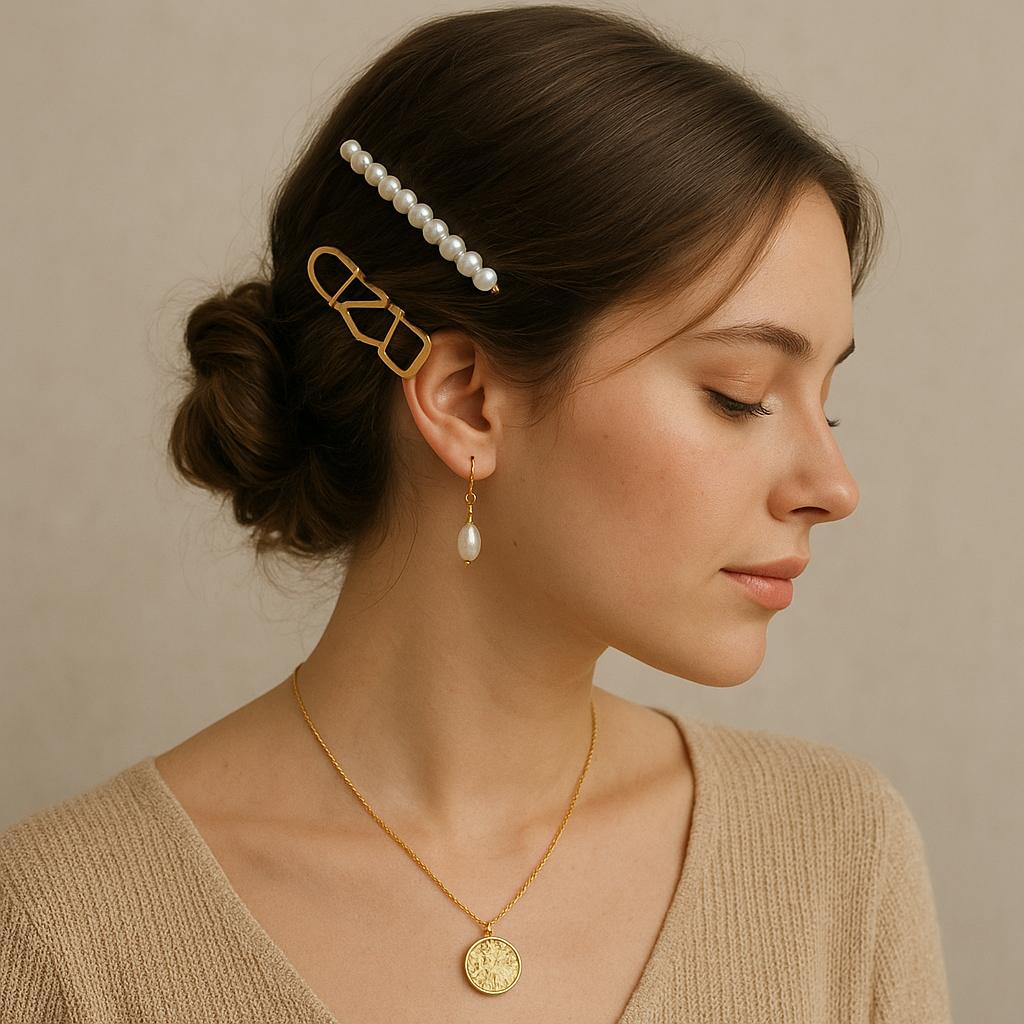
Hair adornments have always been tiny sculptures we carry in plain sight, broadcasting mood, craft, and culture with a flick of a bun or a braid. This guide explores how to handcraft hair accessories that also serve as wearable jewelry—pendants, brooches, bracelets, and chokers—so every piece works twice as hard while looking effortlessly intentional. You will find material choices, tool lists, ergonomic insights, and detailed projects designed to travel from crown to collarbone without compromising comfort, style, or structural integrity.
Why Convertible Hair Jewelry Matters
Hybrid accessories thrive at the intersection of function and ornament. A single object that can secure a twist and later clip to a lapel reduces clutter, encourages thoughtful craftsmanship, and makes getting dressed feel like composing a small exhibition. Historically, multi-use adornments were common: Roman fibulae doubled as garment fasteners, Victorian hairpins concealed lockets, and Art Nouveau combs were designed to detach for evening wear. Reimagining these ideas through modern handicraft methods offers several benefits:
- Wardrobe economy: One piece replaces two or three, streamlining your toolkit.
- Travel-friendly: Fewer fragile items to pack; less risk of tangling chains or crushing feathers.
- Personalization: Modular systems let you adjust scale, color, and silhouette for the day’s hair and outfit.
- Repairability: Hand-assembled components can be refitted or polished, extending life and patina.
- Ethics and ecology: Thoughtful material choices emphasize reuse, repair, and sustainability.
Materials, Tools, and Core Techniques
Choosing Hair-Safe Materials
Start with metals and fibers that respect scalp and strands. Brass, bronze, copper, sterling silver, and stainless steel are classics; sealed hardwood, horn, bone, leather, and silk complement them. If you prefer plated findings, look for nickel-free finishes. For sensitive wearers, titanium and niobium excel for pins, ear wires, and any part touching skin. Textiles should be smooth; avoid abrasive synthetics for scrunchies and wraps unless lined with satin.
Friction is your friend in hair, but snagging is not. Rounded edges, polished surfaces, and smooth hardware prevent cuticle damage. For leather, burnish edges with gum tragacanth or beeswax. For metal, file with progressively finer grits, then polish to a hair-friendly finish. Apply museum wax or microcrystalline wax to raw copper or brass if you want to slow oxidation without lacquers.
Essential Tools and Supplies
- Jeweler’s pliers: flat nose, chain nose, round nose; flush cutters for precise trimming.
- Files and abrasives: needle files, sanding sticks (400–2000 grit), micromesh pads.
- Wire and sheet: 14–18 gauge wire for hair sticks/forks; 20–24 gauge wire for wrapping.
- Drill or rotary tool with small bits for cold connections; optional punch for leather.
- Rivets or Chicago screws (a.k.a. binding posts) for modular joints.
- Adhesive: two-part epoxy for metal-to-metal; flexible fabric glue for textiles.
- Finishes: Renaissance Wax, water-based sealers for leather dye, non-yellowing varnish for wood.
- Findings: bail beads, pin backs, magnetic clasps, French barrette bases (60 mm and 80 mm), D-rings.
Core Techniques You’ll Reuse
- Wire-wrapping: Creates secure stone settings and decorative coils that won’t snag. Keep wraps tight, tuck ends, and burnish with a spoon for hair-smooth surfaces.
- Cold connections: Rivets, screws, or tabs avoid heat and plating damage. Ideal for attaching modular bails and brooch findings.
- Textile sewing: Ladder stitch for invisible seams, topstitching for strength, and elastic casings for scrunchies.
- Leatherwork: Edge burnishing, slot punching, and setting Chicago screws enable easy modularity.
- Surface finishing: Patination for depth, then sealing. Embrace living patina on copper or brass or keep a bright polish—both are valid aesthetics.
Comfort, Weight, and Ergonomics
Hair accessories demand careful ergonomics. Aim for balanced weight distribution and smooth contact points. As a guide:
- Hair sticks: 6–7 inches (15–18 cm) long, with a taper that narrows to a blunt tip. In heavy hair, bump to 7.5 inches (19 cm).
- Hair forks: Prongs at least 3.5 inches (9 cm) of usable length; spacing about 0.5–1 inch (1.3–2.5 cm) depending on hair density.
- Barrette bases: 60 mm for fine to medium hair; 80 mm for thick hair. Add gripping surfaces (suede pad, silicone strip) as needed.
Minimize leverage that pulls. If a piece doubles as a pendant, ensure the center of gravity sits low and close to the hair coil when used as a tool; when worn on a chain, the same mass should sit flat against the chest. This dual constraint is where thoughtful balance shines.
Project 1: Wire Hair Fork That Converts to a Pendant
This is a sculptural two-prong fork with a detachable bail that transforms into a necklace centerpiece.
Materials
- 14 or 12 gauge half-hard brass or copper wire for the fork frame
- 20 gauge wire for decorative wraps
- One focal bead or cabochon (25–35 mm)
- Removable pinch bail or hidden D-ring bail
- Rivets or 2 mm Chicago screw (micro size)
- Optional: clear wax or lacquer
Steps
- Forge the frame: Cut 10–11 inches (25–28 cm) of 14 gauge wire. Mark the center. Form a U-shape with prongs about 1 cm apart. Taper tips with file; round thoroughly.
- Shape the crest: At the top of the U, create a wide loop or spiral plate that will cradle the focal. Hammer lightly on a bench block for stiffness.
- Set the stone: If using a cabochon, create two or three wrap bars across the crest with 20 gauge wire, capturing the stone snugly. Tuck all ends and burnish.
- Add the convertible point: Drill a tiny hole behind the crest. Mount a small D-ring with a micro rivet or Chicago screw. When used in hair, the D-ring lies flat; when converting, clip a pinch bail or chain to the ring.
- Finish: Sand all edges to 2000 grit, polish, and wax. Check that hair glides without catching.
How to Wear
- In hair: Slide prongs through a twist or cinnamon bun. The stone sits like a crown.
- As jewelry: Detach from hair, clip chain to the D-ring, and wear as a pendant.
Design note: Keep the crest no taller than 1.5 inches (4 cm) above the prongs to reduce torque in hair and create comfortable chest placement as a pendant.
Project 2: Brooch-Barrette Hybrid with Hidden Bail
Transform a decorative panel into a barrette, brooch, and pendant. This is especially good for repurposing vintage pieces.
Materials
- Decorative plaque (metal, wood, resin) roughly 3–4 inches (7.5–10 cm) wide
- 80 mm French barrette base
- Brooch pin back
- Fold-down or removable bail
- Rivets or epoxy, plus fine sandpaper
- Thin suede strip for hair grip
Steps
- Prep the plaque: Smooth back surface. If resin or wood, lightly scuff for better adhesion.
- Layout: Arrange the barrette base centrally; leave top edge space for brooch pin and bail.
- Attach hardware: Use rivets where possible; if epoxying, clamp firmly and cure fully. Mount brooch pin parallel to the top edge. Install fold-down bail between pin and barrette base.
- Grip upgrade: Adhere a narrow suede strip to the barrette arm to increase hold in fine hair.
How to Wear
- In hair: Snap onto a low half-up or a ponytail base.
- On clothing: Unclip from hair and pin to a lapel as a brooch.
- As a pendant: Flip the bail up and slide onto a chain or ribbon.
Maintenance: Keep the brooch pin sharp and closed when used in hair to avoid snagging. If you notice movement, add a hidden foam pad to distribute pressure.
Project 3: Silk Scrunchie That Converts to a Bracelet
This project is great for beginners. The scrunchie hides a sleek magnetic clasp so it can wrap the wrist as an elegant bracelet.
Materials
- Silk or satin rectangle, 20 x 4 inches (51 x 10 cm)
- Elastic, 7–8 inches (18–20 cm), 1/4 inch (6 mm) wide
- Low-profile magnetic clasp or snap pair
- Needle, thread, safety pin, fabric glue (optional)
Steps
- Sew the tube: Fold fabric right sides together lengthwise; stitch along the long edge. Turn right side out.
- Insert elastic: Safety-pin one elastic end; thread through tube. Overlap ends 0.5 inch (1.3 cm) and stitch securely.
- Clasp housing: Tuck one short end into the other to close the tube invisibly. Before final stitching, slip a low-profile magnetic clasp into a small inner pocket at the seam line so it meets cleanly when wrapped around the wrist.
- Close: Ladder-stitch the opening neatly.
How to Wear
- In hair: As a gentle scrunchie with minimal creasing.
- On wrist: Wrap twice and let the hidden magnet align; it reads as a soft fabric bracelet.
Safety note: Strong magnets can affect pacemakers; use low-strength snaps instead if needed. Also, keep magnetized accessories away from credit cards.
Project 4: Leather Wrap as Headband, Choker, or Bracelet
This modular strap uses Chicago screws and sliding keepers to morph between headband, choker, and wrap bracelet.
Materials
- Vegetable-tanned leather strip, 18–24 inches (46–61 cm) by 3/8 inch (10 mm)
- Two Chicago screws, two keepers (loops), and a small D-ring
- Edge beveler, burnishing tools, dye (optional), wax
Steps
- Finish edges: Bevel, dye, and burnish until glass-smooth to avoid hair friction.
- Punch holes: At both ends for Chicago screws; one extra hole 1 inch (2.5 cm) from an end for the D-ring.
- Assemble: Attach D-ring with a screw. Slide on keepers for cable management when worn differently.
How to Wear
- Headband: Anchor under hair at the nape and bring ends up; secure with a small elastic threaded through the D-ring and opposite hole.
- Choker: Wrap and fasten with the Chicago screw through a chosen adjustment hole.
- Bracelet: Triple-wrap and fasten; tuck the tail under a keeper.
Because the hardware is removable, you can swap D-rings for a pendant bail or add a chain extender. This piece highlights versatility and controlled durability, as leather can be conditioned and re-sealed over time.
Project 5: Hair Stick That Converts to a Lariat Necklace
A minimalist metal or hardwood stick with a detachable chain turns your updo tool into an evening lariat.
Materials
- Hardwood dowel or 12–14 gauge metal rod, 7 inches (18 cm)
- End cap with loop (for wood) or solder-free loop (for rod)
- Detachable chain, 28–34 inches (71–86 cm)
- Optional charm or stone drop
Steps
- Shape: Taper the stick and round the tip. For wood, sand to 2000 grit and wax. For metal, file and polish.
- Loop: Install an end cap with loop on wood using epoxy; for metal, form a closed, hammered loop at the butt end.
- Convert: Clip the chain to the loop for necklace mode. Add a charm drop to the chain’s midpoint for balance.
How to Wear
- In hair: Twist a bun and secure with the stick. The loop end faces outward as subtle ornament.
- Lariat: Thread one chain end through the loop, pull to adjust, and let the charm weight the drop.
Keep the stick under 15 g to avoid tugging. A slightly matte surface provides hair-friendly grip.
Design Principles for Reliability and Comfort
Weight and Center of Gravity
When a piece doubles as jewelry, it may need extra mass for drape—but mass is a liability in hair. Balance these needs by placing weight near the anchor point. For example, decorative elements should sit over the bun’s densest coil, not on a cantilevered tip. Planar pendants convert best when their back sides are smooth and slightly concave to nest in the hair.
Snag Prevention
- End management: After each cut, stone-set, or rivet, feel with fingertips; if you can feel an edge, hair will catch. Burnish every end.
- Closed shapes: Any loop or jump ring should be fully closed and filed flush.
- Textures: Keep high-relief textures away from hair contact zones; reserve them for visible faces only.
Allergy and Finish Strategy
Nickel is a common allergen. Use stainless steel, sterling, titanium, or niobium for skin-contact components. Seal copper and brass with wax if skin greening is a concern, or embrace the living patina and educate wearers on gentle care. Satin finishes hide micro-scratches better than mirror polishes and remain kinder to hair.
Modular Architecture
Design with small attachment points—D-rings, screw posts, bails—so components can migrate between roles. A decorative plaque can clip onto a barrette base, brooch pin, or chain without rework. Use standardized hole spacing (e.g., 8 mm apart) to accept multiple mounts. Such planning supports genuine modularity and long-term adaptability.
Sourcing and Ethical Considerations
Responsible making starts with materials. Seek recycled metals, reclaimed wood, and deadstock textiles. Vintage brooches and orphaned earrings can be reborn as hair ornaments with new findings, a method that celebrates upcycling while retaining history. If using leather, consider vegetable-tanned sources or cork leather. For stones, research origin and look for small cutters or lapidaries with transparent practices.
Styling Strategies: From Crown to Collar
Proportion and Silhouette
Match the scale of the piece to your hair volume and outfit lines. A slim hair stick becomes a delicate lariat; a wide barrette reads as a confident collar ornament on a ribbon. The visual rhythm matters: mirror strong shoulder lines with geometric plaques, or soften a structured jacket with a fluid silk scrunchie bracelet.
Color and Finish Harmony
- Monochrome: Blackened brass with matte onyx moves seamlessly between hair and lapel.
- Contrast: A pale maple hair fork with turquoise focal brightens dark hair, then pops on a camel coat as a brooch.
- Seasonal shifts: Swap cords and chains—linen in summer, velvet in winter—to refresh mood.
Travel Capsule Tactics
- Pick two bases: a barrette-brooch hybrid and a hair stick-lariat. Add three toppers or charms.
- Carry a slim kit: spare jump rings, a tiny screwdriver for Chicago screws, and a microfiber cloth.
- Store flat: Use felt envelopes with labeled pockets to avoid tangling and abrasion.
Care, Repair, and Longevity
Handmade objects deserve maintenance. Wipe metals after wear to remove oils; re-wax copper and brass seasonally. Replace elastic when a scrunchie loosens. Tighten Chicago screws with a dab of removable thread locker. For leather, condition sparingly; excess softeners can reduce structure needed for hair hold. Consider periodic refresh polish to retain shine or encourage a curated patina depending on your aesthetic. The goal is graceful aging, not premature wear—an embodiment of daily-use durability.
Troubleshooting Guide
- Slipping barrette: Add a discreet strip of silicone or suede on the inside curve. For very fine hair, switch to a smaller base or add a tiny inner comb.
- Heavy pendant in hair: Move weight closer to the anchor by shortening the crest or replacing a stone with a hollow focal.
- Snagging at wire wrap: File and burnish ends, then seal with a thin coat of clear lacquer at the contact zone.
- Allergic reaction: Swap skin-contact hardware to titanium/niobium; seal copper surfaces with microcrystalline wax.
- Magnet concerns: Replace with snaps or hooks; never rely on magnets alone for load-bearing hair hold.
- Fork prongs splaying: Work-harden by hammering the midsection lightly on a bench block; avoid striking the tips.
Advanced Variations and Embellishments
- Interchangeable toppers: Create a universal bayonet mount for hair sticks so different decorative heads click into place, then detach to hang as charms.
- Textile beading: Embroider seed beads onto a felt-backed barrette plaque; back with ultrasuede for softness. Add a fold-down bail to convert to a pendant.
- Wood inlay: Carve a shallow channel in a hardwood fork and inlay contrasting wood or metal wire; wax to a low sheen for better hair grip.
- Chain veils: Suspend fine chains from a barrette’s underside for a fringe that becomes a delicate necklace when transferred to a bail.
Measurements at a Glance
- Hair stick length: 6–7.5 inches (15–19 cm); safe tip radius at least 1 mm.
- Fork prong thickness: 2–3 mm for metal; 3–4 mm for hardwood.
- Barrette widths: 60 mm for fine/medium hair; 80 mm for thick hair.
- Pendant conversion: Keep backside smooth within a 2 x 4 cm zone that might contact hair or fabric.
- Ideal total weight: Under 25 g for hair mode for most wearers; under 15 g preferred for all-day comfort.
Safety and Practicalities
- Child safety: Avoid small detachable parts for accessories destined for households with young children.
- Medical devices: Use non-magnetic closures if magnets could interfere with implants.
- Garment care: When converting to brooch mode, test on a scrap of similar fabric to confirm it won’t distort loose weaves.
- Storage: Separate metal and textile pieces to prevent color transfer; use anti-tarnish strips for silver and copper.
From Maker to Signature Style
Convertible hair jewelry invites a more intentional daily ritual. Each piece you craft carries solutions embedded in form: a hidden bail, a riveted hinge, a grip that respects fragile strands. Over time, this language of small, meaningful details congeals into personal style. Perhaps you favor satin-brushed brass, subtle weight, and soft geometrics; perhaps your signature is botanical filigree and luminous silk. Either way, coherent choices—materials that age well, closures that work quietly, proportions that flatter—build confidence and ease.
For the seasoned maker, the creative horizon widens further: design limited series where every element swaps between roles; publish pattern templates with standardized hole spacing; host repair clinics that extend community and object life. For the beginner, start simple—one fork that becomes a pendant—and compress your learning into that small stage. Along the path you will refine priorities like balance, comfort, texture, and the understated grace of excellent finish.
Most importantly, treat every step as an exchange between hand and material. Test each surface against hair, re-check edges in strong light, and iterate until function disappears into form. In those quiet solutions you will find the enduring charm of true craftsmanship, the daily pleasure of honest versatility, and the gentle discipline that keeps sustainability near the center. When an accessory moves from bun to brooch, from errand to evening, it proves the point: the best adornments work hard, look effortless, and tell your story twice.
