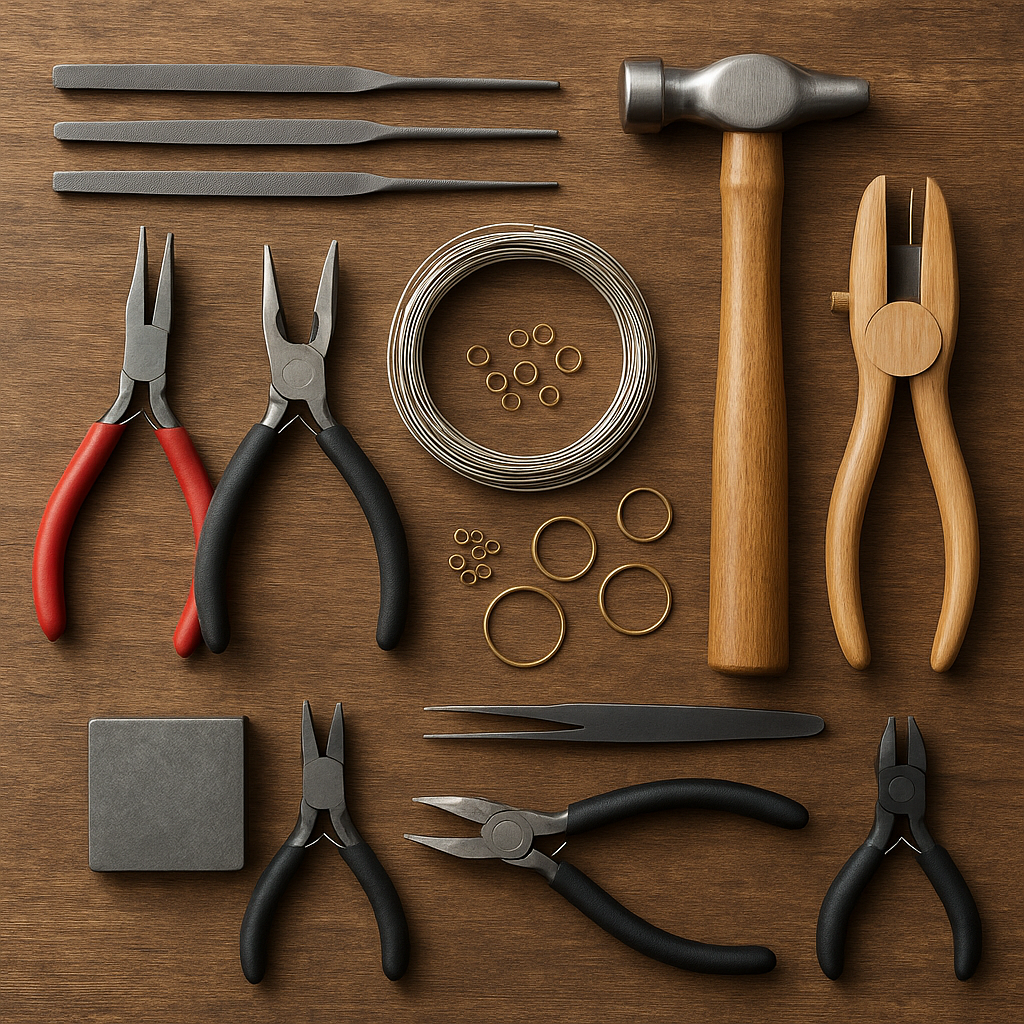
Jewelry making is one of those rare crafts where tiny movements can transform raw material into something personal, durable, and luminous. Whether you’re stringing beads at your kitchen table or fabricating silver on a dedicated bench, your results depend on the tools you choose, how you care for them, and the muscle memory you build with practice. This guide walks through essential tools every jewelry crafter should own, from the absolute basics to more specialized gear. It blends practical advice with the quiet wisdom of handicraft—respect for materials, patience in process, and joy in well-made things—so you can build a toolkit that grows alongside your skills and aesthetic.
Setting Up a Reliable Workbench
Before we talk about individual tools, consider the workspace itself. A stable table or bench, good lighting, and a mindful layout make the difference between frustration and flow. Jewelry work is small-scale and detail-heavy; you need control and consistency. An adjustable task lamp with a neutral daylight bulb helps you judge color accurately and see surface texture. A bench mat or scrap of leather keeps pieces from skittering away and protects your table. A simple wooden bench pin clamped to the edge of your work surface will become the heart of many operations—sawing, filing, and shaping—because it provides support where you need it most.
Ventilation matters, even if you’re not doing metalwork yet. Many adhesives, patinas, and polishes off-gas; an open window paired with a desk fan that draws air away from your breathing zone is a good start. If you plan to use heat or chemicals, think ahead and set a standard for safety in your space from the beginning: keep a small fire extinguisher within reach, wear eye protection, and store flammables in closed metal containers. The ritual of putting on safety glasses and tying back hair is part of the craft—not an afterthought.
Ergonomics is another foundational layer. Height matters: your shoulders should be relaxed, elbows near 90 degrees, and wrists neutral while you work. If your chair is low and your table high, you’ll hunch and tire quickly. Cushion your grips if needed; many artisans wrap tape or silicone sleeves around thin handles to reduce strain. Over long sessions, a supportive setup prevents fatigue and repetitive stress injuries, preserving both precision and enthusiasm.
Finally, develop habits for tool care and organization. Keep like with like, store sharp points with guards, and return each piece to the same spot. A drawer lined with shallow organizers, a magnetic strip for steel tools away from your electronics, and a small parts tray (with a lid) will save hours over time. When you always know where your needle files, scribes, and burrs live, your bench feels calm and ready.
The Core Hand Tools You’ll Use Every Day
Most jewelry work begins with gripping, bending, cutting, and smoothing metal or wire. A starter kit that’s thoughtfully chosen will carry you a long way. While there are countless specialty gadgets, you only need a handful of reliable basics to build strong technique and clean results.
Precision Gripping and Forming
A trio of quality pliers is the keystone of many projects:
- Chain-nose pliers: Tapered jaws with a flat interior surface. Ideal for opening and closing jump rings, gripping small findings, and making precise bends.
- Round-nose pliers: Tapered, conical jaws for forming loops, coils, and curves. Mark graduations on your jaws with a permanent marker to repeat sizes.
- Flat-nose pliers: Wide, flat jaws for straightening wire and holding components without marring. They offer leverage and stability where chain-nose can feel delicate.
Consider a nylon-jaw option for gentle straightening of wire without leaving marks. Bent-nose pliers are a lovely fourth upgrade for reaching into tight spaces and improving line-of-sight when working near a bead cluster or pendant bail.
Cutting Wire and Sheet Cleanly
Flush cutters snip wire as cleanly as possible on one side, reducing filing later. Buy the best pair you can afford and reserve them for precious metals or soft wire; use an older pair for base metals and hard wire. Shears, aviation snips, or jeweler’s snips are indispensable for cutting thin sheet. For intricate shapes, a jeweler’s saw with fine blades will become your precision tool; practice steady, vertical strokes and looser grip to keep blades from snapping. Keep beeswax or blade lubricant at hand to reduce friction and extend blade life.
Smoothing, Shaping, and Aligning
Needle files (a variety set: flat, half-round, round, triangle, barrette) allow you to refine edges, adjust fit, and create subtle transitions. Use the entire length of the file on the push stroke, lifting on the return to avoid dulling the teeth. Follow with sandpaper in a grit progression—400, 600, 800, 1200—backed by a small block for flatness. For forming curves and rounds, a steel or wooden mandrel is essential. A ring mandrel gives accurate sizing and supports shaping and work-hardening. A bracelet mandrel or dowels of various diameters handle bangles and hoops. A rawhide or nylon mallet moves metal without stretching it thin or leaving peen marks.
Hammer and Anvil Companions
Three hammer types cover most needs: a chasing hammer (broad face for smoothing and shaping), a ball-peen (for texturing and riveting), and a planishing hammer (for refining curves). Pair them with a steel bench block or small anvil on a rubber pad to absorb vibration. Keep hammer faces pristine; polish them periodically to avoid transferring scratches to your work.
Measuring, Marking, and Checking Fit
A steel ruler, ring sizer, gauge for wire thickness, and a pair of calipers will prevent guesswork. Digital calipers read inner and outer dimensions and depth, invaluable for bezels, jump ring sizes, and consistent repeating parts. Add a fine scribe, an ultra-fine permanent marker, and dividers for layout work; for sheet patterns, painter’s tape makes a removable guide that adds some visibility and protects the surface.
Stringing and Beadwork Essentials
If your focus is beadwork, your tools shift toward tension control and clean finishes. A bead board with recessed channels helps plan lengths and maintain symmetry. Bead stoppers or clamps keep strands from unraveling while you audition patterns. Needles vary—beading needles for seed beads, twisted-wire needles for pearls—and thread choice matters: nylon for general work, silk for knotting pearls, and braided polyethylene (like gel-spun fibers) for strength with minimal stretch.
Crimping pliers shape crimp tubes into secure, neat terminations; invest the time to learn the two-stage crimping motion for professional results. For knotted designs, a bead awl or knotting tool achieves tight, consistent knots snug against beads. A bead reamer smooths sharp edges or slightly enlarges holes to accommodate thicker stringing material. Keep a small container of thread conditioner to reduce tangling and fraying.
Wirework and Metal Forming
Wire is sculptural and forgiving. Keep a basic palette of copper and brass for practice, then sterling silver or gold-fill when your hands know the moves. Learn the relationship between gauge (thickness) and temperament (dead-soft, half-hard, spring-hard) to choose the right feel for each job. Dead-soft bends easily for elaborate wraps; half-hard holds shape for ear wires and clasps.
Useful formers include stepping mandrels for consistent coils and jump rings, a coiling tool or simple hand crank to create even springs, and a wire jig with pegs to repeat geometric patterns. A small drawplate refines wire diameter and rounds square stock; lubricate with wax and pull gradually. When you hammer wire on a bench block, it broadens and work-hardens; anneal if needed to restore malleability. A tumbler with steel shot simultaneously burnishes and work-hardens finished pieces; use a gentle burnishing solution and separate carbon steel from stainless shots to avoid contamination.
Metal Joining: Heat, Flux, and Control
Joining metal opens the door to layered, architectural designs. At the heart of that process is soldering. A soldering setup includes a heat source, solder in various flow temperatures (hard, medium, easy), flux to encourage flow and prevent oxidation, a firebrick or charcoal block for insulation, cross-lock tweezers, a third-hand stand, and a quench and pickle system for cleaning. Keep separate containers and tools for ferrous and nonferrous metals to avoid plating reactions in the pickle.
Choosing a torch depends on scale and metal. Butane torches excel at small silver joints, jump rings, and bezels. Propane/air torches offer more heat for broader pieces and small brazing tasks. For heavier gauge metals or large solder seams, an oxy-fuel or acetylene/air torch provides focused heat. Control is everything: heat the whole piece to encourage solder to flow toward the joint by capillary action, not just the seam. Pre-position tiny snippets of solder (pallions) with a touch of flux; use binding wire and soldering pins to keep parts from skating out of place as the flux bubbles.
Safety protocols are non-negotiable here. Flame-proof surfaces, a clear zone around your work, and ventilation help prevent mishaps. Keep a crockpot pickle bath on low with sodium bisulfate or citric acid, and use copper tongs only. After soldering, quench and pickle, then burnish with a brass brush under water to reveal a clean surface ready for further refinement.
Stone Setting Starters
Even if full-fledged stone setting feels advanced, a basic bezel workflow is within reach with the right helpers. You’ll want a ring clamp or benchmate to hold work securely. A bezel pusher, curved burnisher, and beading tool will move and compress metal around a stone smoothly. File and sand your bezel edge square; test fit repeatedly. For prong settings, parallel-jaw pliers compress prongs evenly without scarifying the metal. A low-tack wax pencil aids stone placement, and masking tape can protect delicate surfaces during tool contact.
Finishing and Surface Design
Finishing transforms rough construction into a jewel. Start with thoughtful scratch management: move through grits methodically and remove each scratch before the next grit. For mechanical help, a flex-shaft or rotary tool brings tiny abrasives, drills, and brushes to small areas. Radial bristle discs cut and pre-polish at controlled levels of aggression; silicone wheels refine and smooth edges.
Compounds matter. Tripoli cuts, rouge colors and brings mirror finish, and there are specialized compounds for platinum or stainless steels. Dedicated buffs prevent cross-contamination. Ultrasound baths and steamers lift residues from crevices. Hand burnishers harden and brighten edges nicely for a crisp finish. Patinas such as liver of sulfur add depth; seal porous or reactive surfaces with microcrystalline wax or lacquer. Thoughtful polishing is not a single step but an attitude: protect surfaces early, be patient, and let each stage do its full job before moving on.
Adhesives and Cold Connections
Not every join needs heat. Epoxies, UV-curing resins, and cyanoacrylate have roles, especially when working with mixed media—wood, bone, shell, or glass. Choose the chemistry for the task: long-cure epoxies for structural bonds and gap-filling, UV resin for quick, clear domes or inlays, and thin CA for capillary wicking. Clean surfaces meticulously and test fit before committing.
Mechanical fasteners expand your language of design: rivets, tube rivets, micro screws, and tabs attach layers without heat. A center punch marks holes; a miniature drill press or hand drill controls bit alignment; and a flaring tool or simple ball-peen hammer sets the rivet head cleanly. Combine cold connections with patina and texturing for layered effects that would be difficult to achieve with solder alone.
Specialty Techniques and Their Toolkits
As your interests evolve, you may reach for techniques that broaden possibilities:
- Metal clay: A smooth rolling surface, depth slats, texture plates, needle tools, and a kiln or torch for sintering. Post-fire finishing brings the metal to full strength and shine.
- Enameling: A small kiln, trivets, fine mesh sifters, and counter-enamel strategy to balance stress. You’ll also want firing forks and a trivet holder to move hot pieces safely.
- Etching: Resists (vinyl, lacquer, asphaltum), etchants appropriate to your metal, and strict ventilation and disposal protocols.
- Resin casting: Silicone molds, a pressure pot or vacuum chamber for bubble management, and careful measurement tools for resin/hardener ratios.
Care, Maintenance, and Tool Longevity
Tools improve with care. Wipe steel with a lightly oiled cloth to discourage rust, and keep silica gel packs in drawers if your studio is humid. Reserve certain tools for soft metals or nonferrous materials to protect cutting edges. Sharpen shears as needed and replace saw blades and burrs proactively; a dull tool invites slips. Clean compound and metal dust from wheels and buffs to avoid imprinting grit back into work. Store silver solder and sheet separately from steel to reduce unwanted reactions. Keep a notebook—date purchases, track repairs, and log settings or configurations that worked well. Over time this becomes your personal encyclopedia.
Budgeting, Upgrades, and Buying Smart
Buying every tool at once is unnecessary. Start small, then upgrade where you feel friction. If your hands ache after a session, improve handles or step up to a better ergonomic plier set. If you fight with solder flow, refine your fueling system or invest in a higher-precision torch head. Consider reputable used sources for heavy items like anvils or flex shafts. When possible, handle tools in person: balance, spring tension, and jaw alignment are easier to judge with your hands than with a spec sheet. A few excellent tools outperform a drawer of compromises.
Common Mistakes and How Tools Help Prevent Them
Jump rings that don’t close flush often point to twisting with mismatched pliers or insufficient support; correct with two parallel-jaw pliers and a gentle “rocking” motion. Solder that balls up rather than flows usually indicates a cold joint or dirty surfaces; adjust heat strategy, add flux, and ensure tight metal-to-metal contact. Scratches that reappear late in finishing mean earlier grits weren’t fully worked; slow down and clean thoroughly between grits to prevent rogue particles. Loose crimps betray poor tool technique; use the correct crimping pliers and practice the two-step crimp and round sequence on scrap wire before finishing the real piece.
Quick Starter Kits by Focus
Beadwork Essentials
- Chain-nose and bent-nose pliers, flush cutters
- Bead board, bead stoppers, needles, thread selection
- Crimping pliers, bead awl, thread conditioner
- Ruler, small shears, storage with labeled compartments
Wirework Essentials
- Chain-nose, round-nose, flat-nose pliers
- Quality flush cutters, bench block, nylon mallet
- Ring or stepping mandrels, jig with pegs
- Needle files, sandpaper, ruler, calipers
Metal Fabrication Essentials
- Jeweler’s saw with blade assortment and lubricant
- Steel bench block, chasing hammer, planishing hammer
- Ring mandrel, dapping block and punches
- Soldering board, third-hand, flux, solder range, small torch
- Pickle pot, copper tongs, quench bowl, brass brush
- Needle files, abrasives, rotary tool for finishing
Mindset: Hands, Eyes, and the Rhythm of Work
Tools are only half the equation; the rest is the rhythm you cultivate. Work in stages—rough shaping, refining, and finishing—and let each stage be complete before moving on. Keep your bench tidy enough that you can breathe and messy enough that experimentation feels welcome. Treat scrap as a library of materials for tests, color trials, and jigs. When a process frustrates you, slow down and examine your setup: are you fighting a dull blade, a slippery clamp, or poor lighting? In handicraft, the answer is often to improve the environment rather than push harder with the same gear.
A Few Small Upgrades with Outsized Impact
If you’re looking to elevate results quickly, consider these high-value additions: a parallel-jaw plier for even pressure on bezels and prongs, a sandpaper stick set with fixed grits for predictable finishing, a quality head visor or loupe to reduce eye strain, and a micro butane torch with a stable base for confidence at the flame. A simple ring sizer mandrel paired with matching finger gauges avoids the heartbreak of off-size rings. Finally, a small rotary tumbler can transform surfaces with minimal effort, especially on chain and wire-heavy designs.
From Toolkit to Signature Style
As your hands grow fluent, your tools will reflect your voice. A favorite hammer face will carry your unique texture; a well-loved bench pin will wear grooves that fit your motion; jigs and templates of your own making will speed motifs you return to. The essentials described here give you the foundation to explore fearlessly. Keep curiosity close: test a new patina on copper before committing to silver, practice a solder seam on scrap, and file three versions of the same curve to see how small differences catch the light. In time, each tool becomes not just equipment but a partner in the long conversation between material and maker.
Build methodically, choose quality where it matters, and let your hands learn. With simple, reliable tools—your pliers and cutters, your mandrel and files, a well-tuned soldering torch, measuring calipers, and a clear plan for safety, finishing, and organization—you’ll have everything you need to turn ideas into pieces that feel inevitable in the palm, bright on the neck, and treasured for years.
