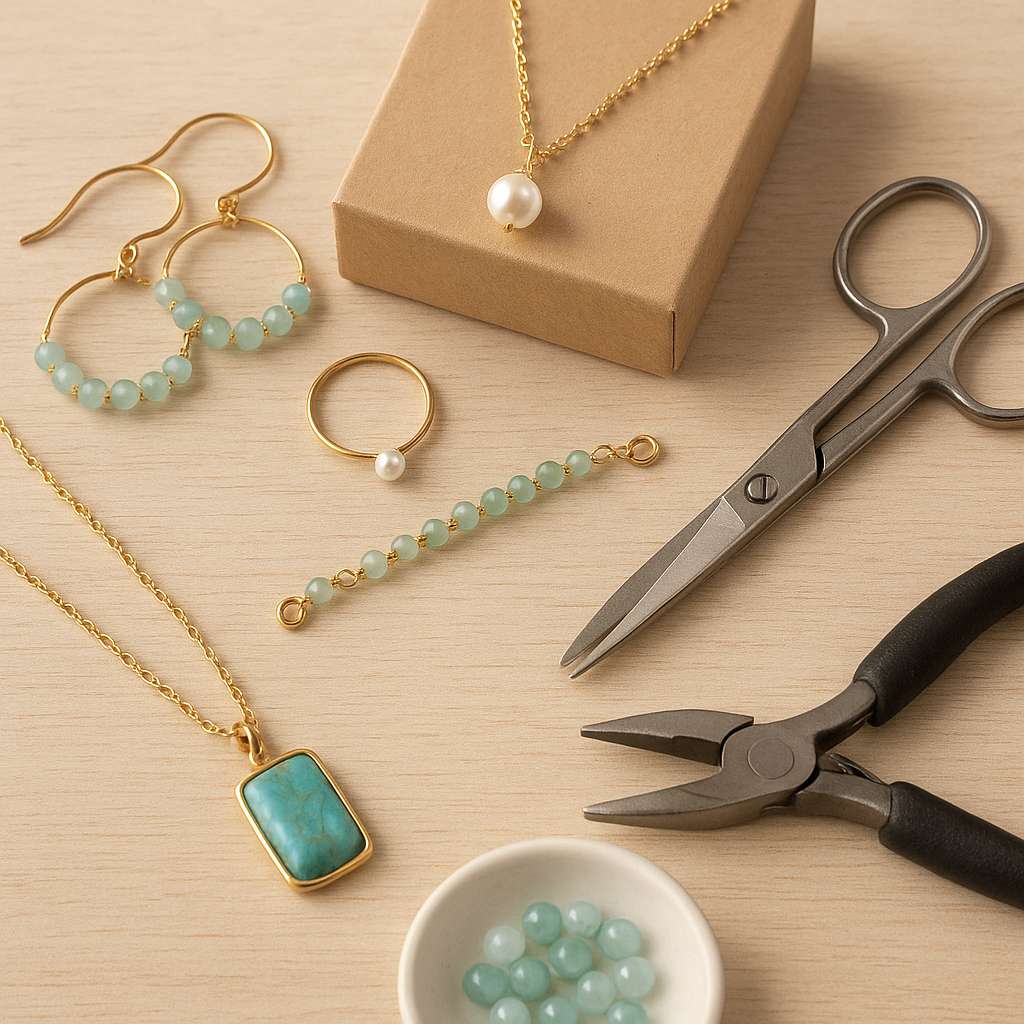
A small bracelet can carry a big message: I made this for you. Handmade jewelry turns a few humble materials into something intimate, wearable, and memorable. You don’t need a studio, expensive tools, or years of practice to create pieces that look polished and feel meaningful. With a handful of techniques, a simple toolkit, and attention to detail, anyone can transform beads, wire, cord, and clay into gifts that tell a story—of time, care, and creative joy.
Why Handmade Jewelry Makes Perfect Gifts
Handmade jewelry sits at the sweet spot between practicality and sentiment. It’s small enough to mail or tuck into a card, yet expressive enough to reflect personality and taste. A beaded bracelet can capture a color palette from a favorite season; a pair of hammered earrings can nod to someone’s minimalist style; a pendant can preserve a tiny pressed flower or a map from a meaningful place. Unlike mass-produced accessories, handmade pieces are infused with your eye for detail and your evolving craftsmanship. They’re also surprisingly approachable: many projects require only a few components and can be completed in under an hour, making them ideal for last-minute yet thoughtful presents.
If you’re exploring gifting on a budget, handmade jewelry scales beautifully. Buy a small selection of beads and findings, then diversify by mixing colors and textures for friends, family, and colleagues. For recipients with sensitive skin, choose hypoallergenic metals or cord-based designs. And for occasions from birthdays to thank-you gifts, the same techniques adapt easily to new looks: swap seed beads for gemstones, or replace leather cord with satin for an elevated finish. Above all, these gifts carry a message of attention and sustainability—mindful making that prizes resourcefulness over overconsumption.
Essential Tools and Materials
You can start with a beginner’s toolkit and expand as your skills grow. Focus on quality where it counts—good pliers protect wire and your hands, and decent cutting tools reduce frustration and waste.
- Basic tools: chain-nose pliers, round-nose pliers, flush cutters, and a bead mat to prevent rolling.
- Findings: jump rings, ear wires, head pins, eye pins, crimps, crimp covers, lobster clasps, and cord ends.
- Stringing materials: elastic cord (0.5–0.8 mm), beading wire (e.g., 0.012–0.018 in), nylon or silk beading thread, leather or faux leather cord, waxed cotton, and micro-macramé cord.
- Beads: seed beads, fire-polished glass, gemstones, wood, metal spacers, and focal beads with a standard hole size.
- Wire: 20–26 gauge craft wire for wrapping, 18 gauge for structural components like ear hooks.
- Surface finishes: patinas, liver of sulfur (for advanced metalwork), and polishing cloths.
- Adhesives: clear-drying craft glue or jewelry cement for knots; UV or two-part resin for embedding.
- Safety: eye protection when cutting wire, a small tray to corral offcuts, and a file for smoothing sharp ends.
As you assemble a kit, think about versatility. For example, 21–22 gauge wire is thin enough for most bead holes but sturdy enough to hold shape for wraps; a neutral bead palette (matte black, natural wood, soft metallics) pairs with nearly any accent color. If you plan to gift regularly, buy ear wires, jump rings, and crimps in bulk to lower cost per piece.
Design Fundamentals Made Friendly
Start simple: you don’t need formal art training to make cohesive designs. A few practical ideas can elevate your results from pleasant to polished.
- Color: choose a dominant hue and add one supporting color plus a neutral. Try triads for playful looks (e.g., coral, teal, mustard). Test combinations on your bead mat before stringing.
- Scale: vary bead sizes for interest; punctuate small beads with occasional larger accents to create rhythm.
- Balance: mirror left and right in earrings; for bracelets and necklaces, distribute weight so the clasp doesn’t rotate to the front.
- Texture: mix matte with shiny, smooth with faceted. Contrast adds depth without clutter.
- Focal point: anchor a design with a unique bead, charm, or pendant, and let the surrounding elements support it.
Train your eye to notice mindfulness in making: consider the recipient’s daily life. Do they type for hours? Choose light earrings that won’t tug. Do they stack bracelets? Keep profiles low so pieces nest comfortably. This attention to comfort and ergonomics turns pretty pieces into favorites.
Project 1: Elastic Beaded Bracelet (15–25 minutes)
Why it’s great
Elastic bracelets are the easiest entry to jewelry making. They require minimal tools, offer infinite combinations, and fit a range of wrists if you string with slight tension and measure carefully.
Materials
- Elastic cord (0.7 mm is a sweet spot).
- Beads of your choice; add a few metal spacers for polish.
- Glue (optional), crimp cover or bead with a larger hole to hide the knot.
- Measuring tape or strip of paper for sizing.
Steps
- Measure wrist circumference and add about 1.2–1.5 cm for comfort.
- Pre-stretch the elastic gently to reduce later sagging.
- Lay out your design on a bead mat. Thread beads onto the elastic, checking length as you go.
- Tie a surgeon’s knot (wrap the tail twice on the first overhand, once on the second), tighten while the string is taut but not strained.
- Add a tiny drop of glue to the knot; let set. Pull the knot into a bead with a larger hole or cover with a crimp cover.
- Trim ends neatly, leaving a 2–3 mm tail tucked into adjacent beads.
Tips: Mix in accent beads every five to seven beads to set a pattern; if you’re creating a set for gifts, vary the pattern order for subtle differences between recipients. Elastic bracelets are also perfect for letter or birthstone accents—simple personalization that feels thoughtful.
Project 2: Basic Wire-Wrapped Earrings (25–40 minutes)
Why it’s great
Wire-wrapping turns loose beads into elegant drops. Mastering a neat loop unlocks countless variations, from minimalist stacks to chandelier forms.
Materials
- Two focal beads or small stones.
- Head pins or 22–24 gauge wire.
- Ear wires (French hooks or lever backs).
- Round-nose pliers, chain-nose pliers, flush cutters.
Steps
- Slide a bead onto a head pin. Using round-nose pliers, bend the wire at a right angle above the bead.
- Form a loop by wrapping the wire around the round-nose jaw. Leave a small gap if attaching a chain or charm.
- Stabilize with chain-nose pliers and wrap the tail neatly two to three times down toward the bead. Trim and tuck the end.
- Attach the loop to an ear wire. Repeat for the second earring, matching length and orientation.
To ensure symmetry, mark your plier jaws with a fine marker so both loops match in diameter. Add tiny spacer beads for a professional finish, or cluster two or three beads on separate pins for movement.
Project 3: Macramé Friendship Bracelet (30–50 minutes)
Why it’s great
Macramé offers intricate texture with a few basic knots, no metal required. It’s travel-friendly and endlessly adaptable—from casual friendship bracelets to refined cord pieces with gemstone accents.
Materials
- Waxed polyester or nylon cord (0.5–1 mm).
- Tape or clipboard to secure your work.
- Optional: small beads with generous holes.
Steps: Square Knot Band
- Cut one core cord (wrist size plus 10 cm) and two working cords (4–5× wrist size).
- Anchor the core. Tie alternating half-knots left and right to create square knots.
- Maintain even tension; beads can be threaded onto the core at intervals.
- Finish with a sliding square knot closure for adjustability.
Macramé shines for ethical and eco-minded makers. Pair plant-dyed cords or repurposed fibers with simple forms for low-impact gifting that aligns with sustainability goals.
Project 4: Leather (or Faux) Wrap Bracelet (40–60 minutes)
Why it’s great
This design wraps twice or thrice around the wrist, displaying a tidy ladder of beads between cord strands. It looks complex but follows a predictable rhythm.
Materials
- Leather or faux leather cord.
- Beading thread and needle.
- Uniform beads (size 6/0 seed beads or 4 mm rounds).
- Button for the closure.
Steps
- Attach the button to a doubled cord with a lark’s head knot.
- Stitch beads between the two cord rails using a figure-eight path.
- Maintain consistent spacing and tension; turn neatly at the end of each row.
- Create a loop at the end sized to the button; secure and trim.
For vegan gifting, substitute leather with waxed cotton or microfiber suede. This project rewards patience and consistent spacing more than advanced skill—ideal for meditative making that fosters mindfulness.
Project 5: Polymer Clay Studs (45–70 minutes including baking)
Why it’s great
Polymer clay is a playground for color, marbling, terrazzo effects, and embossed textures. It cures in a home oven and yields light, comfortable earrings.
Materials
- Polymer clay in 2–4 colors, acrylic roller, blade.
- Stud posts and comfort backs.
- Fine sandpaper or polishing pads; optional glaze.
- Strong jewelry glue rated for metal and polymer.
Steps
- Condition clay by kneading. Create marbled or terrazzo mixes by folding colors rather than over-blending.
- Roll to an even thickness (2–3 mm). Cut shapes with tiny cutters or a blade and template.
- Poke earring holes only if making dangles; for studs, plan to glue posts after baking.
- Bake per manufacturer’s instructions on a tile for even heat. Cool completely.
- Lightly sand edges, wipe dust, and glue posts. Cure glue as directed.
Clay encourages personalization through color stories: match a friend’s favorite coat or recreate the palette of a shared trip. A matte finish reads modern; a glossy glaze leans dressy.
Project 6: Minimal Pendant Necklace (20–35 minutes)
Why it’s great
Pendants highlight a single element—stone, charm, or tiny keepsake—making them universally wearable. They also adapt to different chain lengths, accommodating varied necklines and preferences.
Materials
- Focal pendant or bead with a large hole.
- Pre-made chain or cord, jump rings, clasp.
- Optional: wire to create a bail.
Steps
- Attach the pendant using a jump ring or a custom wire-wrapped bail.
- Cut chain to desired length. Add clasp with jump rings, closing rings with a gentle twist (never pry open).
- Test placement on the body; adjust length for comfort and balance.
Include a short note explaining the pendant’s meaning—birthstone, flora from a meaningful place, or a symbol that resonates. A thoughtful story elevates the gift from accessory to talisman.
Personalization Techniques That Impress
- Alphabet and initial beads: integrate names or dates discreetly among neutral spacers.
- Metal stamping: lightly stamp a brass or aluminum blank with initials or tiny icons; sand and darken impressions for legibility.
- Resin encapsulation: embed a pressed flower, confetti from an event, or a tiny photo within a bezel. Cure with UV for speed.
- Color-coding: align with birthstones or favorite sports team colors for instant recognition.
- Charm clusters: attach a small charm at the clasp so the detail feels intimate but not flashy.
Personal touches don’t require advanced skills; they require attentiveness. Notice hobbies, favorite places, textures they wear, and metal tones in their wardrobe. The more you observe, the easier it is to craft a one-of-a-kind piece that fits seamlessly into their life.
Finishing Moves That Make Gifts Feel Store-Ready
The difference between “homemade” and “handmade” often lies in finishing. Clean wraps, secure knots, and crisp edges signal care.
- Smooth wire ends with a file or cup bur; nothing ruins a gift faster than a snaggy edge.
- Hide elastic knots and refine crimped areas with crimp covers for a cohesive look.
- Burnish metal with a polishing cloth to remove oils and fingerprints.
- Package in a small box or glassine envelope with an anti-tarnish strip for metals.
- Include a care card with metal type and cleaning instructions.
Add a handwritten tag describing materials, especially when they’re thoughtful: “recycled glass,” “fair-trade brass,” or “locally sourced wood.” These details underscore sustainability and intention.
Time, Cost, and Sourcing Smartly
Begin with a small outlay: a quality three-plier set and flush cutters, plus a starter pack of findings. Many bead stores sell beginner kits, but mixing your own components often yields better value. Seek out local suppliers and independent bead shops for unique materials and advice, or explore online marketplaces for bulk discounts. Thrift stores and flea markets are treasure troves for upcycling: vintage necklaces can be re-strung, and old brooches can become pendants. Clean components with mild soap and water, then dry thoroughly before reuse.
Cost per gift drops significantly when you buy in multiples. For instance, one spool of beading wire might supply ten necklaces; a pack of 100 ear wires can outfit fifty pairs of earrings. Keep a ledger: track materials used per project, time invested, and any special notes. This helps you plan future gifts and, if you choose, price items fairly for craft sales.
Troubleshooting and Common Pitfalls
- Elastic bracelets loosening: pre-stretch cord and use a surgeon’s knot; avoid heavy beads on thin elastic.
- Wire wraps slipping: use slightly thicker wire or add a single tiny spacer bead above the main bead to stabilize.
- Green skin from copper alloys: seal metal with a skin-safe barrier or choose hypoallergenic options like niobium, titanium, or surgical stainless steel.
- Earrings too heavy: switch to polymer clay or wood; aim for thin profiles and smaller jump rings.
- Tarnish on silver: store with anti-tarnish tabs and recommend occasional polishing.
- Uneven macramé: mark your work surface at intervals to keep knots consistent, and practice maintaining uniform tension.
Care, Comfort, and Longevity
Gifts last longer with simple care habits. Include a small card with these notes:
- Remove before showering, swimming, or vigorous exercise to preserve durability.
- Store in a dry pouch or box; separate pieces to avoid scratches and tangles.
- Clean metals with a polishing cloth; avoid harsh chemicals on plated components.
- For thread and elastic, roll on and off rather than stretching aggressively.
- For resin or clay, wipe with a damp cloth; avoid acetone or alcohol.
Comfort matters. Smooth any edges touching skin, round the ends of wire, and choose earring backs that distribute weight. If your recipient has metal sensitivities, note the metal type up front and err toward titanium or niobium. Thoughtful materials plus attention to finish elevates perceived value and keeps pieces in regular rotation.
Packaging and Presentation Ideas
Presentation amplifies the gift. Create simple, eco-friendly packaging that looks intentional:
- Kraft boxes with a stamped logo or hand-drawn motif.
- Upcycled fabric pouches sewn from remnants.
- Cardstock earring cards with a tiny message on the back.
- Twine or paper ribbon with a small pressed leaf or dried flower.
Share a short origin note: “Made while listening to your favorite album” or “Colors inspired by the autumn trail we hiked.” These details connect process to recipient, turning an object into a memory.
Safety, Skin, and Metal Choices
Not all metals are equal for all people. When gifting, aim for skin-friendly metals unless you’re certain about preferences:
- Best bets: titanium, niobium, surgical stainless steel for earrings; sterling silver and gold-fill for most skin.
- Watch-outs: nickel-heavy alloys can cause irritation; brass may discolor skin for some wearers.
- Coatings: clear sealants can help, but they wear off; choose safer base metals from the start.
When cutting or hammering, wear eye protection and corral wire clippings in a dish. Ventilate if using resin or adhesives. These small habits keep the process safe and enjoyable.
Simple Skill-Building Path
Each project teaches a building block. As you gift more pieces, layer skills strategically:
- Start: elastic bracelets and wire-wrapped bead drops.
- Next: macramé closures, crimping on beading wire, multi-strand stringing.
- Then: making your own ear wires from 18–20 gauge wire, texturing with a chasing hammer.
- Later: resin in bezels, basic soldering (if desired), cold connections like rivets for mixed media.
Curate a reference tray: a small board showcasing loop sizes, knot samples, and bead spacing tests. It’s a tactile library you can consult when designing new gifts or teaching a friend.
Occasion-Based Gift Ideas
- Birthdays: birthstone stud earrings in polymer clay hues or faceted glass drops.
- Graduations: pendant with a tiny compass charm or stamped year on a metal blank.
- Weddings: bridesmaid sets with color-coordinated seed bead bracelets; groomsmen leather cord bracelets with subtle metal accents.
- Thank-you gifts: minimalist threader earrings or a tea-length pendant in neutral tones.
- New parents: adjustable macramé bracelet with an initial charm.
Assign meaning to colors and symbols—without overexplaining. The right motif can be quietly profound while remaining wearable and understated.
Embracing Imperfection and Hand Touch
Handmade pieces carry the marks of the maker—tiny hammer textures, subtle wrap variations, the organic line of a clay shape. Rather than hiding every trace, lean into the charm that signals human touch. Set a personal bar for quality, but allow space for handmade nuance. The goal is honest craftsmanship, not machine uniformity.
For the Eco-Minded Giver
Choose materials with a smaller footprint where possible. Recycled glass beads, reclaimed wood, and repurposed chains tell a layered story and reduce waste. Package with reusable pouches and paper-only embellishments. Share sources or practices briefly on your care card to celebrate your values without preachiness. Small shifts—like swapping plastic baggies for glassine envelopes—build an ethos of thoughtful making rooted in sustainability.
From Gifts to a Micro-Atelier
If friends start requesting pieces, you can scale at your own pace. Photograph work in natural light, note recipes (bead sizes, counts, and lengths), and standardize packaging. At markets or online, clarity builds trust: list metals, sizes, and care instructions. Price fairly, accounting for time, materials, and a modest overhead for tools and packaging. Even if you never sell, treating your hobby with respect improves outcomes and confidence.
A Maker’s Mindset
Jewelry making is both tactile and reflective. It teaches patience—learning to open a jump ring with a twist, not a pull; it teaches iteration—swapping a bead to improve balance; and it rewards observation—choosing ear wires that match a person’s style. More than anything, it’s a practice of noticing and caring. Decisions about metal tone, bead finish, and clasp placement add up to wearable kindness. That’s the heart of a handmade gift.
Quick Reference: What to Make When
- Running out the door: elastic bracelet with one focal bead and two spacers.
- One-hour window: wire-wrapped gemstone drops with matching pendant.
- An evening of calm: leather wrap bracelet or macramé band with sliding closure.
- Weekend craft session: polymer clay stud trio set in coordinated palettes.
Keep a small stash of finished basics and personalize just before gifting—add an initial charm, swap a chain, or tie on a new ribbon color to match the occasion.
Closing Thoughts
Handmade jewelry’s real value lies in connection: between hands and materials, between maker and wearer, between a moment in time and the memory it becomes. Start with a simple bracelet or pair of earrings, notice what delights you in the process, and let that feeling guide your next piece. With practice, you’ll build a quiet vocabulary of techniques—loops, knots, textures—that express care fluently. Your gifts will carry the grace of thoughtful design, the resilience of good materials, and the warmth of human intent. In a world brimming with objects, few experiences rival the joy of giving something you shaped—small in size, rich in meaning, and made with wholehearted craftsmanship.
