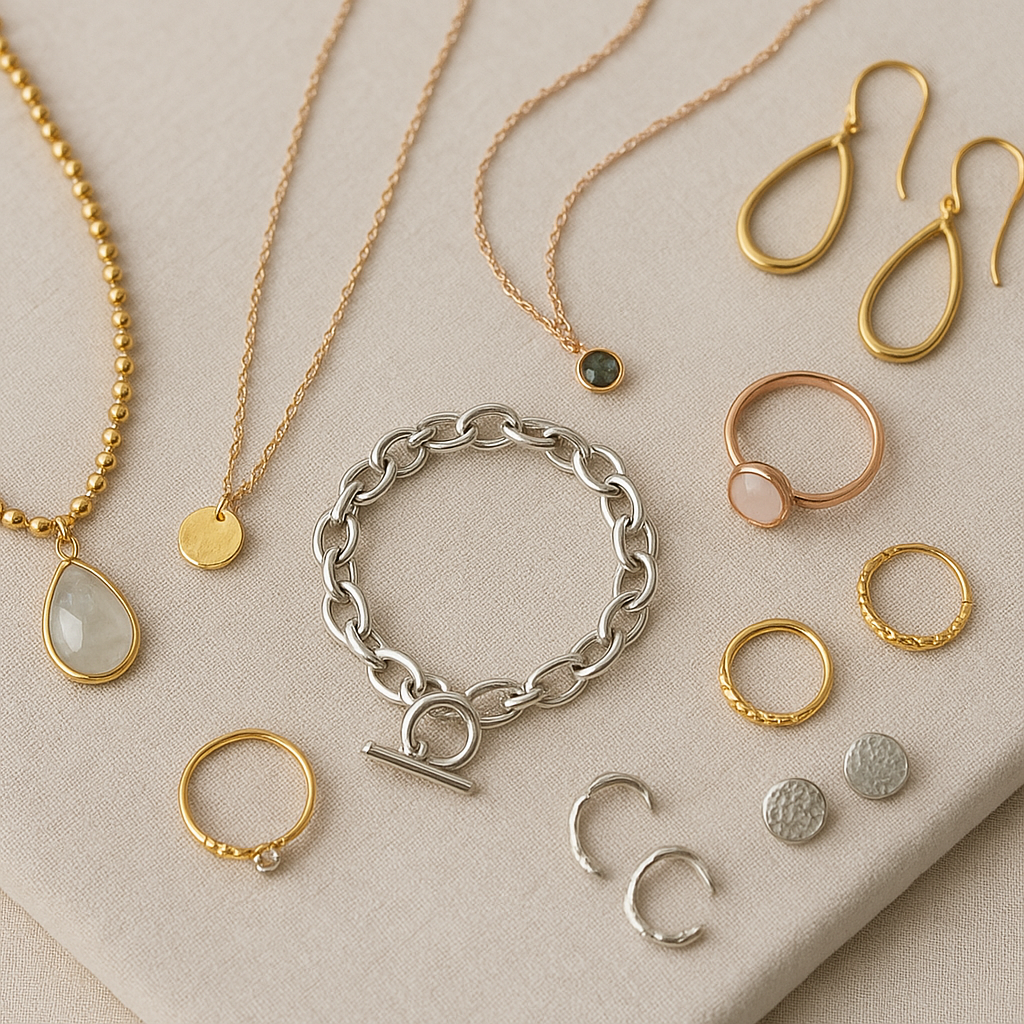
A cohesive jewelry collection behaves like a story you can wear. It feels intentional, not random; it invites the eye to trace patterns, materials, and details that belong together. Whether you make pieces by hand or curate work from independent artisans, cohesion comes from a shared language of materials, motifs, and scale. The goal is not uniformity but resonance: each piece should stand on its own and still contribute to a larger vision. In the realm of handicraft, this vision is anchored in human touch—the marks of tools, the weight of metal, the irregularity of a natural stone—and the decisions that make these elements sing in harmony.
The visual grammar of a cohesive collection
Designers often talk about the building blocks of visual language: line, form, rhythm, and balance. Translating this to jewelry is remarkably practical. The line is the contour of a hoop or the trajectory of a bead strand; form is the mass of a pendant; rhythm is the recurrence of a motif across several pieces; balance is how weight sits on the body. Instead of chasing trends, define a vocabulary you will repeat, recombine, and refine.
- Signature motif: Choose a repeatable idea—a leaf vein, a geometric chevron, a micro-engraved dot field—that can scale from ring to necklace without losing identity.
- Metal philosophy: Decide how metals interact. A collection might commit to warm yellow brass offset with sterling connectors, or to oxidized silver cut by a slash of fine gold using keum-boo. The metal palette is the backbone of visual continuity.
- Volume and proportion: Establish an internal logic. If your rings are low-profile and broad, echo that silhouette in cuff widths and earring drops. Repetition of proportion creates instant coherence.
- Surface character: Track textures across pieces. A single hammered planish, a satin finish, or subtle cross-hatch can bind earrings, pendants, and bangles into one family.
- Color discipline: If gemstones appear, define their role. Use narrow hues, such as smoky quartz, labradorite, and black spinel, or commit to a vivid triad like teal apatite, tomato coral (sustainably sourced alternatives), and creamy pearl.
Think of cohesion as a gentle constraint that makes decisions easier. When a new idea arrives at the workbench, test it against your vocabulary: does it align with your chosen palette, silhouette, and finishes? If not, can it be adapted rather than discarded? Constraints are not handcuffs; they are guide rails.
Handicraft choices that shape identity
In hand-built jewelry, technique is not just a means to an end—it is part of the aesthetic. Each method leaves trace evidence visible to the eye and felt by the wearer. Selecting a narrow set of techniques and using them repeatedly produces coherence without repetition fatigue.
- Forging and planishing: Hammers create curvature, taper, and reflective texture. Flat stock transformed into airy hoops or knife-edge bangles displays a disciplined, tactile signature.
- Cold connections: Rivets, tabs, and hinges offer modularity and ease of repair, reinforcing a collectible, heirloom approach. Cold joins also enable mixed materials without compromising structural integrity.
- Granulation and filigree: Historical methods can become modern signatures. Granule constellations on ring shoulders or fine filigree lattices on pendants unify pieces without feeling ornamental for ornament’s sake.
- Lost-wax carving and casting: Wax encourages organic forms that repeat across a line—knotted loops, pebble clusters, seed pods—while rubber molds provide consistency for editions.
- Enameling and inlay: Vitreous enamel, stone inlay, shell, or wood insertions lend color systems that can be codified—matte cloisonné in three harmonized hues or mosaic inlay that recurs through a capsule series.
- Patination: Intentional oxidation and heats of color unify surface tone. A charcoal-gray silver with brushed highlights becomes a recognizable brand cue.
Artisanship is also ethics. Choose recycled silver or gold, low-impact studio practices, and traceable stones. In a handmade collection, material choices are not footnotes—they are part of the story customers wear. The vocabulary should include a commitment to sustainability and honest provenance.
Theme, narrative, and symbolism
Collections that endure usually have a reason to exist beyond beauty. A theme might be a landscape (dune lines, tide pools), a craft lineage (Etruscan granulation, Japanese mokume-gane interpreted with contemporary restraint), or a narrative (keepsakes for milestones). Selecting a theme that resonates with your own practice ensures the details ring true rather than feeling borrowed.
- Motif map: List three to five recurring symbols and how they shift in scale. A crescent might be a tiny charm, a structural earring element, and a negative-space cutout in a cuff.
- Material allegory: Pair materials with meaning—moonstone for transition, recycled brass for reinvention—without sliding into cliché. Subtlety enriches daily wear.
- Cultural respect: Draw inspiration from traditions while crediting origins and avoiding sacred symbols or protected designs. Collaboration with culture-bearers deepens authenticity.
Introduce symbolism with restraint so wearers supply their own meanings. Over-explaining can fix an interpretation that ought to remain open-ended.
Building a capsule: the 12-piece foundation
Think in families rather than individual items. A capsule of twelve pieces can anchor a long-term line, ensuring cohesion as you expand.
- Anchors (4): One ring, one cuff or bangle, one pendant necklace, one statement earring pair. These show the clearest expression of your style.
- Bridges (4): Smaller studs, a delicate chain with a micro pendant, a narrow stacking ring, a slim bracelet. They link the anchors into everyday wear.
- Accents (4): Seasonal colors via enamel dots, a charm that clips into chains, an ear climber, a ring topper that docks into a base band. Accents add play without breaking rules.
Ensure each anchor has a related bridge counterpart. If your pendant is a hollow-formed oval, then studs might be half-ovals with the same satin finish; if a cuff bears a dot constellation, a stacking ring repeats the dot count and spacing. The collection reads as a single sentence punctuated in different places.
Color systems for stones, enamel, and beadwork
The richest collections use color like a disciplined artist, repeating harmonies and intervals.
- Gem families: Choose a family of cabochons or faceted stones in calibrated sizes for repeatable settings. Labradorite, moonstone, and gray diamond create a moody trio; peridot, garnet, and citrine form a warm set.
- Enamel rules: Limit to two finishes (gloss and matte) and a palette of three hues plus one neutral. Repeat these across pieces to avoid visual noise.
- Bead logic: If working with beadwork, standardize on bead size and stringing method. A collection of 11/0 seed bead fringes in the same geometric sequence makes pattern your signature.
- Contrast and calm: Not every piece needs color. Let metal-only work provide negative space so the colored accents remain intentional.
Document your color decisions in a swatch card kept at the bench. Consistency under varied lighting is vital for photography and reorders.
From sketch to bench: a repeatable process
Repeatable process is the secret engine of cohesion. A consistent method guards against drift and ensures that new pieces join the family seamlessly.
- Research and mood: Assemble a board of textures, forms, and reference objects—seed pods, fabric pleats, archival metalwork. Keep this visible while designing.
- Sketching: Draw in series, not isolation. Place multiple concepts on a single page so relationships emerge. Circle features that should propagate across the line.
- Prototyping: Build quick models in copper, brass, or wax. Evaluate weight, swing, and contact points with skin and clothing.
- Jigs and templates: Create metal or acrylic templates for recurring shapes; forge jigs for consistent curves. Tooling is how handmade stays consistent without losing soul.
- Finish tests: Prepare a finish chart—polish levels, patina times, sealer choices. Record recipes for reproducibility.
- Quality criteria: Define tolerances. Ear wires must be within a gauge range; jump rings must be soldered on pendants; bracelets must pass a flex test without deformation.
Polish and patina decide the final personality of a piece. A brushed face with polished bevels may become your hallmark, as recognizable as a logo. Surface texture and deliberate patina are small choices that deliver giant cohesion.
Wearability and human factors
Even the most beautiful collection fails if it is uncomfortable. Build standards for weight, balance, and movement.
- Weight thresholds: Decide maximum weights for earrings and pendants. Balance large forms with open spaces to reduce pull.
- Skin contact: Smooth undersides, round edges, and flush-set stones prevent snags and irritation.
- Closures: Use the same clasp style across chains; choose earring backs that fit consistently. Familiarity reassures customers.
- Sizing system: Offer rings in full and half sizes, bangles in multiple inner diameters, and chains in standard lengths. Cohesion includes how pieces fit.
Ergonomic discipline is part of design discipline. Consider ergonomics as a design material alongside metal and stone; it binds the collection to the body, which is where the story ultimately lives.
Signature details and maker identity
Small, repeatable details—an engraved dot at the end of a wire, a distinctive ear hook curve, a hidden stone on the back of a pendant—build intimacy between maker and wearer. A maker’s mark stamped in the same location across pieces becomes a ritual encounter.
- Marking: Place your mark and metal fineness consistently. Document this for retailers and collectors.
- Naming: Give families names that reflect theme and materials. Names help customers remember and seek related items.
- Packaging: Carry finishes and motifs into boxes, pouches, and care cards. Packaging can echo textures or color swatches from the line.
Identity grows by repetition. Let customers recognize your work from across a room by a curve, a join, or a finish—quiet iconography more persuasive than a logo.
Ethics, sourcing, and studio practice
Handicraft thrives on responsible choices. Ethical metals, fair compensation, and safe workplaces form the unseen backbone of a collection’s integrity.
- Metals: Recycled sterling and gold reduce environmental burden; document sources for transparency.
- Stones: Work with suppliers who trace origin and treat workers fairly. Consider lab-grown diamonds or post-consumer gems.
- Chemistry: Use citric pickle, ventilated soldering stations, and water-based polishes where possible. Record disposal practices.
- Waste: Keep sweeps; refine scrap; design parts for remelting or repurposing.
Ethics are not an afterthought but a thread woven through design. They reinforce the meaningfulness of handmade and broaden the value beyond aesthetics.
Pricing, editions, and collectibility
Coherence should be legible in pricing as well as design. A rational structure guides customers and retailers.
- Tiering: Group pieces by time and material intensity so prices climb predictably from studs to statement items.
- Editions: Offer limited color runs or numbered casts to encourage collecting without fragmenting the design language.
- Documentation: Include cards describing materials, techniques, and care. Record serial numbers for one-of-a-kind items.
Collectibility grows when each release respects the same vocabulary. Variations across seasons feel like chapters rather than abrupt departures.
Care, repair, and longevity
Cohesion also means continuity over time. Make care part of the promise and design for repair.
- Maintenance: Provide clear guidance for cleaning, avoiding harsh agents for patinated surfaces, and timing of professional servicing.
- Spare parts: Standardize jump rings, clasps, and ear wires so replacements are straightforward.
- Repair pathways: Offer refurbishment—re-oxidation, re-enameling, hinge tuning—so pieces age gracefully.
Longevity feeds a collection’s reputation for craftsmanship and durability. When wearers trust that their jewelry can be renewed, they invest emotionally and financially.
Styling: how pieces converse on the body
Design cohesion sets the stage; styling performs the music. Consider how wearers will combine pieces in real life.
- Layering rules: Define chain lengths that layer without tangling—say, 16, 18, 22, and 28 inches—with pendant scales that avoid visual crowding.
- Stacking logic: Rings should interlock without pinch points; widths and profiles must complement rather than compete.
- Earring ecosystems: Provide studs, drops, and ear climbers with shared motifs, allowing asymmetry within an intentional framework.
- Mixed metals: If you combine metals, do it consistently—silver bodies with gold accents, for instance—so mixing looks deliberate, not improvised.
Offer look guides showing three ways to wear the capsule: minimalist, layered, and statement. Teach customers how to build on your language, not abandon it.
Documentation: the unseen structure
Behind each cohesive collection lies a quiet archive. Documentation protects quality and identity as the line grows.
- Spec sheets: Dimensions, materials, finish codes, and care instructions for each SKU.
- Tool maps: Which jigs, mandrels, and dies correspond to which parts.
- Photography standards: Backgrounds, lighting angles, and styling notes for consistent imagery.
- Supplier roster: Metals, stones, packaging; alternatives in case of shortages.
When the archive is strong, you can revisit early designs years later and integrate them effortlessly, preserving cohesion.
Evolving without losing the thread
Cohesion is not stasis. Collections live, learn, and change. The key is to evolve by iteration, not rupture.
- Seasonal pivots: Introduce one new material or color per season while retaining core metalwork and motif. Sunset one older accent to prevent bloat.
- Feedback loops: Track fit issues, favorite lengths, and best-selling motifs; refine accordingly.
- Collaborations: Invite a lapidary or enamel artist to interpret your motif within your rules. Borrow hands, not voice.
Growth that respects the rules of your own language remains legible to collectors. They should recognize tomorrow’s piece as kin to today’s, even with fresh details.
Practical sequence: from idea to launch
Use this condensed path to keep creative work aligned with cohesion:
- Define vocabulary: motif, metal scheme, finish, proportions.
- Map the capsule: anchors, bridges, accents; outline price tiers.
- Prototype with constraints: build to fit your finish and weight rules.
- Standardize hardware: clasps, ear wires, jump rings, chain types.
- Finalize surfaces: select consistent brush, polish, and patina recipes.
- Photograph in sets: show combinations that highlight the shared language.
- Document and mark: spec sheets, maker’s mark placement, care cards.
- Launch with story: communicate theme, ethics, and collecting pathways.
Following a repeatable sequence frees time for creative play. Your rules become tools.
Handfeel, sound, and micro-rituals
Beyond sight, jewelry is perceived by touch and sound. These sensorial elements quietly strengthen identity.
- Handfeel: The slip of a satin bangle, the micro-resistance of a well-fitted clasp, the warmth of wood against skin—these are design decisions, not accidents.
- Sound: The soft clink of layered chains or the hush of leather ties shapes mood. Tune movement to avoid harsh noise.
- Rituals: A charm that rotates to reveal a hidden engraving, a click of a box clasp—all become daily pleasures that anchor attachment.
Consider how pieces behave during wear and at rest. Intimate moments build loyalty and elevate the handmade experience.
The role of restraint
Editing is as vital as making. Some of the best pieces never leave the bench because they dilute the language. Kill darlings that divert attention from the theme, and redirect good ideas into future families with their own vocabulary. Restraint cultivates clarity; clarity cultivates trust.
Common pitfalls and how to avoid them
- Technique sprawl: Too many unrelated methods make the collection noisy. Pick a lane and revisit it deeply.
- Finish mismatch: Mixing mirror polish with heavy matte across nearby pieces creates friction. Unify or separate distinctly.
- Color creep: Accumulated one-off stones wreck discipline. Establish and enforce a color charter.
- Scale confusion: Undersized pendants with oversized earrings unbalance the line. Calibrate scale relationships.
- Hardware chaos: Random clasps and ear backs feel amateur. Standardize invisible parts; cohesion includes the unseen.
Collecting as curation
If you are assembling a cohesive jewelry collection from multiple artisans, the same principles apply. Curate around a theme (e.g., coastal textures), a metal scheme (oxidized silver with touches of gold), or a motif (circles and ellipses). Seek compatible finishes and proportions, and avoid outliers that demand the spotlight without echoing shared cues. A curated collection is a conversation among voices that respect one rhythm.
Final reflections: a language you can grow
A cohesive jewelry collection is not a rigid uniform; it is a living language. It relies on distilled choices—materials, motifs, finishes, proportions—that repeat with variation. It celebrates human touch: tool marks, a stone’s slightly eccentric dome, the soft curl of a forged wire. In embracing limits, you unlock depth. The reward is a body of work that customers recognize instantly and love for its versatility, its honest craftsmanship, and its enduring sense of place. Keep the rules close, your eyes open, and your hands ready. The rest is attentive practice, a steady rhythm of making that turns intention into adornment.
Appendix: material and technique quick guide
- Metals: Sterling silver, fine silver, brass, bronze, gold alloys; experiment with bi-metal for subtle contrast.
- Surface: Satin brush, mirror polish, cross-hatch, hammered, reticulated, oxidized, selectively highlighted.
- Stones: Cabochons for bezel-setting consistency; faceted rounds and ovals for prong uniformity; consider recycled or lab-grown options.
- Techniques: Forging, sawing, soldering, cold connections, granulation, filigree, enameling, stone setting, casting, keum-boo.
- Hardware: Lobster or S-hooks standardized; lever-back or friction earring backs; jump rings soldered for security.
- Care: Mild soap, soft cloth, avoid ultrasonic for porous stones; re-oxidize patina periodically.
Hold fast to your core ideas: a coherent silhouette, disciplined palette, intentional texture, purposeful patina, ethical sustainability, transparent provenance, humane ergonomics, and expandable systems that welcome cohesion as your enduring companion in design.
