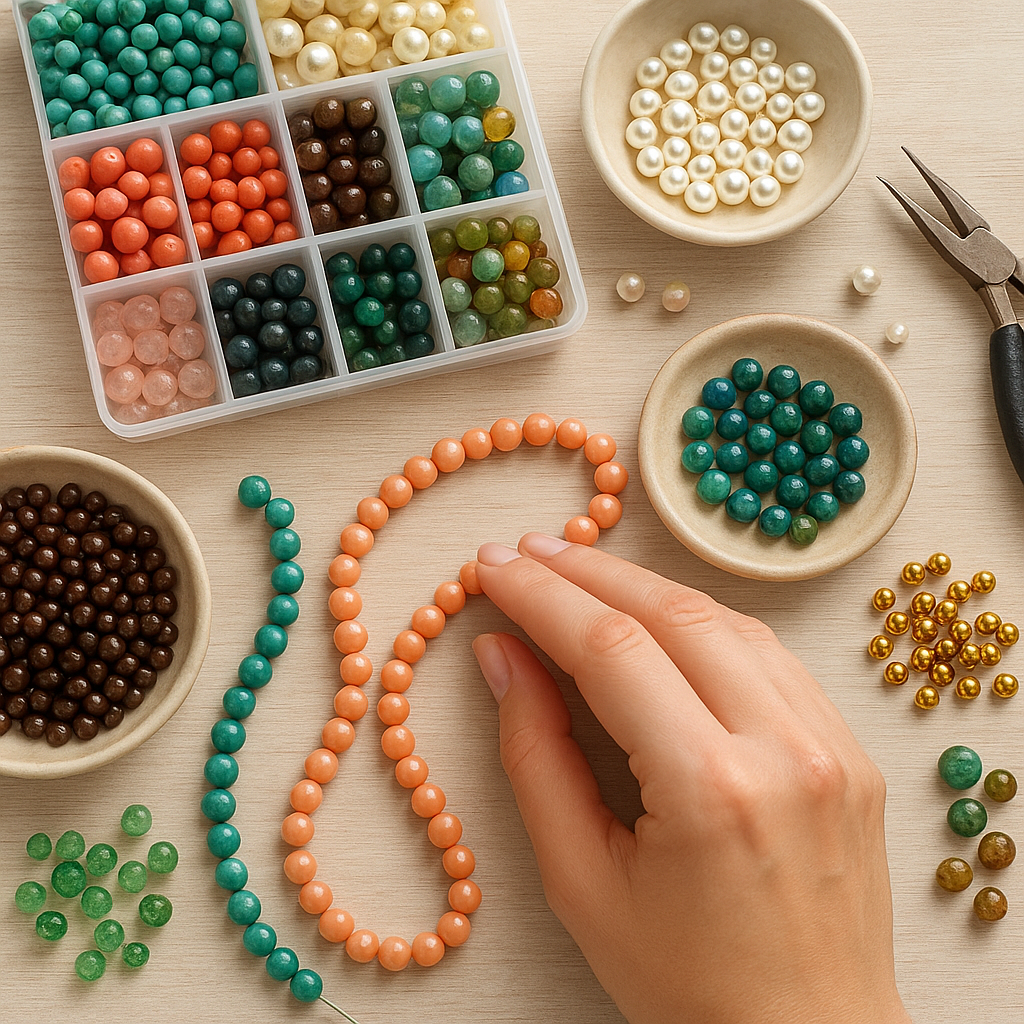
Choosing beads is like choosing a voice for your handmade work: subtle or bold, natural or high-gloss, featherlight or satisfyingly weighty. The right bead will stand up to wear, respect your budget, fit your tools and thread, and harmonize with your design language. The wrong one can chip, fade, snag fibers, feel uncomfortable on the body, or push your piece off-balance. This guide takes you through the practical decisions—material, size, hole, shape, coating, cost, and technique—so you can make confident choices whether you’re stringing a simple bracelet, weaving an heirloom collar, embellishing a garment, or constructing sculptural home decor. Along the way you’ll find field-tested advice about testing durability, mixing textures, reading supplier specs, and avoiding common pitfalls that frustrate even experienced makers.
Understanding Materials: What Beads Are Made Of and Why It Matters
Before color and shape, understand what a bead is made from and how that affects weight, feel, and longevity. Material choice shapes the body of your piece—its drape, sparkle, and maintenance profile—so it’s worth learning the vocabulary and typical use cases.
Glass: The flexible classic
Glass beads cover a vast territory: pressed Czech rounds, Japanese precision-cut cylinders, lampwork artisanal pieces, and faceted crystals. They balance cost, consistency, and shine. Pressed glass is smooth and often more forgiving on thread due to rounded holes. Cut glass sparkles but may have sharper edges; ream or condition the holes if you plan multiple passes. Japanese glass producers are prized for uniformity and larger hole-to-bead ratios, useful in dense weaving.
Crystal and imitation crystal
Lead-free crystals and high-quality glass imitations offer prismatic brilliance. They’re denser than standard glass, which changes drape and weight. Use them strategically for focal points; avoid stacking heavy crystals near clasp ends to prevent flipping on the wrist or neck.
Ceramic, porcelain, and clay
These beads bring earthy presence and tactile variation. They can be porous or glazed; unglazed surfaces may abrade soft fibers. Hole edges can be sharp; test with a sacrificial thread or line the bead with a metal grommet when possible. Polymer clay beads are light and highly customizable, great for bold volume without weight.
Metal beads and components
Plated brass, sterling silver, gold-fill, copper, and stainless steel add structure and visual rhythm. Platings can wear with friction; solid or thick-filled options outlast thin plate when used as spacers that see frequent contact. Stainless is hypoallergenic and hard, but can be heavy. Copper and brass naturally develop a living surface; embrace or seal the evolving patina depending on your design goal.
Natural organics
Wood, bone, horn, shell, and mother-of-pearl bring warmth and subtle sheen. They’re lightweight—excellent for large-scale pieces—and pair well with matte stones or linen cords. Check for sealing: raw materials can absorb dyes or skin oils, deepening the color over time. Mother-of-pearl edges can be brittle; handle gently when crimping nearby.
Stone and mineral
From jade and lapis to jasper and quartz, stone beads vary in hardness, weight, and fracture tendencies. For everyday jewelry, mid-range hardness (Mohs 6–7) holds up best; very soft stones may scratch or crumble in bead weaving. Some stones are stabilized or dyed; learn to spot consistent color that runs through the drill channel, and test suspect beads for dye transfer. When you need cool-to-the-touch elegance and authentic grain, a responsibly sourced gemstone focal rarely disappoints.
Plastics and acrylics
Modern acrylics can look surprisingly refined, with crisp shapes and even color. They’re ideal when weight is a concern—think statement earrings that won’t tug. Watch for surface scratching and ask suppliers about UV stability for outdoor wear.
Why composition is a decision lever
Every one of these categories can be mixed to produce contrast and drape. Keep a sample card that lists weight, hole consistency, and the bead’s composition for your favorite suppliers; it will help you predict how a combination behaves before you commit to a large order.
Matching Beads to Project Types
Start with function: What must your project do? Sit comfortably on skin, move with fabric, hold architectural shapes, or resist the rough-and-tumble of daily wear? Then pick beads accordingly.
Stringing necklaces and bracelets
For classic stringing, bead uniformity, finish quality, and hole smoothness matter more than micro precision. Use glass rounds, stone beads, pearls, and metal spacers. If your beads are heavy, choose flexible beading wire (19- or 49-strand) and size 2 crimp tubes with proper crimping pliers. For soft drape and knotting, use silk or nylon; pearls benefit from hand-knotting to protect their surface and keep them from rubbing against neighbors. Avoid overly sharp-edged crystals right next to knots; add small seed spacers or grommeted beads as buffers.
Earrings
Weight is paramount. Acrylic, wood, and small crystals work beautifully. Use headpins or wire-wrapping to secure dangles; test whether the ear wires balance the design so the piece hangs straight. Sensitive ears may prefer titanium or niobium components.
Bead weaving and loomwork
Weaving calls for highly consistent beads with larger holes relative to size, especially if you’ll pass the needle multiple times. Japanese cylinders (Delica-type) produce crisp geometric patterns; round seed beads yield a softer, organic texture. Choose the size of seed beads based on detail level and working time: 11/0 balances detail and speed; 15/0 delivers fine resolution; 8/0 and 6/0 build volume quickly for beginners or structural experiments. Thread choice matters: braided fishing-style threads resist abrasion and stretch; classic nylon beading threads allow more flexibility and knot snugly.
Embroidery on fabric
Embroidery tolerates more bead variety, but think ahead about laundering and friction. Use lighter beads near delicate fabrics; stabilize the ground with interfacing for heavy or dense beadwork. Consider colorfast coated beads if the piece meets skin oils or sweat. Secure beads with couching stitches for heavier elements like cabochons mounted on felt.
Macramé and fiber pairings
When threading beads onto cotton, hemp, or leather cords, mind hole size, surface smoothness, and cord finish. Waxed linen eases stringing and resists fray. Large-hole wood, bone, and metal beads complement macramé; avoid gritty or sharp hole interiors that can saw through fibers.
Home decor and sculptural work
Go bold with ceramics, large stones, or heavy metal beads where body support is not an issue. For sunlit installations, use UV-stable glass or crystal and avoid coatings that can fade. For chandeliers or mobiles, mix weights to control balance; heavier beads at lower points can reduce twisting.
Getting Size, Shape, and Holes Right
Scale affects everything: time to completion, clarity of pattern, strength, and comfort. Pay attention to millimeter measurements and seed bead sizes, and always verify hole diameter.
Standard bead sizes
Common round beads come in 4 mm, 6 mm, 8 mm, and 10 mm—each step up dramatically increases visual weight. Bicones and rondelles occupy different visual volumes; bicones read more sparkling and angular, rondelles compress vertical space and create pleasing transitions.
Seed bead sizing
Seed beads are designated by aught sizes (6/0, 8/0, 11/0, 15/0). The higher the number, the smaller the bead. Cylinders (like Delicas) produce crisp edges; rounds interlock with a gentle wobble that can add warmth to patterns. Learn the brand tendencies: Japanese beads tend to be extremely uniform with slightly bigger holes; Czech seed beads often have charming variance that suits rustic styles.
Hole diameter, needles, and thread
Hole size governs your thread and needle choice. When weaving, you may pass through a bead five or more times; generous holes make this feasible. Check supplier specs for hole diameter and choose needles accordingly (#10 for larger seeds and #12 for 15/0s). For beading wire, match wire diameter to hole size and weight; 0.018–0.019 inch is a versatile middle ground. Keep a small set of bead reamers for gently widening holes in glass or stone—always ream under water to control dust and heat.
Why gauge matters
Whether it’s thread thickness, wire diameter, or needle size, the right gauge prevents fraying, broken beads, and awkward stiffness. If your thread squeaks or the needle scratches the hole, size down. If your structure collapses or gaps appear, size up or double-pass.
Shape language
Rounds are the universal consonant. Bicones add crisp sparkle; cubes create modern grids; lentils and drops introduce motion; daggers and spikes bring drama. Mix shapes thoughtfully: one lead shape plus one supporting shape typically reads cleaner than a crowded mix. Use spacers to give visual breathing room between focal shapes.
Color, Finish, and Long-Term Wear
Color is design, but coatings and treatments determine whether that color will stay where you put it. Learn to read descriptions and ask the right questions.
Color systems and mixing strategies
Plan palettes using temperature, saturation, and value. Anchor vivid colors with neutrals (metallics, matte stones, smoked glass) and add one unexpected accent to keep the arrangement lively. Keep a swatch board: string a few inches of potential mixes so you can judge real-world interaction under day and evening light.
Popular finishes and what they do
AB (aurora borealis) adds iridescent sheen; matte mutes reflections; Ceylon and luster create soft glow; galvanized introduces metallic shine; inside color-lining enhances transparency with internal color. Each finish behaves differently under wear. Galvanized and some dyed coatings are more prone to rubbing off; premium “permanent finish” lines last longer but still vary by brand. Matte surfaces can show darkening from skin oils; clean gently with mild soap and avoid harsh solvents.
Testing for colorfastness
When in doubt, test colorfastness. Rub a bead on white paper to check for residue. Dab a cotton swab with diluted mild soap or a tiny drop of acetone and touch an inconspicuous bead; if color lifts immediately, avoid using it in high-friction zones like bracelets. Soak suspect beads in warm water for an hour and compare color to a dry control strand.
Environmental and skin considerations
Perfumes, lotions, chlorine, saltwater, and UV light alter coatings over time. If customers expect a keepsake piece, prioritize intrinsically colored materials—solid glass hues, natural stones, or metal with stable plating thickness. For metals, decide whether you celebrate the evolving patina or plan to slow it with microcrystalline wax or clear lacquer. Include care cards: remove jewelry before swimming or heavy activity, store in pouches, and wipe gently after wear.
Thread, Wire, Adhesives, and Structural Choices
The path holding your beads is as important as the beads themselves. Failure usually starts at the string, crimps, or glue joints—build these decisions into your plan.
Threads and cords
- Nylon beading thread: flexible, knots well, suitable for weaving; may stretch slightly.
- Braided polyethylene threads: highly abrasion-resistant, minimal stretch, great for dense weaves and crystals; color can show between beads if not matched.
- Silk: elegant drape for knotting pearls and lightweight stones; more delicate and sensitive to moisture.
- Elastic cord: for stretch bracelets; use high-quality brands, pre-stretch, and finish with secure surgeon’s knots plus a dab of flexible adhesive.
- Leather, cotton, hemp, and waxed linen: for rustic and macramé work; match hole sizes and avoid sharp bead edges.
Beading wire and metalwork
Use 19- or 49-strand wire for soft drape with heavier beads. Choose crimp tubes (not crimp beads) sized to the wire and a dedicated crimping tool for a secure, clean finish. Protect wire at clasp loops with wire guardians or French wire. For minimalist looks, try fine cable with crimp covers that resemble round beads.
Adhesives
Use thin, needle-applied jewelry cements to secure knots inside beads or to set cabochons to backing. Avoid brittle glues in areas that flex. Always test glue near coatings; some solvents can fog plastics or strip finishes. When in doubt, mechanical connections (wire wraps, proper crimps) outperform glue-only solutions over time.
Technique Essentials: Tension, Comfort, and Workflow
Even the perfect bead will misbehave if technique is off. A bit of planning and consistent habits will save hours later.
Managing tension
In weaving, build steady tension: too tight and your piece warps or snaps; too loose and it sags. Use a bead mat to prevent runaway beads, and pause every few rows to massage the work flat. In stringing, test drape by hanging the strand from the center; adjust spacer counts to avoid stiffness near the clasp.
Finishing and wearability
Hide knots inside larger beads or covers, and burnish wire ends so nothing scratches skin. Keep heavy elements away from closure points that see repeated bending. For necklaces, check that the focal doesn’t flip when the wearer moves; if it does, add counterbalance beads near the clasp or choose a different weight distribution.
Ergonomics and workspace
Your hands are tools—treat them kindly. Arrange a comfortable height, good lighting (5000–6500K for accurate color), and a neutral-colored mat. Use curved or padded pliers to reduce strain. Rotate tasks—stringing, cutting, crimping—to avoid repetitive motion fatigue. Good ergonomics keeps your craftsmanship consistent across long sessions.
Budget, Ethics, and Sourcing Smart
Supplies are an investment. A little strategy helps you stretch funds and align your craft with your values.
Where to spend and where to save
Spend on uniformity when designs rely on precision (weaving, loomwork). Save by using mid-tier spacers in low-friction sections and reserving premium metals for closures and focal zones. Buy staples—11/0 cylinders, 8/0 rounds, 4–6 mm rounds—in larger quantities to reduce cost per gram.
Sourcing and verification
Choose reputable vendors who provide clear specs: bead size, hole diameter, coating type, and permanence ratings. Ask for sample packs before committing to bulk orders. For stones, look for transparency about treatments (dyed, stabilized, heated). Examine drill quality in photos; clean, centered holes indicate careful manufacturing.
Ethical and sustainable options
Seek recycled glass beads, reclaimed metals, and traceable stones. Lab-grown gems offer beauty with reduced environmental impact. Support small lampwork and ceramic artists for unique focal beads. When selling finished work, share your sourcing story—it adds meaning and value for customers.
Troubleshooting and Expert Tips
Problems will arise; the trick is recognizing early signs and knowing quick fixes.
- Beads cutting thread: add a pass of thread conditioner, swap to abrasion-resistant line, or buffer with tiny rounds between sharp-edged beads.
- Uneven bracelet drape: redistribute weight, use smaller beads near the clasp, and test on a real wrist instead of flat.
- Color rubbing off: relocate suspect beads to low-friction areas like earrings, or seal lightly if appropriate; better yet, replace with more stable stock.
- Holes too tight: ream under water slowly; if you crack a bead, save it for collage or mixed-media pieces.
- Cords fraying in macramé: melt synthetic ends carefully with a thread burner; for naturals, reinforce with a tiny dab of flexible glue.
- Pattern looks busy: introduce solid spacers or matte textures to reset the eye; remove one color from the palette and reassess.
- Focal flips or twists: add a small weight behind the clasp, shorten the focal hanging length, or switch to a heavier chain section.
- Earring comfort issues: trade heavy materials for acrylic or wood, move the center of gravity closer to the ear wire, and use stabilizer backs.
Design Frameworks You Can Reuse
When in doubt, lean on simple formulas and iterate.
The three-constraint method
- Function: everyday wear, ceremonial, display?
- Environment: sweat, humidity, UV, abrasion?
- Horizon: one season, multi-year, heirloom?
Pick materials and finishes that satisfy all three simultaneously.
The texture triangle
Combine one high-reflectivity bead (crystal or polished metal), one mid-sheen (gloss glass or pearl), and one matte (stone or frosted glass). This creates depth without chaos. Keep shapes simple when mixing textures.
The scale ratio
Anchor with a focal 2–3 times the diameter of surrounding beads. Use tiny spacer accents at roughly one-third the main bead size to rhythmically break the line.
Care, Storage, and Presentation
Protect your work and communicate care to buyers or gift recipients.
- Storage: sort by material and finish; anti-tarnish strips for silver and copper, separate pouches for pearls to avoid abrasions.
- Cleaning: mild soap and water for most glass and metal; a soft cloth for pearls and porous stones; avoid ultrasonic cleaners for glued or coated pieces.
- Transport: use bead tubes, small jars, or compartment boxes; label with size, hole, and supplier to speed future restocking.
- Presentation: hang necklaces during photographs to show drape; include small cards listing materials, sizing, and care tips.
Mini Reference: Pairing Beads and Supports
- Heavy stones, large crystals: 19–49 strand beading wire, secure crimps, wire guardians.
- Dense bead weaving: uniform Japanese cylinders or rounds, #10–#12 needles, abrasion-resistant thread.
- Knotting pearls/light stones: silk or nylon, French wire at clasp, consistent knot sizes.
- Macramé: waxed linen or cotton, large-hole smooth beads, test holes before starting pattern.
- Statement earrings: acrylic, wood, or small faceted glass; lightweight hooks; reinforce loops with wraps.
- Fabric embellishment: lightweight glass, sequins, and stabilized backing; couch heavy elements.
A Practical Buying Checklist
- Confirm bead size (mm or aught) and hole diameter; note target needle and thread sizes.
- Read finish description and permanence claims; plan a quick test for high-friction placements.
- Order a small sample before bulk; check uniformity, edge smoothness, and color consistency through the hole.
- Balance weight with the intended wear location; test drape on a form or wrist.
- Prepare matching findings (clasp metal, wire or thread, crimps, guards) before you start.
- Keep notes on brand tendencies, coating longevity, and true-to-photo color accuracy.
From Selection to Mastery
Beads are more than decoration; they’re architectural elements woven into function and story. By aligning material choice with use, matching size and hole to technique, verifying coatings and longevity, and building with strong structural habits, you turn a tray of parts into pieces that feel inevitable—meant to be. Keep a small library of swatches and a habit of testing; log which beads love which threads, which finishes last in bracelets, which stones pair comfortably against skin. With that practice, choosing beads stops being guesswork and becomes fluency, letting your hands move confidently from idea to object every time.
