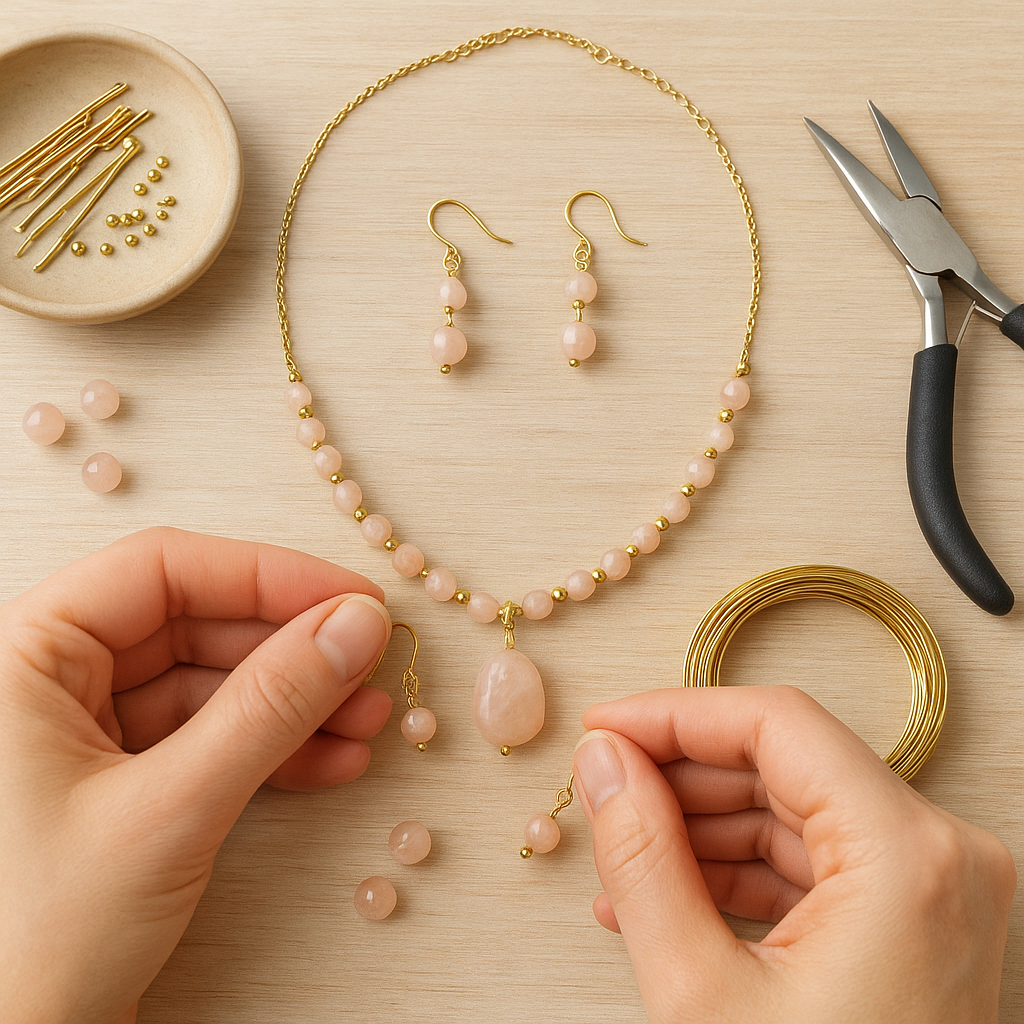
Handmade jewelry has a special way of telling a story across multiple pieces, whispering a theme rather than shouting it. A cohesive set feels like it belongs together without being monotonous. The magic lives in small, thoughtful consistencies—shared materials, repeating motifs, familiar lines—and in contrasts chosen deliberately to support a central idea. Whether you work in metal, beads, fiber, clay, or mixed media, the goal is not sameness; it is resonance. When necklace, earrings, bracelet, and ring are designed as a family, they carry the same visual DNA and still allow each piece to shine. This guide explores how to plan, craft, and finish jewelry sets that feel unified and expressive, keeping a true handicraft sensibility rooted in the hand and eye of the maker.
What It Means for a Jewelry Set to Feel Cohesive
In artisan jewelry, cohesion is a felt experience as much as a formal principle. It means the pieces clearly relate to one another through repeating decisions: color, form, surface, proportion, and movement. But cohesion avoids cookie-cutter repetition. Think of a musical theme with variations rather than a chorus looped forever. The best handmade sets follow a recognizable idea across multiple components, yet each piece adds new information to the overall narrative.
Unity can be established at different levels. A set may share materials (say, recycled sterling silver and smoky quartz), construction methods (cold connections, hammer texturing), a visual grammar (ellipses and ovals), or a stylistic attitude (rustic modern, botanical, architectural). Even the kind of light the set captures—matte vs. gloss, faceted vs. opaque—can provide a unifying thread. Cohesion also relies on the negative space that surrounds the jewelry and the way the pieces move on the body; this is where wearability and design become inseparable.
Ultimately, cohesion protects your creative intent. It tells the wearer what to notice, what to compare, and where to find delight. When done well, a cohesive set carries a quiet confidence that makes the pieces feel inevitable together.
Foundations: Palette, Materials, and Finish
Color is often the first cue that pieces belong together. Establish a core palette early—two anchor hues and one accent is a dependable recipe. For beads, consider an analogous family (teal, blue, lapis) or a high-contrast duo (amber and charcoal) softened with a neutral (linen, pewter). For metals, let warmth or coolness guide the palette: copper with carnelian and bone; sterling with aquamarine and moonstone; brass with jade and onyx.
Materials send strong messages about identity. If you pair raw gemstones with refined metalwork, repeat that interplay across the set. If you mix textile and metal, echo fiber elsewhere, even if only as thread color for stitch-in elements. For polymer clay, maintain a shared cane or color recipe that appears in every component. In lapidary work, repeat the same family of cuts (cabochons, step cuts) so light plays consistently.
Finish is the glue. A unifying finish—satin-brushed silver, matte sealed clay, lightly waxed wood beads—ties components together even when shapes diverge. Decide on a finish vocabulary (high polish, directional brushing, cross-hatching, micro-hammering, edge burnishing) and apply it consistently. The subtleties of finishing are where artisanal identity emerges; they’re a quiet signature visible in the hand.
Shapes, Motifs, and Proportion
Establish a shape language and commit to it. Ovals and arcs convey softness; triangles and chevrons convey clarity and direction; circles suggest wholeness. If you choose crescents as your motif, let their curvature appear in multiple scales and orientations throughout the set. Avoid introducing too many unrelated shapes unless they serve the concept.
Proportional relationships work like rhythm in music. A small-to-large ratio that repeats—say 1:2 or the more dynamic 2:3—creates a dependable beat the eye can follow. Maintain consistent proportion between focal and support elements, especially across necklace and earrings. If your necklace features a large centerpiece, consider mid-scale earrings and a lean bracelet with tiny echoes of the centerpiece’s geometry. That scaling down preserves presence while keeping comfort and context in mind.
Silhouette matters even before detail. Aim for recognizable outlines: a tapered long drop, a compact cluster, a sweeping collar. Similar silhouette across the set does more for cohesion than any single bead could. Sketch silhouettes first, then decide how to populate them with materials and technique.
Texture and Surface: The Tactile Thread
Texture is a subtle unifier. A deliberate surface treatment—planished metal, line etching, seed bead matte fields, braided cord—creates a fingerprint the eye learns quickly. Introduce a signature texture and let it appear in every piece, even if only in a small way. For metalsmiths, a particular hammer face or stippled punch can become your hallmark. For bead weavers, choosing a dominant bead finish (matte vs. AB vs. metallic) can align the entire set. For fiber or leather, stitch density and edge treatment communicate identity.
In mixed media, change only one variable at a time. If the necklace includes rough-cut quartz next to brushed brass, the earrings might use a single rough-cut chip and a brushed disc. That continuity of texture lets you diversify without fragmenting the set’s story.
Focal Points and Visual Hierarchy
A cohesive set benefits from a clear hierarchy—one piece is the anchor, others support. Often the necklace or brooch holds center stage, with the bracelet and earrings echoing details. Decide early where the focal concentration will sit and how the supporting pieces will carry its DNA. An anchor stone, a carved element, a distinctive link shape: choose a motif worth repeating in smaller doses.
Hierarchy can also be achieved through light: a highly reflective element deployed generously in the anchor and sparingly elsewhere; or through saturation: the deepest color appears in the centerpiece and lighter tints migrate to the periphery. The goal is not only visual clarity but wearability; someone might choose a minimal version for daily wear and the full set for events. Clear hierarchy makes the set flexible.
Design Systems: Modules, Ratios, and Repetition
Think in modules. A module is a repeatable unit: a forged leaf link, a 5-bead ladder, a clay tile slice, a wire-wrapped crystal. Build a handful of modules and distribute them across the set, changing scale, orientation, or quantity to match the function of each piece. This approach fosters modularity and speeds decision-making without sacrificing variety.
Repetition breeds familiarity; variation prevents boredom. Repeat no more than two modules prominently, and let one minor module act as a bridge. Pair this with a consistent spacing unit—number of jump rings, number of seed beads, millimeters between rivets—to imprint rhythm across the collection.
Planning Workflow: From Idea to Bench
Start with a concept: a place, a memory, a season, a material. Make a mood board of 6–10 images and pull a concise material set to match. Sketch silhouettes and lay out material swatches side by side; if any item shouts louder than the rest without purpose, remove or tone it down. Then write a one-sentence design brief to keep you honest.
Create a sample card: a strip or board featuring metal finishes, clay test tiles, bead stitch samples, wire gauges, and thread colors. Label each with sources and notes. This singular board guides day-to-day decisions and keeps substitutions aligned with the theme. Before cutting expensive material, produce one prototype module and test it in multiple pieces; this reveals scale and weight issues early.
Construction Choices That Support Unity
Technical consistency reinforces visual unity. Choose a small set of wire gauges and stick to them across the set. Keep jump ring sizes and chain link styles consistent. In soldered work, use one solder color and avoid mixed-color solder unless it’s part of the aesthetic. For cold connections, repeat rivet heads or micro-bolts in the same metal and diameter.
In stringing and bead weaving, maintain a recurring count pattern (for example, 3-3-5 ladder, or a 2-bead spacer after every fourth focal). Use the same thread family and color across pieces; even if hidden, the hue can cast a faint glow that unifies the work. If you knot between pearls or stones, standardize knot size and tension.
Findings can break or make cohesion. Standardize earring wires, clasps, and end caps; if you fabricate them, apply the same finishing regime. When buying, select a finish that matches your metalwork rather than a plated shortcut that will age differently.
Color Harmonies for Sets
Three reliable harmony strategies:
- Monochrome with micro-contrast: Explore one hue in multiple values and surfaces—matte midnight blue seed beads paired with polished navy glass and denim lace. Varying reflectivity keeps it lively.
- Analogous with a grounded metal: Choose neighbors on the color wheel, such as moss, olive, and chartreuse, anchored with oxidized brass. The metal acts as a stabilizer for lively greens.
- Complementary with restraint: Combine purple with a measured amount of yellow-bronze, curbing saturation so it feels sophisticated, not high-traffic signage.
Metal mixing works when controlled. If you mix metals, treat one as primary and one as accent, repeat the ratio across every piece, and separate them with buffer elements like stone spacers or blackened connectors to avoid a noisy clash. A small consistent separater—tiny hematite discs, blackened jump rings—lets dissimilar metals coexist gracefully.
Adapting to Wearer and Context
Consider face shape, hairstyle, and neck length. Long earrings might echo the necklace’s vertical motif but should not compete with a dramatic pendant on a shorter neck. If your audience includes sensitive skin, standardize hypoallergenic ear wires so the set can be gifted without concern. For ceremonial or bridal sets, integrate keepsake elements that carry memory—embroidered fragments, heirloom stones—while repeating your established forms.
Context matters. A workplace-friendly subset might include the bracelet and studs; the full ensemble might add the statement necklace. Design modular closures and extenders so components can be layered or pared down without losing the set’s identity.
Movement, Fit, and Comfort
Cohesion includes how the pieces move. If the necklace flows with articulated links, let the bracelet echo that articulation; if the earrings are rigid geometric forms, keep their weight balanced relative to the neckpiece. Use similar pivot mechanics across pieces—hinges, loops, knots—so movement feels related. Weight distribution should be predictable across the set to avoid surprises for the wearer.
Clasp strategies matter: standardize lobster clasps or toggle diameters; if you handcraft toggles, repeat the same bar length and ring shape. Provide extenders that match chain or cord, not a random leftover. A consistent comfort experience is part of the story you’re telling.
Finishing, Aging, and Care
Surface protection, colorfastness, and aging behavior should match across the set. If you seal patinated copper with microcrystalline wax, do so on every piece. For dyed fibers, test for bleed and UV fade, then document care instructions on a shared card. If your aesthetic includes a darkened surface, ensure your oxidation method is stable and repeatable; nothing breaks cohesion like one piece brightening as others deepen.
Embrace controlled aging. A coordinated patina can be a design element—warm highlights on raised areas with shadows in recesses—so long as it appears intentionally across the entire set. Finish edges similarly, too: if you round edges on a cuff, echo that soft edge on pendant rims and ring shanks.
Pricing, Editions, and Documentation
A cohesive set benefits from cohesive documentation. Name the set, assign part numbers, and keep a bill of materials and finish schedule. If you sell, price using a consistent formula so the set reads as a collection in the shop or gallery. Consider limited editions that preserve the unique qualities of handmade work while signaling collectibility.
Include a care card and a short origin note: material sources, methods, and inspirations. Documentation isn’t just administrative—it underlines the set’s identity and your role as a craftsperson.
Common Pitfalls and How to Fix Them
- Problem: Too many unrelated colors. Fix: Reduce to two anchors and one accent; relegate others to micro-accents or remove entirely.
- Problem: Scale dissonance between pieces. Fix: Define a focal scale for the anchor and set a rule for support pieces (no element larger than 60 percent of the anchor).
- Problem: Finish inconsistency. Fix: Standardize abrasives and polishing compounds; log grit sequences and buffing times for repeatability.
- Problem: Mismatched findings. Fix: Fabricate or source unified findings and retrofit as needed.
- Problem: Over-decoration. Fix: Establish a hierarchy; if everything is special, nothing is. Remove one flourish from each support piece.
Quick Cohesion Checklist
- Concept sentence written and visible on your bench
- Palette swatches and finish samples on one board
- Two primary modules, one bridge module
- Consistent wire gauges, chain types, and findings
- Defined focal scale and proportional rules
- Surface vocabulary documented (brushing, hammering, sealing)
- Comfort considerations tested for each piece
- Care and aging plan aligned across materials
Case Studies: Cohesion in Practice
Moonlit Estuary
Materials: sterling silver, labradorite cabs, hematite spacers, charcoal silk cord. The anchor is a pendant with a bezel-set labradorite on a brushed silver plaque, textured with light cross-hatching. Earrings are small studs featuring tiny labradorite rounds bezel-set on matching plaques. The bracelet alternates brushed links with hematite spacers, echoing the plaque edges. Cohesion arises from the directional brushing, the cool gray-blue palette, and the repeating plaque outline. The set respects balance by scaling down reflective surfaces away from the anchor.
Verdant Geometry
Materials: brass, green aventurine triangles, hand-dyed linen cord. The necklace uses a central triangular frame enclosing a stone slab; the bracelet presents smaller frames with drilled aventurine chips laced in a repeating ladder. Earrings showcase open triangles, allowing air and light to interact. Repetition of the triangular motif and the consistent cord wrap binds the set. Proportions follow a 2:3 rhythm between frame lengths. The pieces share a satin-brushed finish and a wax-sealed surface for comfort against skin.
Ember Weave
Materials: copper, carnelian beads, matte onyx, bead-woven components. The necklace features a handwoven peyote panel with carnelian accents and blackened copper chain. Earrings use smaller peyote tabs with a single carnelian. The cuff integrates a woven strip riveted onto a copper base, continuing the stitch count from the necklace. Consistency stems from the stitch structure, the blackened copper tone, and the regulated bead finishes. The result reads as one voice in three registers.
Sustainable Choices That Strengthen Identity
Ethical decisions become part of cohesion. If you reclaim metal scrap for sheet and wire, allow the slight irregularities in hand-rolled stock to appear across all pieces—those tool marks are your visual signature. If you focus on local or fair-mined stones, say so in your documentation and let their natural variance guide your color choices. Sustainable packaging can echo materials and finishes: kraft boxes with brushed metal tags, plant-dyed ribbon that matches your accent color.
Photographing and Presenting Sets
Presentation reinforces unity. Shoot the entire set together first, then isolated components against the same background and lighting. Keep a consistent camera angle and distance so scale relationships are clear. Use a simple prop that appears in every shot—a linen pad, a dark slate tile—to connect images. In person, display the anchor at eye level, with supporting pieces cascading to either side. Label materials and methods consistently so the narrative reads without a sales pitch.
Bringing the Handmade Voice Forward
Handicraft is more than a technique list; it is a feeling captured in the small evidence of the maker’s hand. Let selective tool marks remain where they make sense, and finish lovingly where the body demands smoothness. Align edges not to sterile perfection but to a living refinement. Above all, keep your design intent close. If a decision does not serve unity, remove it. If an imperfection adds character that supports the story, keep it with intention.
In the end, a cohesive jewelry set is a conversation among pieces. It happens when form, material, and finish harmonize around a strong idea. Define your vocabulary. Repeat with sensitivity. Vary with purpose. And give each piece room to breathe within the family you’ve made. When your set carries shared light, shared rhythm, and shared care, the wearer will feel the coherence before they ever name it—and they will return to that feeling again and again, because it simply makes sense on the body.
Advanced Tips for Experienced Makers
- Map light paths: identify which facets or brushed directions catch light first and ensure that sequence repeats from necklace to earrings.
- Edge grammar: pick one edge treatment—chamfer, round-over, crisp arris—and use it as a punctuation mark throughout the set.
- Hidden structure: unify internal mechanics such as backing plates, reinforcement stitches, or solder seam placements; even unseen, these decisions influence durability and feel.
- Iterative testing: build micro-prototypes for weight and swing—miniature earring dangles and chain samples—to confirm comfort and visual rhythm before finishing.
- Material resonance: if one component is naturally cool to the touch (metal), pair it consistently with a warmer element (textile, wood) to create tactile contrast that reads across the set.
Closing Reflection
The most compelling sets emerge when a maker’s eye and hand commit to a clear idea, then invite variation within that promise. Guard your themes; refine your modules; respect scale. Keep the number of variables small so each choice is legible. With thoughtful planning, tested techniques, and attentive craftsmanship, your work will carry a presence that feels both intentional and alive. Cohesion is not limitation; it is the framework that lets creativity grow branch by branch, piece by piece, as your collection gathers a recognizable and trusted voice.
