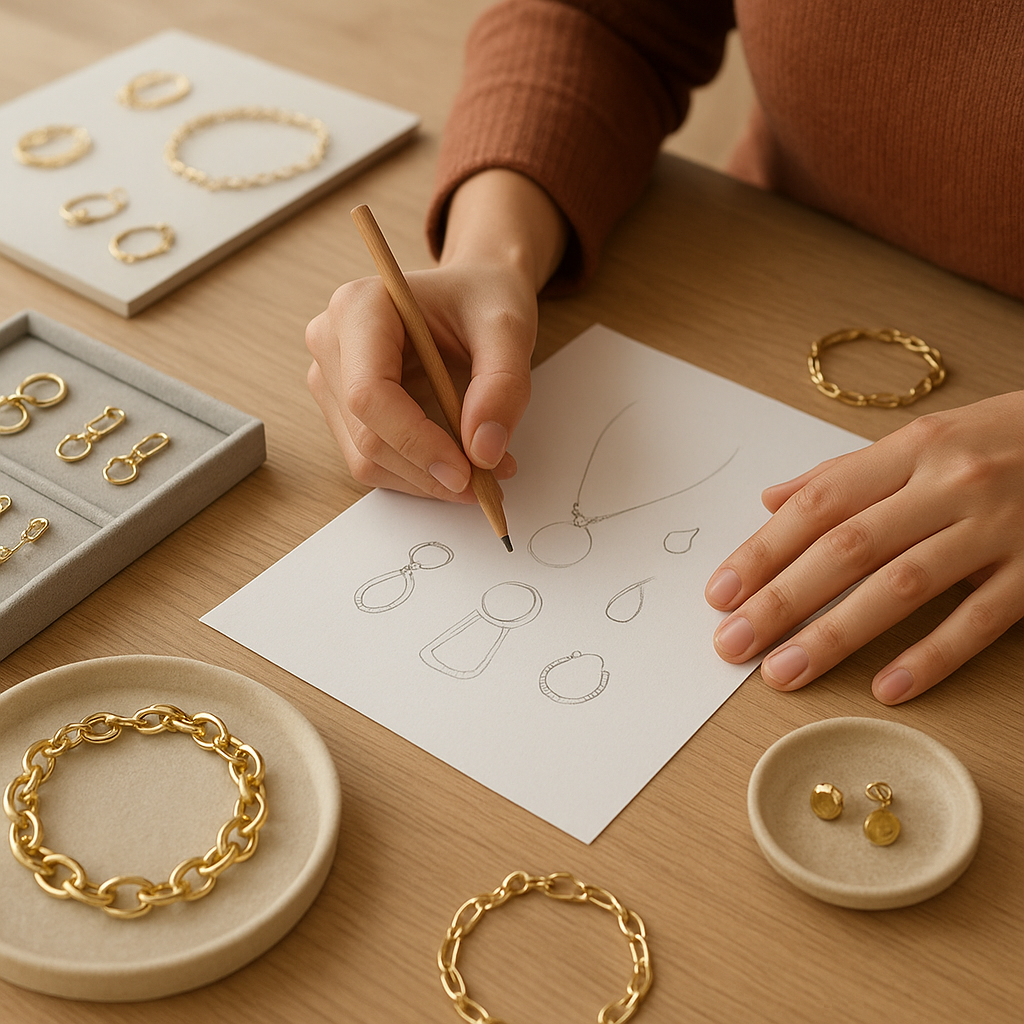
Designing jewelry that resonates with what people want to wear right now is equal parts intuition, research, and disciplined handwork. The goal is not to copy what’s popular, but to translate it authentically into pieces you can make with your hands, tools, and materials—pieces that feel fresh this season yet remain worthy of a keepsake box. The guidance below blends market awareness with bench-based technique so you can move from idea to prototype to limited release without losing the soul of maker-led design.
From Inspiration to Insight: Reading the Trend Landscape
Fashions shift in cycles—some swing fast like viral accessories on social platforms, others move more slowly across years through exhibitions, film, or design schools. Your first task is to separate noise from signal and distill one relevant trend at a time into tangible design directions: shape, scale, texture, color, and function.
Start with a wide funnel, then narrow it. Observe across three time horizons:
- Immediate: creator-led looks on TikTok, Instagram Reels, and Pinterest boards; hot sellers on Etsy and craft marketplaces; what customers try on at fairs but don’t buy yet.
- Seasonal: runway accessories, lookbooks from contemporary brands, curated edits by retailers and stylists, museum gift shop selections, and color stories from paint and textile houses.
- Structural: demographic shifts (piercing culture and ear stacking), workplace dress codes, sustainability expectations, and technology that changes what’s wearable or how it’s made.
Collect images into themed boards: silhouettes (hoops vs. studs vs. ear cuffs), materials (pearls, glass, recycled silver), surface stories (hammered, high shine, enamel brights), and cultural references (ancient amulets, industrial hardware, botanical forms). Annotate why something pulls your eye—curve direction, clasp cleverness, gemstone proportion, or the negative space around a form.
Translate your research into hypotheses you can test in the studio. For example: “Bolder ear climbers will continue” becomes three prototypes exploring weight, curvature, and fastening; “Mixed metals are returning” becomes a capsule mixing sterling, brass, and gold vermeil, each with different textures to emphasize contrast.
Measure interest early. Track saves and replies on work-in-progress posts, count try-ons at markets, and note which samples make people smile. If you run a shop, watch search queries (“pearl choker,” “chunky ring,” “enameled hoops”) and add synonyms to product descriptions. Trends are probabilistic, but a disciplined observation habit reduces risk.
Translating Market Signals into Handcrafted Language
What makes a handmade collection stand apart is not the speed of chasing fashions but the integrity of your methods. Start every season by writing a short brief: your maker DNA, a few references you admire, constraints you’ll embrace (like a single alloy or a defined weight limit), and the emotions you want a wearer to feel. Then interpret the moment using your own craftsmanship—the lines you file by hand, the solder seams you vanish, the textures you strike with a hammer.
Trends often call for a shift in silhouette: thicker cuffs, narrower bands, exaggerated drops, asymmetric pairs. Redrawing outlines can deliver currency without changing your materials at all. Keep outlines simple in the sketch stage. Work in paper first, then translate into brass or sterling test blanks to study scale against the body. The ear, finger, and clavicle each frame jewelry differently; adjust proportions until the piece reads strongly from a distance and invites inspection up close.
Surface treatment is another lever. Mirror polish feels futuristic; directional satin feels tailored; hammered facets catch light with artisanal energy; coarse scratch patterns can read as brutalist or industrial. Vintage-minded customers may love controlled patina—liver of sulfur on sterling, or a warm oxidation on brass sealed with microcrystalline wax. Test durability by wearing samples through showers, workouts, and city days; touch points like ring undersides and bracelet edges will reveal whether a finish will hold.
Color can align you to what’s current without retooling your whole bench. Enameled accents echo ready-to-wear palettes; glass beads and cultured pearls deliver accessible luxury; dyed silk cord nods to craft traditions. Update classics in micro-ways: contrast a freshwater pearl with a burnished forged pin; line a signet bezel with colored vitreous enamel; pair a lab-grown sapphire with a matte blackened shank.
Materials and Techniques That Bridge Trend and Handwork
- Metals: sterling silver (925), fine silver (999) for keum-boo, brass for prototyping and warm gold tone, bronze for sculptural casting, gold-fill and vermeil for cost-effective gold looks, titanium and niobium for hypoallergenic ear wires.
- Gem and bead choices: cultured freshwater pearls, lab-grown diamonds and sapphires, conflict-aware natural stones from vetted cutters, Czech glass, recycled glass beads, vintage deadstock cabochons, enamel for color blocking.
- Techniques: lost-wax casting, sand casting for organic surfaces, granulation and filigree for heirloom texture, forging and anticlastic raising for fluid cuffs, chainmaille weaves for supple drape, cold connections (rivets, tabs) for mixed materials, keum-boo for gold accents on silver, cloisonné/plique-à-jour for translucent color, wire-wrapping and macramé for soft structure, and 3D-printed wax for complex forms still finished by hand.
- Joinery and closures: soldered jump rings where security matters, laser-welded joins near stones, smart clasps (lobster for security, toggles for statement, magnets with safety catches for accessibility), threaded posts or lever-backs for earrings with movement.
Designing for Comfort, Function, and Repeat Wear
Good looks only work if the piece is wearable for long hours. Build comfort and safety into your earliest drawings by prioritizing human-centered details and solid ergonomics. A bold earring that tugs is a return waiting to happen; a cuff that pinches will live in a drawer.
Balance visual drama with mass. For earrings, aim for weight distributions that sit closer to the lobe; crescent forms and climbers can spread load across the helix. Consider titanium posts for strength at lower diameters, and wide clutch backs to stabilize. With rings, bevel inner edges for a comfort fit and avoid under-gallery ledges that trap lotion and grit. For bracelets, let the natural oval of the wrist shape your design; slightly springy cuffs with rounded edges outlast flat, hard bends. Necklaces should allow pendants to articulate so chains don’t kink and hair isn’t caught in jump rings.
Surface and edge safety matters. Round over every exposed edge with emery and rubber wheels. On cast pieces, remove micro-burrs inside piercings and voids. Test snag potential against knit fabric and fine hair. For stacking designs, be mindful of abrasion: a hard stone next to a softer one will scratch it—use polished spacers or protect edges with bezels.
Allergy compliance builds trust. Nickel rules differ by region; in the EU, follow REACH guidelines and in California consider Prop 65 disclosures. Prefer sterling, gold above 14k, titanium, and niobium for posts and wires. If plating, specify thickness (2.5 microns for gold vermeil is a useful benchmark) and seal brass with e-coat to reduce skin reaction and tarnish.
Durability, Testing, and Finishes
- Plating and coatings: use PVD for abrasion resistance on steel or brass; rhodium plate on silver to preserve brightness; e-coat clear lacquers for costume pieces.
- Joint integrity: solder under magnification; pull-test chains and ear wires; tumble and then inspect for microcracks; choose solder grades to avoid reflow at later steps.
- Water and sweat trials: wear test for a week of realistic conditions; rate how finishes age; document cleaning instructions.
- Care cards: include concise care guides tailored to each finish so customers maintain sheen without stripping patinas.
Sustainable and Ethical Choices Without Losing the Edge
Shoppers increasingly ask how things are made and where materials come from. Designing with sustainability in mind is not a detour from style; it is a design input that shapes look and feel. Recycled sterling and gold can be stamped and communicated clearly; Fairmined or Fairtrade gold adds social value. Lab-grown gems provide scale and color consistency. Packaging from FSC-certified or compostable sources carries your ethic through the unboxing ritual.
Go beyond materials. Track provenance for stones and metal batches; keep purchase invoices and supplier certifications in a digital folder tied to each collection. Reduce waste by nesting saw patterns, re-melting sprues, and designing standardized components that allow you to buy and store fewer SKUs. Build looks around repairability: screw-in posts, modular bails, and accessible bezels make future servicing part of the ownership story.
Creative upcycling can deliver visual novelty that algorithms love. Convert single orphan earrings into pendants; harvest vintage chains into mixed-link chokers; set broken porcelain shards in tab settings; rethread deadstock beads with fresh color logic. Communicate your rationale: the slight enamel chip is a history mark, not a defect, and that story should be priced and photographed with care.
Modularity, Personalization, and Limited Editions
Seasonal movements increasingly favor pieces that can change with the wearer’s mood and outfit. Build collections around modularity. Charm carriers with removable drops, convertible earrings that go from studs to shoulder-dusters, pendants with reversible faces, and adjustable rings can serve multiple fashion moments while letting you reuse cores and findings across designs.
Personalization adds meaning without heavy production load. Laser-engraved initials on signets, hand-stamped symbols on discs, or birthstone options layered into a standard setting are efficient variants. Offer curated stacks: three rings that interlock, two chains that nest without tangling, or ear stacks that mix metal tones deliberately.
Time-boxed releases keep attention high and help you test. Use a 70/20/10 mix: 70% evergreen sellers you always restock, 20% seasonal interpretations aligned to current tastes, 10% experimental art pieces that stretch your skills and earn press. Numbered editions and maker marks turn drops into artifacts.
From Sketch to Sample: Prototyping with Agility
Translate your brief into models fast, preserving the poetry of the initial idea while you solve engineering. Begin with two-dimensional trials: paper, acetate, or thin brass sheet to check proportion. Move to low-cost 3D: wax carving for organic massing, polymer clay for volume on the body, or 3D-printed castable resin for filigreed structures. Evaluate the silhouette in a mirror, on a friend, and on different skin tones and hair lengths.
Document your bench path so you can reproduce hits. Photograph tool setups, note saw blade sizes, torch tips, and quench times. Build small jigs for repeatable angles and bends. For components you’ll re-use—hinges, bails, standardized jump rings—create dimensioned drawings and store samples labeled by gauge and inner diameter.
Invite feedback while you still have clay under your nails. Share process clips with your audience and ask a focused question: “Which drop length reads more elegant?” “Brushed or mirror on the outer edge?” Pre-sell micro-batches to fund a casting run, then iterate after first deliveries based on returns, reviews, and repair tickets.
Pricing That Honors the Hand and the Moment
Being on-trend doesn’t mean racing to the bottom. Price with a simple, defendable formula: materials at landed cost (including wastage) + bench hours at a living rate + overhead allocation + target margin. Add surcharges for plating, special stones, or hand engraving. For limited editions or technically complex pieces, price scarcity and time risk fairly. If you release micro-batches, keep a price ladder so repeat customers understand why one pendant sits above another.
Promotions should educate, not discount indiscriminately. Offer early access, bundle pricing for capsules (the full ear stack at a set), or complimentary resizing and cleaning for first buyers. Align retail partners on MSRP and seasonal calendars; provide them with style notes so they can sell the narrative, not just the shine.
Visual Language: Styling, Photography, and Narrative
A clear visual system helps audiences “read” your pieces in the context of what’s current. Build a style guide: daylight or softbox? Glossy acrylic or linen backdrops? Hard shadows for graphic collections, soft gradients for romantic ones. Shoot macro to honor tool marks and textures, but also shoot from five feet away to show scale across different bodies. Include motion—earrings in a turn, a cuff flexing, a chain draping—to communicate tactility.
Tell the why behind each release. Good storytelling is a design material: the stone you chose because of a film still, the hinge you invented to echo a mid-century clasp, the recycled chain links that reference a shipyard. Write short captions that name materials and care, credit suppliers, and point to values without preaching. On product pages, pair hero images with bench shots to close the loop between studio and street.
Cultural Sensitivity and Honoring Sources
Handcraft often draws from traditional forms—indigenous beadwork, talismans, sacred motifs. Study deeply and ask permission when appropriate. Avoid mimicking restricted symbols and garments; seek collaborations that share revenue and visibility. If you learn a technique from a specific lineage, credit the teacher or region in your notes and product copy. Customers increasingly appreciate when a modern piece explains its relationships to older practices.
Three On-Point Applications: Adapting Current Directions
Consider three current directions and how a studio jeweler might interpret them responsibly and distinctively.
- Pearl resurgence: Instead of simple strands, forge asymmetric stick-pearl earrings with hand-textured caps. Mix baroque pearls with knurled brass beads on a silk cord that knots between each unit. Offer a detachable drop that snaps onto a small hoop for day-to-night switching. Photograph pearls against denim and raw wood to shift the context from “bridal” to “everyday elevated.”
- Hardware chic: Borrow the geometry of carabiners and shackles without impersonating climbing gear. Fabricate oversized links from rectangular wire, bevel the corners, and add a spring bar closure you solder and finish by hand. Oxidize the interior faces for graphic depth. Ensure weight distribution so the clasp stays forward as an intentional focal point.
- Color brights: Create low-relief studs with cloisonné cells you fill in two saturated enamel tones, echoing this year’s textiles. Produce a minimal pendant with a matte blackened field and one glossy enamel stripe, then mirror that stripe on the edge of a matching ring. Calibrate kiln schedules for repeatability before releasing multiples.
Finishing Touches: Packaging, Care, and Aftercare
Packaging supports perception and reduces returns. Use boxes that fit the piece—no rattling chains or bent ear wires—and anti-tarnish inserts for silver. Place a tiny polishing cloth and a card that explains care specific to the finish (“wipe enamel sparingly,” “avoid ultrasonic on pearls”). Offer resizing and re-plating services, and list lead times clearly. Simple QR codes linking to how-to-wear videos or stack styling suggestions turn the unboxing into a mini lesson that drives repeat wear.
Efficiency at the Bench: Tools, Layout, and Safety
Design speed comes from bench clarity. Organize mandrels, files, burrs, and solder grades in labeled trays; keep a soldering tile with pre-cut paillons for faster joins. Use a ring stretcher/reducer, drawplate, and rolling mill to standardize stock. A flex shaft with abrasive wheels accelerates finish transitions; a magnetic tumbler burnishes intricate links fast. Wear eye protection, manage ventilation for fumes (especially with patination chemicals), and maintain a clean pickle to avoid copper plate-back.
Rotate between tasks to preserve joints and wrists: a day of forging, a day of stone setting, a day of finishing. Keep a small notebook for process timing; you’ll quickly learn real bench hours and price with confidence. For complex assemblies, make sub-assemblies that can be prepped during quiet hours, so you can respond to spikes in demand without panic.
Marketing the Maker Way: Community, Feedback, and Retail
Trends are social before they are products. Host open studio hours or live streams where you discuss prototypes and invite micro-commissions. Work with micro-influencers who actually wear jewelry and understand fastening and fit; gift them unplated brass samples for approval, then finish their preferred version to spec. At markets, set up a try-on mirror and alcohol wipes, and record questions you hear—those become product page FAQs.
Wholesale partners can amplify reach if you equip them: provide line sheets with clear dimensions and care notes; bundle displays that respect your aesthetic; and a seasonal calendar that aligns with their floorset dates. Offer small exclusives so each partner feels special without fracturing your brand.
Legalities and Marking: The Quiet Foundations
Stamp metals accurately (925, 585, 750), and follow local hallmarking laws. If you use gold-fill or vermeil, disclose it plainly. Keep receipts for recycled content claims. Mind safety rules for children’s jewelry. Trademarks and design registrations may be worth considering for signature closures or repeating patterns you’ve developed—consult a specialist when releasing a hero piece.
Checklists You Can Use Tomorrow
Trend-to-Design Checklist
- Gather 30–50 reference images from at least five sources.
- Extract three design levers: shape, texture, color/stone.
- Define limits: max earring weight, minimum ring shank thickness, clasp type.
- Sketch five variants; reduce to two for prototyping.
- Build paper/brass trials; photograph on body; gather feedback.
- Prototype in final material; test comfort, snag, finish durability.
- Decide edition size, price, and launch story.
Bench and Quality Checklist
- All solder joints flow and are cleaned under magnification.
- Edges eased; no burrs; fabric snag test passed.
- Clasps self-orient; bracelets don’t flip; earrings don’t tilt.
- Allergies addressed in skin-contact parts; plating thickness documented.
- Care card and storage solution matched to finish.
Launch and Feedback Checklist
- Photography includes macro, full-body scale, and motion.
- Copy states materials, dimensions, finishes, and care succinctly.
- Early-bird or bundle offer defined; ship dates realistic.
- Post-launch survey questions ready; returns tracked for insights.
Looking Ahead: Building a Practice That Outlasts Any Moment
The most durable way to “be on trend” is to know what you stand for as a maker and to revisit that core each season with new lenses. Keep a library of master forms you can resize or resurface to meet shifting tastes. Maintain relationships with a few trusted suppliers who can help you source unusual stones or cast quickly when an idea lands. Continue studying historical jewelry—Etruscan granulation, Art Deco geometry, mid-century clasp engineering—so your present-day experiments are anchored in craft history.
Finally, allow room for surprise. Some of your strongest pieces will come from accidents at the bench, odd materials on your tray, or customer interactions that reveal latent desires. When your process keeps one foot in research and one in the studio’s stubborn reality—the smell of flux, the scrape of a file—you’ll make jewelry that feels of-the-moment and deeply personal. That is how a hand-maker stays fluent in fashion without ceding authorship, how a collection becomes a conversation between what’s happening out there and what only your hands can do.
As you plan your next release, revisit these cornerstones: articulate your point of view; refine shape and scale; choose finishes that invite touch; build comfort in; source with care; use limited editions to test; photograph truthfully; speak in a clear, warm voice. Amid cycles of novelty, your steady devotion to materials and method—the parts the camera can’t fully see—will show up in wearers’ lives every day, and that is the quiet signature of true hand-made design.
