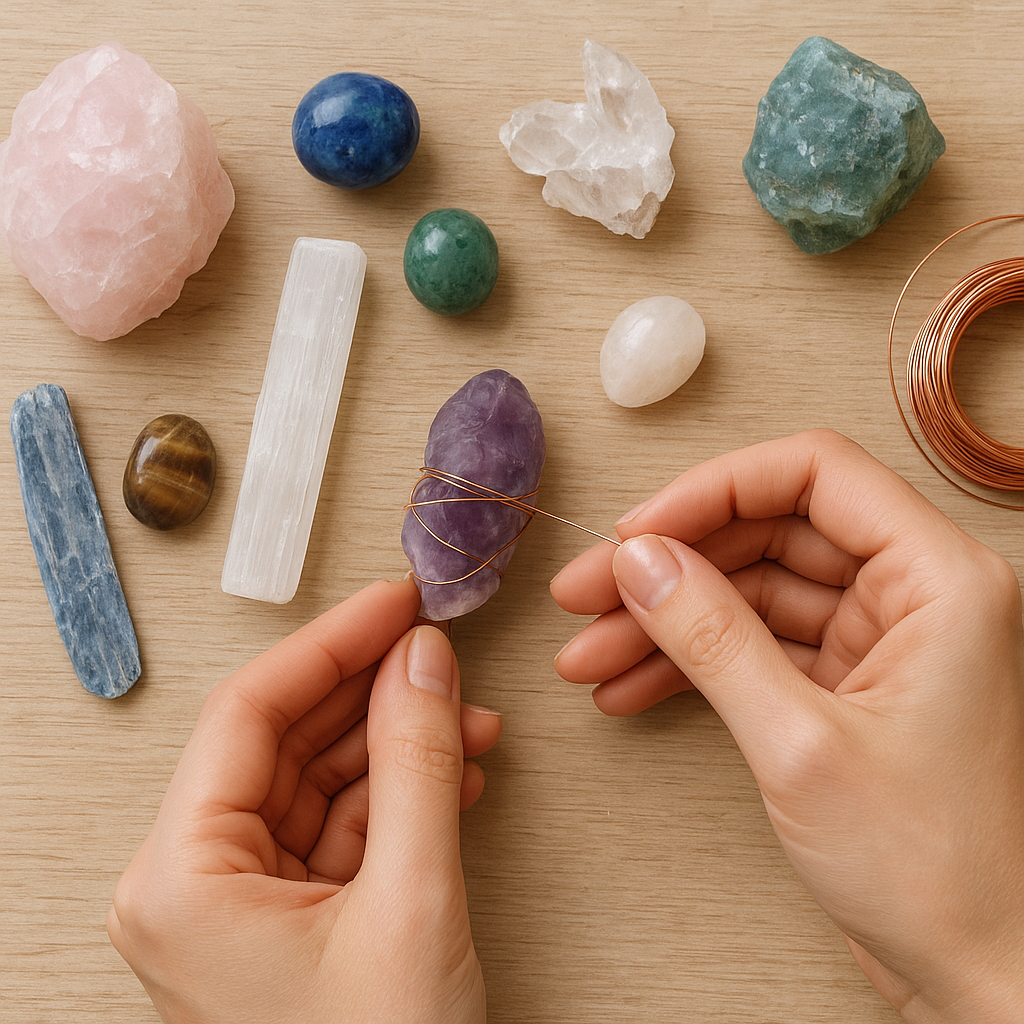
Hands learn stories that words forget, and few materials carry as much lore, color, and tactile fascination as crystals and healing stones. For crafters, these minerals are more than pretty accents; they are a palette of textures, light, and narratives. Whether you’re braiding a talisman cord, soldering a bezel, or setting a cluster into a candle holder, the meeting point between mineral and maker invites slow attention and refined craftsmanship. This guide offers a practical, art-forward path for incorporating stones into handmade work—balancing design sense with studio safety, ethical sourcing, and the quieter rituals that many artisans find meaningful.
The Material Language of Stones
Before setting a single bead or hammering a bezel, spend time with the vocabulary of minerals. Density, luster, fracture, and hardness shape both function and form in your craft. The Mohs hardness scale matters, as it determines how a stone will scratch, abrade, or hold up under wear. Quartz (7) and agate (6.5–7) endure daily friction better than selenite (2) or malachite (3.5–4). If you make rings or keychains, you’ll want that extra durability; for wall hangings or altar objects, fragility can be acceptable—and even desired for its softness of line.
Shape and cut also inform design. Raw points radiate asymmetry and drama; tumbled pebbles lend smoothness; cabochons invite bezels; chips and rondelles create dense texture in weaving. Pay attention to light: stones with translucency reward backlighting in sun-catchers and lamps; iridescent labradorite needs angled surfaces to wake its flash. Some stones are porous or sensitive to acids and heat, changing the adhesives, sealants, or patinas you can safely use.
Color stories guide mood and theme. Blue sodalite and dumortierite anchor cool, contemplative palettes; warm carnelian and amber conjure hearth energy; green aventurine and prehnite sit easily among botanical fibers. Beyond hue, consider pattern scale: banded agates or scenic jaspers work as focal pieces, while uniform chips support backgrounds and fringe.
- Everyday wear jewelry: quartz, agate, jasper, rose quartz, amethyst (cabochons or beads)
- Delicate art objects: selenite, kyanite blades, vanadinite clusters (protected mounts or shadow boxes)
- Textile embellishment: lightweight chips, seed beads, tiny pearls
- Metalwork focal points: cabochons in oval or freeform cuts with a stable back
- Resin inclusions: small tumbled stones, chips, flakes (ensure dryness to avoid bubbles)
Cultural meanings accompany minerals, and many makers draw from that archive of stories. Use this not as a rigid rulebook but as a reservoir of symbolism—a way to notice how materials influence posture, gesture, and mood while making.
Tools, Materials, and a Maker’s Bench
A crystal-friendly studio is organized around gentle holding, accurate measurement, and clean finishes. Build out your bench in layers so you can adapt quickly to different stones and scales.
- Pliers: round-nose, chain-nose, flat-nose, nylon-jaw (to avoid marring soft wire and stone edges)
- Cutters: flush cutters for wire; heavy-duty snips for thicker gauge metals
- Files and sandpapers: micro files, polishing papers from 400 to 8000 grit; diamond files for hard stones
- Adhesives: epoxy (two-part, clear), flexible jewelry cement; avoid cyanoacrylate near porous stones that can fog
- Wire: copper, sterling silver, brass, or plated options across gauges (20–28 AWG for wrapping, 16–18 for structural frames)
- Beading supplies: needles, thread (nylon, silk, FireLine), crimp beads, bead stoppers
- Textiles and cords: waxed linen, cotton, hemp, micro-macramé cord, leather thong
- Metalwork gear: saw frame and blades, solder, torch, pickle, third hand, firebrick, bezel wire, dapping set, burnishers
- Resin kit: two-part resin, silicone molds, pressure pot (optional), torch for bubbles, nitrile gloves, respirator
- Safety: eye protection, dust mask (N95/respirator), ventilation, gloves, aprons, proper storage for chemicals
Dedicated trays lined with felt or silicone keep stones from chipping or rolling into oblivion. A lightbox or daylight lamp helps you judge color accurately, and a notebook keeps track of suppliers, wire gauges, time spent, and design sketches. Label stones by name and hardness so you can choose techniques that suit them.
Design Principles: From Intention to Iteration
Good design arranges weight, line, and light in a way that feels inevitable. Begin by articulating your intention: what should the finished piece invite? Calm focus? Celebration? Protection for a home entryway? Even if you don’t subscribe to metaphysical frameworks, a clear design statement shapes color choices, scale, and finish.
- Focal hierarchy: a single striking stone supported by smaller accents, or an evenly distributed field of texture
- Proportion: match stone mass to cord or chain thickness; dainty stones need delicate findings, bold clusters want robust structures
- Movement: allow pendants to swing, fringe to swish, and light to travel
- Negative space: open wire frames, airy macramé, or spaced beads create breathing room
- Finish: matte vs. gloss; dark patinas for drama; bright polish for clean modern looks
Translate these ideas into thumbnails—tiny sketches that map composition and connection points. Then prototype with inexpensive beads or mock stones before committing rare specimens. Iteration is a maker’s best friend; each draft teaches your hands something new.
Core Techniques for Incorporating Stones
Wire Techniques: Structural Grace
Many artisans fall in love with wirewrapping because it blends sculpture with engineering. It also avoids heat, which is safer for fragile stones. Use softer temper wire for intricate wraps and half-hard for structural frames. Plan for three anchor points around a cabochon or irregular nugget; triangles are more stable than line-on-line pressure. Employ prong-like claws or a woven bezel made from fine gauge wire for non-drilled stones.
- Basic cage: Create a cross-frame, fold up arms, and cinch with 26–28 AWG weaving wire.
- Weaves: 2/2 or 3/3 wraps between base wires produce rhythmic textures and grip.
- Bail: Spiral or wrapped loop finished with a mandrel; size it to the cord or chain.
- Work-hardening: Light hammering on a steel block (avoid hitting near stones) stabilizes shape.
Macramé and Knotting: Textile Architecture
Macramé cradles stones using repeatable knots that distribute stress. With waxed polyester or micro-cord, you can create intricate bezels for tumbled stones and cabochons without any drilling. Learn lark’s head, square, half-hitch, and Josephine knots. Sketch the pathway of cords around your stone; then set markers to align symmetrical patterns. Knot snugly but avoid overt tension that can chip edges.
Bead Weaving: Precision and Pattern
Seed beads combined with gemstone chips or rondelles yield elegant drape. Peyote bezels can secure small cabochons, while right-angle weave builds flexible straps. Use thread conditioners to reduce fraying against rough drill holes. Finish with crimp guards and wire guardians to protect points of wear.
Metalwork Settings: Bezels and Tabs
For those comfortable with flame, bezel settings in silver or copper turn stones into heirloom objects. Choose bezel wire slightly taller than your cabochon’s shoulder. Solder cleanly, file flush, then sand to finish before setting the stone. Burnish slowly, working from cardinal points to avoid trapping gaps. For heat-sensitive stones, fabricate a cold-connection tab setting or riveted frame.
Resin Casting and Mixed Media
Resin opens sculptural possibilities for embedding small stones into coasters, trays, or jewelry. Dry stones thoroughly to prevent trapped moisture from off-gassing bubbles. Seal porous specimens with a thin acrylic varnish if needed. Layer stones and botanicals in stages for depth. Keep resin from contact with heat-sensitive or coated stones that may discolor.
Clays, Wood, and Fiber Integrations
Polymer or air-dry clays can be sculpted around stones to create custom frames; cure temperatures must respect stone limits. Wood settings—carved recesses or inlays—give organic warmth; finish with oil or wax that won’t stain adjacent minerals. In fiber arts, hand-stitch small stones into embroidery with couching techniques, backing the fabric for strength.
Functional Objects and Wearables
Jewelry is only one doorway. Stones can become cabinet pulls, wind chimes, suncatchers, or inlaid tray borders. With home goods, respect handling and cleaning realities: mount stones on bases that can be dusted and wiped without soaking. Stabilize centerpieces that could tip. For candles, keep stones out of the melt pool to avoid thermal shock and wicking hazards; instead, embed them decoratively in lids or rings around the vessel. Lamps and wall art benefit from translucent stones that play with light; mount them in front of LED strips for glow without heat.
Wearables invite comfort tests. Necklaces should balance front and back weight; bracelets need rounded edges that won’t snag knits; earrings deserve featherlight construction despite a stone focal. Test prototypes by wearing them during ordinary tasks—making tea, typing, walking—so you learn where a design rubs or twists.
Energetic Practice: Rituals without Rules
Many makers relate to stones through a contemplative lens. While perspectives differ about how or whether minerals affect human energy, adding simple practices can cultivate presence. For some, this centers on cleansing, setting intentions, and noticing shifts in attention during making.
- Arrival: Take a breath with the stone in hand, then write a one-line prompt for the piece you’re about to make.
- Cleansing approaches: resting on dry salt in a dish (then discard the salt), brief sound bath with a singing bowl, or a wash in clean water for non-soluble, non-porous stones. Avoid water for selenite and other soluble minerals.
- Charging: Place finished pieces near a window or among plants between sessions; the pause matters more than dogma.
- Attention practice: Pause every 30 minutes to feel how the tool grip and body posture respond—a practical form of grounding.
Let personal experience guide you. If a ritual helps you focus or offers a sense of continuity, keep it. If it doesn’t, your work still stands on skill and sensitivity.
Ethics: Sourcing, Story, and Stewardship
Stone supply chains vary widely. Asking better questions supports both your work and the communities that extract and cut the materials. Favor vendors who provide mine origin, cutting location, and treatment disclosures. Look for recycled metals and reclaimed stones. Explore local lapidary clubs and rockhounding sites where regulations allow, and learn to leave habitats as you found them. Choosing sustainability also shapes business identity: fewer, higher-quality pieces with traceable materials can be a stronger story than mass variety.
When sharing cultural associations, credit sources and avoid appropriating sacred practices. Speak from your lived craft experience. Customers respond to authenticity—how you learned a technique, why you chose a stone, how the object fits a life.
Safety, Quality, and Longevity
Safety keeps creativity sustainable. Some minerals contain copper, lead, or arsenic; do not grind, drill, or polish unknown stones without proper dust control and PPE. Keep food and drink away from the bench. Ventilate when soldering, using adhesives, or casting resin. Dispose of chemical waste responsibly. Test finishes for skin sensitivity; nickel-free and lead-free findings broaden accessibility.
Quality emerges from consistent joinery and stress-tested designs. Tug-test cords and clasps. File every sharp edge. Choose findings proportionate to load. Apply protective wax to copper and brass to slow patina transfer to skin. Include maintenance instructions with sales so pieces age gracefully.
Selling, Storytelling, and Pricing
A crafted object carries both material and narrative value. Photograph stones in natural light, using a neutral background that reveals texture and translucency. Write concise copy that blends fact (stone type, size, materials) with a poetic note. Price with a transparent formula: materials + time + overhead + profit. Offer small care cards that recommend storage and cleaning. Be clear: craft with stones is not medical treatment; it is handmade art that some people use in personal contemplative ways. A respectful tone builds trust.
Project Walkthrough: Copper-Wrapped Quartz Amulet
Materials:
- 1 medium quartz point or tumbled stone
- 18 AWG copper wire (base), 26 AWG copper wire (weave)
- Round-nose, chain-nose pliers, flush cutters, nylon-jaw pliers
- Bench block, chasing hammer, polishing cloth
- Optional: liver of sulfur for patina, microcrystalline wax
Steps:
- Measure and cut two 18 AWG base wires, each 25–30 cm. Cross them at the midpoint, then twist once to create an X. This forms a cradle beneath the stone.
- Place the stone on the cradle and bend arms up along its sides to mark contact points. Remove the stone.
- Begin weaving the arms together with 26 AWG wire in a simple 2/2 pattern for 2–3 cm to create a bezel-like band.
- Reinsert the stone and mold the woven band around it, easing tension with nylon-jaw pliers to avoid scratches.
- Gather top wires and form a bail with round-nose pliers. Wrap the throat of the bail neatly with 26 AWG to lock it.
- If the structure feels flexible, lightly hammer non-stone-contacting sections on the bench block to work-harden.
- Optional patina: Dip in liver of sulfur following safety guidelines; neutralize and rinse. Polish high points to bring out contrast.
- Seal with microcrystalline wax to slow oxidation, then string on cord or chain.
Learning goals: planning anchor points, managing wire tension, and finishing surfaces that meet skin comfortably. Adapt the method to other stones by altering the number of base wires and weave density.
Troubleshooting Common Issues
- Stone shifts in its cradle: add a wire bridge or switch to a denser weave; verify that at least three planes of contact are secure.
- Wire kinks or mars: anneal or switch to a softer temper; use nylon jaws; slow down pulls.
- Adhesive fogging on porous stones: change to a two-part epoxy and mask adjacent areas with tape during application.
- Resin bubbles around stones: pre-warm resin slightly, seal porous stones, and pour in layers; use a quick pass with a flame to pop surface bubbles.
- Macramé bezel loosening over time: back the knotwork with a hidden line of fine stitch at stress points or add an extra round of knots.
- Metal bezel gapping: check for uneven seat; sand the base, re-burnish from opposing sides, and use a polished agate burnisher for better glide.
- Earring weight causing pull: reduce stone size, switch to hollow forms, or move to layered materials like wood with stone inlays.
Care and Maintenance
- Cleaning: wipe stones with a soft cloth; avoid ultrasonic cleaners for porous or fracture-filled stones.
- Sunlight sensitivity: amethyst, rose quartz, and some dyed stones can fade; store out of direct sun.
- Water caution: selenite and halite dissolve; malachite dislikes acids; turquoise absorbs oils—treat gently.
- Metal finishes: polish occasionally; reapply wax to copper/brass to reduce skin transfer; silver cloth for tarnish.
- Storage: separate pieces in soft pouches or compartments to prevent scratching.
Include a brief card with each piece that lists stone type, known sensitivities, and simple care steps. This small gesture elevates the experience and supports longevity.
Design Prompts to Spark the Next Piece
- Palette prompt: choose three stones from a single landscape photo and match cord and metal accordingly.
- Texture prompt: combine one polished stone with two matte surfaces (wood, leather, clay) for contrast.
- Scale prompt: design a micro-object (ear climber) and a macro-object (wall hanging) using the same stone family.
- Light prompt: make one piece for daylight and one for evening—treat translucency and reflectivity differently.
- Story prompt: pick a verb—“nest,” “flow,” “brace,” “spiral”—and let it shape structure.
Keep a log of what worked and what didn’t. Over time, patterns emerge: stones you reach for, techniques that suit your rhythm, finishes that complement your surfaces at different seasons or markets.
Material Combinations That Sing
Pairing amplifies each material’s strengths. Quartz with oxidized copper gives a grounded industrial elegance; pale blue lace agate with brushed silver reads quiet and formal; smoky quartz against walnut finds warmth; citrine with brass vibrates with cheer. Don’t neglect humble companions: cotton cords, linen threads, and beechwood beads resolve visual tension and add breath. In advanced work, consider kinetic joints—hinges or swivels—to encourage movement where light can play through facets.
Learning Pathways and Practice Routines
Skill-building thrives on structure. Set weekly exercises with constraints: one hour to prototype a bezel with scrap wire; five thumbnails before touching tools; one resin pour with only three inclusions; one macramé pattern using just square and half-hitch knots. Participate in critique circles—online or local makerspaces—to trade process notes. Create a reference board of failures with annotations so you can teach your future self what your present self learned.
From Bench to Ritual Space
For those who blend making with reflection, the object often becomes a meeting point of memory, craft, and place. A windowsill altar with a handmade stand, a travel talisman sewn into a pouch, a desk paperweight that reminds you to pause—these are practical ways to keep a thread between studio and life. Let small ceremonies mark your milestones: a first sale, a new technique, a repaired heirloom. Objects grow richer when they accumulate care.
Closing Reflections
Working with stones is an invitation to listen—to edges, to weight, to light, to hands. Refine technical processes, yes, but also cultivate the capacity to sense when a design needs one fewer wrap or one more breath. With patient attention, you will assemble a personal vocabulary of forms that feel both inevitable and alive. Let the materials teach you where they want to sit; respond with craft grounded in skill, curiosity, and respect. Over time, the dialogue between stone and maker becomes its own teacher, guiding choices toward clarity and grace.
