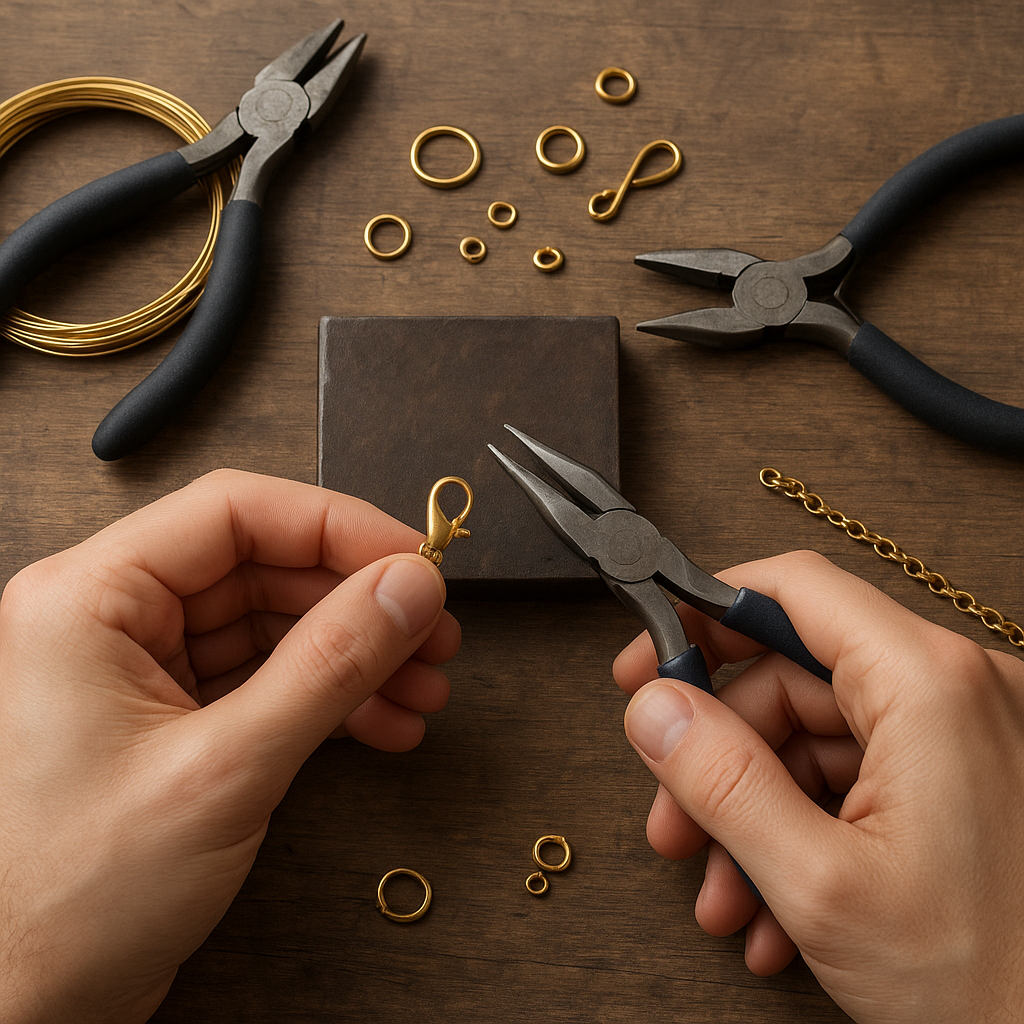
For many makers, the heart of jewelry craft lies not only in focal beads or stones but in the small, hardworking components that make a piece wearable, safe, and elegant. Clasps and findings are those humble heroes—hooks, rings, ear wires, head pins, end caps, and connectors that tie a design together. Learning to fabricate your own opens a world of customization: you can match the style of your closures to the mood of a piece, ensure reliable proportions for heavy pendants, and maintain control over material quality and finish. This guide walks through practical methods, creative variations, and studio wisdom for producing strong, beautiful, handmade findings with repeatable accuracy.
Materials and Wire Basics: Choosing the Right Metal for the Job
The metal you select will determine how your clasps behave, age, and feel. Common choices include copper, brass, bronze, nickel silver, aluminum, stainless steel, and precious alloys such as fine silver and sterling silver. Each has a distinct hardness, color, and oxidation profile, which in turn affects forming, finishing, and long-term wear.
- Copper: Soft and forgiving, ideal for beginners. It bends and forges easily, takes patina beautifully, and teaches good habits. It can be work-hardened for resilience.
- Brass/Bronze: Stronger than copper with golden or warm brown tones. Excellent for clasps needing spring. Polish can be bright or brushed; both develop character with time.
- Nickel Silver: Silvery tone without being silver. Contains nickel, so it may irritate sensitive skin. Its spring quality suits hooks and toggles but test for skin compatibility.
- Stainless Steel: Hard, resilient, less prone to tarnish, but tougher on tools and hands. Requires sharp cutters and robust files; best for high-stress connections.
- Fine Silver: Very soft and easy to fuse; beautiful but not ideal for parts that must resist constant stress.
- Sterling Silver (.925): A balanced choice with good strength and classic color. Ideal for refined clasps once your technique is solid.
Wire temper matters as much as alloy. For shaping clasps, “dead soft” forms easily and is then hardened; “half-hard” holds a bend well but can be tougher to form without marks; “spring” temper offers snap but needs careful handling.
Wire gauge depends on the finding. Ear wires commonly use 20–22 AWG (0.8–0.6 mm). Jump rings for medium chains: 18–20 AWG (1.0–0.8 mm). Heavy clasps and toggles: 14–16 AWG (1.6–1.3 mm). Sheet metal for tabs and box clasps often ranges from 22–18 gauge (0.6–1.0 mm). When in doubt, start sturdier; sculpting a robust profile prevents bend-outs and failures in wear.
Core Tools and Setup: Building a Small but Mighty Bench
You can build professional findings with a minimal kit if each tool is well-chosen and maintained. Essential hand tools include round-nose pliers for smooth loops, chain- or flat-nose pliers for gripping and shaping, flush cutters for clean ends, needle files for deburring, and a bench block paired with a rawhide or nylon mallet for gentle shaping. Add a chasing hammer for controlled flattening and a planishing hammer for crisp, polished facets.
Forming is easier with mandrels—ring mandrels, stepped pliers, and dowels. A steel mandrel preserves accuracy when coiling or shaping rings. Complement with calipers for precise measurements, a scribe for layout, and a ruler with clear metric and imperial graduations.
Optional but powerful additions: a jeweler’s saw for cutting jump rings with perfect seams; a torch for balling wire and classic solder joints; flux and solder; pickle to clean firescale; Wet/Dry abrasive papers; polishing compounds; and a rotary tool or tumbler for finishing. Ventilation, eye protection, and a fireproof station are non-negotiable if heat is involved.
Techniques You’ll Use Again and Again
Cutting and Deburring
Clean cuts ensure tight closures and smooth wear. When trimming wire, align your flush cutter so the flat face finishes the part you’re keeping. Immediately address the cut end: stroke a fine file around the circumference and across the face to remove burrs, then soften edges with 600–1200 grit abrasive. Ear wires and pins that contact skin deserve special attention—finish them mirror smooth.
Forging and Texture
Light forging on a bench block shapes and strengthens wire. Flatten a hook’s tip slightly to prevent slippage, or forge a toggle bar’s center to add mass. Hammering work-hardens the metal and introduces texture that can be polished or left matte.
Heat Control: Annealing and Soldering
When wire resists bending or kinks, return it to softness. Heat to a subtle, dull red (low light helps you see it) and quench where appropriate for the alloy. Pickle to clean, then rinse. Controlled annealing prevents cracks and allows sweeping curves. For joints that must never open—closed jump rings in a chain or hidden connections—solder provides permanence. Learn to flux, bring the entire piece to temperature, and let solder flow into the joint rather than chase the solder with the flame.
Work-hardening
Most clasps rely on controlled hardness. After forming, lightly hammer, burnish, or tumble to increase springiness and improve resistance to deformation. Over-hardening can embrittle thin sections, so test often and adjust.
Making Foundational Findings
Jump Rings: The Skeleton of Most Assemblies
Jump rings connect clasps to chains and components to one another. To make them, tightly coil wire on a smooth rod or stepped mandrel. Saw through the coil along one line for perfectly flush cuts, or use flush cutters for small runs. Proper aspect ratio (ring inner diameter divided by wire diameter) prevents stiff, unmovable chains and weak, openable links. Keep cuts square so seams disappear after closing. For critical points—at the clasp, near a pendant—consider soldering the ring closed.
Eye Pins and Head Pins
Eye pins are lengths of wire with a loop on one end; head pins have a stop (a ball or paddle) to keep beads from sliding off. To make eye pins, form a small, centered loop with round-nose pliers, then straighten the spine. For head pins, either melt a ball with a torch or lightly hammer a flattened paddle. Uniformity matters: use calipers or a simple stop block so every pin matches length and geometry. Balling wire works especially well in copper and sterling.
Ear Wires
Cut two equal lengths of 20–21 AWG wire. Form identical loops, then bend over a dowel for the shepherd-hook arc. File the ends round, refine the shape, and harden by light hammering or tumbling. Consider adding a small “safety stop” kink near the tail to reduce loss during wear. Lastly, polish the part that passes through the ear until glassy-smooth.
Clasps Without Springs: Reliable, Elegant, and Maker-Friendly
S-Hook Clasp
The S-hook is fast to fabricate and surprisingly versatile. Cut a 1.5–2.0 inch length of sturdy wire (16–14 AWG for necklaces with weight). Taper the ends with a file or light forging. Form opposing curls at each end around a small mandrel, and arc the center to create the S silhouette. Harden by forging the center spine and lightly planishing the curls. For security, gently pinch one curl closed after attaching to a jump ring; leave the other slightly open for easy operation. Add a small retention loop or gate on the open side if you want extra security for bracelets.
Hook-and-Eye
Form the hook similarly to the S-hook’s half. For the eye, create a sturdy closed ring from heavier wire or soldered strip. Forge the hook’s tip slightly flat to prevent unintentional escape, then test by tugging. Hooks excel because users can fasten them with one hand, and they pair beautifully with hand-textured eyes that echo design motifs from a pendant or chain.
Toggle Clasp
A toggle consists of a ring and a bar at least 1.25 times the ring’s inner diameter for reliability. Form a thick wire or soldered strip ring; file the joint seamless. Forge a bar with a gentle central swell and thin, rounded ends so it passes easily but won’t slip back unintentionally. Toggle geometry is a dance between proportion and friction—test while wearing on the wrist or neck to ensure it holds at typical drape angles. For soft chains, add a few short, stiff links near the toggle to help it operate predictably.
Button and Loop Closures
For fabric or cord-based pieces, a metal “button” with a shank and a knotted cord loop forms a satisfying closure. Saw a small disk, dome it on a dapping block, and solder or rivet a wire shank beneath. Pair with a sturdy braided loop; finish the knot ends inside a cap or cone for strong, clean terminations.
Advanced Concepts: Box Clasps, Hinges, and Magnets
While most makers stop at S-hooks and toggles, building more complex closures elevates your skillset and design language.
Box Clasp Anatomy
A box clasp involves a hollow box and a springy tongue that clicks into place. Fabricate the box from sheet with a precise inner cavity; make the tongue from tempered strip with a tab for thumb release. The alignment must be exact so the tongue seats with a satisfying click yet releases on demand. Add a safety figure-eight on the side for high-value pieces. This approach demands careful filing, consistent heat control during soldering, and a good eye for tolerances.
Hinges and Catches
Hinged catches add both elegance and serviceability. Create knuckles from small tubing sections and align them on a wire pin. Solder the knuckles to adjoining parts while keeping the pin greased or removed so you don’t lock the hinge unexpectedly. Shape a latch that engages a notch; fine-tune with files until it holds with just the right tension.
Magnetic Closures
Encased neodymium magnets offer easy one-handed wear. Build housings from tube or formed sheet, then epoxy magnets inside. Consider the user’s environment; some people avoid magnets. Shield magnets with nonmagnetic barriers and ensure the housing resists shear forces, not just direct pull. Surface finish the housing to match the rest of the design.
Cold Connections and Endings for Cords, Leather, and Ribbon
Not every piece uses chain. Leather, braided fibers, silk ribbon, and rubber cords call for different terminations.
- Crimp Ends: Make your own from short pieces of tube. Insert cord and crimp gently with parallel pliers. Add a dab of epoxy for extra security and a wire loop on the other end.
- Cones and Caps: Form from sheet by cutting a sector and rolling into a cone or by dapping a disk into a cap. Solder a loop in the apex, or rivet for a no-heat solution. Texture the surface to echo the piece’s style.
- Fold-Over Ends: Cut a small rectangle of thin sheet, place the cord, and fold tabs over with smooth pliers. Rivet or stitch through the tabs if the material allows.
- Wire Guardians: U-shaped protectors prevent wear at connection points. Bend a U around a fine rod, align ends closely, and use with crimps or wraps where the cord connects to a ring.
Surface Finish, Color, and Protection
Finish influences both look and feel. After filing and sanding through progressive grits, decide on your texture: high polish, satin, or directional brushing. A tumbler with steel shot burnishes and hardens small parts efficiently; it is invaluable for ear wires and jump rings. For color, controlled oxidation and chemical coloring offer depth. A thoughtful patina can make fresh work feel heirloom-rich, especially on textures that trap darkness and let highlights sing. Seal with microcrystalline wax or lacquer if you want to stabilize color or slow tarnish, understanding that coatings may need maintenance.
Proportion, Comfort, and Wear Testing
Functional jewelry is a blend of mechanics and aesthetics. Here are practical considerations to help your closures serve real life as well as design intent.
- Proportion: A heavy pendant needs a clasp with mass. A fine chain prefers a delicate closure that doesn’t overwhelm scale. Match wire gauge to anticipated forces.
- Edge Management: Round every contact edge. Snagging hair or scratching skin ruins the experience of a beautiful object.
- Balance: Position toggles where gravity helps them stay put. On necklaces, balance the bar length with the ring size and chain stiffness.
- Testing: Perform pull and twist tests. Simulate catches on sweaters or handbag straps. Observe whether forces tend to open the clasp; adjust geometry accordingly.
- Allergy Awareness: Nickel and some brasses can irritate. Offer hypoallergenic options like titanium ear wires, niobium, or well-finished precious alloys.
- Comfort: Consider ergonomics. Small loops for arthritic hands or magnetic assists can transform usability without sacrificing style.
Repeatability and Small-Batch Production
Once you discover a shape that works, make it reproducible. A simple jig—a board with nails or dowels set to your target arcs—ensures that every hook, ring, or toggle matches the last. Mark your plier jaws with non-marring tape at key reference points for consistent loop sizes. Batch tasks: cut all lengths at once, form all initial loops, then forge, file, and finish in groups to maintain rhythm and uniformity.
Keep a shop notebook. Record wire gauge, mandrel sizes, angles, and finishing steps for each design. Sketch cross-sections and note improvements. This log becomes a personal library of proven geometries and a foundation for pricing and production planning.
Joining Without Heat: Rivets, Wraps, and Epoxy
Cold connections are essential when heat-sensitive materials are present or when you prefer modular assembly. Wire wraps can be handsome and strong when neatly executed; double-wrap stress points for security. Rivets—both solid and tube—create mechanical bonds and add a decorative element. When using epoxy, roughen contact surfaces, degrease thoroughly, and allow full cure time. The combination of a tight fit and adhesive yields long-lasting connections for cord ends and mixed-media findings.
Quality Control: Finishing Touches That Matter
Quality control elevates home-made findings to professional standard.
- Seamless Closures: A jump ring seam should be invisible after closing or soldering. Feel with a fingernail; if you sense a ridge, file and refinish.
- Spring and Set: Hooks must spring back to shape. If they don’t, add a slight arch and harden further by forging or tumbling.
- Mirror-Smooth Ends: Any part that touches skin should be polished. Ear wires and pin tips should glide without catching.
- Finish Consistency: Maintain identical sheen across elements. A glossy clasp with a matte chain can be a design choice, but it should be intentional.
- Documentation: For precious metal, keep track of alloy and fineness. Responsible marking and hallmarking where legally applicable build trust.
Design Variations and Aesthetic Integration
Findings are an aesthetic language as much as a mechanical one. Repeat motifs—spirals, stamped patterns, or hammered facets—from the focal components into your clasp. Use contrasting finishes: matte clasp with polished chain or vice versa. Try asymmetry: a toggle bar shaped like a leaf; a hook whose curve echoes a pendant silhouette. Mix materials carefully—wood or stone inlays in a box clasp, textile wraps around a toggle bar—always ensuring structural integrity remains primary.
Sustainability and Material Stewardship
Scrap is a valuable resource. Save cutoffs to melt into balls for head pins or to roll into sheet for tabs. Re-profile excess lengths into spacer rings or wire guards. Sourcing recycled metals and using long-lasting tools minimize environmental impact. Water-based polishing compounds and responsible disposal of pickling solutions keep your studio safer and cleaner.
Troubleshooting: Common Problems and Fixes
- Ring Gaps That Won’t Close: Your cuts may not be square. Saw instead of clip, or refine with filing blocks. Re-annealing can help if spring-back fights you.
- Clasps Deforming in Wear: Gauge too light or insufficient hardening. Increase wire diameter or add gentle forging to place strength where forces focus.
- Ear Wires Irritating Ears: Surface not polished enough or alloy causing reaction. Upgrade to hypoallergenic alloys and finish to a high polish.
- Solder Refusing to Flow: Joint not clean, flux insufficient, or heat uneven. Clean, re-flux, and heat the whole piece evenly until solder flows toward the seam.
- Magnetic Clasps Popping Open: Shear force overwhelms magnet strength. Increase surface area of the housings, upgrade magnet grade, or switch orientation to resist shear.
- Toggle Slipping: Bar too short or ring too large. Lengthen the bar, reduce ring diameter, or add a balancing link sequence.
Finishing Workflow: From Bench to Shine
A reliable finishing sequence converts a well-made shape into a professional component:
- Refine: File to remove tool marks and square any seams.
- Abrade: Progress through grits (320–600–1200–Micro-Mesh) for consistent surfaces.
- Forge/Planish: Add strength with controlled blows where needed.
- Polish: Use compounds appropriate to your metal. Avoid rounding crisp edges you labored to define.
- Clean: Ultrasonic or warm soapy water to remove residues. Dry thoroughly.
- Color: Apply or refresh patina selectively, then seal if desired.
- Harden: Tumble burnish to add final strength and uniform sheen.
Measuring, Templates, and Accuracy
Good findings repeat. Templates—paper, plastic, or sheet-metal—guide consistent curves. Mark your pliers for standardized loop sizes. Log the relationship between wire gauge, loop diameter, and clasp length so components scale predictably when you shift from necklaces to bracelets or anklets. Calipers are your friend: verify inner diameters of rings and thickness of stock before committing to a batch.
Case Studies: Three Useful Builds
Everyday S-Hook for a Medium Necklace
- Material: 16 AWG brass wire, 40 mm length.
- Process: Taper ends with file; arc center. Form opposing curls on a 3 mm rod. Lightly forge the spine, then planish each curl. Close one end slightly; leave the other just open enough to engage a 5 mm inner diameter jump ring. Tumble for 45–60 minutes.
- Why it Works: Balanced mass and spring; forged center resists widening; proportion suits most chain weights.
Decorative Toggle with Textured Ring
- Material: 18 AWG sterling silver for the ring; 16 AWG for the bar.
- Process: Wrap wire around a 10 mm mandrel; saw cut; solder closed; hammer a light texture on the outer edge. Forge bar center thicker and round the ends. Pickle, polish, then apply selective oxidation in the texture and brighten high points.
- Why it Works: The ring’s texture hides small scuffs and provides visual interest; bar length balances ring diameter for security.
Comfort Ear Wires with Front Catch
- Material: 21 AWG hypoallergenic wire (niobium or titanium).
- Process: Form consistent front loops, bend over a 10 mm dowel, introduce a gentle counter-curve near the tail, and add a micro-kink. Sand to 1200 grit and burnish.
- Why it Works: The micro-kink resists loss; polished ends respect sensitive skin; spring temper retains shape.
Safety, Care, and Maintenance
Ventilate when heating or polishing; eye protection is essential. Keep acids labeled and neutralize before disposal per local guidelines. Organize your bench so hot and cold zones are clearly separated. For wearers, recommend occasional wipe-downs with soft cloths, storage in anti-tarnish pouches, and keeping pieces dry to prolong finish. If a clasp loosens with time, gentle re-work-hardening with a mallet or a short tumble can often restore snap.
When to Buy vs. Make
Handmade findings are rewarding, but time is precious. Consider buying spring-loaded lobster clasps, micro box clasps, or precision magnetic components when tolerances are extreme or when production volume dictates. Focus your bench time on closures that clearly express your style and deliver functional advantages—S-hooks tailored to your chain width, signature toggles, or custom end caps that unite disparate materials.
Bringing It All Together
Making your own clasps and findings is an invitation to design holistically: the closure becomes an intentional part of the visual statement instead of an afterthought. Through deliberate choice of metal, gauge, and finish, through attention to proportion and durability, and through small efficiencies like a reliable jig or templated bending marks, your handmade components will perform daily service with grace. Over time, a personal vocabulary emerges—recognizable curves, textures, and mechanics that belong to your hand alone. The next time you finish a necklace, let the clasp be the final flourish that tells the wearer they are holding something crafted with care from end to end.
