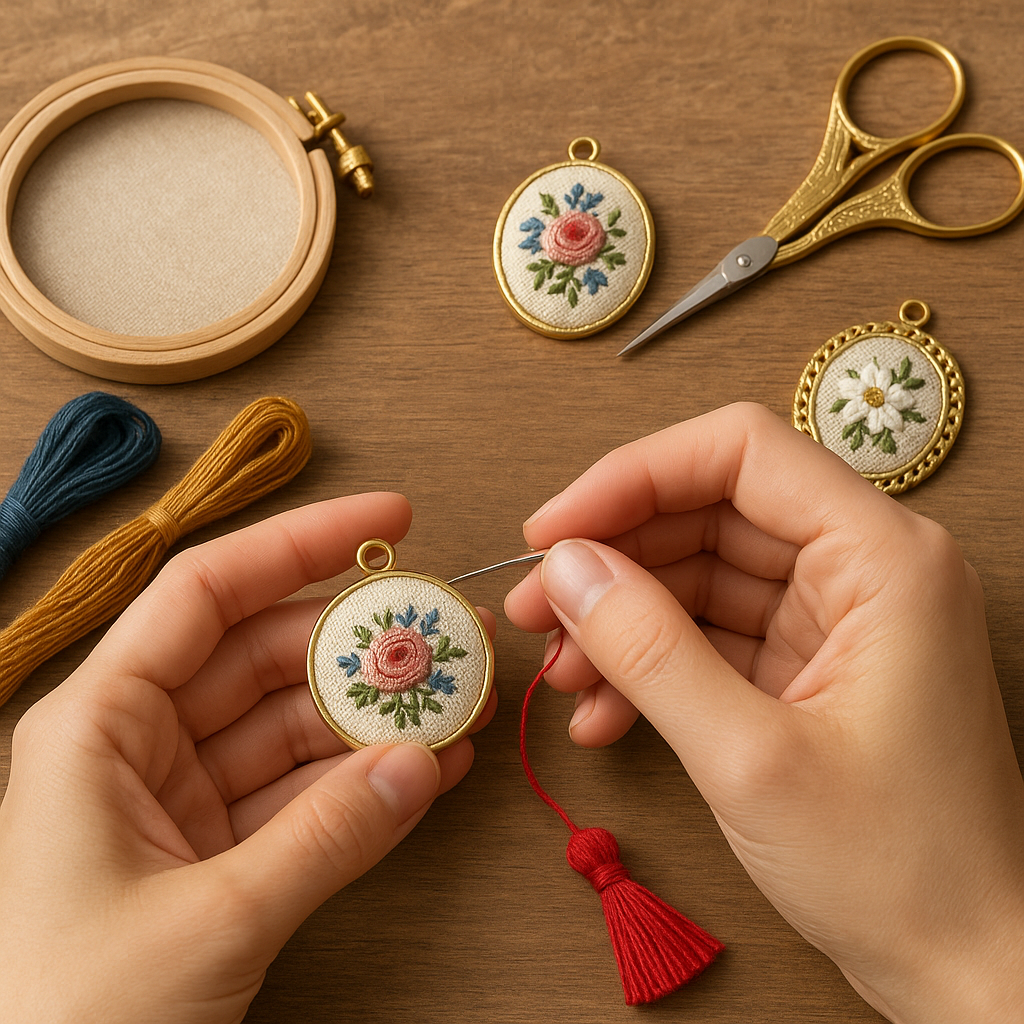
Embroidery has always been a language of texture, patience, and light. When it moves from cloth to jewelry, that language becomes remarkably intimate: the canvas shrinks to a few centimeters, stitches translate into gemstones of thread, and every decision about color, stitch direction, or bead size suddenly matters at the scale of a blink. This guide walks you through the mindset, materials, and methods that turn needlework into wearable art—pendants, earrings, brooches, rings, and cuffs that are comfortable, durable, and beautifully finished. Whether you favor spare minimalism or ornate storytelling, you will learn how to design for movement, resist humidity and abrasion, and celebrate the textile soul of jewelry.
Materials and Tools for Textile-Based Jewelry
Working small does not mean using fewer tools; it means choosing them more carefully. Each component becomes part of the engineering of the piece, and small upgrades can have an outsized impact on longevity and comfort.
Fabrics and Foundations
- Ground fabrics: Fine-weave cotton, linen, silk organza, and high-count evenweave are classic choices. For bead embroidery or thread-heavy motifs, a dense felt or stiffened interlining adds body and resists distortion.
- Stabilizers: Lightweight fusible or sew-in stabilizers prevent puckering and keep outlines sharp. For very delicate fabrics, a removable wash-away stabilizer helps during stitching and disappears at finishing.
- Backing materials: Faux suede, leather, and microfiber backings protect the reverse side from skin oils and snagging. Many artisans prefer Ultrasuede for its soft hand, clean cut edges, and color range.
Threads and Wires
- Thread fibers: Cotton floss, stranded silk, filament silk, and polyester machine-embroidery threads each behave differently. Silk offers a luminous sheen and tight curves; cotton provides matte softness; polyester excels in abrasion resistance for earrings and rings.
- Metallics: Japan gold thread, passing thread, gimp, and fine metal twist enable classic accents. They demand deliberate tension to avoid kinks.
- Beading threads: Nymo, FireLine, KO, and polyamide threads resist wear and keep beads aligned. Use thin diameters (e.g., 6 lb FireLine) for compact bezels and crisp edges.
- Wire: Soft wire (28–32 gauge) secures sculptural embroideries to frames or forms prongs in hybrid pieces without adding bulk.
Needles, Frames, and Findings
- Needles: Beading needles pass through seed beads repeatedly; milliners/straw needles are ideal for bullion knots and wrapped stitches; embroidery sharps suit general work. Swap needles the moment you feel drag.
- Frames and hoops: Mini hoops, tambour frames, and tension rings keep fabric steady. For small motifs, hand tension with tape around the frame edge reduces slippage.
- Findings: Pendant trays, brooch backs, ear wires, jump rings, and chain are your connectors to the body. Nickel-free, hypoallergenic metals reduce skin reactions, especially in hot climates.
Adhesives and Finishes
- Adhesives: Contact cements and flexible jewelry glues help bond backing and beadwork. Use sparingly, keeping glue at least 1–2 mm from edges to prevent bleed-through.
- Protective coatings: Microcrystalline wax or fabric sealers reduce linting and resist moisture on thread-painted areas that will see friction.
Foundations of Technique at Jewelry Scale
Jewelry-scale stitching compresses the vocabulary of needlework. Stitches that look bold on a sampler become abstract pixels. With practice, you will sculpt light and shadow with the tilt of a thread or the angle of a bead.
Thread Stitches That Translate Well
- Backstitch and split stitch: Excellent for ultra-fine outlines and lettering, easy to curve. Ideal for monograms, borders, and graphic motifs.
- Satin stitch: Creates gemstones of thread. At small scale, break large areas into staggered sub-sections to avoid ridging.
- Long and short stitch (thread painting): Blends shades for floral petals, feathers, or miniature landscapes. Use three or more tones for depth.
- French knots and bullion knots: Bubbled textures and raised dots. Anchor securely to prevent loosening with wear.
- Couching: Lays thicker thread or cord on the surface, secured with tiny stitches. It visually “frames” shapes without adding height that snags.
Bead Embroidery Basics
- Seed bead backstitch: Anchor beads in pairs, then pass back through to firm up. Align rows like shingles for smooth coverage.
- Edge beading and picot: Encases raw edges and adds a refined outline. Picot edges soften transitions and protect threads.
- Cabochon settings: Secure a stone or glass cabochon on a felt base with beaded walls. Follow with a stitched peyote bezel to lock the stone and achieve a neat profile.
Micro-Scale Approaches
- Silk gauze and high-count fabrics: Enable tiny motifs for rings and stud earrings. A 48–60 count ground can hold detailed initials or mini botanicals.
- Micro-embroidery: Uses ultra-fine needles, single-thread strands, and magnification. Keep stitches short; keep tension feather-light; rest your eyes frequently.
Tambour and Chain Techniques
- Tambour beading: A hook forms chain stitches while adding beads at speed. On sheer bases like organza, it creates airy, luminous fields that feel weightless as earrings.
- Chain stitch: On opaque grounds, chain stitch can outline leaf veins or create flexible bands that drape beautifully in pendants.
Classic Metal-Thread Accents
- Goldwork details: Purls, check purls, and passing threads introduce metallized brilliance without heavy cast metal. Pair with couching for controlled sparkle.
Designing for Wearability and Durability
Great embroidered jewelry looks exquisite on the table and even better on the body. That difference hinges on scale, weight, flexibility, and skin comfort.
- Scale and profile: Keep thick textures away from collars or scarves that might abrade. Aim for smooth domes in brooches and flatter textures where hair might tangle (earrings).
- Weight balancing: Back pendants with light but rigid inserts (thin brass or plastic) to distribute tension from bails and chains.
- Edge management: Always finish edges—beaded rims, whip-stitched leather, or turned fabric edges—to prevent fray and to feel smooth against skin.
- Moisture and oils: Choose threads with dyefastness. For humid climates, favor polyester or silk over unmercerized cotton for exposed areas.
- Movement: Earrings should flex slightly; brooches need rigidity, especially at the pin stem area. Reinforce stress points with hidden stitches or a tiny dab of flexible adhesive.
- Color strategy: Understitch backgrounds in a color close to your beads or threads; any microscopic gaps will disappear visually.
Step-by-Step Projects to Build Skill
Project 1: Bead-Embroidered Cabochon Pendant
- Trace and prepare: On firm felt, trace your pendant tray’s inner shape. Lightly roughen the tray base for better adhesion later.
- Seat the stone: Glue the cabochon to the felt with a thin, even layer; let cure fully to prevent slip.
- Bead the wall: Using seed bead backstitch, encircle the stone. The first two rows should be tight without distorting the oval or circle.
- Lock with a peyote bezel: Work a round or two of even-count peyote over the top bead row. The bezel should tip inward slightly to secure the stone mechanically.
- Decorative rows: Add a halo of accent beads, tiny picot buds, or couched metallic twist. Keep height low for comfort.
- Trim and back: Cut the felt close to the outer bead edge. Adhere to an Ultrasuede backing, then stitch the edges with a tidy brick stitch or picot.
- Mount: Glue the finished disk into the pendant tray or stitch directly to a decorative hanger. Attach a chain and test hang so the pendant lies flat.
Project 2: Thread-Painted Floral Brooch
- Design: Sketch a simple flower with 3–5 petals; plan three thread values for each petal and two for shadows.
- Stitch: Work long and short stitches from the petal tip toward the center, alternating lengths for a blended gradient.
- Texture: Add a few French knots or tiny satin stitches at the center to mimic pollen.
- Structure: Interline with a thin card or plastic oval. This resists warping when pinned to a coat.
- Edge finish: Whip-stitch the perimeter to the backing, then add a minimal beaded rim for protection.
- Hardware: Stitch a brooch pin back onto a small leather bridge before securing the entire back. This isolates stress from stitches.
Project 3: Mini Hoop Earrings with Negative Space
- Frame: Use 2–3 cm wooden or metal mini hoops. Stretch silk organza smoothly; its translucency adds visual lightness.
- Motif: Outline tiny ferns with split stitch, keeping negative space between leaflets. Add micro French knots sparingly.
- Finish: Trim and back with a lightweight circle; paint and seal the hoop if wood. Add hypoallergenic ear wires.
- Balance: Test swing. If the earrings pitch forward, shorten the ear wire loop or add a discrete counterweight bead near the top.
Project 4: Cuff Bracelet with Bead-Backed Spine
- Base: Wrap a premade cuff blank with stiff felt, then sketch a geometric pathway down the center.
- Embroider: Alternate matte and lustrous beads to create rhythm; intersperse satin-stitch bars in coordinating thread.
- Reinforce: Add a flexible insert at the sides to prevent collapse at the wrist bend.
- Back: Adhere a smooth lining to prevent catching on sleeves, then edge with a robust brick stitch.
Advanced Hybrids and Structural Play
Textile and metal can collaborate rather than compete. Consider ways to secure embroidered components with mechanical means so they can be removed, cleaned, or repaired.
- Prong-set textiles: Build a shallow metal frame with short prongs that fold over an embroidered insert. A thin acrylic or mica shield protects thread surfaces without obvious glare.
- Resin doming: Seal small embroideries beneath domed resin for spill-proof pendants. Pre-seal threads to prevent resin wicking; degas to remove bubbles.
- Laser-cut backplates: Lightweight acrylic or brass with slots lets you lace embroidery in place, distributing stress evenly.
- Stumpwork volume: Wire-edged petals stitched off-canvas can be arranged into 3D florals on brooches. Keep forms shallow for everyday wear.
- Kinetic elements: Chain-framed tassels or bead fringes amplify sparkle while staying clear of necklines. Test for tangling before final assembly.
Finishing Techniques and Professional Touches
Finishing is where handcrafted quality becomes visible. Clean edges, thoughtful backings, and discrete signatures elevate the entire piece.
- Backings: Choose a lining that matches the front’s tone; a slight contrast can create an intentional frame. Press gently with a cool iron and pressing cloth where appropriate.
- Edge literacy: Brick stitch, whip stitch, and beaded picot each telegraph different aesthetics—sleek, classic, or ornate. Pick one that reinforces your design language.
- Attachment philosophy: Prioritize mechanical joins—stitches, prongs, bezels—over glue wherever feasible. Adhesive is a helper, not a crutch.
- Marking: Add a tiny embroidered monogram or metal tag to the back. It helps brand recognition without marring the front.
- Packaging: Store earrings on perforated cards that keep tension off hooks; place pendants in trays that avoid crushing texture.
Troubleshooting Common Issues
- Puckering: Increase stabilization, reduce stitch length, and avoid pulling laterally. Mount the piece while still on the frame to lock in alignment.
- Thread shredding: Switch to a fresh needle and wax only non-beading threads lightly. For metallics, let the thread dangle periodically to unwind twist.
- Bead drift: Re-pass through edge beads to anchor. Switch to a stiffer beading thread for fringes.
- Visible glue halo: Apply glue with a toothpick and stop at least a bead’s width from the edge. Allow full cure time before cutting.
- Warped brooch: Insert a thin, springy core (plastic sheet or metal shim) and stitch it into the seam to restore flatness.
- Tarnish near textiles: Use tarnish-resistant metals or seal raw brass edges. Avoid commercial dips; they can wick into fibers.
Care and Long-Term Maintenance
Jewelry lives hard lives: sun, perfume, motion, and skin oils accumulate. Small habits will dramatically extend beauty and structure.
- Cleaning: Dust with a soft brush; spot clean with barely damp cotton. Avoid soaking. For beaded pieces, compressed air on low helps lift lint.
- Storage: Lay pieces flat, away from direct light, and separate metals from threads with acid-free tissue.
- Repairs: Keep a spool of the original thread color with each finished piece. A single restitch with a matching dye-lot makes damage invisible.
- Environmental exposure: Apply perfume and lotions before wearing; remove jewelry before exercise or heavy rain.
Sustainability and Thoughtful Sourcing
The intimacy of handcraft invites mindful choices. Fiber and metal supply chains vary widely; transparency is part of the story your jewelry tells.
- Recycled metals: Many suppliers offer recycled sterling or brass findings; they pair beautifully with textile fronts while reducing mining impact.
- Natural fibers and dyes: Plant-dyed silks and cottons add layered narratives and subtle tonal depth. Pre-test lightfastness on windowsill swatches.
- Upcycling: Vintage linens, kimono scraps, or heirloom handkerchiefs become meaningful grounds for new adornments.
- Local sourcing: Buying threads and tools from regional shops fosters knowledge-sharing and reduces shipping footprint.
Color, Texture, and Light: A Mini Design Clinic
Small canvases amplify errors and triumphs alike. Intentional choices make micro-compositions sing.
- Value before hue: Plan lights and darks in grayscale thumbnails to confirm form reads at a glance. Then layer color.
- Luster mixing: Combine matte threads with glossy beads to avoid visual monotony. Metallic hints act as punctuation, not paragraphs.
- Edge choreography: Heavier edges push motifs forward; feathered edges blend them into ground. Use this to guide attention.
- Directional light: Angle satin stitches like roof shingles; they catch light differently and animate the surface as the wearer moves.
From Bench to Body: Testing and Iteration
Wear-testing exposes realities a bench cannot: hair snags, heat-induced stickiness, or pendants that flip while walking. Build testing into your process.
- Prototype quickly: Stitch one quadrant or a smaller sibling of your intended piece. Evaluate drape and finish before committing to full scale.
- Stress points: Hang pendants on a wall hook overnight to test glue and stitch integrity. Flex cuffs repeatedly to see if beads loosen.
- Skin sense: Check for itchy or scratchy backings; swap to softer materials or add an extra lining layer.
Professional Presentation and Selling Tips
If you plan to sell, communicate care as clearly as craft. Buyers respond to pieces that feel complete—technically and narratively.
- Photography: Use diffused light; angle the piece to reveal thread sheen and bead facets. Include a close-up to celebrate stitch discipline.
- Scale cues: Always show jewelry on a neutral bust or hand to clarify size; micro-work can be misread without context.
- Copywriting: Share the motif’s origin, fibers, and hours invested. Words like archival and hypoallergenic, when true, build trust.
- Pricing: Account for design time, sampling, and finishing—these dominate at small scales. Reproducible designs can be priced differently than one-of-a-kind work.
- Aftercare: Include a small card with do’s and don’ts tailored to textiles and beads.
Cultural Motifs and Respectful Practice
Embroidery is a global language with deep cultural roots. When incorporating regional stitches or motifs, study their histories, credit lineages, and avoid sacred or restricted symbols. Learning from living practitioners—via workshops or collaborations—creates reciprocity and keeps traditions alive.
Expanding Your Repertoire: Skill-Building Roadmap
- Start: Master backstitch outlines and tiny satin fills; practice clean edges with brick stitch or whip stitch.
- Next: Add bead embroidery and simple bezels in pendants or brooches. Explore micro florals on silk gauze.
- Deepen: Study couching with metallics, gentle thread painting, and tambour basics for speed and fluidity.
- Advance: Combine stumpwork elements, laser-cut frames, or prong-set inserts to develop a personal signature.
Checklist Before You Call It Finished
- Front: Even tension, consistent stitch direction, no stray fuzz, beads aligned, no visible glue.
- Edges: Fully enclosed, no sharp ends, profile suits intended wearing area.
- Back: Smooth against skin, pin or bail anchored on reinforced substrate.
- Wear test: Hang, flex, and rub lightly with fabric to simulate use; make any final reinforcements.
- Documentation: Note threads, beads, fabrics, and finishing steps for future repair or reproduction.
Closing Thoughts: Jewelry as Intimate Text
At jewelry scale, embroidery becomes a whisper—light caught in a satin ridge, a seed bead reflecting a window, a thread-paint gradient no larger than a thumbnail. Treat each piece as a micro-architecture built for contact with skin and movement through light. With thoughtful materials, disciplined technique, and iterative testing, your work will not only survive daily wear; it will gather stories, season after season, like the best handcraft always does.
