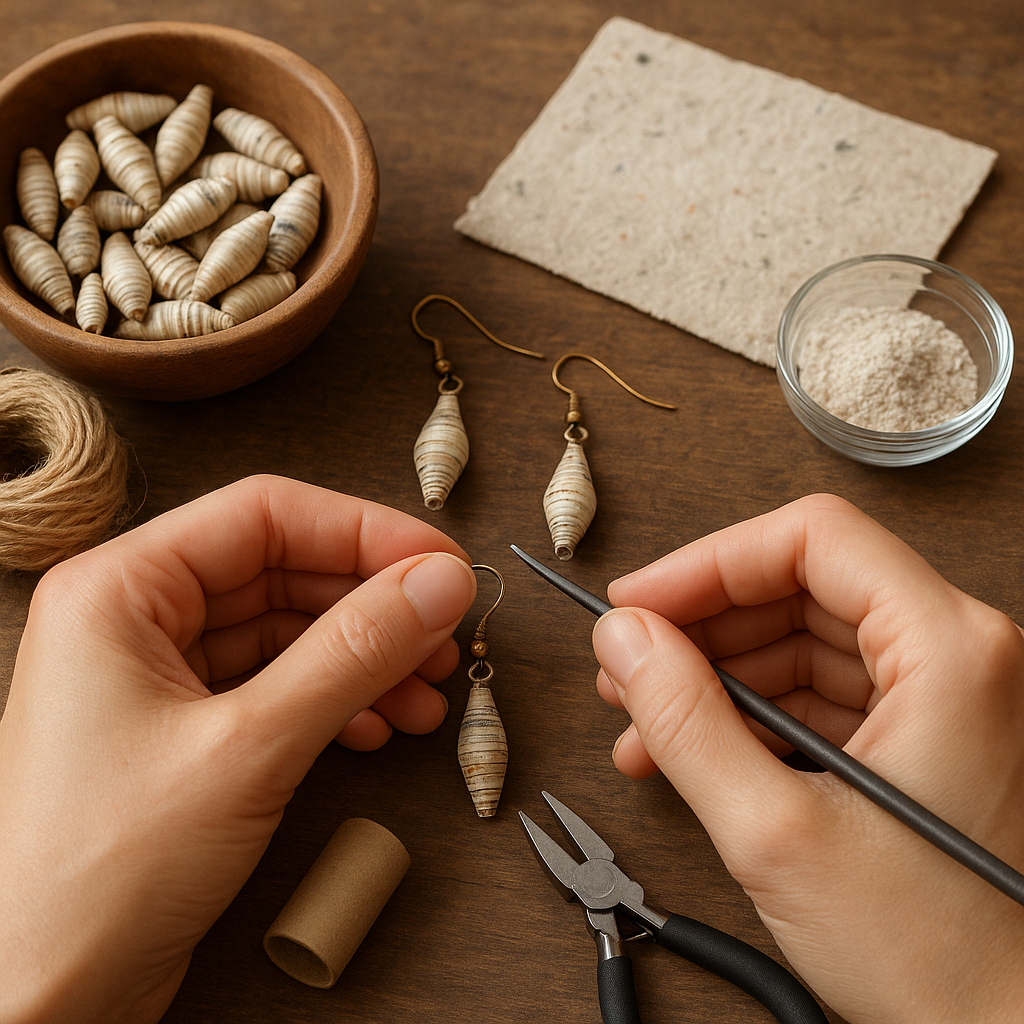
Paper is humble, abundant, and astonishingly expressive. Give it a second life as jewelry and it becomes a vehicle for story, texture, color, and memory—light on the body yet rich in presence. Working with recycled paper invites craftspersons to explore form with almost no barrier to entry: an old magazine becomes a pair of vibrant earrings; a vintage map turns into a locket that carries a place close to the heart. The practice blends mindful making with resource-savvy values like sustainability and thoughtful upcycling, while keeping costs low and possibilities high. Whether you prefer delicate filigrees or bold sculptural statements, recycled paper adapts with surprising strength when layered, sealed, and connected with intention.
Choosing and Preparing Recycled Paper
The success of paper jewelry begins with attentive material selection. Not all paper behaves the same: fiber length, coatings, weight, and pH determine how it folds, bonds, and ages. Getting familiar with these characteristics will elevate both aesthetics and longevity.
Sources worth exploring
- Magazines and catalogs: Glossy coatings produce crisp, vivid edges in rolled beads. The clay coating resists deep dye penetration but accepts surface varnish beautifully.
- Maps, sheet music, and book pages: Evocative imagery with fine print lends instant narrative. Seek acid-neutral or buffered papers when longevity matters.
- Packaging offcuts: Cereal boxes, tea cartons, and skincare sleeve boxes offer sturdy chipboard layers ideal for pendants and bangles after lamination.
- Art book dust jackets and calendars: Heavy, richly printed stock that cuts cleanly and shapes well.
- Handmade papers and envelopes: Fiber-forward textures, security patterns, and deckled edges add visual intrigue.
Paper anatomy and performance
Grain direction matters. Most papers bend more easily along the grain and resist across it; matching grain with intended fold lines reduces cracking. When rolling beads or laminating layers for bangles, alternating grain orientation strengthens the composite, much like plywood.
Weight and thickness guide use. Thin (70–100 gsm) sheets fold, coil, and quill elegantly; midweight (120–180 gsm) supports small structures; heavier cover stock (200–300 gsm) builds rigid bases and components for brooches or statement earrings. For heirloom pieces, consider paper labeled as archival to reduce yellowing over time.
Pre-cleaning and flattening
- Remove adhesives and tape with a warm putty knife; residual glue can repel finishes.
- Flatten curled pages between clean boards under weight for 24–48 hours.
- Dehumidify slightly in a dry room to reduce buckling during lamination.
Cutting and stockpiling
Pre-cut strips and shapes accelerate making. Batch-produce common sizes: 5–10 mm strips for coils, triangles for rolled beads, 30–50 mm bands for bangles. Store them in labeled envelopes noting source, weight, and grain direction. This micro-inventory keeps color palettes cohesive across sets.
Essential Tools, Adhesives, and Sealants
Paper jewelry thrives on precision and clean edges. You don’t need a full studio; a compact, thoughtfully chosen toolkit ensures consistent results and comfortable work.
Core tools
- Self-healing cutting mat and sharp craft knife or rotary cutter for clean lines.
- Metal ruler with cork backing for safe, straight cuts.
- Bone folder or Teflon folder for crisp creases and pressure during lamination.
- Micro hole punch (1–2 mm), awl, and eyelet setter for secure connection points.
- Round mandrels, knitting needles, or paper bead rollers to form consistent cylinders and saucers.
- Small files and fine-grit sanding sticks (400–1200) to refine edges.
- Soft paintbrushes and foam applicators for glues and finishes.
- Calipers or a micrometer to track thickness during lamination.
- Clamps, bulldog clips, or spring clothespins to maintain pressure while curing.
Adhesives
- PVA (polyvinyl acetate): The everyday hero; choose neutral pH, bookbinding-grade varieties for flexible bonds and reduced brittleness.
- Methyl cellulose or wheat paste: Slower set for quilling and delicate laminations; dries matte and is repairable with moisture.
- Double-sided adhesive sheets: Seamless laminations without squeeze-out; excellent for stacking layers before cutting shapes.
- Contact cement (water-based): For stiff substrates; ventilate well and test for color shift.
- CA glue (cyanoacrylate): Spot reinforcement; can fog glossy surfaces—use sparingly and mask areas if needed.
- Epoxy or UV-curable resin: Doming, encapsulation, and enhancing depth—ensure compatibility with inks and print (some inks bleed).
Sealants and surface protection
- Water-based polyurethane or acrylic varnish: Clear, nonyellowing, available in matte to gloss. Build 3–6 thin coats for effective waterproofing.
- Shellac: Warm tone and quick drying; excellent on vintage papers but may amber over time.
- Wax finishes (beeswax/microcrystalline): Tactile sheen; combine with hard varnish for structure, then wax for hand.
- Edge sealers: Thin PVA, lacquer pens, or clear nail topcoat for vulnerable edges.
Always test: apply a dab of finish to a scrap to watch for ink bleed, blotchiness, or warping. Multiple light coats beat one heavy flood every time.
Techniques for Structure and Form
The magic of paper lies in its ability to transform with simple manipulations. Mix and match techniques to achieve distinctive forms that are featherlight yet sturdy.
Rolled beads
Cut long isosceles triangles. Apply glue along the length and roll from base to tip on a mandrel. Wider bases yield saucer beads; narrow triangles produce slender barrels. Lock the final tip with a tiny bead of PVA, then seal. Variations include double-walled rolls for added rigidity, and “lace rolls” that incorporate punched holes along strip edges before rolling.
Lamination and carving
Stack and glue multiple sheets at cross-grain to produce a thick blank (2–5 mm). Once cured under pressure, shape with knives and microfiles as you would with softwood. This “paper microlam” accepts crisp facets and beveled edges; seal pores before sanding to avoid fuzz.
Origami and kirigami
Folded modules create volume without heavy cores. Modular stars, tessellations, and exploded cubes can be stabilized with interior brush coats of dilute PVA. Think about modularity—repeatable units link into chains or pendants that can be reconfigured.
Papier-mâché and pulp casting
Blend torn paper with water, drain, and mix with PVA or methyl cellulose to form a sculpting paste. Press into silicone molds for quick domes and cabochons or hand-sculpt organic pods. Dry thoroughly (low heat, moving air), then harden with varnish before sanding smooth.
Coiling, weaving, and basketry-inspired forms
Cut uniform strips and coil flat or on a dome mold, gluing each layer. Weave narrow bands into checkerboard or herringbone textures for cuffs and pendants. Interleave slender cords of twisted paper with wire for hybrid strength.
Paper filigree
Traditional paper filigree—better known as quilling—translates exquisitely into earrings and pendants. Combine tight coils, teardrops, marquise, and scrolls on a waxed template; float-coat with thinned varnish for translucency that evokes enamel.
Surface Design and Finishing
Surface treatment turns form into ornament, guiding the eye and enhancing tactile pleasure. Because paper is porous, finishes influence both look and longevity—apply with restraint and intention.
Coloring and pattern
- Acrylic washes and inks: Thin with water for transparency; build glazing layers to preserve print beneath.
- Natural dyes: Avocado pits, tea, and onion skins yield subtle hues; pre-mordant paper with alum solution for richer uptake.
- Pastels and colored pencils: Soft gradients without clogging pores; fix lightly before varnish.
- Image transfer: Gel medium transfers from laser prints onto laminated blanks for crisp motifs; burnish, then lift paper fiber to reveal the image.
- Decals and rub-ons: Clean edges without brush marks; overcoat to integrate.
Texture and relief
- Embossing: Press dampened paper in a stencil with a ball stylus to raise motifs; harden with thin varnish before handling.
- Foiling: Apply heat-activated foil over toner-printed areas or use gilding adhesive for selective metallic luster.
- Microcollage: Layer tiny snippets of maps, tickets, or stamps; unify with a glaze to avoid clutter.
Edgework and sheen
Edges reveal craftsmanship. After sanding to 800–1200 grit, seal, then repeat. A final pass with a smooth agate or bone tool—careful, firm strokes—adds luminous burnishing that looks jewelry-grade even without high-gloss varnish.
Findings, Connections, and Wearability
Paper components transform into jewelry when connected thoughtfully. Balance strength, movement, and skin comfort.
Hardware choices
- Eyelets and rivets: Distribute stress around holes in pendants and charms. Choose small-diameter, thin-flange units; back with a washer disk of laminated paper for reinforcement.
- Jump rings and wire: Use tempered brass, bronze, or stainless to resist deformation; for a cohesive look, enamel or patinate to complement paper tones.
- Magnets: Low-profile closures for paper lockets and bracelets; epoxy-set and seal edges to prevent corrosion.
- Textile cords: Waxed cotton, linen, or silk ribbons keep the material narrative consistent while staying gentle on paper edges.
Comfort and balance
Weight is an ally, but scale affects swing and torque. Consider ergonomics: earrings longer than 60–70 mm may need counterbalance or ultra-light components; bangles should maintain a smooth inner diameter with sealed edges to avoid fiber abrasion against skin. Round every touchpoint; buff and seal interior surfaces thoroughly.
Project 1: Laminated Map Pendant with Clear Dome
Concept
Turn an old atlas page into a keepsake that highlights a city or coastline through a glossy dome.
Materials
- Vintage map (matte, tightly printed)
- Double-sided adhesive sheet or PVA
- Clear doming resin (epoxy or UV)
- Eyelet, jump ring, and chain or cord
- Circle punch or craft knife and circle template
- Acrylic sealer, fine sandpaper, and micro brush
Steps
- Select a 20–30 mm circle area with meaningful geography. Back it with two or three identical circles laminated cross-grain to reach 1.5–2 mm thickness.
- Seal printed surface with two thin coats of acrylic to lock inks.
- Bevel the edge lightly with 600–800 grit and reseal.
- Punch or drill a 1.5–2 mm hole near the top; set a micro eyelet to reinforce.
- Dome the face with clear resin, allowing a surface-tension bubble to form a cabochon lens. Cure flat and dust-free.
- Attach jump ring and chain. Option: back-coat with matte varnish for contrast.
Project 2: Quilled Galaxy Earrings
Concept
Concentric coils and teardrops in midnight blues and silver create lightweight statement drops with celestial flair.
Materials
- Pre-cut paper quilling strips (or 3–5 mm strips from recycled magazines in blues and grays)
- Methyl cellulose or bookbinding PVA
- Template board with pins, fine-tipped tweezers
- Acrylic wash, iridescent mica powder, and matte varnish
- Eyelets, jump rings, earring wires
Steps
- Form tight coils for “stars,” loose coils for “nebulae,” and marquise for orbit paths. Pin elements on a waxed surface and tack together sparingly.
- Float-coat the assembly with thinned varnish to maintain translucency between fibers; let dry.
- Dust select edges with mica powder set in varnish for a soft shimmer.
- Install tiny eyelets through reinforced nodes; connect to ear wires with small jump rings.
Project 3: Braided Bangle with Hidden Wire Core
Concept
A flexible wire core wrapped with braided paper strips yields a durable cuff that reads like leather but breathes like paper.
Materials
- Recycled kraft or security-envelope strips (10–12 mm)
- Soft craft wire (1–1.5 mm) and two end caps
- PVA, clips, sanding sticks
- Matte polyurethane and wax
Steps
- Tightly wrap wire with a paper strip to form a smooth base; glue and dry.
- Braid three prepared strips around the core, maintaining even tension; secure every 20–30 mm with a dot of PVA on the underside.
- Trim and tuck ends into metal or laminated paper end caps; glue and crimp lightly.
- Seal with two coats of matte polyurethane; burnish lightly with wax for a supple hand.
Durability, Testing, and Care
Paper jewelry, when engineered properly, can withstand everyday wear. The difference lies in fiber orientation, lamination quality, connection design, and finish build. Treat strength holistically—structure, edgework, and coating contribute to the whole.
Bench tests
- Abrasion: Rub a sealed sample on denim for 200 strokes; evaluate scuffing and colorfastness.
- Moisture: Place a droplet of water for 5 minutes; look for swelling or clouding. Add sealing coats until the droplet beads cleanly.
- Torsion: Twist a pendant across its axis; if you hear fiber crackle, add cross-grain lamina or reduce cutouts near stress points.
- UV: Leave samples in indirect sun for a week; note fade. Switch to lightfast pigments or UV-protective varnish where needed.
Document build sequences so successful recipes can be repeated. Name your stacks: “Kraft-Kraft-Map/Matte x3” says everything at a glance.
Care instructions for wearers
- Remove before showering, swimming, or intense exercise.
- Store flat or hanging, away from direct sunlight and excess humidity.
- Wipe with a dry, soft cloth; avoid solvents and perfumes.
Share a small care card with each piece; it elevates perceived durability and invites mindful use that preserves beauty. Over time, micro-scratches can enrich the surface, building a gentle resilience that tells the story of wear.
Sustainability and Sourcing with Intention
Recycled paper jewelry is more than a technique; it’s a design philosophy. Harvest materials from community art bins, libraries, and print shops. Cut around stains but embrace patina, postal marks, and margin notes—these human traces invite connection. Choose low-VOC, water-based adhesives and finishes when possible; ventilate well and capture sanding dust with a simple bench mat for easy disposal. Shipping in paper pillow boxes or stitched envelopes continues your material narrative from studio to client.
Mind waste in process: batch-cut strips to minimize offcuts, and transform micro-scraps into pulp cabochons or confetti inlays. Offer a take-back program to refurbish or reseal beloved pieces, closing the loop elegantly.
Troubleshooting and Common Mistakes
- Wavy laminations: Too much glue or uneven pressure. Use a brayer and press between smooth boards with breathable release paper; apply thinner coats.
- Ink bleed under varnish: Seal first with a light mist of fixative or a brush coat of clear acrylic medium; test every new paper source.
- Fraying edges: Sand, then edge-seal before final coats. For high-wear edges, add a narrow strip of tissue as a bandage and seal again.
- Cracking at holes: Reinforce with eyelets or backers; avoid placing holes near cutouts or along the paper grain where stress concentrates.
- Cloudy resin dome: Moisture or incompatible inks. Warm the piece gently before doming and pre-seal inks; use fresh resin and protect from dust while curing.
Design Language and Storytelling
What makes recycled paper jewelry captivating is its narrative density. A metro ticket earring holds a commute, a program stub pendant recalls a concert. Lean into provenance: pair a map locket with coordinates on the tag, or stamp a tiny date inside a laminated bangle. Curate palettes: security envelope blues with oxidized brass; sepia textbook pages with warm copper; neon magazine clippings with satin-black findings.
Compose families of forms—discs, pods, bars—so wearers can layer a cohesive story. Use negative space: openwork quilled frames set against simple studs feel airy and sophisticated. Contrast finishes: matte body with a high-gloss accent, or soft waxed surfaces against crisp metallic foils.
Scaling Up: From Craft Bench to Small Brand
If you aspire to sell, build repeatable processes without sacrificing soul. Standardize strip widths, invest in a reliable circle punch set, and template your top-selling silhouettes. Record curing times by season; humidity shifts finishing behavior. Photograph with soft, raking light to reveal fiber texture and edge quality—details that signal craftsmanship online.
- Pricing: Track time per stage (cut, assemble, finish, hardware) and material usage; pay yourself for design, not just assembly.
- Packaging: Paper-forward solutions—die-cut cards, stitched pouches, recycled tissue—echo your material choices.
- Compliance: Nickel-free findings reduce allergy concerns; include clear care notes to minimize returns.
- Batching: Run work in cohorts—laminate all blanks one day, sand and seal the next—so each layer cures fully and consistently.
Consider limited editions tied to specific paper sources (a run of earrings from one vintage map), creating scarcity that aligns with authentic material limits.
Advanced Hybrids and Explorations
Stretch the medium through hybrid builds. Embed thin paper motifs into bio-based resins for glasslike depth; back with laminated paper instead of plastic to keep the narrative coherent. Sandwich a sheer layer of tissue with gold leaf between transparent varnish coats for luminance. Stitch through laminated paper with linen thread; dot each exit hole with thin varnish to prevent tear-out. For rigid forms, inlay slender bands of brass or wood veneer into a paper microlam blank; finish flush and unified.
Sound matters, too. Paper jewelry often moves quietly, but tiny chimes from seed beads or metal spacers can add a lively presence without weight. Explore scent by waxing with lightly infused natural waxes for a subtle, pleasant aura.
Mindful Workflow and Studio Habits
Keep a clean, dry, and organized bench. Separate “ink-heavy” stock from unprinted fibers to avoid cross-contamination when sanding. Label jars for sanded dust by color; this pigment-like fluff can tint PVA for seamless edge repairs. Maintain a curing rack to protect wet finishes from dust; a simple storage bin inverted over spacers works wonders. Rotate two or three projects at staggered stages—while one cures, another gets cut—so you maintain momentum without rushing layers that need time to set.
A Practical Glossary for Paper Jewelers
- Cross-grain lamination: Stacking paper with alternating grain directions for structural stability.
- Edge-sealing: Saturating exposed edges with thin finish to prevent moisture ingress and delamination.
- Doming: Building a convex, glasslike surface with resin or multiple varnish coats.
- Quire: A small stack of sheets; in jewelry context, a measured unit for batching layers.
- Sizing: A treatment that controls absorbency; affects how paper takes dye or finish.
Closing Thoughts
Recycled paper jewelry rewards curiosity and care. It asks you to listen to fibers, to honor the history printed on a page, and to orchestrate layers into objects that feel inevitable in the hand. Its lightness frees you to play ambitiously with scale and silhouette; its surface invites luminous glazes and quiet matte whispers. Begin with a single strip rolled into a bead and watch it multiply into a language—of folds, layers, and edges—that can express anything from minimal calm to intricate exuberance. With patience, testing, and a reverence for small, repeatable gestures, paper becomes unapologetically precious—crafted not from rarity, but from attention.
