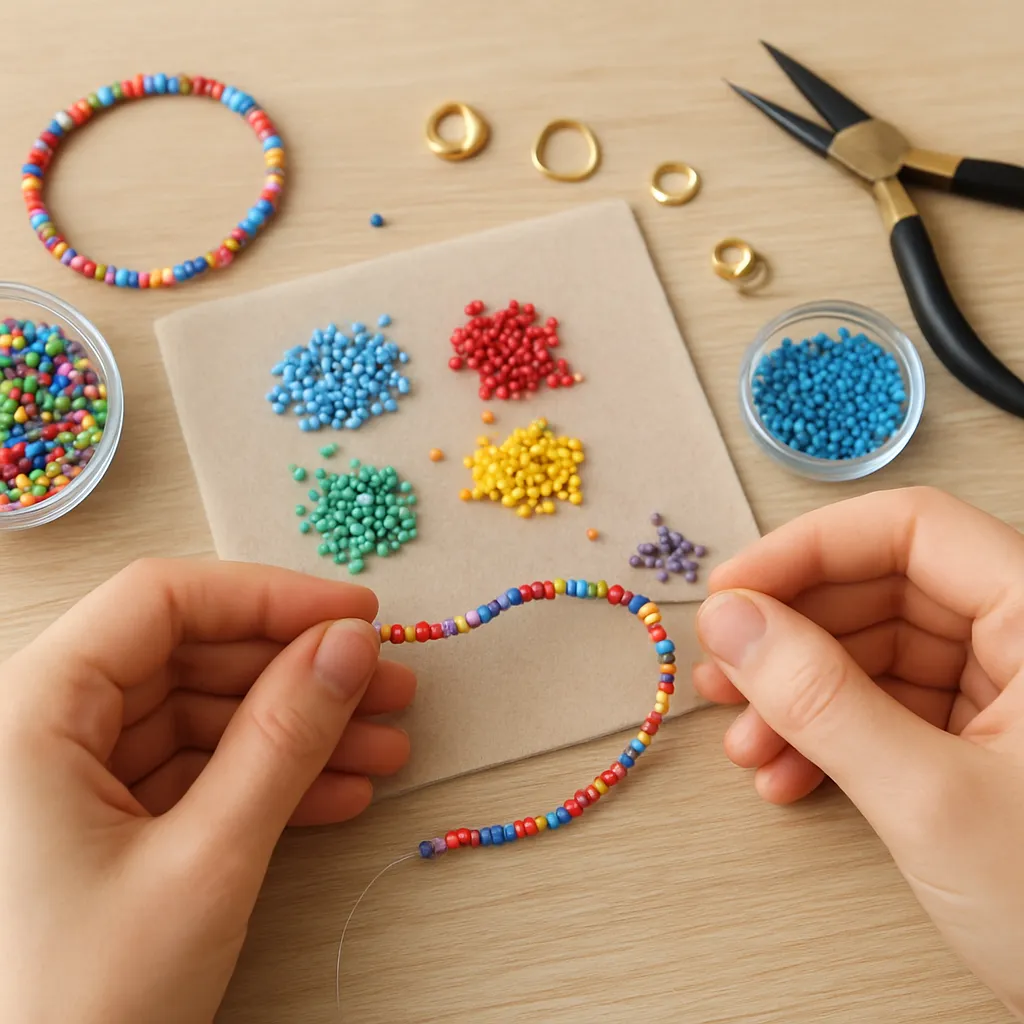
Small beads, big impact: making jewelry with diminutive glass seeds is a craft that rewards patience, curiosity, and a sense of play. With a modest kit and a few approachable techniques, you can turn a handful of shimmering dots into bracelets, earrings, and pendants that look refined yet carry the unmistakable warmth of handmade work. This guide welcomes absolute beginners while offering depth for returning crafters who want to refresh skills, refine finishing, and approach design with new confidence.
What Makes Seed Bead Jewelry Special
Seed beads—tiny, uniformly shaped beads traditionally made of glass—sit at the intersection of precision and poetry. Their small scale supports both geometry and improvisation: you can follow a chart to weave a perfect repeat, or let color and texture guide a spontaneous pattern.
Types vary by origin and manufacture. Japanese brands (often prized for consistency) include cylindrical beads that stack like bricks, producing crisp edges ideal for graphic motifs. Rounder Czech beads lend a softer profile, great for organic contours and drape. Finishes range from transparent, opaque, matte, luster, metallic, and AB (aurora borealis) to specialty coatings like color-lined and silk satin. Understanding finishes matters because they influence how your piece reads under different lighting, how it wears against skin, and how it partners with metals and fibers in mixed-media designs.
Size is typically denoted as 15/0, 11/0, 8/0, etc., with higher numbers indicating smaller beads. Beginners often start with 8/0 or 11/0: they’re easy to see, handle, and count, yet small enough to create refined detail. As your accuracy improves, you may explore 15/0 for intricate edging, bezels, and micro-patterns. Scale affects time and mood: larger beads build quickly, smaller beads reward meditative focus.
You can approach seed bead jewelry through several modes: off-loom weaving techniques (like peyote, brick, herringbone), loom weaving for fabric-like panels, and simple stringing on flexible wire or fiber. Each method invites different thinking about structure, drape, and wearability. As you practice, you’ll also get a feel for material synergies: how bead finish interacts with thread sheen, or how a minimal metal accent can elevate a humble palette.
Tools and Materials That Make Learning Easier
Collecting tools is part of the fun, but you can start lean and upgrade as you go. The following essentials support clean work, fewer frustrations, and long-lasting results.
Beads and thread
- Seed beads in one comfortable size (11/0 is classic for starters), plus a few complementary colors and finishes. Consider one or two accent beads in a larger size for focal points.
- Thread options: nylon beading thread (widely available) is supple and traditional; braided fishing-style thread such as FireLine is slick, strong, and abrasion-resistant, particularly helpful with sharp-edged beads or metal components.
- Conditioner or wax (optional) to tame twist and reduce fraying on nylon.
Needles and findings
- Beading needles in sizes 10–12 for 11/0 beads; a size 10 is forgiving for beginners.
- Metal components called findings: jump rings, ear wires, head pins, crimps, and a clasp style you enjoy. Choosing quality metal finishes prevents discoloration and skin reactions.
Cutting, shaping, and support tools
- Flush cutters or sharp scissors dedicated to thread.
- Round-nose and chain-nose pliers for opening/closing rings and shaping simple wire loops.
- Crimping pliers (if you plan to string with wire and use crimps).
- Bead mat or soft fabric to prevent beads from bouncing away and to improve visibility.
- Storage: small trays or boxes with compartments; labels save time later.
- Good light and optional magnification. Proper posture and tool placement promote good ergonomics, reducing hand and neck fatigue during longer sessions.
Core Concepts and Techniques for Confident Results
Threading, tension, and securing
Begin by threading a comfortable length—about an arm’s span to avoid excessive tangling. Add a stop bead (a stray bead you thread and then pass through once more) a few inches from the tail; this prevents your initial beads from sliding off while you work. As you stitch, aim for consistent tension. Think of thread as a line of energy connecting each bead; too loose produces gaps and wobble, too tight causes puckering or breakage, especially around turns.
To end a thread, weave a few half-hitch knots between beads, traveling through multiple beads to distribute stress, then trim close. When starting a new thread, weave in silently—no need to knot if your path is well secured. Avoid overusing glue; when applied, choose a precision-tip cement and keep it off visible areas.
Essential stitches: the vocabulary of beading
- Even-count peyote: a rhythmic, interlocking pattern where each new bead sits in the “gap” of the previous row; wonderful for bands and patterned panels.
- Brick stitch: beads stack like masonry and hang from thread bridges; perfect for triangles, medallions, and fringe earrings.
- Right-angle weave (RAW): beads form squares with flexible drape; great for ropes and bezels with added embellishment.
- Square stitch: builds grid-like fabric similar in look to loom work but done off-loom.
- Herringbone (Ndebele): pairs of beads lean together in columns, making supple ropes and textured cuffs.
- Netting: airy, lacy structure that adapts to scalloped collars and bead-woven cabochon surrounds.
Loom vs. off-loom
A bead loom creates warp threads stretched across a frame. Weft thread carries beads in rows, producing near-perfect grids quickly. Off-loom techniques need no frame, travel well, and allow more sculptural shapes. Many artists enjoy both: loom for clean plaids and text, off-loom for curves and dimensional work.
Starter Projects You Can Finish in an Afternoon
1) Calm-Color Stretch Bracelet
Best for first-timers, this project teaches stringing, color flow, and secure finishing without metal tools. You’ll need 8/0 or 6/0 beads, quality elastic cord, and a dab of flexible jewelry cement.
- Measure wrist and add comfort allowance (about 1.5–2 cm). Cut elastic accordingly, leaving extra to tie.
- Pre-stretch the cord gently to reduce later slack.
- Plan a simple gradient or repeating motif. String beads until you reach desired length.
- Tie a surgeon’s knot (double overhand with an extra wrap). Add a tiny dab of cement, snug the knot into a larger bead if possible, and trim tails.
- Roll the bracelet to test wear; adjust by adding/removing beads if it feels too tight or loose.
2) Even-Count Peyote Band Bracelet
This teaches counting, tension management, and edge finishing. Choose 11/0 beads in two or three colors, nylon thread, size 10–12 needle, and your preferred closure.
- String the first two rows at once: alternate colors (e.g., A-B-A-B-A-B for 12 beads). Add a stop bead before these.
- Turn and begin peyote: pick up a bead, skip one on the base, pass through the next. The new bead will nestle into a gap. Repeat across.
- At row ends, turn by passing through the top bead of the previous row; maintain consistent spacing. Your edges should look like tidy stair-steps.
- Keep checking width and length against your wrist. Introduce a subtle pattern: stripes, checkerboard, or a simple motif like diamonds.
- Finish by adding a beaded loop and a button, or attach metal ends and a micro lobster. Weave in ends; do not knot on an edge bead where friction is highest.
3) Brick Stitch Fringe Earrings
Lightweight and expressive, these earrings teach increases, decreases, and controlled drape. You’ll need 11/0 beads, a pair of small rings or a beading loop at the top, ear wires, and fringe beads (optional bugles or drops).
- Start with a ladder base of 6–8 beads; connect the strip into a ring or leave flat if working from a metal ring.
- Work upward in brick stitch: each stitch hooks under a thread bridge from the previous row. Add or subtract beads per row to taper into a triangle.
- Anchor fringe along the bottom edge: pick up the desired fringe length, add a small accent, and climb back up the strand leaving the last bead as a stopper.
- Attach ear wires via jump rings. Mirror your second earring by counting rows and fringe lengths carefully.
4) Mini Loom-Woven Bracelet
Perfect for graphic stripes or simple text, this teaches row rhythm and finishing warps cleanly.
- Warp a small loom with 7–9 threads for 6–8 columns of beads. Keep warps parallel and evenly tensioned.
- Load beads across the weft needle to match your pattern, slide them under the warps, then lift and pass the needle back through above the warps to lock beads in place.
- Continue rows, maintaining steady beat and width. Check edges for straightness; adjust finger pressure as needed.
- Finish by weaving weft tails into the beadwork. Secure warp ends by stitching them into the last rows or using ribbon clamps for a quick metal finish.
5) Right-Angle Weave Charm or Key Fob
Using 8/0 beads for visibility, form a small RAW square with three or four units by looping through sets of four beads at a time. Reinforce the perimeter, add a loop, and connect to a key ring or purse clip. This project introduces path planning and thread reinforcement—key skills for durable pieces.
Design Confidence: Color, Pattern, and Texture
Great seed bead jewelry often begins with a simple, confident palette. Classic triads (e.g., teal, coral, mustard) feel lively, while analogous schemes (e.g., sea blues and greens) soothe. Metallics act like spices—small amounts transform a piece, but too much can overpower. Consider the tactile and visual: a matte row next to glossy beads emphasizes line and shadow; transparent beads atop a metallic surface glow from within.
When exploring color theory, try these practical habits:
- Build a swatch card: stitch tiny squares of favorite combinations. You’ll learn how finishes interact in real light, not just in a tray.
- Anchor brightness with neutrals. Charcoal, cream, or soft browns allow saturated hues to sing without shouting.
- Use value contrast to define motifs. A mid-tone pattern on a mid-tone background disappears at a distance; a dark-on-light motif remains legible.
- Test small before committing. Make a 1–2 cm wide strip to audition a pattern for a larger cuff.
Pattern reading usually follows grids (for loom, square stitch) or staggered charts (for peyote). Learn the chart’s orientation and whether you’re reading right-to-left or left-to-right per row. Mark progress with a sticky note or washi tape; it’s low-tech but extremely effective. For fringe designs, sketch a quick elevation with strand lengths marked; symmetry grows easy when there’s a plan.
Professional Finishing Without Fancy Equipment
Strong, neat endings distinguish craft from keepsake. Take care at connection points and any place that moves against metal or skin.
- Thread management: weave—and occasionally backtrack—through multiple beads before trimming tails. Hide knots in the “turns” between beads, not right at an edge.
- Metal finishing: when crimping flexible beading wire, use a well-sized tube or bead and a crimping tool for a two-step fold and round. Add a crimp cover for a polished look if desired.
- Protect wear points: use wire guardians or small beads between a beaded loop and a metal ring to reduce abrasion.
- Edging: a simple picot (adding tiny beads around a cuff’s perimeter) tidies edges and adds a couture touch.
- Closures: choose the right scale and motion for the piece—toggles are intuitive for bracelets; magnetic closures excel for ease but need secure seating and quality plating.
Troubleshooting: From Snags to Satisfying Fixes
Beadwork teaches patience through little puzzles. Common issues have reliable cures:
- Uneven edges in peyote or loom work: check for miscounts or skipped beads one or two rows back; it’s faster to unweave a short section than to compensate with awkward fixes later.
- Holes too tight to pass the needle: change to a finer needle, flatten thread end with your fingernails, or sidestep that bead and replace it later by gently snapping it with flush cutters and reinserting a new bead on a repair thread.
- Curling or cupping bands: ease your tension; add a relaxed pass of thread around the perimeter to encourage drape.
- Fringe tangles: vary end beads and lengths slightly so strands nest rather than knot; use smooth-turn beads (rounded, not sharp-edged) at the tips.
- Thread twist: let your needle dangle occasionally and spin out twist. Wax lightly or switch thread types for stubborn kinks.
Care, Comfort, and Wearability
Well-made beadwork is durable when treated kindly. Keep pieces away from perfumes and hair sprays, which can dull coatings. Store flat or hanging to avoid kinks in fringe. If something snags, resist the urge to yank; inspect, unwind, and, if needed, perform a small repair by weaving a new thread path through the area.
Comfort matters: if a bracelet flips or a necklace rides up, adjust weight distribution with a few larger beads near the clasp or switch to a different closure style. For earrings, consider hypoallergenic metals and balanced designs that don’t tug on lobes. Smooth any rough thread tails with a careful melt (for specific threads that allow it) or a tiny dot of precision cement hidden between beads.
Sustainability and Cultural Respect
Seed beads carry stories across time and continents. Many communities—from Indigenous artists in North America to artisans across Africa and Eastern Europe—maintain profound beadwork traditions. Learning techniques can be a way of honoring those lineages; when drawing direct inspiration from cultural motifs, attribute the source respectfully and consider supporting living artists and ethical suppliers.
Minimize waste with planning: sketch and test swatches before cutting long threads. Save small lengths for mending or micro-embellishments. Upcycle: a single broken earring can become a pendant or charm. When buying, choose suppliers who disclose origin and labor standards where possible; durable materials also mean fewer replacements over time.
Leveling Up: From Skills to Personal Style
Once you’re comfortable with starter projects, gently raise the stakes:
- Combine stitches: a peyote base with netted edging; RAW core with herringbone embellishment.
- Explore dimensional forms: beaded beads, bezels around stones or crystals, and sculptural motifs.
- Develop signatures: a favorite palette, a recurring texture, or a recognizable silhouette across your pieces.
- Document your process: keep a notebook with thread types, needle sizes, counts, and finishing notes. These records make repeats and sizing variations painless.
- Photograph with diffused light and neutral backgrounds to showcase color and detail; consistent styling enhances a portfolio.
Safe Setup and Gentle Practices
Working comfortably supports better craft. Arrange tools within easy reach on a stable surface, and keep beverages away from your bead mat. Take short stretch breaks to rest hands and eyes. Good posture, wrist support, and lighting are as essential to results as the beads themselves. Small daily sessions build skill faster than occasional marathons.
Step-by-Step Mini Tutorials for Reference
Even-Count Peyote Start (quick recap)
- String base (two rows at once): for a 10-bead-wide band, start with 10 beads alternating colors as needed.
- Row 3: pick up a bead, skip one, pass through the next; continue. Turn through the edge bead to start the next row.
- Maintain a gentle arc in your thread path to avoid tight corners; flatten rows with a fingertip press after each pass.
Brick Stitch Increases
- At row start, add two beads on the first bridge to widen; at row end, place the last bead on a shared bridge if needed.
- To decrease, skip the first or last bridge. Keep the silhouette smooth by planning increases symmetrically.
Simple Wire Loop for Dangles
- Slide bead(s) onto a head pin; bend the wire 90 degrees at bead top.
- Use round-nose pliers to form a loop; wrap the tail if desired for strength.
- Attach the loop to ear wires or chain with a jump ring opened side-to-side, not pulled apart.
Checklists for Smooth Sessions
Before you start
- Choose one technique focus—stringing, peyote, or brick—to minimize context switching.
- Lay out a limited palette: 2–4 colors. Constraints boost creativity.
- Measure and note target lengths; keep a ruler or measuring tape nearby.
During work
- Check length often, especially for bracelets; body heat can subtly relax fibers.
- Replace a bead that looks scratched or misshapen; tiny flaws add up visually.
- Rest your eyes by looking across the room every 20 minutes; bright beads can dazzle under strong light.
After finishing
- Inspect stress points: loops, crimps, and ends. Tug-test gently.
- Document counts and materials if you plan a matching set or a size variant.
- Store with silica gel if humidity is high, particularly with unsealed metal finishes.
Common Myths, Kindly Debunked
- “Small beads are only for experts.” Starting big helps, but beginners can absolutely succeed with 11/0 and a simple stitch.
- “Beadwork is fragile.” Proper thread choice, reinforcement, and mindful finishing produce pieces that handle daily wear beautifully.
- “Patterns limit creativity.” Patterns teach structure; creativity often blooms once the grid feels familiar.
Finishing Touches That Elevate
Subtle refinements make starter projects look boutique-made:
- Edge alignment: add a final pass along bracelet edges, lightly snugging to flatten any waver.
- Bead choice rhythm: repeat a specific accent at measured intervals to create a heartbeat through the design.
- Mixed finishes: pair matte with metallic or glossy with etched for depth without changing color.
- Hardware harmony: match metal tones across ear wires, jump rings, and closures; a unified metal story reads as intentional and elegant.
Where Practice Leads
The road from first bracelet to heirloom cuff is paved with small, satisfying wins: learning to read your materials, to anticipate drape, and to fix a hiccup invisibly. Perhaps most delightful is how these skills translate across pieces: the meticulous counting you hone in a narrow band suddenly makes a patterned collar feel achievable; the loop you perfected on a dainty earring steadies your hand when you wire a pendant.
As you continue, give yourself playful prompts: interpret a favorite painting as a palette, re-create a vintage textile motif in beads, or translate a city skyline into a bracelet silhouette. Set gentle limits—only three colors, only matte finishes, or only round beads—to discover fresh solutions.
Resources You Already Have
Beyond specialized tools, you have everyday assets: a phone camera to capture patterns on a sidewalk; a spice rack that teaches hue relationships; a window whose changing light reveals how transparent beads shift throughout the day. Turn to your wardrobe for practical testing—will a cuff snag a sweater? Would a lighter earring complement a blouse neckline better than a statement pendant?
Closing Encouragement
Seed bead jewelry rewards presence. You thread a needle, pick up a bead, and commit a tiny act of placement. Over time, those acts accumulate into something wearable and expressive that holds hours of attention in every row. With a clear workspace, a few favorite colors, and a forgiving beginner mindset, your first finishes will come quickly—and they’ll only get more thoughtful as you go. Along the way, you’ll gather the quiet joy of solving small structural puzzles and the bold joy of designing pieces that feel undeniably yours.
Choose a starter project, set a comfortable pace, and let your hands learn. Everything else—the polish, the speed, the instinct to improvise—arrives bead by bead.
