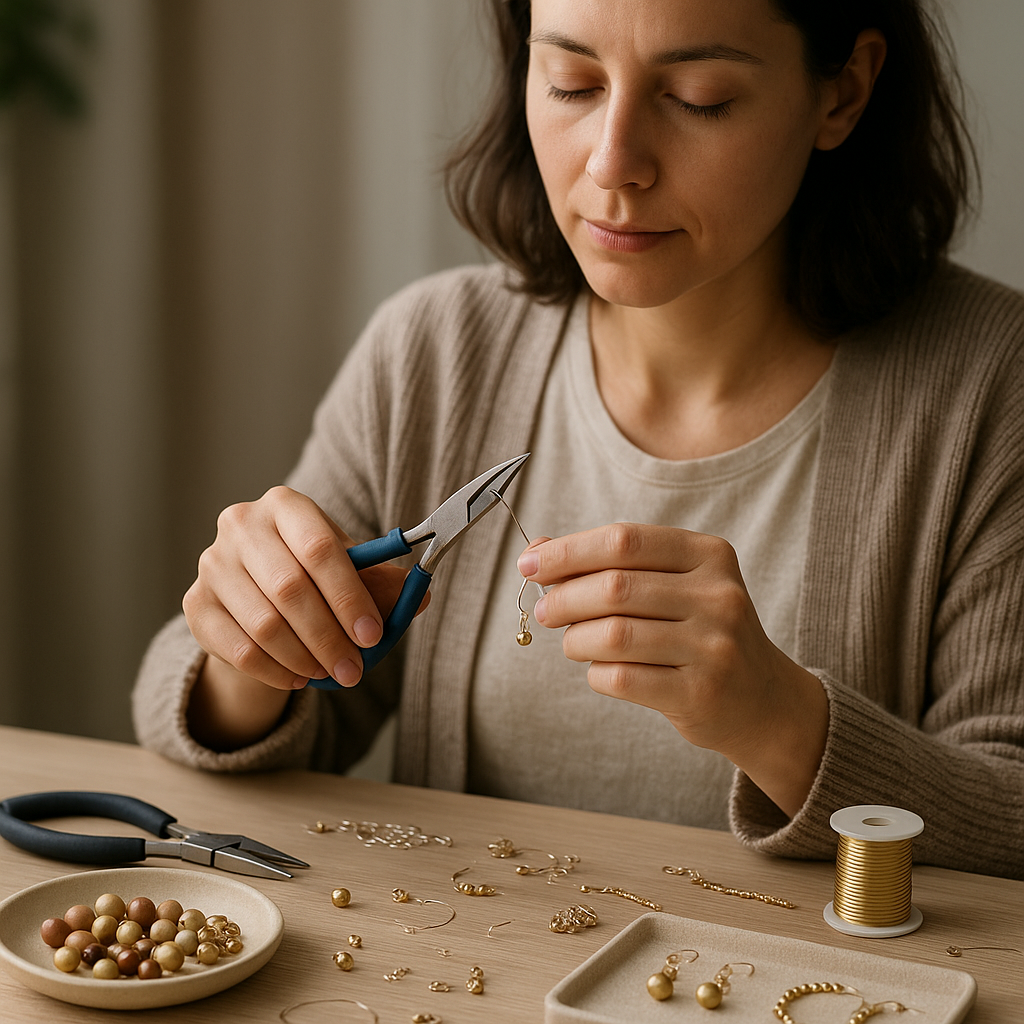
Making jewelry trains the mind through the fingertips. Each cut of a saw blade, each bright flicker of a torch, and each curve coaxed from metal can become a small anchor in the stream of thought. Handicraft is not merely a means to a wearable object; it is a practice of noticing—the grain of a file, the temperature shift before solder runs, the softness of wax as it yields to a carving tool. Practiced with intention, jewelry making becomes a gateway to mindfulness and deep presence, illuminating how attention steadies when guided by movement, material, and meaning.
Jewelry Crafting as a Mindful Practice: Why Hands Teach the Mind
Jewelry has always invited intimacy. Unlike many crafts, it culminates in contact with the body—on skin, near pulse points, close to breath. That intimacy extends to the process itself. The bench becomes a quiet theater where small actions have clear consequences: saw true, and the seam closes cleanly; rush, and the blade snaps. This immediate feedback is what makes the practice fertile for mindful learning. When the task is fully embodied, the mind is encouraged to release unhelpful ruminations and settle into a gentle, sustained flow.
Hands-on craft offers a rare blend of structure and improvisation. A bezel must fit the stone; solder will only run at a specific temperature; but within those constraints, the maker tunes rhythm, touch, and timing. The mind becomes a conductor of micro-decisions: one more stroke with the file, two degrees more heat, a softer grip on the saw frame. Each micro-choice is a bell that calls the maker back to what’s here, now.
Because jewelry tasks are small-scale and repeatable, they lend themselves to “pulses” of awareness. The mind does not need to hold a vast plan; it can rest inside one cut, one link, one hammer strike. Over an afternoon, these pulses accumulate into a quiet steadiness—proof that attention can be learned, not by force, but by contact with the real.
The Science of Slow Hands: Neuropsychology and Somatic Calm
Makers often report a subtle physiological settling during bench work. Regular, controlled motions—sawing, bead stitching, hammering—can entrain steadier breathing. Steady breath, in turn, supports the parasympathetic nervous system, which dampens reactivity and reduces the sense of threat. The mind reads the body’s signals. When the body says, “We are safe enough to make,” the mind can consider beauty, nuance, and detail.
Repetitive fine-motor actions also engage bilateral coordination and proprioception, the inner sense of where the body is in space. Attuning to these sensations encourages embodiment, the felt experience of being in one’s body with clarity and care. Over time, this can soften rigid thinking patterns, because the nervous system is receiving a rich stream of non-verbal information that says: locate, adjust, explore.
Neuroscientific models of attention suggest that focusing on a task with immediate sensory feedback strengthens networks associated with executive function and working memory. Jewelry offers abundant feedback loops. The pitch of a blade cutting through sterling changes as you approach the line; the color of the flux shifts the moment solder is about to flow; the resistance at the burnisher eases when a stone finally seats. Each cue rewards listening, which is precisely the skill that quiets mental noise.
There is also a social neurobiology at play: the objects we create carry stories, and stories connect people. Anticipating the gift of a handmade ring for a friend, or the lineage of a technique learned from a mentor, supports meaning-making systems in the brain that elevate motivation and resilience. The craft bench becomes an ally, not a demand.
Materials, Tools, and Tactile Choices That Shape Attention
Different materials invite different qualities of attention. Hard metals like stainless steel ask for patience and deliberate pacing; soft metals like fine silver reward gentler pressure and teach subtlety. Natural fibers used in stringing lend warmth; gemstones teach respect for fracture lines and internal structure. Choosing materials mindfully can be part of the practice itself:
- Metals: Copper trains beginners to read heat. Brass reveals tool marks clearly, encouraging precision. Silver forgives but records intention; gold amplifies every cue, inviting care.
- Stones: Cabochons encourage protective settings and smooth finishes; faceted stones require exact seat preparation and teach patience with micro-adjustments.
- Organic elements: Wood, shell, bone, and horn offer tactile warmth and an awareness of living origins. They remind the maker to consider sustainability and story.
- Threads and wires: Silk, nylon, and coated wire each shape rhythm; knotting pearls, for instance, cultivates breath-synchronized repetition.
Tool selection also acts as a mindfulness teacher. A heavy hammer cultivates intention; a light hammer cultivates finesse. A sharp file rewards minimal effort and proper angle; a dull file punishes overexertion with sloppy lines. The lesson is simple: maintenance is not an interruption—it is a practice of attention. Tuning saw blades, dressing hammer faces, cleaning polishing wheels—each act of care improves outcomes and builds prideful calm.
Rituals and Studio Setup for Mindful Making
Environment cues behavior. A considered workspace reduces friction and invites ease. Keep benches clear enough that each tool has a place; let light fall from the side to reveal texture; place magnification within reach rather than as an afterthought. Tidy trays for works-in-progress create confidence that ideas won’t be lost.
Before you begin, begin well. A small opening ritual can shift the mind into craft mode:
- Light a bench lamp only when ready to start, as if drawing a stage curtain.
- Lay out tools in order of operations; touch each one, name its role, and feel its weight.
- Take three slow breaths, lengthening the exhale, and set a gentle intention: “Attend to sensation,” “Give the work enough time,” or “Notice the moment before a mistake.”
- Put your phone on airplane mode; let silence be part of the material palette.
Closing rituals matter, too. Record a brief note of what you learned; photograph the piece under consistent light; sweep the bench pin and save filings. Ending with order tells the future self: your work is safe; you may return without dread.
Step-by-Step Mindful Exercises for Jewelers
Sawing as Breathwork
Mount a 2/0 blade. Place a straight line on scrap brass. Inhale to lift the saw; exhale to cut. Let your wrist do less; let your shoulder anchor. Notice the sound—a higher pitch when aligned, a scratchiness when twisting. Continue for ten breaths. Pause to loosen your grip by five percent. The output is a straighter line; the outcome is a calmer nervous system.
Hammering as Metronome
On a steel block, planish a copper disc. Set a slow tempo in your mind: tap, lift, rotate the piece a few degrees, tap. After a minute, soften your gaze and “listen” with your palm. The uniformity of marks shows whether your swing arc is consistent. Use micro-corrections, not force, to improve. End when the surface sings one note, not a chorus of clanks.
Bezel Setting as Listening
Seat a cabochon in a soldered bezel. With a pusher, compress metal at the cardinal points—north, south, east, west—then between them. After each push, stop. Ask: Did the stone shift? Is the lip even? Does the burnisher glide or catch? Pause every two minutes to let impatience surface, then return to feel. The stone will tell you when it is ready.
Bead Stringing as Mantra
Knotting pearls or gemstones becomes a series of small devotions: pick, place, knot, seat. Count every fifth knot with an exhale you can hear. If a knot misbehaves, do not fight; unmake, remake, and smile at the lesson. Completion is less about speed than about keeping kindness in the fingers.
Community, Heritage, and Meaning in Handicraft
Mindfulness grows in community. Traditional jewelry methods have long been taught hand-to-hand at benches and kitchen tables. Apprenticeships, guilds, and contemporary workshops transmit not only technique but also sensibility: how to hold a file without waste, how to listen for solder flow, how to rest when fatigue makes mistakes inevitable.
Learning from elders and peers provides an ethic of attention: show your work, accept critique as a gift, and share sources. Many jewelers keep a lineage list—a simple acknowledgment of whose hands shaped theirs. This lineage invites humility and fuels continuity. When a maker feels part of a long story, the piece in the hand becomes both personal and communal.
Gifting or commissioning jewelry amplifies meaning. A ring handed down across generations carries grace notes of care; a brooch made from reclaimed family gold merges memory with the present. Mindfulness in making begets mindfulness in giving: the timing of the gift, the words spoken, the way the piece is worn on ordinary days and on days of passage.
Sustainability and Ethical Mindfulness in Jewelry
Mindful craft attends to consequences. Metals and stones come from specific places shaped by labor, geology, and history. Choosing recycled metals, tracing gemstone provenance, and supporting artisanal mining initiatives align the inner calm of making with outer justice. When the supply chain is treated as part of the creative field, the maker enjoys a cleaner conscience and a richer story to tell.
Waste can be teacher and resource. Kept dust becomes casting grain; offcuts become ear wires; failed experiments become texture samples. A “nothing wasted” ethos sharpens design because limits press creativity forward. Even packaging can convey care: reusable tins, cotton pouches, and notes explaining repair services reinforce a circular mindset.
Design as Inquiry: Sketching, Prototyping, and the Art of Decision
Design choices are opportunities to practice discernment without harshness. Sketch rapidly, then slowly; move from wild to refined. Prototyping in brass or wax invites curiosity with low stakes. Ask guiding questions:
- What does the material want to become if I listen?
- Where does the piece meet the body, and how should that feel?
- What story or symbol would deepen daily use rather than perform spectacle?
Constraints help. Choose one feature to push—scale, texture, movement—and keep others modest. The aim is not maximal novelty but coherent voice. Over time, voice matures into style, and style frees mental energy; you no longer reinvent every choice but refine a living vocabulary.
From Bench to Body: Wearing as a Continuation of Practice
The mindful loop does not end at polishing. When a piece is worn, it continues to instruct. A ring’s comfort under a bag’s handle teaches ergonomic shank design; an earring’s sway in wind suggests a better hinge; a pendant warmed by skin reminds the maker of intimacy and heat. Wearing invites feedback that refines craft and deepens care for the wearer’s day.
Some makers set private intents into their work: a quiet engraving on the inner band, a hidden stone against the body, a pattern that carries a mantra. These gestures are not secrets so much as living threads. They affirm that ornament can serve not only display but also grounding—a touchstone at the collarbone or wrist that says, “Back to breath.”
Common Obstacles and How to Work with Them
Every jewelry bench hosts a few familiar visitors: frustration, perfectionism, and fatigue. These are not enemies but conditions to be navigated.
- Frustration: Break tasks into smaller wins. If a bezel won’t seat, make three practice bezels with scrap and declare them experiments. Celebrate clean lines and good solder joins even if the larger design fails.
- Perfectionism: Establish a “good enough to learn” threshold. Keep one piece intentionally imperfect on your bench as a reminder that progress matters more than flawlessness. Map errors to causes without self-judgment; replace “I’m bad at this” with “Next time I’ll lower heat sooner.”
- Fatigue: Fatigue predicts mistakes. Institute a non-negotiable pause after an hour. Stretch wrists, roll shoulders, drink water. Return to work only when clarity returns.
Resets can be built into the day. A two-minute “re-sensitization” routine—rub palmar muscles with a rubber ball, breathe out longer than in, glance at a distant object to relax eye muscles—restarts awareness loops. Over time, setbacks become platforms for resilience.
Measuring the Invisible: How to Notice Benefits Over Time
Mindfulness shifts are often subtle. Rather than waiting for dramatic calm, track small markers:
- Tool maintenance becomes more consistent without forcing.
- Error recovery speeds up; you diagnose more quickly and escalate less.
- Breath returns sooner after surprises—like a solder seam opening or a stone chipping.
- Design decisions feel less like guesswork and more like listening.
- The bench feels like a place you want to be, not should be.
Some makers keep a studio log. Note minutes spent, sensations noticed, and one lesson per session. A monthly review reveals patterns: perhaps late-afternoon work produces cleaner bezels, or classical music steadies your saw. These observations feed the next month’s experiments and keep growth explicit.
Hand Techniques That Naturally Cultivate Calm
Different paths through the craft highlight different meditative qualities. Lost-wax carving rewards slowness and tactile exploration as forms emerge from subtraction. Fold-forming brings the thrill of metal behaving like fabric. Chain-making is a hymn to repetition; each link adds a small proof that care compounds over time. Stone inlay asks for precision coupled with love for mineral character; the mind learns to accept a vein or cloud as part of the stone’s biography.
For bead artists, color harmonies become breath maps. For wire wrappers, tension and release are literal: pull until snug, not until strained. For enamelists, waiting through kiln cycles trains patience; the glow of cooling enamel is a classroom on change. For casters, investing and burnout prepare a mold that you will never fully see; this leap of faith teaches trust in process rather than outcome.
Safety as a Mindful Framework
Careful handling of heat, dust, and chemicals is not an obstacle to creativity; it’s a container that allows the nervous system to relax. Good ventilation, eye protection, dust collection during polishing, and safe pickle handling become automatic rituals. When your setup respects the body, the mind can afford to focus on subtleties like form, proportion, and surface. Safety protocols are acts of kindness to your future self.
The Aesthetics of Stillness: Designing for Feel, Not Just Look
Pieces that support mindful wear often share traits: smooth interior edges, considered weight, subtle movement, and finishes that invite touch. Think beyond the gallery photograph. How does the ring travel over the knuckle? Does the pendant settle at a heartbeat-friendly point? Do earrings balance swing and quiet? Designs that privilege sensation return to the wearer a steadying cue throughout the day.
Texture can be a tactile mantra: matte surfaces that soften glare, hammered facets that invite stroking, sandblasts that whisper rather than shout. These are not compromises; they are choices that align exterior beauty with interior ease.
Teaching and Mentoring: Passing On More Than Technique
When you teach a beginner to saw straight, you also teach a way of listening. Mentoring can foreground mindful habits: naming the micro-moment before a mistake, praising accurate self-observation over lucky outcomes, modeling how to pause and reset. In group settings, brief shared silences before torch work create collective steadiness. Critiques can open with what the maker learned about their process, not only what the piece looks like.
Workshops that combine technical demos with short body-awareness practices—wrist mobility, breath timing, eye-rest breaks—help students discover that skill and calm are mutually reinforcing. The promise you offer is not “make perfect things” but “make with awake hands.”
Cultural Symbols, Personal Myths, and Gentle Meaning
Jewelry lives at the meeting point of personal and cultural symbols. A motif borrowed with respect can carry forward a heritage; a symbol invented at the bench can encode a private myth that steadies a life transition. Mindful design asks: what does this mark assert, and for whom? This question reduces empty decoration and invites generous storytelling: a pendant celebrating a recovery milestone, a brooch made from beach-found wire to remember a season of change, a ring that holds a tiny map of a loved city.
Economy of Effort: How Efficiency Supports Calm
Mindfulness and efficiency are not enemies. Laying out tools once prevents twenty micro-frustrations. Standardizing certain forms—ear wires, clasps, chain lengths—frees mental bandwidth for new focal points. Batch processes like cutting multiple blanks at once or tumbling pieces together can create long, quiet intervals ideal for reflective notes or hand stretches. Paradoxically, the more your process flows, the more space you have to savor.
Repair and Reuse: The Ethics of Care in Action
Jewelry repair is a study in humility and empathy. Meeting older pieces reveals how other makers solved problems; it also reveals where wearers needed comfort that the design did not provide. Repair invites conversation: what does the piece mean now? Should we preserve a scar that tells a story? Mindfully repairing honors both object and person, and extends the craft’s social life.
The Business of Calm: Mindfulness in Selling and Sharing
If you sell your work, the mindful frame can extend to pricing, photography, and communication. Price for time, skill, and materials without apology; clear pricing reduces cognitive friction for both maker and buyer. Photographs that show scale on the body and texture in natural light set honest expectations. Packaging with repair instructions and a short maker note turns a transaction into relationship. Calm business practices safeguard the studio’s creative climate.
Daily Micro-Practices to Sustain the Bench Mind
- Start-of-day metal warm-up: two minutes of gentle wire bending to feel elasticity and limit.
- Tool gratitude: pick one tool and list three ways it saves you effort; put it back mindfully.
- Heat watch: during soldering, narrate color changes quietly—flux-clear, metal-dull-red, flow—and stop right after flow.
- Surface scan: close eyes and run fingertips over an edge; open and see what you felt but didn’t see.
- Evening close: write one sentence beginning with “Today my hands learned…”
Why Jewelry, Specifically?
Many crafts cultivate attention, but jewelry offers a uniquely intimate scale and durable outcome. The smallness of the workbench world intensifies precision. The durability of metal means your decisions will live on; your mistakes and graces become part of someone’s daily ritual of dressing. This responsibility can be bracing in the best sense: it encourages care rather than haste, presence rather than distraction. Jewelry dissolves the gap between making and wearing, art and body.
Closing Thoughts
To make jewelry is to join a conversation across centuries about beauty, use, and time. The practice refines the senses and steadies the spirit, not through abstention from life but through deeper participation in it. Each stroke of a file, each drop of solder, each thread pulled snug is a vote for attention over noise. At the bench, you can learn to carry calm out into the world: to hold the subway rail as you would a saw frame, to time a difficult conversation like you time the moment before solder flows, to meet change with the same curiosity you bring to a new alloy.
In the end, the handmade piece remains—a small, shining record of care. But its quieter gift is the habit of making with awake hands. That habit becomes a way of seeing, and that way of seeing becomes a portable sanctuary, a source of steady creativity, gentle compassion for yourself and others, and a trustworthy compass that points you back, again and again, toward what matters most.
