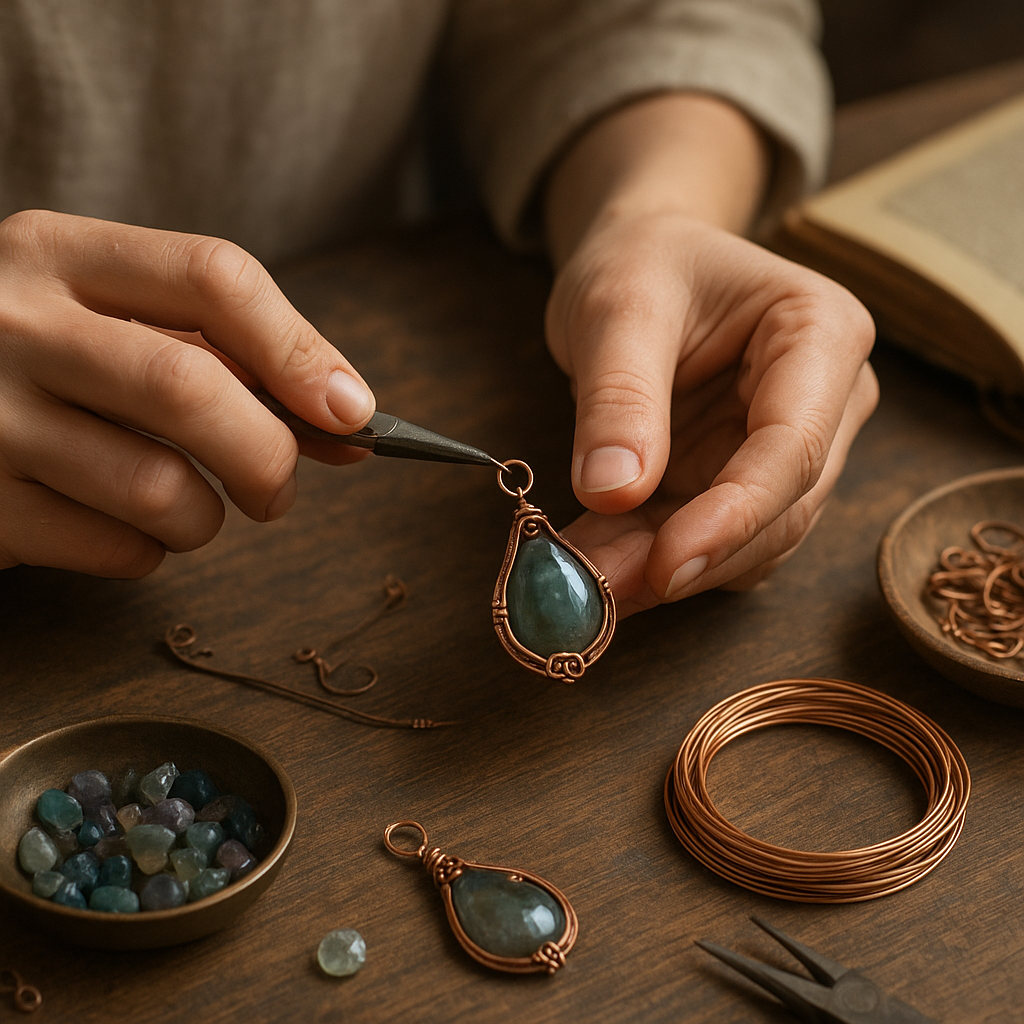
Handmade jewelry is not simply an arrangement of metal, stone, and fiber. It is a small stage where memories rehearse themselves and meanings are rehearsed anew each time the piece is worn. Each brooch, ring, or pendant invites a quiet conversation between maker and wearer: a story of hands, places, and moments condensed into portable form. In this sense, the piece becomes a living narrative, changing as it passes through time, bodies, and contexts. The world of handicraft offers a uniquely rich language for these conversations, because the act of making is visible in the object itself—the tool marks, the seams, the subtle asymmetries that betray the presence of a person. When a piece can be read like a page from someone’s life, it steps out of the commodity realm and into the realm of memory, kinship, and meaning.
Why Stories Matter in Handmade Jewelry
Stories do at least three things for handmade jewelry: they anchor it in the world, they expand it beyond the object, and they invite participation. Anchoring gives weight to a piece: a ring made from melted family silver, a pendant shaped like the mountain you grew up near, earrings patterned after a grandmother’s quilt. Expanding stretches the meaning beyond the material: a necklace can call forth a river, a season, a vow, a threshold crossed. Participation asks the wearer to finish the piece—to put it on and let it accumulate oils, scratches, and the hum of daily life. These three functions answer a modern hunger for things that carry stories rather than simply occupy space.
In this process, jewelry becomes a device for building and reshaping identity. To wear a talisman is to narrate a self; to gift a hand-forged bangle is to narrate a relationship. The story both precedes the object (inspiration, research, sketches) and follows it (care, repair, heirloom transfer). When artisans speak plainly about their sources and process, they reinforce a sense of authenticity that markets cannot mass-produce. The resulting piece operates as a condensed form of cultural heritage: its motifs, techniques, and materials become transmitters of knowledge that might otherwise fade.
Origins and Provenance
Few elements are as persuasive as the origin story. Where did the metal come from? Who passed down that hammer? What town’s shoreline provided the sea-glass? A thoughtful trace of provenance turns the jewelry into an index of relationships—the miner, the lapidary, the toolmaker, the mentor, the apprentice, the client. These relationships can be narrated with precision: place names, dates, materials documentation, and even the names of tools used. The deeper and more transparent the trail, the more compelling the piece becomes.
Provenance is also geographic texture. A brooch can carry the geometry of adobe walls; a ring can hold the chroma of lichens from a northern forest; a chain can echo the rhythms of a coastal tide. Sometimes origins are diasporic: materials gathered from one hemisphere, techniques from another, motifs shared by a community that spans continents. This braid of sources turns the piece into a portable atlas.
Artisans have long used maker’s marks to record lineage. A modern extension includes digital records: high-resolution process photos, workbench diaries, and material certificates stored with the sale. Such careful documentation invites trust, and trust is the soil where patrons feel comfortable investing in a piece that will live alongside them for decades.
Symbolism and Myth in Form
Symbolic language gives jewelry a vocabulary that pre-dates it by centuries. Forms carry myths: the serpent of renewal, the eye of protection, the knot of unity, the seed of becoming. Geometry is a grammar of feeling—circles for continuity, triangles for ascent, spirals for evolution. Cultural motifs translate lived experience into wearable signs that can be read across time and community. A designer’s fluency in symbolism allows them to write pieces that speak quietly yet clearly.
Color compounds the message: deep blues for depth and calm, greens for life, reds for warmth and will. Texture also speaks. Hammered surfaces imply meteor showers, rainfall, or the irregular cadence of footsteps. Smooth polish suggests ceremony; matte finish whispers about the everyday. Even the scale of a piece tells a story of temperament and posture—bold cuffs speak of presence, tiny studs speak of precision and secrecy.
When borrowing motifs from cultures not one’s own, artisans carry an ethical responsibility to study context, seek permission where appropriate, and resist flattening symbols into aesthetic tokens. Deep listening and collaboration prevent stories from becoming costumes. A respectful process makes the finished piece more resonant, because the story remains intact rather than reduced to ornament.
Materials as Narrators
Every substance has a voice, and the artisan is its interpreter. Silver remembers fire; gold remembers pressure and time; iron remembers stars. Stones carry both geological epochs and the hands that cut them. Wood holds weather and growth rings; fiber remembers friction and the path of a spindle. When materials are presented honestly—allowing a small inclusion to shine, leaving a forge scale edge, embracing the grain of a seed—then the piece retains a tactile biography.
In practical terms, the selection of materials can be presented as a map. For example: recycled sterling sourced from a local refiner, pearls from a community farm that documents water quality, sapphires from a cooperative that pays living wages. A simple card or digital note detailing these facts bridges the gap between raw matter and meaning. It helps the wearer tell the piece’s story forward, extending the jeweler’s voice into the wearer’s circle.
Material storytelling also involves technique. Granulation speaks of ancient workshops around the Mediterranean; filigree tells of patient hands and tiny threads; mokume-gane is a record of layered metals and fire-driven diffusion; repoussé records pressure and breath. Patina, intentionally developed, functions like editing in poetry—it adds contrast, hides noise, and highlights verbs. Even failures have narrative power: a solder that flowed a bit too far can become a topographic contour; a crack repaired becomes a signature of survival.
Ethical questions are central. Reuse and traceable sourcing align with the broader story of planetary care, which many clients now seek. A piece made from reclaimed heirloom gold or studio scrap can stand as an artifact of sustainability, turning material scarcity into narrative richness. In this way, the ecological story enhances beauty rather than lecturing it.
Time, Technique, and the Hand’s Trace
Time is the invisible medium of jewelry. The rhythm of hammer strikes, the hours of filing, the cycles of anneal and quench—these leave tiny records on the object. Under magnification, you can read the choreography of process. The tactile evidence of handwork becomes an aesthetic in its own right, signaling craftsmanship that machines simulate but cannot fully replace.
Patina and wear deepen the story long after the sale. Rings develop micro-scratches; pendants polish where they contact skin; chains learn the angle of a wearer’s neck. Repairs add chapters: resizing an inherited ring, replacing a clasp with a stronger one, re-setting a stone after a snag. A thoughtful repair policy is a narrative contract between maker and wearer—an assurance that the relationship with the piece continues.
Some artisans lean into wabi-sabi, celebrating imperfections. Others pursue crisp exactitude. Both are coherent philosophies as long as they are conscious choices. Make the philosophy explicit, and the client understands not just how the piece looks but why it looks that way. The surface becomes a manifesto in miniature.
Personal Commissions and Life Passages
Custom jewelry offers the most direct path from lived moment to object. Engagements, births, leaving home, healing after loss—these transitions ask for a witness, and a jewel can serve. Commissions begin with listening. The jeweler hears stories, asks about habits of wear, gauges symbolism, and proposes forms. The process transforms raw feeling into a translation made of metal and stone.
Life-passage jewelry often holds traces: a sliver of fabric sealed under crystal, a pinch of sand inside a tiny locket, a line from a letter engraved on the inside of a ring. Memorial pieces can be deeply gentle, using textures and colors that hold grief without spectacle. Celebration pieces can be exuberant or quiet, depending on the wearer’s temperament. What matters is that the story can be retold each time the piece is fastened. That retelling is a small ritual that sustains the meaning.
In family contexts, jewelry becomes a conduit between generations. Heirloom stones can be re-set; broken chains can be melted into new forms; motifs can be carried forward like a chorus line in a song. The resulting piece does not erase the past; it illuminates it, like a lantern carried to the front of a procession.
Telling the Story Beyond the Bench
The making is only half the storytelling. How the story is communicated matters just as much. Language, photography, packaging, and presentation create the first frame through which a wearer encounters the piece. Clear prose, honest images, and unpretentious materials invite trust. Overwrought text or borrowed drama does the opposite.
Ways to Communicate Story
- A maker’s note that explains intention, key materials, and care.
- Process photos that show steps from sketch to finish, emphasizing scale and texture.
- Short videos demonstrating a hallmark technique or the sound of filing and hammering.
- Place-based descriptions tying motifs to landscapes, architecture, or daily rituals.
- Material certificates for stones and metals, when available, or at least a plain-language sourcing statement.
- Thoughtful naming conventions that reflect themes rather than trends.
Exhibits, trunk shows, and studio visits amplify the narrative. When clients see the bench, the bins of offcuts, the smell of flux in the air, the story gains atmosphere. Digital tools can extend this intimacy: augmented reality try-on, close-up macro photography, interactive maps of materials. For limited editions, numbered cards and date stamps become small anchors of fact inside the flow of feeling.
The Economy of Meaning
Storytelling also participates in the economics of craft. When pricing a handmade piece, hours and materials tell one part of the tale. Design development, research, and the lifetime of skill-building tell another. Clients often accept price more readily when they understand the narrative of labor and learning behind a piece. Scarcity, edition size, and technical difficulty all have stories; saying them aloud dignifies both maker and buyer.
There is also the question of integrity in a market of fast copies. Story acts as a quiet form of protection: the more specific and well-documented the process and origin, the harder the object is to reduce to a surface-level replica. Conversely, openness about techniques can be a gift to the field, as long as generous crediting and consent guide how knowledge travels. The story thrives when it remains relational rather than extractive.
Cultural sensitivity matters here too. If a pattern or practice belongs to a living community, wise artisans seek collaboration, permission, or alternative routes. A respectful approach ensures that the object adds to the web of meaning instead of thinning it.
A Practical Guide for Artisans
Gathering and Shaping a Story
- Listen first: ask the client about purpose, feelings, and daily life with the piece. Note words they repeat.
- Translate feelings into forms: pick shapes, textures, and colors that mirror the client’s language.
- Map materials: list sources, constraints, and ethical considerations. Choose options that align with the values of the story.
- Document the process: a few photos per stage, plus notes about decisions. This strengthens both memory and trust.
- Name with care: titles can be poetic but should match the actual mood and materials.
- Write a short card: two paragraphs describing intention and care; include any relevant folklore, place names, or dates.
- Design for repair: anticipate future resizing or stone replacement so the narrative can continue rather than end at damage.
Building a Studio Voice
- Keep a lexicon of motifs and their meanings in your practice to maintain coherence across collections.
- Develop a visual signature: hallmark, maker’s stamp, or recurring structural move that readers can recognize.
- Set an ethical baseline for sourcing and waste, and publish it in plain language.
- Photograph pieces on bodies, not only on stands; the wearer is part of the story.
- Archive iterations; what you do not release still informs future pieces and educates clients about depth.
Case Vignettes
Sea-Glass Solstice Ring
A client brings three bits of green glass gathered with a parent on winter walks by a northern sea. The jeweler studies tidal maps and the parent’s handwriting from postcards. The band is forged from recycled silver with a hammered texture echoing wind-chopped waves. Inside the ring, a line from a postcard is engraved, cropped to a fragment that reads like a breath. The bezel holds the glass without overly refining it; the surface still bears beach-softened pits. The card explains the dates of the walks and the latitude of the shore. Each time the wearer turns the ring, their thumb finds the wave texture and remembers the cold air, the companionship, the quiet. The ring is a small coastline worn on a finger.
Ancestor Coin Pendant
A family discovers a tarnished coin carried by a great-grandparent during migration. Rather than polishing to mint shine, the jeweler preserves the relief, adding a protective frame with motifs from the region of origin—olive leaves and geometric steps. A hidden hinge allows the coin to flip without removing the necklace, inviting conversation and choice. A simple booklet tells the migration route, the year the coin entered the family, and a few lines about the ancestor’s trade. The piece becomes a compass, pointing toward the work and will that made the present possible.
Meteorite and Iron Band
The commission celebrates a partnership between an astrophysicist and a blacksmith. The ring combines etched meteorite inlay with a forged low-carbon iron band. The jeweler documents the differential etch that reveals the Widmanstätten pattern and the quench that sets the iron’s grain. A line drawing within the presentation card diagrams the meteorite’s crystal structure and the iron’s flow lines. The result is a convergence of sky and forge, science and hearth, and a daily reminder that intimacy can bridge disciplines.
Loom-Woven Bead Collar
A collar necklace is woven on a loom using glass beads dyed in a palette taken from a childhood landscape: river mud, reeds, dusk clouds. The central motif repeats a motif from a traditional textile, used with permission from a community elder who also receives a collaborative credit. The clasp is carved from reclaimed horn. The package includes a small fold-out map of color references and a paragraph in both the artisan’s and the elder’s languages. Wearing the collar feels like carrying a horizon on the shoulders.
Packaging, Care, and Afterlife
Even the exit from the studio is part of the story. Handwritten notes, reusable boxes, natural fiber pouches, and minimal plastic signal care. A care card frames future acts: oiling wood, avoiding chemical dips on darkened silver, storing on a soft surface. The more the wearer knows, the longer the story can run without interruption. Repair invitations are another narrative device: when a clasp fails, it can come home; when a stone chips, it can be shifted or embraced; when a finger changes size, the circle can adjust.
Over time, pieces may migrate through a family or be consigned for resale. A well-kept archive—photographs, original invoices, story cards—helps the piece retain its context as it moves. Museums and community archives increasingly accept oral histories alongside objects, treating the voice as part of the artifact. This is an important correction to the idea that objects stand alone. They do not; they stand with us.
Handmade Jewelry in the Digital Realm
The web stretches the storyteller’s reach. Process reels, studio livestreams, and long-form essays let clients witness making without collapsing it into spectacle. Some artisans attach scannable codes to packaging that open to a private page containing the piece’s diary—dates, images, and material notes. Others experiment with digital certificates to keep origin data intact through resales. Tools are useful when they preserve intimacy and context; they become noise when they chase novelty for its own sake. The test is simple: does the tool help the wearer feel closer to the maker, the materials, and the meaning?
Community also grows online. Critiques, study groups, and apprenticeships find new forms in video calls and shared folders. Yet the bodily aspects remain indispensable: weight against skin, temperature shifts, the faint click of jump rings. The best digital stories return the listener to the physical piece with heightened attention.
Cross-Cultural Pathways and Responsibility
One of jewelry’s powers is its ability to carry cultural knowledge across distances. This power demands careful stewardship. When artisans draw from motifs outside their own histories, research becomes an ethical practice, and compensation or collaboration becomes a material practice. Stories must travel with their stewards, not be harvested from them. In turn, communities benefit when their motifs are honored and their craftspeople remain visible participants in the economy surrounding those motifs.
Mutual learning can yield hybrid forms that are neither appropriation nor pastiche. Joint authorship credited in public materials, revenue-sharing arrangements, and consent-based archives are all tools that keep stories whole and relationships healthy. The jewelry then affirms what it claims to celebrate.
Education: Mentors, Archives, and the Long View
Story skills can be taught. Apprentices learn to listen, to research, to keep bench notes. Schools and community studios can prioritize contextual classes: not just how to set a stone, but why a certain setting emerged in a place and what meanings it carries. Archives of drawings and molds matter; so do recordings of elders speaking about their methods and decisions. With each generation that records not only techniques but reasons, the field gains depth. The result is an ecosystem where new pieces refer gracefully to older ones without being trapped by them.
Future Horizons
Jewelry will continue to intersect with fields that open fresh narrative possibilities. Sensors embedded in bracelets can track circadian rhythms, turning well-being into an intimate story carried on the wrist. Responsive enamel that shifts hue with skin temperature can make the body’s weather visible. Blockchain records can maintain material histories across decades without overshadowing the simplicity of a ring’s arc. Circular studio practices, regional metal refining, and shared tool libraries can strengthen local economies while preserving craft lineages. The future of storytelling in handmade jewelry is not louder; it is clearer, more specific, more relational.
Conclusion
Handmade jewelry is a compact form of meaning-making: a hinge between matter and memory. When artisans treat origin, technique, ethics, and presentation as parts of one story, the resulting pieces travel well through lives and generations. Wearers become custodians as much as owners, co-authors rather than consumers. In this shared work, a ring or pendant becomes less a possession and more a companion—quiet, enduring, and persuasive in the way only a lived object can be. The smallness of jewelry is not a limitation; it is a discipline. Within inches of metal and thread, whole landscapes and lifetimes can be carried, sounded, and kept.
