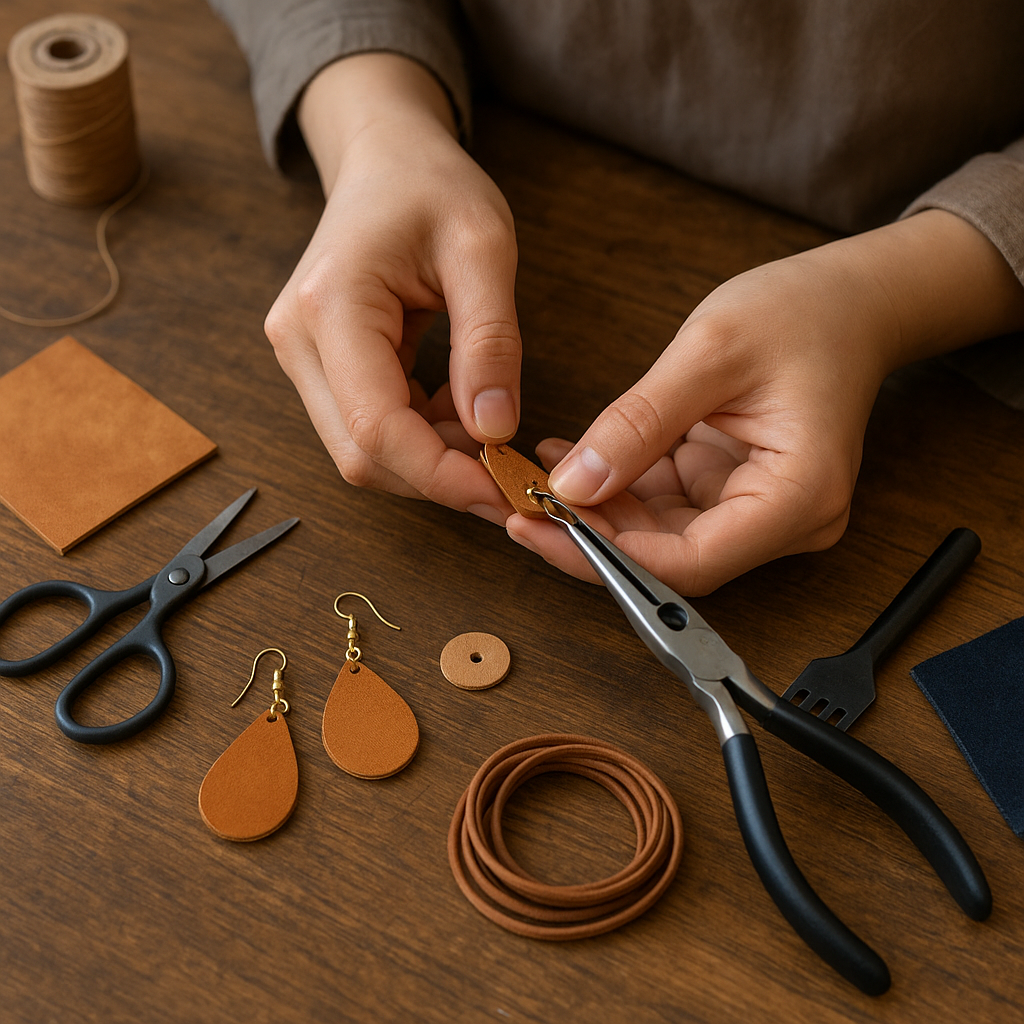
There is a particular satisfaction in transforming a flat, humble hide into jewelry that is light on the skin yet layered with texture, color, and story. Working with leather invites both beginners and seasoned makers to explore a material that is forgiving, durable, and endlessly customizable. Unlike metalwork, most beginner leather techniques can be mastered with modest tools, a small workspace, and a healthy curiosity. This guide focuses on accessible jewelry projects—bracelets, earrings, and pendants—that teach you foundational skills you will reuse again and again.
Why Leather Jewelry Captures the Hand and Eye
Leather jewelry bridges opposites: it can look rugged or refined, bohemian or minimalist, earthy or vividly dyed. It is gentle on the skin, warms to body temperature, and resists the kind of tarnish that can plague metal. For people with sensitivities, leather components reduce contact with metals to only small findings (which can be swapped for hypoallergenic options). Thin leather is lightweight, so even dramatic earrings remain wearable all day. And because scraps go a long way, you can experiment freely without the anxiety of wasting costly materials.
On a practical level, leather jewelry adapts to real life. Bracelets flex with your wrist while typing, a cord necklace can be sized with a sliding knot in seconds, and earrings cut from a single piece of hide won’t shatter if dropped. For the maker, the creative range is wide: cut clean geometric shapes or organic silhouettes; emboss patterns; paint, stain, or resist-dye; stitch contrasting edges; combine leather with wood, beads, or minimalist metal findings.
Materials and Tools: Building Your Starter Bench
Choosing Leather
For most jewelry, thinner leathers shine. Look for 2–5 oz thickness (about 0.8–2.0 mm). Thinner leathers like 2–3 oz work well for earrings and layered pendants; 4–5 oz suits cuffs and structured components. Understand basic types:
- Vegetable-tanned: Tanned with plant tannins. It starts pale and ages into a caramel patina. It can be wet-formed, stamped, carved, and takes dye beautifully. If you want to learn deep decoration or crisp edges, choose vegetable-tanned first.
- Chrome-tanned: Softer, often pre-dyed, with excellent drape (great for tassels and fringe). It resists water better out of the box but does not accept carving/stamping as cleanly as veg-tan.
- Suede and nubuck: Velvety surfaces; excellent for earrings and tassels. They need edge management (either painted, folded, or intentionally raw) and a protective spray.
- Oil-tanned and pull-up: Pre-oiled with a rich color that lightens when bent, adding depth. Good for rustic bracelets.
- Bonded leather and eco-alternatives: Reconstituted or plant-based options for those seeking reduced animal use. They cut easily but may behave differently under stress and with adhesives; test before committing.
Understanding Temper, Grain, and Stretch
Temper describes stiffness: firm leather holds shape (cuffs), while soft leather drapes (tassels, earrings). The grain direction matters; leather stretches more across the belly section than along the backbone. When cutting bracelets, align the length with the backbone direction to minimize stretch. For earrings, stretch is less critical, but consistent grain orientation in pairs keeps them matching.
Tools You Actually Need
- Cutting: A sharp craft knife or rotary cutter; small fabric scissors for curves; a self-healing cutting mat.
- Measuring: Metal ruler (cork-backed), wing divider or compass for parallel lines, and a flexible sewing tape for wrists and necklines.
- Hole-makers: Leather hole punches (individual hollow punches or a rotary punch) and pricking irons or stitching chisels for clean stitch rows.
- Edge work: Edge beveler, slicking agent (gum tragacanth or water with a drop of soap), and a wooden or resin burnisher for burnishing.
- Setting tools: Hand rivet setter, snap setter, and a soft-face mallet. Small anvil or steel block helps achieve crisp sets without mushrooming the metal.
- Adhesives and finishes: Contact cement or water-based leather glue; dyes, paints, and topcoats; microfiber or wool daubers.
- Thread and needles: Waxed polyester or linen thread, size 0.4–0.8 mm for jewelry; blunt harness needles (size 002–004) for hand sewing.
- Findings: Snaps, rivets, eyelets, button studs, ear wires, jump rings, and clasps—collectively, your jewelry hardware.
Budget-friendly substitutes can get you far: a smooth spoon as a bone folder, a dowel for edge slicking, sharpening a cheap craft knife often instead of buying many blades. You can also buy scrap packs from leather suppliers for practice.
Safety and Workspace
Cut away from your body and keep your non-cutting hand behind the blade. Wear eye protection when setting rivets or snaps. Ventilate when using solvent-based adhesives and dyes. Use a bench block or granite tile for punching; avoid cutting directly on your kitchen table. Keep pets and children away from small metal parts. Prioritize good lighting and organize sharp tools upright in a jar. Note that natural finishes and water-based products improve air quality and general safety, and are kinder to your home setup.
Essential Techniques You’ll Use in Every Project
Measuring and Templates
Start by developing a repeatable pattern habit. Trace designs on cardstock or thin plastic. Mark hole positions and centerlines. Pair earrings by cutting a paper prototype first; mirror it and confirm the size on the ear before cutting leather. Label the thickness you used so you can reproduce fit later.
Cutting Cleanly
Always cut in multiple light passes rather than forcing a single heavy cut. Keep the blade vertical for square edges. For interior cutouts, punch a starter hole and insert the tip of your scissors to begin clean curves. When cutting pairs (earrings, layered pendants), stack two pieces flesh-to-flesh with a bit of double-sided tape and cut together for perfect symmetry.
Edge Beveling and Finishing
Bevel the sharp corners on thicker leather with an edge beveler to avoid bitey edges against the skin. Then slick edges with water or gum and friction using a burnisher until they shine. This step elevates the look from craft to heirloom. For suede and chrome-tan that resist slicking, seal the edge with edge paint or fold-and-stitch for a refined border.
Dyeing, Painting, and Topcoats
Test your chosen dye on a scrap, as the color deepens when dry and with topcoat. Alcohol-based dyes penetrate deeply; water-based versions are more pleasant indoors. Acrylic leather paints allow color blocking or fine motifs. Seal with a compatible topcoat: waxy finishes enhance a matte glow; acrylic finishes offer more protection and gloss. Mask with painter’s tape to keep clean divisions.
Stamping, Embossing, and Carving
With veg-tan, dampen the surface until it returns from dark to its original shade (called casing). Use stamps or simple improvised textures (linen, lace, the flat side of a screw) to press patterns. Light mallet taps suffice for jewelry; deeper impressions risk weakening thin pieces. Basic tooling can outline shapes or monograms. For chrome-tan and suede, choose surface embellishments like paint, foiling, or pressed fabric textures instead of deep impressions.
Adhesives and Assembly
Contact cement gives a fast, strong bond for layered components. Water-based glues are kinder for small apartments and can be plenty strong when clamped overnight. Apply thin, even coats, let them go tacky per instructions, then align carefully. Excess glue on the grain side can be hard to remove; work neatly and keep a scrap cloth ready.
Hand Stitching
Saddle stitch is the gold standard: two needles pass through the same hole from opposite sides, locking the thread. Mark a stitch line with a wing divider, punch holes with pricking irons or chisels, then sew with waxed thread. For bracelets, shorter runs of stitching can reinforce stress points (near snaps or button studs) and add decorative contrast. Tie off by backstitching two holes and snipping tails close.
Closures and Findings
Popular closures include snaps (fast and secure), button studs (clean look for minimalist cuffs), and Chicago screws (removable). For necklaces, sliding knots offer adjustability without hardware. For earrings, use hypoallergenic ear wires; add tiny rubber stoppers to prevent loss. Always test hole sizes before setting hardware—too small and you’ll split the leather, too large and the hardware loosens.
Project: Classic Cuff Bracelet
Concept
A timeless piece that teaches measuring, clean cutting, edge work, and a simple closure. Ideal leather thickness is 4–5 oz for structure.
Materials
- Veg-tan or oil-tan leather, 4–5 oz
- Button stud or medium snap set
- Edge beveler and burnisher
- Hole punches (for stud/snap and adjustment)
- Optional: dye, paint, topcoat
Steps
- Measure the wrist snugly with a flexible tape. Add 1.5–2 cm for comfort and the thickness the stud or snap consumes. A common finished length is 17–20 cm for most adults, but custom beats averages.
- Cut a strip 2–3 cm wide. If aiming for sleeker style, taper the ends slightly or round them with a 20–30 mm coin as a template.
- Bevel and slick edges. For veg-tan, dampen edges and burnish to a glassy finish. If dyeing, color the piece now and let it dry, then topcoat. Remember to dye edges for cohesion.
- Mark hole positions. For a button stud closure, punch a small pilot hole for the stud screw side and a keyhole slot on the opposite end: a round hole plus a short slit just wide enough to slip over the stud head and lock under the shoulder. For snaps, punch corresponding holes as directed by the setter’s instructions.
- Install hardware. Set the stud through a cleanly punched hole into the leather, or set your snap halves using a firm, level surface and gentle, controlled mallet strikes.
- Test fit and finish. Secure the closure and check for wobble. If the bracelet is slightly loose, add a second hole or move the keyhole slit back by a few millimeters on a second version. Note your final measurements on the back of your paper template for duplicates.
Variants
- Two-layer cuff: Glue a colored chrome-tan strip over a firm veg-tan base. Add stitch lines 3–4 mm from the edges for contrast.
- Cutout cuff: Use a hole punch to create a sequence of crescent or dot cutouts before dyeing, echoing a constellation or Morse code.
- Stamped cuff: After casing veg-tan, press a repeating geometric or botanical motif, then antique gel to emphasize impressions.
Project: Minimal Wrap Bracelet with Button Stud
Concept
A slender strip wraps the wrist twice or thrice. It’s quick, giftable, and a test bed for color experiments. Use 2–3 oz leather for a slim profile that sits nicely under sleeves.
Materials
- Soft chrome-tan or veg-tan, 2–3 oz
- Button stud (small)
- Rotary cutter or knife, ruler
- Hole punch and small chisel for keyhole slit
- Optional: paint pens or foil for accents
Steps
- Measure your wrist and multiply by the number of wraps. Add 3–4 cm and cut a strip 6–8 mm wide.
- Edge finish lightly; thin leather may need only a quick slick or clear edge paint for polish.
- Install the stud close to one end. Punch a corresponding keyhole on the other end. Test the fit around your wrist; trim if needed for tidy overlap.
- Add decoration: a dash of metallic paint at intervals, a riveted charm, or a small stamped word near the tail.
Project: Feather Earrings from Scraps
Concept
Feather-style earrings showcase leather’s ability to hold crisp cuts without weight. Choose soft chrome-tan or suede for sway, or veg-tan if you plan to paint graphic details.
Materials
- Leather scraps, 2–3 oz
- Ear wires and jump rings
- Scissors or craft knife, hole punch (2 mm)
- Optional: acrylic paint, metallic leaf, edge paint
Steps
- Create a paper template about 6–8 cm long and 1.5–2 cm wide. Trace two mirrored pieces onto leather.
- Cut the outlines, then snip angled notches along both sides for the feather barbs, leaving a 3–4 mm spine uncut for strength.
- Punch a small hole at the tip top for the jump ring. Paint a central vein or add thin metallic highlights.
- Attach jump rings and ear wires. Use rubber stoppers for security on the ear.
Variants
- Layered feathers: Stack two different colors or textures, slightly offset, riveted together at the top.
- Geometric drop: Instead of feathers, cut nested diamonds or circles; stack with small spacers to create depth.
Project: Simple Pendant with Inset Accent
Concept
A small leather frame holding a bead, washer, or wooden disc makes a striking pendant with minimal hardware. Perfect for practicing precise cutting and gluing.
Materials
- Veg-tan, 2–3 oz
- Accent item (flat bead, coin-like charm, small washer)
- Contact cement or water-based leather glue
- Hole punch for cord passage
- Leather cord or waxed cotton
Steps
- Cut two identical shapes: circles, ovals, or rectangles with rounded corners. In one piece, cut an interior window slightly smaller than the accent item to seat it.
- Edge-finish both pieces. If dyeing, color now and allow to dry.
- Glue the accent into the window piece, then glue the back piece to form a sandwich. Clamp between smooth boards until cured.
- Punch a top hole for the cord, or add a small metal bail if preferred.
- Thread a cord and finish with a sliding knot for adjustability.
Design Language: Shape, Color, and Texture
Your design vocabulary grows by playing with contrast: rigid vs. flowing lines, matte vs. sheen, natural vs. saturated colors. A neutral leather backdrop with a single bright line of paint can feel high-end. Explore negative space by punching holes or creating window layers. Try asymmetry by pairing a long bar earring on one side and a shorter, layered motif on the other. Move beyond brown: cool grays, deep navy, and vine green love gold-toned findings, while warm tans sing with copper.
Textures amplify light: pebble-grain chrome-tan catches highlights; sleek burnished edges make color blocks pop. Pair leather with wood beads for earthy warmth or minimal steel for industrial chic. Remember scale: a shape that looks bold on your cutting mat can feel huge when worn; use a mirror during mockups and err on slightly smaller for daily wear.
Ethics, Ecology, and Smarter Making
How you source and finish materials impacts both people and planet. When possible, choose offcuts or scrap bundles from upholstery shops or leatherworkers; it’s budget-friendly and diverts materials from waste streams. If you want tanning transparency, look for suppliers who document origin and processes. Plant-tanned leathers and water-based products often align with improved studio air and broader sustainability goals.
Use non-toxic, water-based finishes where possible. Keep a small jar for collecting dye-soaked swabs and dispose responsibly. Upcycle: an old handbag can yield dozens of earring pairs. Repair rather than discard; replace a broken ear wire or loose rivet instead of remaking the entire piece.
Troubleshooting: From Oops to Elegant
- Fuzzy edges won’t slick: Bevel first, add a small amount of gum or water, and increase pressure and time on the burnisher. For chrome-tan, switch to edge paint or fold the edge.
- Stitch line drifts: Lightly score a guide channel with a wing divider and use stitching chisels to pre-punch; it’s the straight-line secret.
- Snap won’t set square: Ensure the post length matches leather thickness. Too long, and the cap swivels; add a washer or choose a shorter post.
- Uneven dye patches: Prep with a damp sponge to slightly case the leather, then apply multiple thin coats. Buff with a clean cloth before topcoat.
- Earrings curl: Press between wax paper sheets in a book overnight, or add a thin backing layer glued flush for stiffness.
- Bracelet stretched over time: Align the next version’s length along the back (spine) direction or reinforce with a stitched underlay.
Care, Wear, and Repair
Wipe pieces with a soft, dry cloth after wearing. Avoid prolonged soaking or perfume directly on leather. Condition sparingly with a light balm or cream; over-oiling can darken and soften structure. Occasional conditioning prevents cracking, especially on veg-tan. If paint scuffs, lightly sand, repaint, and reseal. Replace ear wires and jump rings at the first sign of deforming.
Store earrings flat or hanging to prevent bends; keep bracelets in a tray out of direct sunlight. For suede, use a nubuck eraser to lift minor stains and a protective spray to resist future moisture.
Skills You Can Layer Next
- Laced edgings: Flat or whip lacing in contrasting color can frame pendants elegantly.
- Braiding: A three-strand or mystery braid strap turns into a simple, striking bracelet.
- Pyrography: Woodburning tools can add permanent line art to veg-tan at low temperatures.
- Foiling and leafing: Apply heat-activated foil or metal leaf to add shimmer bands or shapes.
- Resist work: Use a clear resist before dyeing to preserve highlights and patterns.
Measuring Guide and Fit Notes
- Cuffs: Wrist circumference plus 1.5–2 cm for comfort and hardware allowance. Widths vary from 10 mm (minimal) to 30 mm (statement). Try a paper band first.
- Wrap bracelets: Multiply wrist measurement by wraps (2–3). Narrow widths reduce bulk; check keyboard comfort if you type often.
- Earrings: Most people find 5–7 cm earrings wearable daily; above 8 cm reads more dramatic. Test weight by hanging the blank on a hook before embellishing.
- Pendants: A 45–60 cm cord covers most preferences; add sliding knots to adjust on the fly.
Finishes and Feel: Choosing the Right Surface
Matte finishes read modern and pair well with raw brass findings; semi-gloss feels polished and more traditional. Waxy balms retain leather’s tactile depth; acrylic topcoats protect painted graphics from abrasion. Suede benefits from a protective spray to resist rain, while veg-tan appreciates a light wax buff that deepens tone gradually. Whatever you choose, test on a hidden edge first.
Starter Shopping List by Priority
Essential
- 2–3 small sheets of leather (veg-tan and chrome-tan, 2–5 oz)
- Craft knife with spare blades, small scissors, metal ruler
- Rotary or single-hole punch, small anvil or steel block, soft mallet
- Edge beveler, simple wooden burnisher
- Waxed thread and two harness needles
- Basic findings: snaps, button studs, ear wires, jump rings
- Water-based glue and a versatile topcoat
Nice to have
- Pricking irons or stitching chisels
- Wing divider, corner rounder punches
- Dyes and acrylic paints; small brushes and daubers
- Edge paint in a neutral or black for chrome-tan edges
Glossary for Quick Reference
- Oz (ounce): Leather thickness measure; roughly 0.4 mm per oz.
- Grain: The smooth outside of the hide; flesh is the inner side.
- Temper: Stiffness or softness of leather.
- Burnish: Polish edges by friction with water or gum to compact fibers.
- Saddle stitch: Strong hand stitch using two needles passing opposite directions.
- Edge beveler: Tool that rounds the sharp corner of edges before finishing.
- Skiving: Thinning leather at an edge or overlap for neat joins.
- Antiquing: Applying darker gel or finish to settle into impressions and add depth.
Make It Yours: Personal Logos and Story Layers
Stamp a tiny monogram on the inside of a cuff. Choose a motif—a leaf vein, a spiral, a constellation—and let it echo across a set: earring cutouts, a pendant window, a bracelet stamp. Keep a swatch book: small labeled pieces noting leather type, dye, and topcoat combinations. You’ll thank yourself when reproducing a favorite tone months later.
Working Small, Learning Big
Jewelry-scale projects act like micro-workshops. Cutting a crisp curve for an earring trains your knife hand. Setting a single snap teaches you to judge post length and strike pressure. Dyed layers on a pendant teach color behavior under sealant. These mini lessons compound quickly, reducing errors and expanding confidence for larger projects like belts or bags.
Adaptations Without Specialized Gear
- No edge beveler? Sand the edge lightly at 45 degrees, then slick.
- No burnisher? Use a hard cloth or the rounded back of a spoon to compact edges.
- No punching board? A plastic cutting board or scrap of dense end-grain wood protects your tools and table.
- No rivet setter? Choose Chicago screws for removable, screw-in connections using a simple screwdriver.
Color Play and Surface Experiments
Try ombré dye gradients by applying more color at one end and blending with a damp sponge. Mask stripes or triangles with low-tack tape and paint crisp graphics. Add metallic leaf to earring tips, then seal with a clear topcoat. For a stone-wash look, dye lightly, let dry, then scuff with a fine abrasive pad on high spots and re-seal. Keep notes on ratios and sequence; color memory is unreliable without swatches.
Time Estimates and Workflow
- Simple wrap bracelet: 25–40 minutes including finishing.
- Classic cuff with dye and edge burnish: 60–90 minutes plus drying time.
- Feather earrings, painted: 45–60 minutes plus paint cure.
- Pendant with inset: 60–90 minutes including clamping time.
Batch-making speeds you up: cut multiple blanks at once, then move through the same step across all pieces—edge work, dye, seal, hardware. This reduces setup time and leads to cleaner outcomes through repetition.
Quality Checks Before You Gift or Sell
- Edges: Even bevel and smooth, sealed finish without fuzz.
- Holes: Centered and appropriate size; no tearing or ovalization.
- Hardware: Firmly set with no rattle; snaps open and close confidently.
- Color: Even coverage; buffed before sealing to avoid dye rub-off.
- Symmetry: Pairs of earrings match in shape, size, and hole position.
Leather Myths to Set Aside
- Myth: Veg-tan is only for heavy belts. Reality: Thin veg-tan is ideal for fine jewelry, accepts detail, and ages beautifully.
- Myth: You must own expensive tools. Reality: A sharp blade, basic punches, and patience produce clean work.
- Myth: Dye always rubs off. Reality: Proper buffing and compatible topcoat stop rub-off.
Closing Encouragement
Leather jewelry rewards intention. A single evening can take you from a scrap to a finished, signature piece. Start with small, focused projects—a classic cuff, a minimal wrap, feather earrings, a sleek pendant—to practice the techniques that unlock entire worlds of making. Honor the material by finishing edges, setting clean lines, and choosing simple, thoughtful details. Whether your style is monochrome modern or richly patterned, there is room in leathercraft for your voice—one polished edge, one precise cut, one balanced piece at a time. Along the way, you’ll come to love the scent of a fresh topcoat, the feel of a polished edge, and the soft click of a properly set snap as signals that your hands have turned an idea into something you can wear.
Quick Reference: Ten Key Habits
- Measure twice, cut lightly in multiple passes.
- Plan with a template and mark hole centers before punching.
- Match leather temper to purpose; softer for drape, firmer for structure.
- Bevel and slick edges for a professional look.
- Test color on scraps and buff before sealing.
- Pre-punch stitch holes; keep stitch tension consistent.
- Size hardware to thickness to avoid loose sets.
- Work clean: small glue amounts, tidy surfaces.
- Batch similar steps to increase consistency.
- Document combinations—leather type, color, finish—for reliable repeats.
With these fundamentals and a small kit, you can explore leathercraft through jewelry confidently, blending technique and personality in pieces that are light to wear and rich with detail. The more you touch the material, the more fluently you’ll speak its language—edge, color, curve—until every project feels like a conversation between your hands and the hide, shaped by intention and finished with care.
