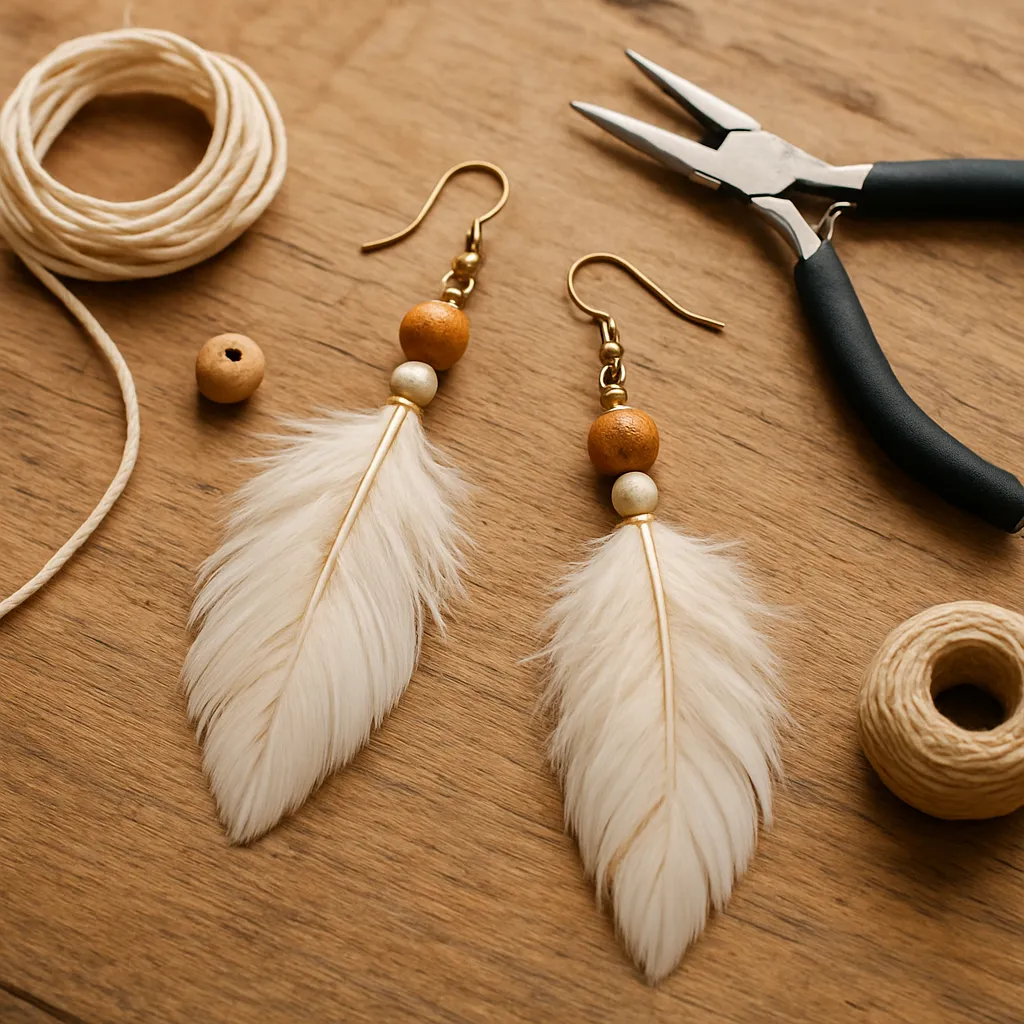
Light, expressive, and full of movement, DIY boho feather earrings are a small canvas where nature, texture, and personal style meet. They sway as you walk, whisper color near the jawline, and can be built from humble materials into statement pieces that tell a story about travel, music, and craft. Whether you prefer earthy neutrals, jewel-toned festival brights, or muted pastels, this project rewards experimentation and offers an approachable path into jewelry-making. It is also an invitation to slow down, to notice how a curve of barbules catches light, how a single bind of thread creates structure, and how choosing the right finish preserves a handcrafted treasure for years.
What Makes Boho Feather Earrings Special
Boho style leans into unforced elegance—an interplay of textures, natural silhouettes, and unexpected combinations. Feather earrings find their perfect home here because they are both dramatic and delicate. They add verticality to the profile without adding weight, they invite layering with necklaces and bangles, and they adapt to countless outfits: denim and white tees, linen dresses, gauzy scarves, or tailored blazers for high-low contrast. Their design language draws on influences ranging from desert sunsets to folk textiles, balancing spontaneity with intention.
From a maker’s perspective, the joy is twofold. First, they are approachable: you can finish a pair in under an hour with simple tools. Second, the learning curve is generously wide: beginners can start with a minimal layered drop, while advanced crafters can move into lattice-weaves, micro-macramé, hammered metalwork, or resin preservation. In every variation, the medium itself—those airy vanes and slender quills—becomes the teacher, guiding spacing, color, and rhythm.
Tools, Materials, and Smart Substitutions
At the heart of the project are the feathers themselves, plus a handful of jewelry basics. You can assemble a complete kit for a modest budget and add specialty tools over time. Consider the following list as a menu—choose what supports your design and your hands.
- Feathers: goose, rooster (schlappen, saddle), peacock herl and eye, pheasant, duck, or synthetic options. Look for ethically sourced or vintage trims, avoiding species protected by law.
- Ear hooks or hoops: French hooks, lever-backs, kidney wires, or huggie hoops. Nickel-free and hypoallergenic options are best for sensitive ears.
- Jump rings: 4–6 mm, 18–20 gauge, preferably hardened. Oval jump rings help prevent accidental openings.
- Wire: 24–26 gauge for wraps, 20–22 gauge for structural loops. Choose brass, copper, sterling, or plated varieties.
- Thread or cord: strong beading thread, waxed linen, or nylon for binding bundles.
- Cones or end caps (optional): to hide bindings and transition the feather bundle to metal components.
- Crimps and crimp covers (optional): for thread-based designs that benefit from clean, rounded finishes.
- Adhesive: jewelry-grade flexible glue, applied sparingly, to secure bindings.
- Clear protective finish: a feather-safe sealant can tame frizz, protect dye, and resist humidity, applied in micro-layers.
- Pliers: chain-nose, round-nose, and flush cutters. Nylon-jaw pliers are helpful for straightening wire.
- Scissors and/or micro snips: for trimming quills and threads cleanly.
- Tweezers and an awl or needle: for fine placement and gently opening the quill if needed.
- Ruler, masking tape, soft brush, and a lint-free cloth: for measuring, securing, and cleaning.
Substitutions are common—and encouraged. If you lack cones, wrap with thread and cover the binding with a narrow strip of suede lace. If wire skills are new to you, use thread and crimp components to avoid bulky knots. If natural feathers are not your preference, faux alternatives now mimic authentic texture beautifully and accept paint and dye well.
Choosing, Preparing, and Caring for Feathers
The right feather transforms a design. Think in families of shape: long tapers (rooster saddle), rounded fans (duck), dramatic eyes (peacock), and variegated patterns (pheasant). Mix shapes for dimensional layering—one elongated base feather, one medium accent feather with pattern, and a small highlight feather for contrast is a reliable trio.
Preparation makes all the difference:
- Cleaning: If the feathers feel dusty, gently swish them in lukewarm water with a drop of mild soap. Rinse, then squeeze in a towel (do not twist). Let air-dry on a flat surface.
- Re-fluffing: Steam lightly from a distance or hold in bathroom steam. Stroke the barbs into alignment with a soft brush.
- Trimming: Use micro snips to taper the tip or clean the top where bindings will sit. Keep off-cuts for smaller accents.
- Dyeing: For color experiments, pre-wet with water and a dash of vinegar, then dip in textile dye. Set and rinse thoroughly. Test-lightfastness on a spare before committing to a design.
- Stabilizing: A whisper-thin coat of feather-safe finish on the lower third can reduce frizz in humid climates; let it cure completely between coats.
Ethics and legality matter. Avoid feathers from wild migratory species restricted by conservation laws in many countries. Favor farmed, molted, vintage, or artisan-dyed stock with traceable sourcing. Beyond compliance, ethical sourcing aligns with the free-spirited yet conscientious heart of boho making.
Core Technique: A Clean Layered Drop
This foundational build emphasizes flow, proportion, and an invisible transition from organic to metal.
Plan and Arrange
Lay three to five feathers on your work surface. Establish a gentle cascade, with the longest as the backbone and smaller feathers stepping forward. Ensure the tips land at subtly different heights—variety reads as natural. Aim for visual balance not through perfect symmetry, but through scale and spacing.
Bind the Bundle
Mark a tidy “collar zone” near the top of the quills with a small strip of masking tape to keep edges aligned. Bind firmly with waxed thread or 26-gauge wire. Make a few tight wraps, add a speck of glue, and continue until you have a 3–5 mm collar. Finish with a neat tuck. The objective is structural neatness without bulk, allowing an end cap or cone to slide on flush.
Attach the Metalwork
Slide a cone over the binding, add a 4–5 mm jump ring, and attach to your ear hook. Always open jump rings laterally—never pull ends apart vertically—to preserve their strength. If you prefer hoops, suspend the bundle from a short length of chain to add movement and space from the face.
Final Grooming
Shake the earrings gently. Watch how they settle. If a feather twists, flip its position or add a second discreet wrap nearer the tip to “train” direction. Trim any fuzzy thread ends and, if desired, apply a minimal protective finish to the ends of the barbs to help them hold shape during wear.
Variations to Stretch Your Design Vocabulary
- Hoop Cluster: String micro-feathers onto short lengths of fine chain and hang at three points along a hoop for an airy, mobile effect.
- Dreamer’s Web: Weave a small circle of wire with a laced thread pattern at the center and suspend a peacock eye feather from the bottom. Keep motifs abstract to avoid direct replication of sacred cultural symbols (more on respect below).
- Leather Splice: Sandwich a trimmed feather between two slender leather leaves for a durable edge and subtle contrast in texture.
- Beaded Spine: Add a line of seed beads along a bare quill with clear-drying glue for sparkle that doesn’t overwhelm.
- Hammered Accents: Forge thin copper paddles for light-catching shimmer—a low-mass alternative to gemstones.
- Paint and Print: Use fabric-safe paints, metallic inks, or mica washes to edge feathers or stencil tiny motifs. Test on off-cuts to gauge capillarity and bleed.
- Resin Kiss: Dip just the tip in thin UV resin for durability and gloss. Cure carefully to avoid heat damage to the barbs.
Color Play and Styling Sense
Color can guide mood. Earth neutrals—sand, bark, moss—pair with knitwear and boots, whispering autumn. Jewel tones—teal, amethyst, garnet—celebrate evening light and metallics. Monochrome in black or cream reads architectural and modern, especially with sleek hair. Consider skin undertone and hair color; warm copper and chestnut harmonize with golden blonds and redheads, while cool blues and charcoals flatter ash and black hair.
Outfit pairings reward scale awareness. Small feather studs or micro drops support minimalist looks. Shoulder-grazing cascades work with simple necklines. When stacking jewelry, echo one detail—matte brass, a turquoise bead, or a leather accent—rather than repeating everything. Irregular asymmetry can look intentional when tied together by a shared color or motif.
Comfort, Wearability, and Long-Term Care
Feather earrings are blessedly lightweight, but metal choices affect comfort. Hypoallergenic hooks reduce irritation; silicone stoppers prevent loss. For windy days, a slightly shorter design tangles less with scarves and collars.
Care is simple: store hanging or laid flat in a compartment. Keep away from crushing weight, heat sources, and perfumes. If a feather gets bent, a moment of steam and gentle stroking will resurrect its shape. For dyed stock, sunlight can fade color, so avoid long exposures on a window ledge. If earrings pick up odor (campfire, cooking), air them in a breathable pouch with a pinch of baking soda nearby—not on the feathers—for a day.
Troubleshooting: From Frizz to Flawless
- Frizzing Barbs: Tame with a feather-safe finish. Apply in micro strokes from quill outward, never saturating the vane.
- Twist and Spin: Use an oval jump ring or add a tiny counterweight bead hidden under the end cap to orient the drop.
- Drooping Bundle: Shorten the collar or switch to a narrower cone to prevent leverage that pulls forward.
- Uneven Pair: Accept small differences but align visual weight by balancing length against pattern contrast—e.g., shorter but more patterned on one side.
- Discoloration on Metal: Seal with a jeweler’s wax or clear lacquer, or choose non-tarnishing findings like stainless steel or niobium.
Ethics, Safety, and Cultural Respect
Adhesives and finishes require ventilation. Work on a protected surface, cap bottles immediately, and keep materials away from pets. If you have respiratory sensitivities or feather allergies, consider faux options or mask and glove use. Dispose of solvent-soaked wipes responsibly.
Legal frameworks differ by country, but many protect wild birds and restrict possession of molted feathers. Purchase from reputable suppliers who certify farmed or legally obtained stock. If you gather naturally molted feathers locally, research regional regulations first.
Cultural respect is essential. Many feathered objects have sacred significance in Indigenous communities worldwide. Inspiration does not require imitation; avoid reproducing protected regalia, headdresses, or specific ceremonial motifs. Focus on textures, colors, and abstract patterns that celebrate nature without appropriating cultural symbols.
Responsible Sourcing, Budget Wisdom, and Creative Scavenging
There is artistry in material choice. Seek suppliers who disclose origin and treatment. Vintage trims from estate sales, millinery shops, and costume houses offer unique patterns; sanitize and refresh before use. Leather offcuts, metal scraps, and broken vintage jewelry can be reborn as connectors, end caps, and charms.
Stretch your budget with thoughtful upcycling: a single damaged peacock feather can yield multiple accent tips; a thrifted copper chain can be cleaned and rebuilt into pairs. Keep a “palette jar” of small feathers sorted by color and length for easy mixing across future projects.
From Hobby to Gift to Micro-Business
Feather earrings make heartfelt gifts. Include a small care card with storage tips and a note on sourcing. For a booth or online shop, present designs on neutral cards that let color breathe; photograph on textured backgrounds—linen, slate, worn wood—to evoke warmth without distraction.
Pricing considers material cost, time, overhead (tools, packaging), and a fair profit. Track each design’s minutes-to-make, and remember that design, photography, and customer communication are labor, too. Offer customization: length adjustments, metal choice, and color palettes. For compliance, list metal composition and note hypoallergenic options. If shipping, brace earrings within a small box to protect from crushing, and avoid plastic when possible, replacing it with glassine or recycled paper.
Advanced Techniques to Elevate Craft
- Micro-Macramé Bridges: Knot a slim chevron or ladder panel, then suspend two contrasting feathers from its ends for a light architectural feel.
- Electroformed Quills: Build a copper skin on reinforced quills to blend organic lines with metal sculpture. Seal thoroughly before skin contact.
- Feather-in-Resin Droplets: Encapsulate trimmed barbules in crystal-clear resin shapes and pair them with a natural feather drop for a double-texture duet.
- Stamped Metal Tabs: Texture thin brass tabs and rivet them to leather leaves for a mixed-media hinge above the feather bundle.
- Twist and Coil: Master clean loops and controlled coils with round-nose pliers; consistency here is the difference between hobby and heirloom.
A Guided Build: Minimal Equipment, Maximum Poise
Use this blueprint to complete a refined pair with just pliers, thread, and scissors.
- Select 4–6 compatible feathers per earring: two long, two medium, and optional small accents. Preen and trim.
- Align quills at top, staggering lengths below. Tape lightly to define a collar zone.
- Bind with waxed thread: 10–12 firm wraps, a tiny adhesive touch, then 6–8 more wraps. Tuck the end cleanly.
- Slide a tidy end cap over the collar. If none is available, wrap with a narrow leather strip and secure with discreet glue underlap.
- Add a jump ring and attach to a hypoallergenic hook. Check alignment; adjust with gentle finger pressure.
- Groom: steam lightly if needed, shape with a soft brush, and let rest flat for ten minutes to set memory.
Time: 25–40 minutes. Skill emphasis: neat binds, proportion, and light touch. The result is fluid and wearable with jeans, maxi dresses, or a tailored blazer.
Wire Skills Without Intimidation
Clean, consistent loops elevate finishing. Practice on scrap wire: form a right angle 5–7 mm from the end, roll a loop with round-nose pliers, and wrap the tail neatly three times. This same motion creates secure links for chains, connectors for end caps, and decorative coils. The key is gentle tension and even spacing—over-gripping flattens wire and adds kinks.
When adding beads, keep mass low. Two or three 3–4 mm beads near the connection point can sparkle without weighing the earring down. If you crave more shimmer, hang beads on micro chains rather than on the main quill, allowing independent movement without torque.
Design Psychology: Movement, Proportion, and Rhythm
Great earrings choreograph movement. Feathers flutter in micro-eddies of air, so design for that motion: tiered lengths that won’t collide constantly, space between layers to reduce matting, and a top connection that allows pivot without spinning freely. Proportion is read at a glance—earring length relative to jawline length, feather width relative to ear-to-neck distance. Try on during the build; a quick mirror check saves time later.
Rhythm arises from repetition and contrast: repeat a texture (matte leather, brushed brass) and contrast a shape (taper vs. fan). If you pursue deliberate irregularity, echo one element—color or metal finish—so the mind reads harmony. This is where balance becomes a felt sense rather than a strict equation.
Frequently Asked Questions
Will my earrings shed? Minor shedding is natural, but proper binding and light finishing reduce it. Avoid heavy brushing, and store carefully.
Can they get wet? Occasional mist is survivable, but saturation warps barbs and weakens adhesives. If damp, reshape and let air-dry flat.
How do I clean them? Dust with a soft brush. For grime, light steam and fingertip preening. Do not use alcohol or harsh cleaners.
Are they heavy? Properly made feather earrings are extremely light. Choose brass or aluminum hardware for minimal mass; avoid bulky beads at the tip.
What about allergies? Those with feather sensitivities might choose faux feathers or seal natural quills thoroughly. Always use hypoallergenic ear hooks.
The Heart of the Handicraft
This project reminds us that craft is a dialogue. Materials speak—even the quietest barbs suggest how they wish to lie, how much space they need, and how they catch dawn light. The maker listens, arranges, tests, and refines. The finished pair feels inevitable, as if it always existed and your hands merely introduced each piece to the others. That sensation is the true reward of handcrafted work: a moment when design, touch, and intention align.
There is also a deeper ecology at play. Building with natural fibers and light metals invites thoughtful choices: local suppliers when possible, recycled packaging, and finishes that are kind to skin and waterways. Selecting durable hooks, teaching recipients how to store earrings, and offering repairs extend the life of each pair. Small acts—choosing hypoallergenic metals, swapping single-use plastics for paper, reducing off-cut waste—add up to a quiet, steady commitment to sustainable making.
A Note on Technique and Memory
Skills like neat wrapping, clean loops, and proportion sense become muscle memory. Document your process: snap progress photos, keep a swatch ring of dyed samples with notes on ratios and times, and file paper templates for leather leaves and end-cap covers. When a design sings—balanced length, confident silhouette, secure connections—annotate it. Future you will thank present you for the roadmap.
Final Encouragement: Your Ears, Your Story
Feather earrings thrive on individuality. Some days demand monochrome minimalism; others call for peacock flash and festival sway. Try an all-neutral pair with matte brass to learn restraint, then a riot of variegation to learn contrast. Swap hooks for hoops. Trade cones for wrap collars. Name each pair after a place or a season. The process is iterative and joyful, and no two builds will ever be exactly the same—and that’s the point.
Gather your findings, select a palette, and set out your tools. Let your hands lead, your eyes edit, and your ears be the gallery. With a few thoughtful choices and a willingness to experiment, your next pair of boho beauties will feel inevitable from the moment the first quill meets the binding. And when they catch the light and sway, they’ll tell a story only you could compose—quietly, confidently, beautifully.
