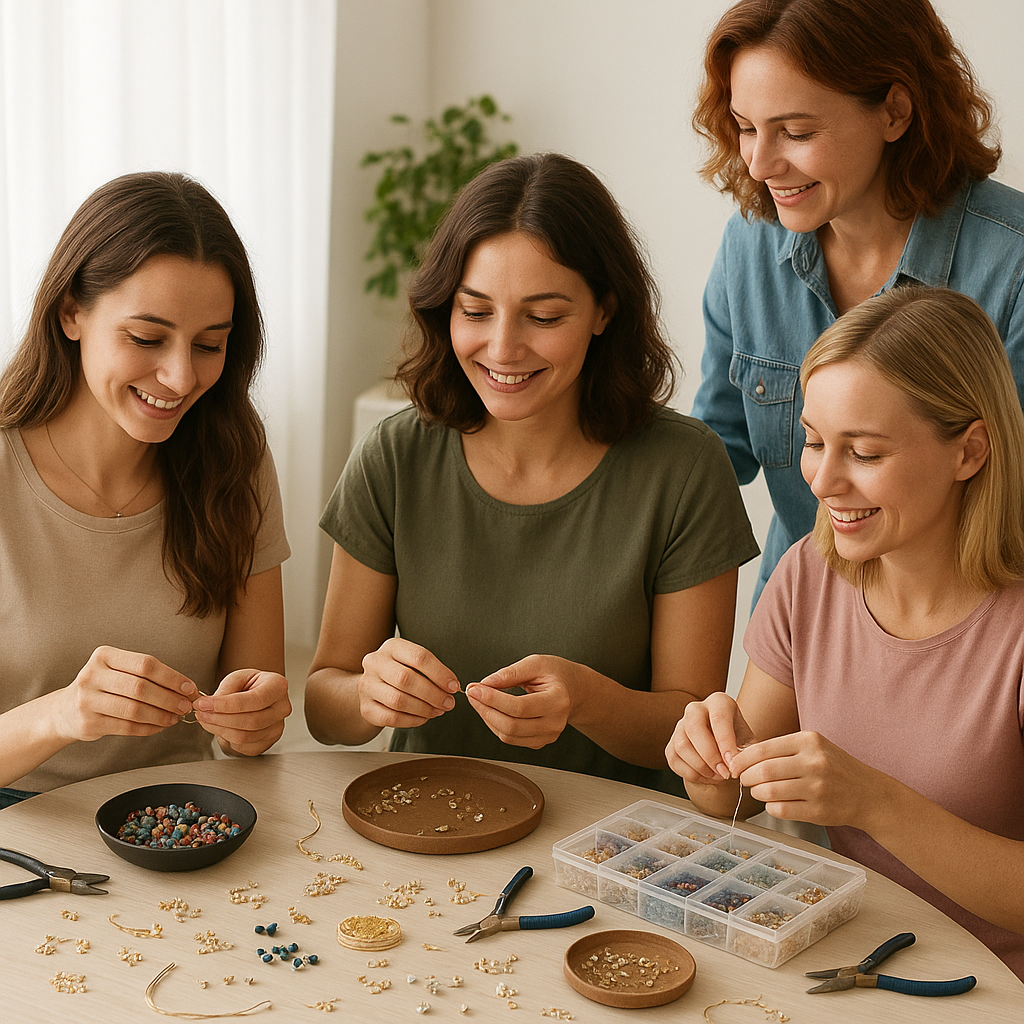
A well-hosted jewelry-making party turns a casual gathering into a hands-on celebration of color, texture, and personal style. Guests don’t just leave with a new bracelet or pair of earrings—they walk away with stories, skills, and a tangible reminder of a shared creative experience. Whether you’re inviting three friends to your kitchen table or curating a larger studio-style event, a thoughtful approach to planning, set-up, and guidance will make your party feel effortless and memorable. Below you’ll find a comprehensive guide that blends creative inspiration with practical checklists, so you can focus on conversation, sparkle, and the gentle rhythm of beads clicking into place.
Why Host a Jewelry-Making Party
A jewelry-making party invites people to slow down, play with patterns, and discover the joy of making. It’s tactile—cool glass beads, warm copper wire, silky cords—and satisfyingly immediate. Many projects can be completed in an hour or two, allowing guests to enjoy the full making arc from idea to finished piece.
This format suits a wide range of occasions: birthdays, bachelorette gatherings, parent–child afternoons, team-building events, or seasonal celebrations. Jewelry also makes excellent gifts, which turns your party into both a social occasion and a mini gift workshop. The atmosphere naturally fosters collaboration—someone perfects a crimping motion, another shares a color trick, and suddenly the table becomes a small atelier.
Unlike many crafts, jewelry-making requires a compact footprint and a modest investment in core materials and tools. With a few trays, pliers, and beads, you can host nearly anywhere: a living room, a library community room, a patio, or an office lounge.
Core Planning Foundations
Start with intention. A clear intention helps you choose the right projects, set the budget, and craft the ambiance. Consider the following pillars as you design your event:
- Guest profile: total number, ages, comfort with crafts, and whether guests have pierced ears.
- Theme: color story (e.g., sapphire and gold), vibe (bohemian, minimalist, celestial), or occasion (Bridesmaid Night, Autumn Equinox, Birthstone Birthday).
- Time frame: 2–3 hours works well, with a short demo, a main making window, and photo/wrap-up time.
- Skill levels: offer at least one very easy project alongside one intermediate project.
- Cost: decide whether you’ll fully host, co-host (guests chip in), or run a fee-based workshop.
Build a mood board, even a quick one on your phone. Collect a few reference photos: a beaded bracelet with matte stones, a wire-wrapped pendant, a delicate chain with a single charm. Show guests examples early—seeing options reduces decision fatigue and gets the creative energy moving.
Tools and Materials That Make Everything Easier
Good tools prevent frustration. A basic kit per two guests generally includes round-nose pliers, chain-nose pliers, flush cutters, and crimping pliers. Add bead boards or felt-lined trays (a baking sheet lined with fabric works, too). Small bowls or ramekins keep beads contained; a bead scoop or teaspoon helps move them cleanly. Label everything clearly and keep one “demo set” for yourself.
Choose core supplies with versatility in mind. A simple selection—mixed glass beads, a few strings of semi-precious gemstones, plated chain, a palette of head pins and eye pins, jump rings, ear wires, and a couple types of cord—can support half a dozen project types. Stock a range of clasp options: lobster clasps for secure finishes, toggle clasps for ease of use, magnetic clasps for accessibility, and sliding knots for adjustable cord bracelets.
Wire and stringing choices matter. For beading, 0.46–0.51 mm beading wire handles many bead sizes; pair it with crimp beads and crimp covers. For stretch bracelets, 0.7–1.0 mm elastic cord is common—test for fraying and pre-stretch to reduce later loosening. For wirework, 20–24 gauge craft wire in copper or silver tone shapes loops nicely; dead-soft wire is beginner-friendly. Organize your findings (clasp parts, jump rings, crimp beads, ear wires) in a lidded box with compartments and labels: “Open Jump Rings 5 mm,” “Crimp Tubes 2 mm,” “French Hooks (Hypoallergenic).”
Consumables such as beeswax or thread conditioner help prevent tangles in nylon cord; clear-drying jewelry glue reinforces knots (use sparingly). Keep a bead reamer for clearing snug holes, a ruler or soft tape for sizing, and a microfiber cloth for polishing and reducing fingerprints on metal.
Setting the Space for Comfort and Flow
Arrange your space to spotlight both beauty and practicality. Good lighting is essential—daylight or warm task lamps reduce eye strain and help with color matching. Provide a central inspiration board or tray with finished samples to spark ideas. Place nibbles and drinks at a separate side table so work surfaces stay clean.
- Stations: One station for tools, one for beads sorted by color/size, one for chain and wire, and one “help desk” where you demonstrate steps.
- Seating: Stable chairs, generous elbow room, and a shared tools caddy for every 2–3 guests.
- Signage: Small tent cards labeled “Open Jump Rings by Twisting, Not Pulling” or “Measure Bracelet: Wrist + 1.5–2 cm” prevent repeated questions and build confidence.
- Trays: Assign each guest a tray and a small felt mat. It keeps components from rolling and makes cleanup fast.
Set the tone with sound and scent—gentle instrumentals or jazz, unscented or very light candles if any, and a small vase of flowers. Consider a “Color Bar” where guests combine beads by hue, value, and finish (matte vs. glossy) to learn simple design techniques organically.
A Menu of Projects for All Skill Levels
Offer a trio of projects so guests can complete at least one and attempt a second if time allows. Balance instant gratification with a chance to learn foundational moves.
Project 1: Stretch Bracelet (Beginner, 20–30 minutes)
- Materials: elastic cord, beads with comfortably sized holes, a focal bead or charm, bead stopper or tape, glue (optional).
- Steps: Measure wrist; cut elastic with extra length. Pre-stretch elastic. String beads to pattern. Tie a surgeon’s knot, add a tiny dot of glue, and hide the knot in a larger bead. Trim ends cleanly.
- Tip: Mix sizes (6 mm rounds with 4 mm spacers) and finishes (matte with metallic) to add dimension.
Project 2: Charm Earrings (Beginner-Plus, 25–35 minutes)
- Materials: ear wires, head pins, small beads/spacers, jump rings, charms.
- Steps: Create a simple loop or wrapped loop at the top of a beaded head pin; attach to ear wires or to a charm with a jump ring.
- Tip: Teach “open jump ring by twisting sideways” to preserve ring shape and strength.
Project 3: Beaded Necklace with Clasp (Intermediate, 45–60 minutes)
- Materials: beading wire, crimp tubes, crimping pliers, clasp set, beads, optional crimp covers.
- Steps: Cut wire to length (neck size + clasp space + 7–10 cm buffer). String beads to design. Attach clasp: crimp one side, add beads, crimp the other, then add covers.
- Tip: Use a bead board to test patterns and check finished length before crimping.
Optional Project 4: Wire-Wrapped Pendant (Intermediate-Plus, 40–60 minutes)
- Materials: 20–24 gauge wire, focal stone/bead, chain or cord, jump rings.
- Steps: Form a bail with round-nose pliers, wrap neatly, tuck tails with chain-nose pliers, attach to chain.
- Tip: Emphasize gentle tension to avoid kinks; consider practice with craft wire before switching to sterling.
Teaching Strategy That Builds Confidence
Plan short, focused demos that get everyone moving quickly. Demonstrate each new move once slowly, once at a natural pace, then let participants try immediately. Keep sample pieces that show every step so late arrivals can catch up visually.
- Micro-lessons: how to open/close jump rings, form a basic loop, make a wrapped loop, tie a surgeon’s knot, and crimp correctly without crushing.
- Visual aids: laminated cards with photos of the key steps live at each station.
- Mentor pairs: seat a confident crafter next to someone newer; peer learning is powerful.
- Timing cues: gentle time checks keep the group in sync—“10 minutes until we crimp,” “5 minutes to finalize your pattern.”
Celebrate small wins. Call out great color choices and tidy loops. If someone struggles, hand them practice wire and have them loop three times in a row before they return to their real piece. Mastery of tiny motions pays huge dividends in jewelry-making.
Event Timeline and Flow
- 0:00–0:10 Arrivals and mingling; guests choose a tray, name tag, and browse sample pieces.
- 0:10–0:25 Welcome and demo: knotting elastic and opening jump rings. Quick Q&A.
- 0:25–1:00 Guests create Project 1 (stretch bracelet). You circulate and assist.
- 1:00–1:10 Showcase break: brief share-out for color combinations and knot tips.
- 1:10–2:00 Project 2 or 3 (earrings or beaded necklace). Offer an intermediate demo for wrapped loops or crimping.
- 2:00–2:15 Photos, light cleanup, packaging finished pieces in small pouches or cards.
Adapt this rhythm as needed, but keep the demo windows crisp and the making windows generous. Provide a small “Design Buffet” where guests can try an accent bead or swap a charm during the final 15 minutes.
Safety, Clean-Up, and Troubleshooting
Jewelry-making is low-risk when handled thoughtfully. Keep a kit with bandages, tweezers, and antiseptic wipes on hand. Watch for stray wire clippings, sharp head pin ends, and small parts near young children. Offer hypoallergenic ear wires (stainless steel, titanium, or niobium) and label metal types for guests with sensitivities. Emphasize safety when using adhesives: ventilate lightly, cap bottles immediately, and use a tiny dot with a toothpick.
- Clip discipline: collect wire clippings in a designated cup; sweep table mats with a lint roller before guests depart.
- Magnets: avoid very strong magnets if anyone has medical devices sensitive to magnetism.
- Allergy notes: label nickel-free options and keep a small card station where guests can record requests.
Troubleshooting tips save the day:
- Broken elastic: pre-stretch, use fresh cord, tie a surgeon’s knot plus a back-up half knot, dab a tiny bit of clear glue, and hide the knot.
- Gapping at crimps: ensure the wires sit parallel inside the crimp; use the correct notch in crimping pliers; add crimp covers for a clean look.
- Uneven loops: practice consistent hand placement on round-nose pliers; mark the jaw with a non-permanent marker to maintain uniform loop size.
- Kinked wire: straighten gently with nylon-jaw pliers; avoid overworking the same section to prevent metal fatigue.
- Short necklace finish: add a small extender chain segment with a jump ring and lobster clasp.
Budgeting and Smart Sourcing
Set a per-guest budget that accounts for beads, findings, consumables, packaging, and snacks. Expect to spend more up front on pliers and bead boards, which you’ll reuse. Buying mixed bead strands and multipacks of jump rings and crimps drastically reduces the per-person cost. Look for vendor discounts, craft-store coupons, or wholesale options for recurring events. Create simple kits per guest so you can track costs and avoid overbuying.
Price guidance varies by market, but a thoughtful approach to budgeting keeps the experience generous without waste. Reserve premium accents—like a few natural stone focals or gold-plated charms—for optional upgrades. Encourage guests to bring an old necklace they’d like to rework; upcycling stretches the budget and sparks conversation.
Color, Theme, and Atmosphere
Choose a cohesive color palette to make decision-making easier: for instance, teal–copper–cream; blush–charcoal–champagne; indigo–silver–opal. Offer a quick primer on contrast and repetition: repeat a color three times in a piece, vary bead sizes to create rhythm, and balance sparkle with matte elements so the eye has places to rest.
- Theme ideas: Celestial Night (stars, moons, lapis), Garden Party (floral charms, greens, rose quartz), Coastal Calm (sea glass, pearls, light cord), Minimalist Metals (tiny geometrics in brass and silver).
- Food pairings: finger-friendly fare like skewers, nuts, cut fruit, and bite-sized pastries; avoid greasy or colorful sauces near beads.
- Drinks: sparkling water with citrus wheels; a light spritz option; tea in lidded cups to protect work surfaces.
Inclusivity and Adaptations
An excellent party welcomes all hands. Build inclusivity from the start: provide non-pierced earring options (clip-ons, ear cuffs), bracelets with sliding knots for one-handed fastening, and magnetic clasps for guests who prefer easy closures. Offer large-hole beads and bigger jump rings for guests with dexterity challenges. Keep reading glasses and a couple of desktop magnifiers on hand for detailed steps.
Kids thrive with quick wins: stretch bracelets, plastic needles for threading, and big-bead color play. Older adults may enjoy memory-wire bracelets (no clasp) and larger tools with cushioned grips. Left-handed makers appreciate mirrored demos; stand opposite them and perform the steps so they can mirror you naturally.
Eco-Conscious and Ethical Choices
Thoughtful sourcing can transform your event into a celebration of sustainability. Seek recycled glass beads, upcycled metal components, and responsibly sourced wood or seeds. Support fair-trade bead co-ops and small-batch makers. Use reusable bowls, fabric table mats, and minimal packaging—simple kraft jewelry cards and cloth pouches are elegant and low-waste. Encourage guests to bring a “treasure dish” of orphaned beads from old jewelry to remix at the party.
Hosting Roles and Group Dynamics
As host, you are both facilitator and cheerleader. Greet guests at the door, point them to the Inspiration Board, and hand them a tray. Keep an eye on momentum: if a table stalls on a tricky step, pause the room and demo again. If you have a co-host, assign roles in advance: one leads demos; the other manages tools, refills, and photos. Invite guests to name their piece and display it on a stand for a quick group gallery at the end.
Photo Moments and Presentation
Provide a neutral backdrop—a linen cloth, a marble tile—for photographing finished pieces. Natural light near a window elevates every bead. Small display props like ring cones, earring cards, and a bust stand make pieces feel boutique-worthy. Offer simple gift wrap: kraft pillow boxes with a ribbon, or a stamped jewelry card fitted into a glassine envelope. These details elevate the experience and underscore the value of handmade work.
Skill-Building Nuggets to Sprinkle In
- Jump ring best practice: twist sideways to open; never pull apart. Close past center, then align for a seamless join.
- Crimping confidence: use the “crimp then fold” approach with the correct plier notch; tug-test gently before finishing.
- Loop uniformity: mark plier jaws with a removable marker to create loops of identical size.
- Patterning: odd numbers of accent beads often feel more dynamic; repeat an accent color near the clasp for visual continuity.
- Metal mixing: two-tone looks deliberate when repeated at least three times across a piece.
Common Pitfalls and How to Avoid Them
- Analysis paralysis: limit palette choices on each tray; refresh with curated accent bowls mid-party.
- Tool traffic jams: duplicate core tools; put wire cutters and crimpers at multiple points along the table.
- Bead avalanches: use bead mats and low-lipped trays; keep larger bowls for bulk storage off the main work surface.
- Time sink on clasps: prep small “finish kits” (two crimps, one clasp set, four jump rings) so people don’t hunt for parts.
- Necklace too heavy: intersperse spacers or lighter beads to reduce weight and improve drape.
Sample Shopping List (For 8 Guests)
- Tools: 4 sets of pliers (round-nose, chain-nose, flush cutters), 2 crimping pliers, 8 bead mats, 4 bead boards, nylon-jaw pliers.
- Stringing: 1 spool beading wire (30 m), elastic cord (10 m mixed gauges), nylon cord (20 m), memory wire (bracelet size).
- Findings: 200 jump rings (5–6 mm), 80 crimp tubes, 20 clasps (mixed styles), 16 ear wires (hypoallergenic), 50 head pins, 20 eye pins, a few magnetic clasps.
- Beads: 3–4 mixed strands of glass, 2 strands semi-precious stones, 1 strand pearls or shell, spacer beads (metal), seed beads (size 8/0).
- Extras: small charms, tassels, cord ends, crimp covers, bead caps, a minimal jewelry glue, labels, small pouches or boxes for packaging.
Pre-Event Checklist and Day-Of Flow
One Week Before
- Finalize guest list; note allergies and piercing status.
- Confirm theme and color palette; order any missing supplies.
- Make 2–3 finished samples per project, including a “works-in-progress” set for demos.
Two Days Before
- Assemble guest kits (elastic, a clasp set, jump rings, crimps, ear wires, head pins).
- Sort beads by color family; label bowls and trays.
- Print or laminate instruction cards and a wrist-measuring guide.
Day Of
- Set stations; test lighting; queue a playlist.
- Pre-stretch elastic cords; cut sample lengths of beading wire.
- Prepare a small “repair clinic” area with extra crimps, glue, and spare charms.
Design Prompts to Spark Creativity
- Three-Color Rule: pick a main color, a supporting color, and a metallic. Repeat each at least twice.
- Texture Trio: combine matte, faceted, and smooth beads for depth.
- Story Starter: build around one focal (a charm that says “wander,” a beach-found shell) and support it with two subtle accents.
- Symmetry vs. Asymmetry: try a balanced center with a playful offset charm near the clasp.
Offer mini “design laps” where guests lay out patterns without committing to stringing; a bead board groove prevents scatter and makes rework simple. A shared critique moment—kind, specific, and brief—helps everyone learn to see pattern, proportion, and flow.
Beyond the Party: Keep the Spark Alive
After the party, send guests a simple skills recap and a list of local or online suppliers. Invite everyone to a shared photo album where they can post their finished pieces in natural light. Consider a rotating “maker’s circle” that meets monthly with new focuses: color theory one month, wire basics, knotting, or simple metal stamping. Establish a lending library of pliers and bead boards to keep momentum between events and to reduce extra purchases.
What to Avoid and What to Embrace
- Avoid overly advanced techniques (like torch soldering) in tight indoor spaces. Save those for a dedicated workshop with proper ventilation and equipment.
- Embrace skill ladders: from knotting elastic to crimping, from simple loops to wrapped loops, and then to light wire-shaping.
- Avoid overly tiny seed beads for beginners unless you pair them with needles and bead stoppers—and extra time.
- Embrace oversized spacers and focal beads for quick wins and a sense of accomplishment.
Key Techniques to Teach First
If you only have time for a few moves, choose those that unlock the most projects:
- Open/close jump rings properly.
- Tie and secure a surgeon’s knot for elastic.
- Crimp cleanly and add a crimp cover for polish.
- Form a basic loop with round-nose pliers and cut flush tails safely.
Mastering these steps lets guests make bracelets, earrings, and necklaces confidently. Everything else builds on these foundations.
Measuring and Fit Tips
Comfort determines whether a piece becomes a favorite. Provide a wrist-measurement strip and post a “Size Guide” card: typical bracelet sizes range from 16 cm (small) to 19 cm (large), with a bit extra for bead bulk. For necklaces, list common lengths—choker (36–41 cm), princess (43–48 cm), matinee (51–61 cm). Offer a short extender chain on request and explain how it adds flexibility for layering.
Finishing Touches That Feel Luxe
Polish metal components with a soft cloth; tuck wire tails cleanly; align jump ring seams. Small upgrades—crimp covers, bead caps framing a focal, a tiny charm at the clasp—create a boutique finish with minimal effort. Package pieces on simple cards stamped with a date or event name for a keepsake quality. Invite guests to name their pieces, and record titles on their cards.
Handy Reference: Vocabulary to Share Casually
- Jump ring: a small metal ring used to connect components; opened with a sideways twist.
- Head pin: a wire with a flattened “head” that holds beads for dangles.
- Crimp: a small metal tube squeezed to secure beading wire to a clasp.
- Bail: a loop or finding that connects a pendant to a chain or cord.
- Gauge: thickness of wire; higher numbers mean thinner wire.
Final Encouragement for First-Time Hosts
Perfection is not the goal; delight is. Choose a narrow palette, curate a few sparkling accents, and keep your demos simple. The experience of transforming tiny parts into wearable art is the real magic. With a modest toolkit, a calm setup, and an eye for flow, you’ll create an evening that hums with creativity and connection. As guests clasp their new pieces, they carry away not just adornment but memory—of small decisions that became design, of collaboration at a shared table, and of how making something by hand can make a gathering feel rare.
When your guests ask how you pulled it off so smoothly, you can smile and reveal the secret: an intentional plan, clear stations, and a love of small, luminous details. From there, the beads do the talking—and every party becomes a tiny studio, a tiny gallery, and a tiny school of art, all at once.
Quick Recap: Essentials at a Glance
- Prep: define theme, skill levels, and budget; assemble kits; pre-stretch elastic.
- Set: bright lighting, labeled stations, clean trays, and separate snack zone.
- Teach: show core moves—jump rings, knots, crimps, loops—then circulate.
- Finish: test closures, polish, package on simple cards, and photograph in soft light.
- Follow-up: share resource list, photos, and a date for your next creative gathering.
With the right balance of artistry and organization, a jewelry-making party becomes more than an event—it’s a ritual of pattern, patience, and play, where the smallest components assemble into something personal and bright. Keep refining your kit and your cues, and each gathering will flow a little more smoothly, inviting everyone around your table to discover their own style, rhythm, and joy in handcrafted adornment.
Key words to remember throughout your hosting journey: planning, materials, tools, techniques, gemstones, findings, safety, budgeting, inclusivity, sustainability.
