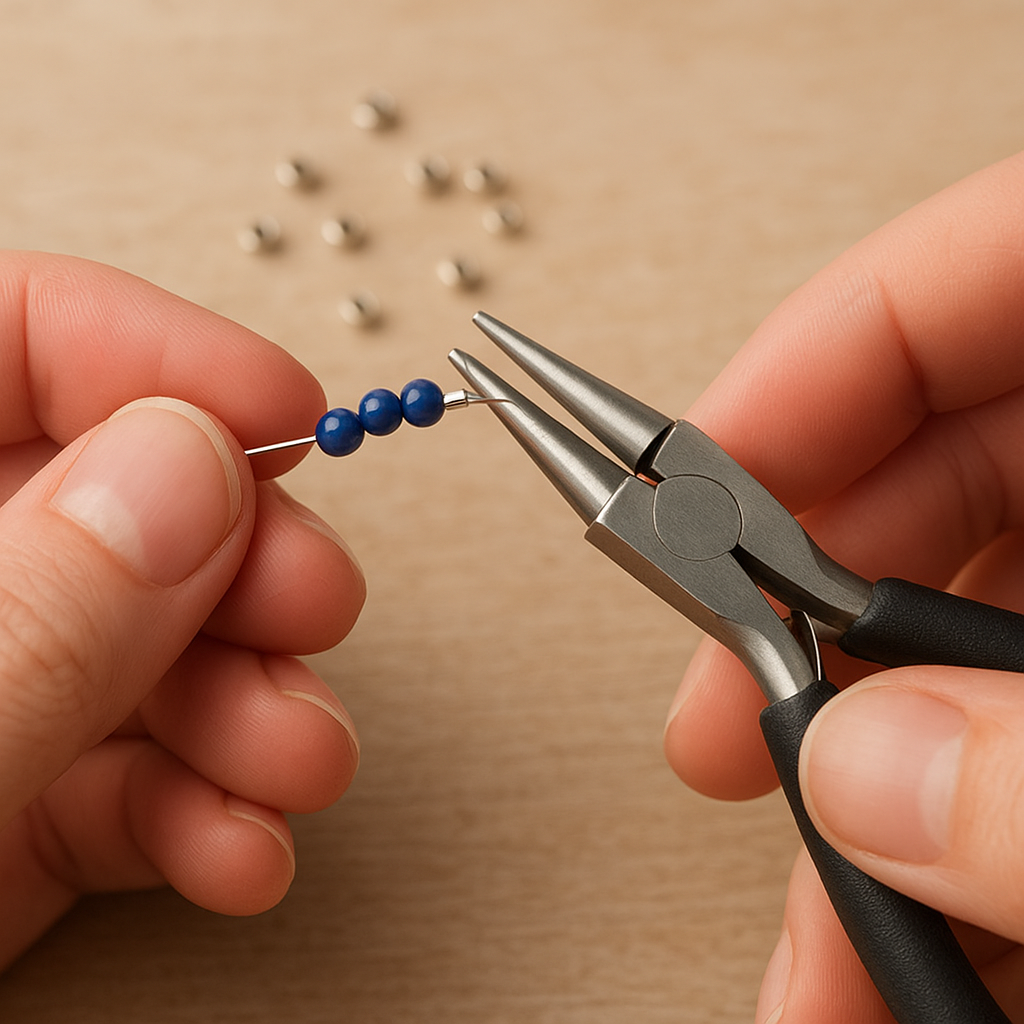
Few techniques can transform the professionalism of handmade jewelry as decisively as crimping. A well-set crimp bead doesn’t just join components; it creates an invisible architecture that supports the entire piece. Whether you design ethereal illusion necklaces or weighty multi-strand chokers, mastering the humble crimp opens the door to cleaner finishes, sleek silhouettes, and long-lasting wear. This guide distills the mechanical logic, material choices, and practiced hand movements that make a crimp bead function flawlessly—then pushes further with advanced methods for creative structure, clean endings, and repair strategies that keep your work on a professional footing.
What Crimp Beads Actually Do
Crimp beads (and crimp tubes) are tiny metal sleeves that lock a beading wire loop in place around a clasp or intermediary finding. Unlike knots or adhesives, a crimp’s security comes from metal-to-metal compression. When formed correctly, the crimp reshapes around the wire’s strands, gripping them without slicing through. The resulting junction is compact, mechanically reliable, and nearly invisible once finished with a cover or tucked near a decorative bead.
There are two main families of crimps: round beads and tube-shaped sleeves. Tube crimps are favored for most beading wire because their flat walls compress predictably with standard crimping pliers. Round crimps can work, but their geometry can make controlled deformation trickier. There are also specialty crimps for leather, suede, or fabric cords; these often feature longer barrels or internal teeth designed to grip soft materials without cutting them.
Crimps shine in places where jewelry needs an elegant workaround to bulk. A tiny crimp can replace several messy knots or a clunky wire wrap. They’re essential when joining flexible beading wire to metal components, spacing floating beads on illusion strands, making ladder bracelets, or building multi-strand terminations that must meet a single clasp plate.
Materials and Sizes: Matching the Metal to the Mission
Base Metals and Finishes
Crimps come in brass, copper, stainless steel, sterling silver, and gold-filled. Each metal has a different hardness profile and response to pressure. Soft metals (like fine silver) can mold cleanly around wire but may deform too easily under heavy wear. Harder crimps (like stainless steel) hold shape but demand higher compression accuracy. In plated crimps, the base metal’s hardness and the plating’s thickness matter; thin plating may crack if over-squeezed, exposing base metal underneath.
When choosing between sterling and gold-filled, consider the chemistry of skin oils, lotions, and local climate. Sterling may tarnish faster in humid or high-sulfur environments, while gold-filled often provides a more stable finish. For designs likely to encounter sweat or saltwater, stainless steel can deliver robust performance—but confirm that your beading wire’s alloy plays well with it.
Tube vs. Round, Standard vs. Micro
Tube crimps in sizes like 1×1 mm, 2×2 mm, and 3×3 mm are the backbone of beaded stringing. A 2×2 mm tube is the everyday workhorse for most 0.014–0.019 inch (0.36–0.48 mm) diameters of 19- or 49-strand wire. Micro-tubes serve fine nylon-coated stainless cable as thin as 0.010–0.012 inch, popular for delicate station necklaces. Larger 3×3 mm tubes pair with heavy 0.021–0.024 inch wire used for substantial pendants or clustered strands.
Round crimps can be charming when used decoratively as stops on illusion work, but consistent compression is less predictable unless you have specialized jaws. If you aim for repeatable, pro-grade results, adopt tube crimps with crimping pliers designed specifically for them.
Wire Pairings and Internal Fit
The crimp-to-wire fit must be snug before you ever squeeze. If the wire slides through the crimp with obvious slack, the finished compression risks slipping. If the wire barely enters, you may shear filaments or create sharp kinks. A good rule of thumb: the total cross-sectional area of the wire (single or doubled back) should fill most of the crimp’s interior while still allowing the metal to flow during compression. Always test-fit: double the wire back through the crimp with your chosen clasp or wire guardian in place and tug gently. The loop should move, but the wire should not rattle inside the tube.
The Tools That Make All the Difference
Crimping Pliers vs. Flat-Nose Pliers
Crimping pliers have two stations in the jaw: a first-stage “crimp” station with a curved notch and a second-stage “fold” station. The first stage compresses the tube into a crescent with a central indentation that separates the wire strands; the second stage rotates and folds that crescent into a compact cylinder. This two-step method locks wire filaments in place far more reliably than a single flat squeeze from chain-nose pliers. Once you internalize this sequence, your work gains a repeatable level of precision that’s difficult to achieve otherwise.
Flat-nose pliers have their place, particularly for finishing crimps that have already been set or applying crimp covers. However, “smashing” a crimp flat risks cutting into the nylon coating of beading wire and reducing long-term stability.
Specialized Variants and Essentials
- Micro crimpers: sized for tiny tubes and thin wire, perfect for delicate station necklaces.
- Mighty or large crimpers: for heavier 3×3 mm tubes and thick cable.
- “Magical” crimping pliers: engineered jaws that roll certain tube crimps into bead-like spheres; great for designs where you want crimps to double as decorative elements.
- Nylon-jaw pliers: to straighten wire kinks without marring.
- Flush cutters: for trimming the tail cleanly; invest in quality to avoid squashing strands.
- Awl or beading needle: for guiding loops or opening tight spaces.
- Magnification and task lighting: small tolerances require attention to micro-details.
Tool Care and Jaw Alignment
Check your pliers’ jaw faces for burrs or misalignment. Even small scratches can scar crimps, create weak points, and nick wire coatings. Keep a scrap strand and a few spare crimps at hand for quick test squeezes whenever you pick up a different tool. Wipe tools clean of metal dust. If hinge action stiffens, a tiny drop of light machine oil on the pivot keeps movement smooth—just be sure to clean residue so it never transfers to finished pieces where it might undermine tension friction.
Step-by-Step: A Professional Crimp Every Time
The following sequence assumes a tube crimp, coated multi-strand beading wire, a clasp or closed ring, and standard two-stage crimping pliers.
- Prepare the components. Thread the crimp onto the wire, add a wire guardian or thimble if desired, pass the wire through the clasp ring, then back through the guardian and the crimp. If you skip a guardian, make a small, even loop that won’t pinch the clasp’s edge.
- Adjust loop size. Before crimping, set the loop so the clasp can pivot freely but does not gape. Aim for a consistent loop size across both ends of the piece for symmetrical appearance.
- First-stage compression. Seat the crimp in the first station (the one with the curved notch) so the tail and main wire lie parallel. Squeeze firmly to create a crescent with a defined central dimple. This dimple divides the strands, resisting slippage and optimizing load distribution.
- Rotate and fold. Turn the crimp 90 degrees, place it in the second station, and squeeze to fold the crescent into a compact cylinder. The edges should tuck neatly without sharp wings.
- Refine the shape. Lightly rotate and tap the folded crimp from two or three angles to achieve a consistent cylinder that will accept a crimp cover cleanly if you plan to add one.
- Tension check. Tug firmly on both wire directions. The loop should hold fast without creeping. If it slips, cut it away and start fresh—never re-crimp a compromised tube.
- Trim the tail. Slide two or three adjacent beads over the tail whenever possible for a smooth transition before trimming. If space is tight, trim close with flush cutters, keeping the cut end turned inward.
- Add a cover if desired. A crimp cover snaps over the crimp and closes with gentle pressure from chain- or round-nose pliers. Avoid over-squeezing, which can flatten the cover into a taco shape.
This is the foundational end-termination, and it supports a surprising range of designs. Executed consistently, it protects durability while preserving a sleek, minimal look.
Wire Guardians, French Wire, and Bead Tips
Wire guardians (also called protectors) are U-shaped guides that prevent metal-to-metal abrasion between the clasp and looped wire. They are invaluable on bracelets and necklaces that see frequent movement. French wire (gimp) is a coiled metal tube slipped over thread or silk to make a dignified, period-correct connection in pearl knotting. Bead tips are clamshell findings that hide knots or small crimps while providing a loop. Understanding when to use each keeps the connection attractive and mechanically sound.
Design Power: Using Crimps Architecturally
Station Necklaces and Floating Beads
Crimps can stop a bead mid-strand, creating “floating” intervals. Place a micro crimp where you want a bead to rest, compress it, slide the bead against it, then add a second micro crimp on the far side to lock position. For a cleaner look, tuck micro crimps inside beads with slightly larger bores, or roll them into small spheres with specialized pliers so they resemble tiny accent beads. The result is airy geometry that showcases negative space while keeping beads predictably spaced.
Multi-Strand Terminations
Complex pieces that gather multiple strands into one clasp plate demand careful planning. Use multi-hole end bars or crimp bars to seat each strand separately, crimping them in symmetrical sequence so the final assembly lies flat. Stagger the crimps by half a bead length when necessary to prevent bunching. For very heavy or high-movement designs, double up: two crimps per strand, spaced 2–3 mm apart, boost integrity without visual clutter once covered.
Ladder and Woven Structures
Crimps excel in ladder bracelets where short horizontal bars of wire connect two parallel cords or beading wires. Each rung is a miniature architecture: crimp-tube-bead-crimp sequences build consistent spacing and gentle articulation. Use a jig or marked bead board to maintain even lengths, and keep first- and second-stage compressions perfectly perpendicular to the direction of stress for even wear over time.
Mechanics That Matter: Loads, Loops, and Edges
Understanding basic mechanics improves your outcomes. A small, clean loop distributes loads evenly around a clasp ring. Oversized loops let the crimped junction rock and concentrate stress at an edge, accelerating wear. The dimple formed in the first crimping stage prevents both strands from sliding at once, increasing frictional resistance. Smooth interior wire coatings and intact plating on crimps reduce micro-abrasion that can erode grip. Keep edges rounded; sharp corners can act like cutting tools under cyclic motion, especially in bracelets where motion—and therefore fatigue—is high. This is the territory where real-world resilience is won or lost.
Troubleshooting and Quality Assurance
- Slippage after wear: Often caused by an oversized crimp, under-compression, or slick wire coating. Move one size down in crimp or use a different brand of wire with a slightly grippier nylon jacket.
- Frayed tails or broken wire at the crimp: The crimp may have been over-flattened or formed with damaged jaws. Inspect tools, lighten pressure, and ensure the fold is cylindric rather than sharp-edged.
- Cracked plating on the crimp: Reduce hand force, make sure the first-stage crescent is fully formed before folding, or switch to thicker-walled crimps.
- Uneven loops: Mark a spacer line on nylon-jaw pliers or use a loop-sizing rod to standardize openings before compressing.
- Visible, lumpy covers: Close covers in tiny bites from multiple orientations. Practice on scrap to develop a gentle squeeze that rounds rather than crushes.
- Beads jamming over tails: Plan bead-bore sizes near the termination. Use a short tail and bury it under two beads with wider bores; never force a tight bead over the cut end.
Build a habit of proof testing. After finishing both ends, give the piece a sustained, firm pull approximating real use. You are verifying not just immediate hold but also long-term security under cyclic loads. If anything moves, redo immediately rather than gambling on customer wear.
Workflow, Jigs, and Repeatability
Professional results are about repeatable steps. Set up a small fixture or mark positions on your bead board for consistent loop sizes and crimp placements. Prepare components in batches: pre-cut wire lengths, pre-load crimps for station necklaces, and group clasps with matching guardians. This assembly-line rhythm reduces errors, supports accurate calibration of your hand pressure, and frees your attention for aesthetic decisions.
Finishing Touches That Elevate the Look
- Color harmony: Match crimp and cover metal to the clasp for coherence, or contrast them intentionally as a design accent.
- Cover choice: 3–4 mm covers hide most 2×2 mm crimps. For micro crimps, tiny covers or bead-shaped rolled crimps look sleeker.
- End symmetry: Confirm that both end loops are the same size and angle. Symmetry makes the clasp sit centered at the nape or wrist.
- Transition beads: Use a slightly larger bead at each end to prevent skinny tails from printing through a tight bead hole.
Beyond Beading Wire: Leather, Silk, and Hybrid Builds
Not all cords behave like nylon-coated stainless cable. Leather and suede need longer, toothed cord ends or fold-over crimps that increase surface contact without cutting. Silk and nylon threads often pair with French wire and bead tips; micro crimps can help stealthily secure a junction before the tip closes. Hybrid builds—wire plus chain, or cord plus wire—thrive on thoughtful transitions where crimps anchor hidden substructures that blend dissimilar materials with clean, modern lines.
Environmental and Wear Considerations
Perspiration, lotions, and perfume affect metals. Bracelets suffer higher motion and abrasion than necklaces; earrings experience light loads but can snag. Choose crimps and wire that match the use profile. For beachwear or high-humidity regions, stainless components and high-strand-count wire resist corrosion and kinking. For heirloom pieces, solid precious metals with proper sealing and routine cleaning slow tarnish and maintain brightness. Your goal is to preserve both appearance and functional integrity after months and years of handling.
Repairs, Retrofits, and Design-Saving Fixes
Even careful work may need repair someday. If a crimp fails near the clasp, salvage length by moving the termination in by a bead or two and balancing the other side to keep symmetry. When a strand breaks mid-run, use tiny decorative stations: add a micro crimp and bead on each side of the break, then conceal a short connector wire under those beads and lock with additional micro crimps—turning the fix into part of the pattern. Keep a travel kit with micro and 2×2 mm crimps, a small crimper, chain-nose pliers, and flush cutters; quick, neat field repairs build trust with clients and retailers.
Testing Protocols for Peace of Mind
- Sample and stress: Build a test loop for each new wire/crimp/plier combo and perform 10–15 strong pulls.
- Inspect under magnification: Look for hairline cracks, plating splits, or wire jacket cuts.
- Cycle flex: Bend the crimped junction gently back and forth 50–100 times to simulate wrist movement; check for creep.
- Record choices: Note crimp brand, size, wire diameter and strand count, and tool used. Small shop logs pay dividends in consistency.
Aesthetic Strategies: Making Crimps Disappear—or Shine
You can treat crimps as stealth or sparkle. To disappear them, color-match metal and hide them beneath slightly larger end beads or covers. To celebrate them, roll special tubes into bead-like spheres at measured intervals and repeat the pattern rhythmically. Mixed-metal designs can alternate silver and gold-toned crimps as dotted lines between gemstone groupings, adding structure and subtle sheen without extra bulk.
Ergonomics and Hand Skill
Hand fatigue sabotages accuracy. Position your elbows level with the work surface, keep wrists neutral, and let the tool’s pivot do the heavy lifting. Practice closing your grip just to the point of full form—excess force deforms metal, increases wear, and tires your hands. Mastery feels like light but deliberate contact: consistent squeezes that result in uniform cylinders, identical loop sizes, and crisp endings, the hallmarks of mature craftsmanship.
Common Myths, Clarified
- Glue makes any crimp safe: Adhesives can lubricate during set and degrade coatings; rely on proper mechanical compression, not glue.
- One crimp size fits all: Tolerances vary across brands; always test the fit with your exact wire.
- Flat-smashed is faster: It’s faster until it fails. Two-stage compression is the professional standard for a reason.
Checklists for Reliable Results
- Fit check: Does the wire fill most of the crimp interior without binding?
- Loop check: Free pivot with no gaping.
- First-stage crescent: Center dimple visible and even.
- Second-stage fold: Round, compact cylinder with no sharp edges.
- Pull test: Firm, sustained tug with zero creep.
- Finish: Tail concealed, cover closed smoothly, end symmetry achieved.
Scaling Up: Production Tips for Batches
In small-batch production, every second counts. Pre-string ends with crimps and guardians, close all first-stage compressions across the batch, then rotate and fold in a second pass. This keeps your hand memory consistent and reduces errors that creep in when you switch mental modes piece-to-piece. Keep multiple pliers of the same model on hand; if one starts to misform tubes, you can isolate the issue quickly and maintain throughput without sacrificing quality.
A Quick Guide to Choosing Wire and Crimp Combos
- Delicate pendants or pearls: 0.012–0.014 inch, micro tube crimps, gentle fold, optional cover for elegance.
- Everyday necklaces: 0.015–0.019 inch, 2×2 mm tubes, standard crimper, wire guardians for longevity.
- Heavy chokers and clustered beads: 0.021–0.024 inch, 2×3 or 3×3 mm tubes, mighty crimper, double-crimp redundancy.
- Illusion work: ultrafine wire, micro crimps hidden in beads or rolled spherical with specialty pliers.
A Note on Feel: The Language of Metal
Great crimp work is partly tactile. As jaws close, you’ll feel a subtle give when the metal reaches its plastic deformation point; go a hair further and stop. Over-squeezing past this moment squashes, under-squeezing leaves slack. Train your sense by making 20 identical crimps on scrap wire, measuring visual uniformity, and pull-testing. This ritual builds intuitive control over tension and results in consistent outcomes across different brands and batches.
Final Polish: Confidence You Can See and Feel
When your crimps are compact, loops measured, covers rounded, and transitions smooth, people may not notice why your jewelry looks refined—they just feel that it is. That seamless professionalism starts with methodical technique, appropriate materials, and patience. Keep testing, keep notes, and stay curious about the tiny physics inside every connection. The payoff is jewelry that wears comfortably, lasts longer, and projects calm assurance the moment it’s clasped. That’s how small metal sleeves become quiet guardians of form, function, and long-term durability.
Glossary: Quick Terms You’ll Use Often
- Crimp bead/tube: A small metal sleeve compressed to lock beading wire or cord.
- Crimp cover: A C-shaped shell that closes over a finished crimp to look like a round bead.
- Wire guardian/thimble: A U-shaped channel protecting wire where it loops through a clasp.
- First-stage crimp: The initial compression that creates a dimpled crescent, separating wire strands.
- Second-stage fold: The rotation and final squeeze that forms a compact cylinder.
- Illusion/station necklace: A design where beads appear to float on an invisible strand, held by stops.
- Strand count: Number of filaments in coated beading wire (e.g., 7, 19, 49), affecting flexibility and kink resistance.
Practice Plan: From Good to Exceptional
- Warm-up: 10 practice crimps on scrap, alternating metals and sizes.
- Consistency drill: Make five identical end loops and measure with calipers or a loop gauge.
- Stress drill: Proof pull each sample and log results—note any slipping or coating damage.
- Finish drill: Apply five crimp covers without flattening; aim for perfect spheres.
Within a few sessions, your hand learns the nuanced squeeze that balances secure hold and clean finish. From there, everything else—symmetry, proportion, material harmony—builds on the same disciplined base. That base is your quiet signature, the reason a client can pick up your work and sense order, care, and lasting security in every detail.
