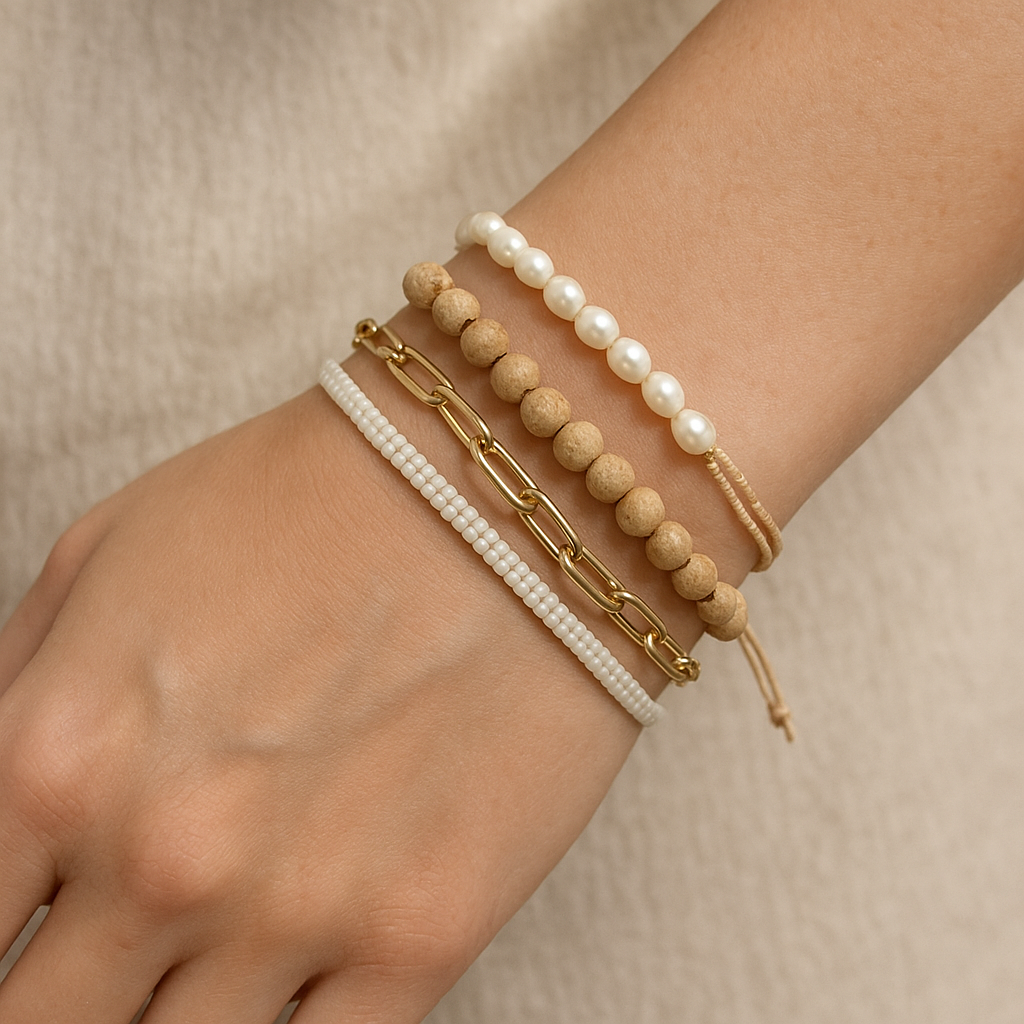
Necklaces may have the drama, but stacked bracelets carry the rhythm of everyday life. Each strand moves with your gestures, gathers small memories from places you visit, and quietly amplifies your outfit with pattern, shine, and tactility. Making your own stacks gives you control over scale, weight, and message: calming neutrals for focus, playful charms for weekends, a single metallic thread to echo the hardware on your bag. This guide walks through the materials, techniques, and design thinking behind DIY stacks that feel personal, durable, and genuinely wearable from sunrise coffee to late-night trains.
Why Stacked Bracelets Capture Everyday Style
Bracelet stacks are intimate. Unlike a statement necklace that announces itself across a room, a stack lives at the edge of your sleeve where you and your close circle notice it most. That intimacy encourages storytelling—shell beads from a beach day, a stamped charm with initials, a line of hematite for grounding, a pop of neon to remember a festival. Stacks also solve a common styling puzzle: they bridge casual and polished with ease. A soft cotton tee, a blazer, jeans, and a six-strand stack can read composed yet spontaneous.
Another reason they work so well day to day is modularity. You can add or subtract in seconds to adapt to tasks—pull off the two chunkier bangles before typing for hours, then slide them back on for lunch. Stacks inherently invite experimentation; you rarely need a completely new piece to refresh the look, just a different pairing or a seasonal accent bead. Handicraft traditions across cultures echo this modular approach, from African trade beads layered for market days to slender Indian glass bangles stacked by the dozens for festivals. Your own stacks can respectfully nod to these lineages while staying true to your everyday needs.
Materials and Tools That Elevate Handicraft
The pleasure of making stacks is tactile as much as visual. Choosing materials with intention leads to bracelets that age well and invite touch.
- Beads: Glass (pressed, lampwork, seed), gemstones (agate, jade, quartz, hematite), metals (brass, copper, sterling), wood (sandalwood, bayong), ceramic, recycled paper, bone and horn (ensure ethical sourcing), polymer clay (custom colors and cane patterns). Each brings weight and sheen; mix heavier stones with lighter wood or acrylic to keep the total stack comfortable.
- Cords and stringing: Elastic (0.5–1.0 mm), nylon beading thread (Nymo, FireLine), waxed polyester, leather lace, cotton or silk cord. Elastic suits quick slips, while nylon threads excel for intricate beadweaving. Leather and cotton add an earthy line that contrasts nicely with glossy glass.
- Wire: Memory wire for coils, 20–24 gauge craft wire for bangles and wrapped charms. Stainless steel memory wire is springy and holds shape; cut it only with hardened memory-wire cutters to avoid ruining standard pliers.
- Findings: Jump rings, split rings, crimp beads and covers, lobster clasps, magnetic clasps, end caps, cord sliders, tube beads, bead tips (clamshells). Quality findings transform “DIY” into artisanal—opt for soldered jump rings when possible to reduce snag points.
- Adhesives: A flexible jewelry cement or a clear-drying epoxy for knot security. For elastic, a drop of glue on a surgeon’s knot helps, but avoid saturating the elastic which can make it brittle.
- Tools: Round-nose pliers, chain-nose pliers, flush cutters, memory-wire cutters, beading needles (sizes 10–12 for seed beads), bead mat, ruler or tape measure, mandrel (or a sturdy glass) for shaping wire bangles, polishing cloths.
Skin chemistry and allergies matter for everyday wear. If you react to base metals, favor sterling silver, stainless steel, titanium, or gold fill; seal raw brass or copper with a jewelry-safe lacquer. For summer or workouts, threads and cords that handle moisture (like nylon or waxed polyester) are more forgiving than leather.
Where you source materials also shapes your project’s story. Seek fair-trade beads, artisan-made lampwork, recycled glass, and reclaimed metals when possible. Supporting small-batch makers enhances the soul of your stack while offering unique textures you won’t find in bulk assortments.
Design Foundations: Color, Texture, and Proportion
Even a spontaneous-looking stack follows a few quiet rules that keep it cohesive.
Color cues that never fail
Start with a neutral base—matte black, warm camel wood, soft gray hematite, or muted metallics—then introduce a controlled accent. The 60–30–10 guideline is handy: 60% base, 30% secondary (maybe a medium-tone stone), 10% accent (a high-saturation bead or charm). Consider the temperature of your palette: cool silvers, blues, and greens feel crisp; warm golds, corals, and browns feel inviting. Skin undertone matters too; olive and deep skin often glow next to gold and saturated jewel tones, while fair skin can benefit from gentle contrasts like rose gold or smoky quartz. To enhance planning, think about your wardrobe’s dominant color and echo it subtly instead of competing with it.
Texture as a design engine
Visual sameness is where stacks fall flat. Alternate gloss and matte, faceted and smooth, rigid and pliant. A tiny line of seed beads makes chunky rondelles look even chunkier by contrast. Leather knots calm the shimmer of metallics. Memory wire’s firm coil next to a floppy macramé brings delightful rhythm. Let texture do as much storytelling as hue.
Finding balance without being boring
Successful stacks often rely on deliberate asymmetry with echoes that tie the whole together. Repeat a bead color three times across the stack, but change bead size in each occurrence. Mirror a motif on opposite sides of a watch face. Insert slim spacers between busier strands so the eye can rest. Keep overall balance by checking your stack from a slight distance; if one area looks visually heavy, add a calm strand next to it or redistribute larger beads.
Symmetry and proportion in practice
Symmetry can be formal (centered focal bead with mirrored sides) or loose (two bangles of similar weight on either edge of the stack). Gauge symmetry by the feel on your wrist: twisting means the weight isn’t evenly distributed. Size your focal elements sensibly; three giant stones in a row might dominate, whereas one focal flanked by spacers preserves proportion. A good rule: for everyday wear, aim for a total stack width between 15–35 mm; beyond that, consider tapering with a couple of slim strands to keep movement natural.
Five Essential Bracelet Types for a Mix-and-Match Stack
Master these five and you can build infinite combinations, from minimalist to boho-rich.
1. Quick Stretch Bracelet (Elastic)
- Best for: Speed, gifting, beginners, bead showcases.
- Materials: 0.7–1.0 mm clear or black elastic, beads with smooth holes, bead stopper or tape, jewelry cement.
- Steps:
- Cut elastic 10–15 cm longer than wrist circumference for knotting ease.
- Pre-stretch the elastic gently to reduce future slack.
- String beads. For heavy stones, alternate with light spacers to prevent sag.
- Check fit by wrapping around wrist; adjust count so the bracelet meets without strain.
- Tie a surgeon’s knot (overhand, overhand, then pass one tail again), snug down while keeping tension even.
- Add a tiny drop of cement, let it set, and hide the knot inside a larger-holed bead.
- Tip: Use seed beads as “micro-spacers” to fine-tune length without changing the look.
2. Macramé Slider Bracelet
- Best for: Adjustable sizing, gifts, casual texture.
- Materials: Waxed polyester or nylon cord (0.8–1.2 mm), optional beads, lighter to melt ends.
- Steps:
- Cut a base cord that fits the wrist with 10 cm extra on each end.
- Cross ends to form a loop and secure side-by-side with tape.
- Use a 40–50 cm cord to tie square knots across both base cords, creating a sliding closure 1.5–2.5 cm long.
- Trim and melt the working cord ends lightly to lock. Add small stopper knots or beads to the base cord tails.
- Tip: Alternate square and half-knots for a spiral effect; thread seed beads into the knots for subtle shine.
3. Memory Wire Wrap
- Best for: Structured stacks, zero clasp fuss, statement bases.
- Materials: Stainless memory wire, memory-wire cutters, round-nose pliers, beads, end caps or simple wire loops.
- Steps:
- Cut 1.5–3 coils depending on desired width.
- Form a small loop at one end to prevent beads from sliding off.
- String a repeating or gradient pattern, mixing bead sizes for movement.
- Finish with a loop or glue-on end cap.
- Tip: Insert occasional 2–3 mm spacer beads to keep curves graceful and reduce bulk.
4. Simple Chain with Charm
- Best for: Sound and sparkle, layering with beaded strands.
- Materials: Cable or rolo chain, jump rings, lobster clasp, charm, pliers.
- Steps:
- Measure chain to wrist plus 1–1.5 cm ease.
- Attach clasp with jump ring; on the other end, add a small extender chain for adjustability.
- Hang a charm with a jump ring near the clasp or as a movable dangle.
- Tip: Mix metal finishes intentionally—one bright, one antique—then echo each finish elsewhere for cohesion.
5. Forged Wire Bangle
- Best for: Structural edges to frame a soft stack.
- Materials: 14–16 gauge wire (copper, brass, sterling), mandrel, file, hammer, bench block, polishing cloth.
- Steps:
- Measure hand circumference at its widest (thumb tucked) to determine bangle size.
- Cut wire, file ends smooth, shape around a mandrel, and close ends with a neat wrap or solder (if equipped).
- Lightly hammer to work-harden and add texture; polish.
- Tip: Hammer just the top arc for a half-textured sheen that catches light without feeling rough.
Measuring, Fit, and Everyday Comfort
Measure your wrist where a watch would sit. For snug elastic, add 0.5–1.0 cm; for drape with clasps, add 1.5–2.0 cm. If stacking many strands, err slightly smaller on each so they don’t migrate up the forearm. Mind bead hole edges—some stone beads have sharp openings that can saw at elastic; add metal or glass spacers near the knot to shield stress points.
Weight affects how a stack behaves. A heavy strand wants to sit lowest; use that as an “anchor,” then layer progressively lighter pieces above. Complement a stiff element (memory wire, bangle) with flexible cords to reduce clacking while you type. Breathability matters in heat—add small seed-bead or heishi “air gaps” between larger beads to keep skin cool and improve comfort. For daily longevity, choose abrasion-resistant cords and tuck away any wire tails; these details add real-world durability that you’ll appreciate after months of wear.
Starter Palettes and Recipe-Style Stacks
Use these building blocks as templates, swapping beads to suit your wardrobe.
- Urban Minimal: 1 hematite stretch (3–4 mm rounds), 1 matte onyx stretch (6 mm), 1 slender sterling chain with tiny bar charm, 1 thin hammered sterling bangle. Accent with a single bead of deep cobalt on the onyx strand.
- Earth + Sky: 1 matte amazonite stretch (6 mm), 1 cedar wood macramé slider, 1 brass chain with leaf charm, 1 brass bangle. Thread three tiny gold spacers into the amazonite at irregular intervals to catch light.
- Soft Neutrals: 1 rose quartz stretch (4 mm), 1 blush seed-bead ladder bracelet, 1 silk cord with a freshwater pearl knot, 1 thin rose-gold-filled chain. Keep metal tones cohesive for a gentle glow.
- Graphic Monochrome: 1 black-and-white chevron seed-bead tube on elastic, 1 matte black rubber cord with steel magnetic clasp, 1 stainless memory-wire coil with alternating black glass and steel heishi.
- Weekend Color Pop: 1 rainbow heishi stretch, 1 macramé slider in navy, 1 silver chain with enamel charm, 1 slim wood bangle. Limit bright tones to two adjacent strands, letting the others calm the look.
Advanced Techniques and Variations
Once the basics feel natural, expand your vocabulary with a few deeper skills.
- Bead Weaving: Try odd-count peyote for snug-fitting tubes, right-angle weave for tailored grids, or ladder-and-brick combinations for lightweight, flexible bands. Add custom clasps using beaded loops and toggles.
- Kumihimo and Crochet with Beads: Braided cords interspersed with beads produce round, elegant strands that balance a stack. Nylon beading cord paired with size 8 seed beads yields a satisfying drape.
- Wire Wrapping: Wrap rough-cut gemstones as focal charms; connect them via double-wrapped loops for strength. Mix wrapped charms with chain for a hybrid strand.
- Metal Stamping and Texturing: Stamp dates, initials, or mantras on narrow metal blanks, then round and polish for cuff-style additions. Lightly dome blanks for comfort on the wrist.
- Polymer Clay Beads: Blend custom hues that match your wardrobe precisely; bake, sand, and buff to a satin finish. Create faux stone effects (terrazzo, granite) for visual variety at low weight.
Troubleshooting and Maintenance
- Elastic Fatigue: If a bracelet starts to gape, your knot likely slipped or the elastic degraded. Re-string with slightly thicker elastic and pre-stretch before beading. Avoid essential oils and alcohol-based sanitizers directly on elastic.
- Tarnish on Brass/Copper: Clean with a gentle polishing cloth; store in anti-tarnish bags. Consider sealing raw metals with microcrystalline wax for fewer touch-ups.
- Fraying Threads: Use beeswax or thread conditioner on nylon to reduce abrasion; pass through beads multiple times to share stress. Replace any bead with a sharp inner edge.
- Snagging Charms: Replace open jump rings with soldered ones or use split rings. File any rough points on wire-wrapped loops.
- Fit Creep in Macramé: Over time, knots compress. Start closures slightly tighter; a single overhand stopper on the tails limits expansion.
- Storage: Lay flat on a bead mat or hang from a padded dowel. Keep sets together in small pouches so morning routines stay quick.
Eco-Friendly and Ethical Choices
Everyday jewelry touches skin and routine; aligning your materials with your values makes each wear feel better. Recycled glass beads, vintage Czech seed beads, and reclaimed sterling reduce mining demand. Source wood from responsibly managed forests and favor vegetable-tanned leather. When buying gemstones, consult vendors who disclose origins and cutting practices. Repair rather than discard—replace a clasp, refresh elastic, or rework a design into key fobs or zipper pulls. Package gifts in recycled kraft boxes with natural twine. Small decisions accrue, turning your hobby toward real sustainability.
Style Play: From Desk to Dinner
Think of stacks as adjustable volume knobs. For the office, keep the center calm: one matte strand, one slim chain, one quiet bangle. If you use a keyboard often, place rigid bangles toward the sleeve end and softer cords closer to the hand to reduce noise. For dinner, swap in a higher-shine element and a charm with movement. Sleeves matter a lot—cropped or pushed-up sleeves invite taller stacks; long, narrow cuffs look best with flatter, woven pieces that slide under gracefully. Watches integrate beautifully: treat the watch as a focal and flank it with two similar-weight strands for visual continuity. These choices reflect personal craftsmanship in how you edit rather than just how you make.
Inclusive Sizing and Accessibility
Wrists and hands vary widely. Keep a sizing chart handy: children’s wrists often range 12–14 cm, many women’s 15–18 cm, many men’s 17–21 cm, and plenty of people fall outside those averages. Design with extra links or sliders so recipients can tweak fit. Magnetic clasps with safety catches help those with limited dexterity; wide, soft macramé avoids pressure points for sensitive skin. Weight can trigger fatigue during long wear—aim for lighter strands near the palm side to reduce strain during typing or lifting.
Gifting and Memory-Making
Stacks make meaningful gifts because you can encode messages through materials. Birthstones as subtle spacers, a Morse-code pattern spelling a name in beads, colors tied to a favorite sports team, or beads collected on a shared trip. Add a small card that lists materials and care instructions. For sets, include an extra neutral strand so the recipient can dial the overall intensity up or down. Personal meaning paired with practical thoughtfulness yields treasured daily wear.
Teaching, Workshops, and Selling Your Stacks
Stacks are ideal for community classes: minimal tools, fast wins, broad style appeal. Set up stations by technique—elastic, macramé, wire—and let students rotate. For selling, cost out materials per piece, add time (with a clear hourly rate), overhead (tools, packaging), and a profit margin that sustains growth. Photograph stacks on neutral backgrounds and on-wrist to show scale; natural light near a window with a reflector is friendly to beads. Offer curated minis (three-strand sets) and à la carte singles so buyers can build gradually. Clear descriptions—bead size, finish, clasp type—reduce returns and build trust. Flexibility is a market advantage; the inherent versatility of stacks helps customers imagine repeat wears.
Seasonal and Thematic Ideas
- Spring: Pastel seed beads with tiny botanical charms, satin cord sliders, pale gold accents.
- Summer: Turquoise and shell, knotted waxed cord (water-friendly), bright enamel on chain.
- Autumn: Tiger’s eye, brass, deep garnet glass, leather lacing with leaf-stamped blanks.
- Winter: Hematite, onyx, icy clear quartz, sterling chain; add a knitted cuff for warmth and contrast.
- Occasions: Minimal black-tie stack (one polished bangle, one delicate chain, one black spinel), festival stack (color-saturated heishi, jingling charms, memory wire).
Safety and Everyday Practicalities
Avoid long, dangling charms in environments with machinery or active sports. For children, skip small components that could detach; favor macramé with large, securely tied beads. Test magnetic clasps for holding power relative to bead weight. When traveling, pack stacks in a roll-up felt wrap; slip silica gel packets inside to slow tarnish. Remove bracelets before swimming; chlorinated and salt water can dull finishes and weaken elastic. Lotion and perfume last; jewelry first—let skincare absorb to protect cords and plating.
Pattern Starters and Creative Prompts
- Odd Harmony: Build five strands where only one uses bright color; let the other four whisper in neutrals and textures.
- Metal Echo: Mix two metal tones, but repeat each at least twice—chain and spacers in one tone, bangle and charm in the other.
- Scale Ladder: Sequence beads by size across strands—2 mm seed, 4 mm rounds, 6 mm rondelles, then drop back to 3 mm tubes.
- Storyline: Three charms representing place, person, and plan—map tag, initial, tiny compass—spaced across different strands.
- Negative Space: One strand of knots only, no beads; it lets every other strand breathe and heightens overall impact.
A Simple Workflow for Confident Results
- Define the mood: calm, energetic, formal, earthy.
- Pull a limited palette: 1–2 neutrals, 1 secondary, 1 accent.
- Choose three techniques for diversity: elastic, chain, one structured (bangle/memory wire).
- Lay out strands side by side on a bead mat; photograph variations to compare quickly.
- Assemble, then wear-test for an hour at home—type, cook, fold laundry—to reveal pinch points or noise issues.
- Refine lengths and components, then finish cleanly with tucked knots and filed wire ends.
Finishing Touches That Make It Feel Boutique
Small upgrades transform the experience. Use crimp covers to convert functional crimps into round “beads.” Add wire guardians near clasps to reduce thread wear. Match jump ring sizes so connections look intentional. Burnish leather lightly with beeswax for a subtle glow. Include a micro polishing cloth with gifts. Photograph the finished stack on a neutral, textured surface—linen, slate, weathered wood—to celebrate its handmade character without visual clutter.
Your Everyday, Your Signature
The beauty of DIY stacked bracelets is how they evolve with you. You can start with three simple strands this afternoon and, over months, let the set grow into a small archive of moments: a bangle from a metals class, a woven piece learned from a friend, a bead or two scavenged from a broken heirloom. Give yourself permission to edit often. Swap in a quiet strand for a busy morning, a bright one for a gray day. With attention to material choices and a handful of design habits, your wrists will carry a living sketchbook—objects that move when you move, and that hold meaning as lightly or as loudly as you wish.
