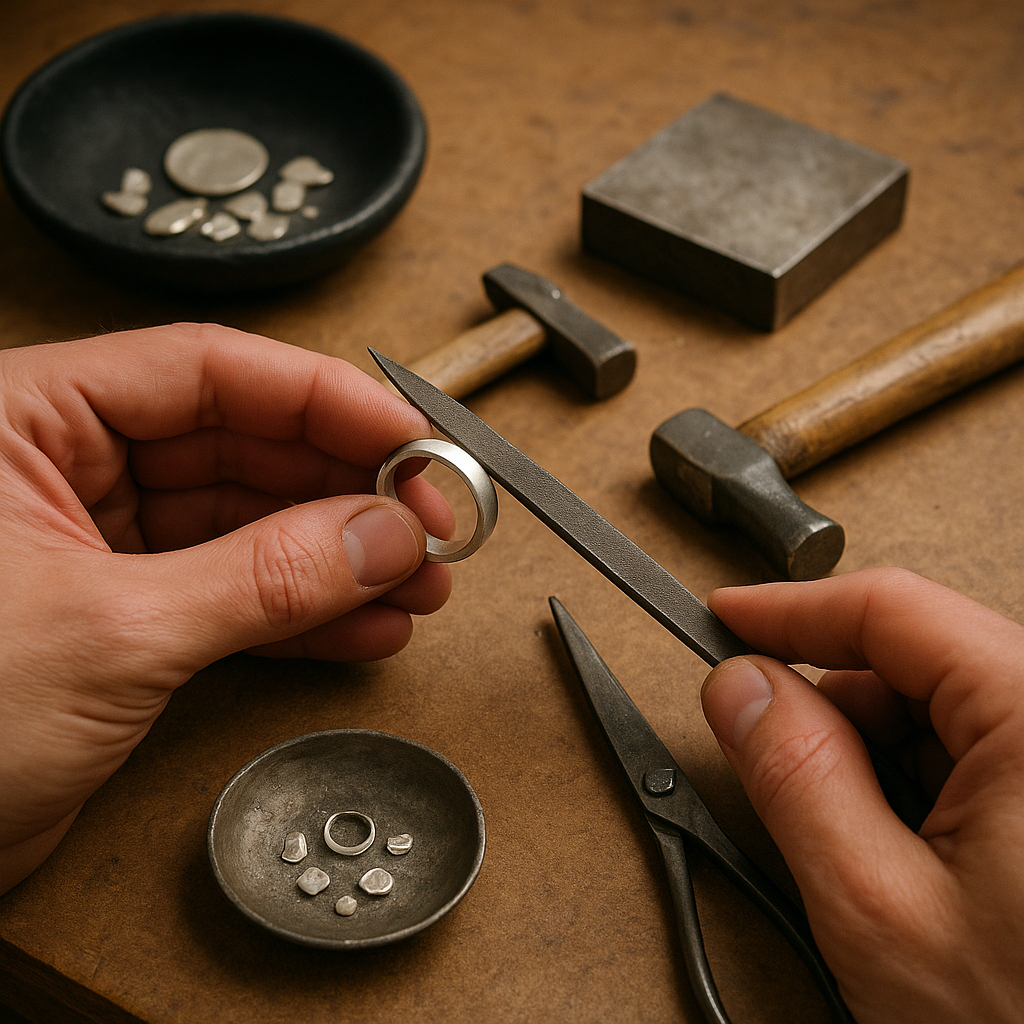
Silversmithing sits at the crossroads of artistry and engineering, a tactile craft where heat, pressure, and patience turn raw metal into meaningful objects. For beginners drawn to the glow of polished silver, the path forward can feel both exhilarating and bewildering: there are new tools to learn, new materials to understand, and new ways of seeing three-dimensional form. This introduction brings clarity to that path. You will learn what silver is and how it behaves, how to select and care for tools, what happens when you heat or hammer metal, and how to turn sketches into wearables or small vessels with finishes that last. The aim is not only to show techniques, but also to build your judgment—so you know why a joint fails, how to correct a warped seam, when to anneal, and how to design for strength and comfort from the outset.
What Silver Is and Why It Behaves the Way It Does
Silver is prized for its reflectivity, workability, and resistance to corrosion. Pure silver (often stamped .999) is very soft and most suited to pieces that won’t experience rough wear, such as delicate earrings, inlay, or raised vessels with substantial thickness. Jewelry, flatware, and many decorative objects are commonly made in sterling silver, an industry standard that contains 92.5% silver and 7.5% copper. That added copper increases hardness and durability while preserving most of silver’s luster. Modern variations like Argentium substitute some copper with germanium to resist tarnish and reduce firestain, making finishing less laborious for beginners.
Two facts guide a silversmith’s decisions from the first cut to final polish: silver work-hardens, and it conducts heat extremely well. Work-hardening means that as you bend, hammer, or otherwise deform silver at room temperature, its crystalline structure becomes more resistant to further deformation. The result is a springier, tougher metal—useful for clasps or rings—until it becomes brittle and prone to cracking. Heat resets that crystalline structure through a process known as annealing, where metal is heated to a defined temperature and then cooled to restore softness. Thermal conductivity means heat moves rapidly away from your torch’s focal point; solder won’t flow if the surrounding mass is cool, so heat must be applied broadly and evenly when joining.
Alloy choice matters for color, hardness, and tarnish resistance. When you hear jewelers talk about an alloy, they mean a blend of metals designed for specific properties. Sterling’s copper content gives strength at the cost of slightly faster tarnishing than fine silver. Argentium or de-ox alloys reduce tarnish and firestain formation. Know your intended use: a cuff bracelet needs greater spring and thickness than a pendant; a ring shank must withstand compressive loads; an earring hook benefits from work-hardened springiness.
Stock forms include sheet, wire, tube, and casting grain. Sheet thickness is often denoted by gauge (lower number equals thicker sheet in the American Wire Gauge system). For beginners, memorize a few conversions: 20 gauge (~0.8 mm) works for lightweight pendants; 18 gauge (~1.0 mm) makes sturdy earrings and bezels for larger cabochons; 16 gauge (~1.3 mm) is robust enough for rings or bangles with less flex. Wire comes round, half-round, square, or patterned; half-round is traditional for ring shanks and bangles, while square wire can be twisted or forged into textures.
Setting Up Your Bench: Tools That Earn Their Keep
A functional bench balances accessibility, stability, and comfort. At its heart is a bench pin—an inexpensive wooden V-shaped support clamped or fixed to the work surface for sawing and filing. Around it you’ll gradually add pliers (chain-nose, flat-nose, round-nose), a jeweler’s saw frame with blades from 8/0 to 2/0 for fine to coarse cuts, files (flat, half-round, needle files), dividers and calipers for precise marking, and an array of hammers: nylon mallets for non-marring forming, rawhide for gentle persuasion, ball-peen for texturing, cross-peen for directional stretching, and a flat planishing hammer to smooth and refine raised surfaces. Mandrels—ring, bracelet, and bezel—provide forms for consistent curves. A bench vise, third-hand tool, charcoal or soldering board, and cross-lock tweezers round out the core layout.
Your heat source dictates the pace and scale of work. Small butane torches are sufficient for fine jump rings, tiny bezels, and spot annealing of thin stock. Propane/air torches offer broader heat for larger pendants, bangles, and small bowls. Air-acetylene systems deliver a very hot, focused flame suitable for efficient soldering of heavy stock and precise operations like sweat soldering overlays. A range of torch tips lets you tune the flame size to match the thermal mass of your piece. Alongside the torch, you’ll stock different solders—hard, medium, easy—each with progressively lower melting points, allowing you to make multiple joints without reflowing the earliest ones. Students often try to do everything with easy solder; using hard where feasible results in stronger, cleaner seams and better heat training early on.
Flux and pickle complete your joining toolkit. Flux shields heated silver from oxidation and enables solder flow; liquid fluxes brush neatly along seams, while paste fluxes sit where you place them and are ideal for sweat soldering. Pickle (commonly a sodium bisulfate solution) dissolves copper oxides after heating and returns the surface to a clean, pick-white finish. Use a dedicated non-reactive pot (ceramic or plastic) with copper tongs; steel contaminates pickle and causes copper to plate onto silver. Good ventilation and thoughtful layout—torch far from flammables, pickle on a stable surface, tweezers and brushes within easy reach—are essential aspects of workshop safety.
Comfort and injury prevention matter as much as shiny finishes. Plan bench height so your forearms are roughly parallel to the surface while filing, and your shoulders stay relaxed when sawing. Good lighting (a bright task lamp plus diffuse ambient light) reduces eye strain. Anti-fatigue mats relieve long stances, and a stool with proper lumbar support helps during intricate tasks. Simple attention to ergonomics—neutral wrist positions, frequent micro-breaks, rotating tasks—keeps hands and shoulders healthy over years of making.
Heat, Hardness, and Clean Joints: The Thermal Language of Silver
Soldering and annealing are not just discrete operations; they’re a conversation with your material. Torch control begins with flame chemistry: a neutral flame (balanced oxygen and fuel) is stable and efficient. A reducing flame (fuel-rich) can protect against oxidation but may leave soot; an oxidizing flame (oxygen-rich) overheats and can cause pitting. Keep your tip moving to warm the entire assembly; don’t “chase” the solder with the flame. Instead, bring the parent metal to the correct temperature so the solder flows toward the heat, wicking neatly through a well-fitted seam.
Success starts with fit. Solder is not a gap filler; it’s a microscopic bridge between two clean, tight surfaces. File or sand mating edges until no light peeks through. Use binding wire or self-locking tweezers to hold pieces firmly. Apply flux sparingly but completely along the joint. Place snippets (pallions) of solder on the side where you anticipate the best capillary action. Heat broadly, pausing to let the thermal mass equalize, then focus near—but not on—the solder until it flashes and flows. If it balls up, the surfaces are either dirty, not hot enough, or the flux has burned off. Quench, pickle, rinse, and inspect. Practice sequences: hard solder first (for structural seams), then medium (for secondary elements), then easy for small findings.
Annealing returns cold-worked silver to a soft state. Mark a corner with a Sharpie; when the mark turns brown and disappears under heat, you’re near annealing temperature. For sterling, that’s roughly 650–705°C (1200–1300°F). Heat evenly to a dull red in dim light, hold briefly, and remove. Quench after air-cooling a few seconds to avoid thermal shock to a thin edge. If you overheat sterling, you risk firestain—deep subsurface oxides that appear as a grey cloud and require abrasion to remove. Prevent firestain by using protective flux coatings, clean flames, and minimal overheating; Argentium and de-ox alloys reduce the problem but don’t eliminate the need for careful heat control.
Measuring, Marking, and Cutting with Precision
Design lives or dies in the layout phase. Scribe arcs with dividers, mark centerlines, and use calibrated rulers and ring charts. Compensate for thickness when calculating ring blanks: ring size circumference plus two times material thickness yields a close starting length; refine by test-bending around a mandrel. For cuffs, add overlap for finishing, accounting for springback in thicker gauges.
Choose saw blades that match your material thickness: thinner stock pairs with finer blades (e.g., 5/0 to 2/0), while thicker sheet tolerates coarser teeth. Tension the blade so it sings a high note when plucked. Lubricate with wax or beeswax to reduce friction and improve cut quality. Keep the sheet firmly against the bench pin; move the metal, not the saw frame, to follow curves. Deburr edges with a fine file and follow with progressively finer abrasives. A light touch yields control; forcing the blade leads to wander and breakage.
Shaping Metal: Bends, Curves, and Controlled Deformation
Forming blends understanding and feel. Start by bending on mandrels: narrow curves for jump rings, steep arcs for bezels, gradual sweeps for bracelets. Use a nylon or rawhide mallet to shape without stretching; switch to steel hammers only when you intend to move metal. Hammering on a steel stake compresses the surface (planishing), creating strength and a refined finish. Cross-peen strikes elongate material in one direction, useful for tapering ends of cuffs or spreading a narrow strip into a leaf shape. Anticlastic and synclastic forming—curvatures in opposite or same directions—are achieved with sinusoidal stakes and specialty hammers, producing elegant, ergonomic cuffs that feel like they belong on the wrist.
For small bowls or spoons, start with a disk and sink it into a dapping block or a sandbag using a ball-peen hammer. Anneal frequently as the metal work-hardens; otherwise, cracks will begin at the rim. After achieving depth, switch to planishing with a polished hammer on a polished stake to smooth facets into a continuous curve. This is where rhythm and consistency pay off: even, overlapping blows produce surfaces that polish quickly later.
Introduce controlled thickening through directional hammering, commonly referred to as forging. The edge of a bar can be drawn into a taper for a graceful spoon handle, or the center of a strip compressed to add stiffness to a cuff without increasing thickness. Each series of blows is followed by planishing and annealing as needed. Learn to read the metal: a “tinny” ringing and springiness signal work-hardening; visible cracking at edges is a red flag to stop and anneal immediately.
Joining Beyond Solder: Cold Connections and Rivets
While soldering is foundational, cold connections unlock mixed-media work and heat-sensitive elements. Simple wire rivets secure layers of metal without melting anything. Drill matching holes, slightly countersink, insert a snug wire pin, and upset both ends with a small hammer to mushroom and lock. Tube rivets create a clean, modern look and can double as hinges for kinetic elements. For removable parts, use threaded posts with knurled nuts or miniature screws. These techniques also offer repair-friendly strategies when working with wood, leather, or enamel components.
Surface Finishes: From Workshop Matte to Gallery Shine
Good finishing starts long before the polishing motor. After filing, move through abrasives systematically: 320 grit to remove file marks, 600 to eliminate 320 scratches, 1200 or higher to approach a pre-polish. Skipping grits traps deep scratches that reappear after polishing. For curved interiors, use abrasive cords and rubber wheels in fine grades. A burnisher compacts and brightens edges or bezel walls mechanically, producing a shine without compound.
Polishing compounds cut and color. Tripoli or gray compounds remove fine scratches; red rouge brings a mirror finish. Use separate buffs for each compound to avoid contamination. Keep the piece moving to prevent wavey finishes and heat buildup. Ultrasonic cleaners and steamers remove residual compound from crevices; in a small studio, a toothbrush and warm soapy water suffice.
Intentional oxidation alters mood and contrast. A classic patina uses liver of sulfur (potassium sulfide solution) to darken recesses. Control tone by adjusting temperature, concentration, and time; quench the reaction with a baking soda rinse. Seal porous, textured finishes with microcrystalline wax to slow wear. Matte surfaces can be achieved with Scotch-Brite, sandblasting, or satin wheels; hammered textures catch light and hide minor wear, an ally for everyday pieces.
Stone Setting Basics: Secure, Clean, and Repairable
For beginners, bezel setting is forgiving and elegant. Start with bezel strip slightly taller than the stone’s girdle. Curve and fit the strip snugly around the cabochon, solder the seam, and file the bottom flat. Solder the bezel to a backplate using hard solder, quench, pickle, and saw the backplate to shape. After polishing the interior lightly, seat the stone onto a thin bed of jeweler’s wax or paper to take up minute irregularities. With a pusher or bezel roller, compress the bezel wall down evenly in cardinal directions, then work around the circumference in small steps. Finish by burnishing, which both tightens and brightens the edge. For faceted stones, tube settings and flush (gypsy) settings are common next steps; they demand tight tolerances, sharp burs, and steady hand control.
Design Thinking: From Sketch to Wearable Structure
A great piece starts with intent. What will it feel like on the body? Where will it bear load or rub against skin or fabric? Translate answers into a plan that balances aesthetics and durability. Mock up in copper or thick paper to test scale and mechanics. Note where joints will be hidden, how you will access a seam with heat, and at which stage each component will be finished. Many novices discover mid-build that a polished interior will be impossible to reach—plan your sequence so that subassemblies are finished before final closure.
This process, often called fabrication, strings together cutting, shaping, joining, and finishing in a logical order. Create a job sheet: dimensions, material thickness, solder grades per joint, surface finish targets, and a checklist of operations. Keep track of time and consumables; even if you don’t sell your work, these notes show where bottlenecks occur and help you estimate for future projects. As you iterate, refine details like the arc of an ear wire for comfort, the balance point of a pendant, or the springback of a cuff sized for warm versus cool weather.
Studio Health, Sustainability, and Care of Tools
Ventilation keeps fumes and particulate under control. Charcoal and flux produce vapors; polishing generates fine dust loaded with metal particles. A dedicated fume extractor, open windows with fans, or even a hood above the soldering area all help. Wet-wipe benches instead of dry sweeping to keep dust out of the air. Collect silver swarf and polishing waste for refining—your bench skin (the leather or canvas sling under the bench pin) captures valuable metal, turning cleanup into a savings account for fresh stock.
Source recycled silver when possible and choose de-ox alloys that reduce chemical steps. Water-based fluxes and citric acid pickle alternatives lessen environmental impact. Maintain tools with the same respect as finished pieces: keep hammer faces polished to prevent transferring dings, lap stakes smooth, oil steel surfaces lightly against rust, and replace saw blades at the first sign of grabbing. Sharp, clean tools are safer, faster, and produce better work.
Quality Marks, Legality, and Professional Finish
Understanding hallmarking protects both maker and buyer. In some countries (e.g., the UK), hallmarking by an independent assay office is legally required for items over a stated weight threshold. In others (e.g., the United States), voluntary quality marks like “925” must be accompanied by a registered maker’s mark. Stamp discreetly on a thick area before final forming, using a hardened steel punch on a lead, plastic, or end-grain block to avoid distortion. Over-stamping thin sections can warp a finished ring or locket; plan a cartouche or thicker pad for marks during the design phase.
Common Problems and How to Fix Them
- Solder refuses to flow: Clean the joint thoroughly, refresh flux, and ensure even heating of the entire assembly. Check that you didn’t accidentally grab white gold or stainless binding wire, which can chill the joint.
- Copper plating after pickling: Steel contamination in the pickle turns the solution into a plating bath. Discard, neutralize, and mix fresh pickle. Remove copper plate with abrasion or a quick dip in a bright pickle solution.
- Firestain clouds on sterling: Minimize overheating, use a protective flux coat, switch to Argentium or de-ox alloys for critical surfaces, or plan a satin texture that hides subtle tonality. If present, remove by abrasive reduction before final polish.
- Warped sheet after soldering overlays: Use more, smaller solder snippets and clamp with binding wire or weight on a charcoal block to limit differential expansion. Quench evenly, then planish on a flat steel block to restore planarity.
- Bezel won’t tighten: The wall is too thick or too hard. Anneal the bezel, thin the top edge slightly with a file, ensure a perfect seat, and work gradually in alternating positions.
- Pits after polishing: Usually trapped flux or overheating. Strip polish, ultrasonically or manually clean, and repolish with lighter pressure and cooler buffs.
Projects that Build Skills Step by Step
Textured Band Ring
Cut a strip of 16–18 gauge sheet to the calculated length. File ends square, texture the surface with a hammer or rolling mill, and anneal. Form around a ring mandrel into a D-shape, refine the seam until it is gapless, and solder with hard solder. Pickle, planish lightly to round, sand the seam flush, and polish inside and out. Finalize texture if desired and apply a selective patina to emphasize hammer marks.
Bezel-Set Cabochon Pendant
Form a bezel around the stone, solder the seam, and attach it to a backplate with hard solder. Saw the shape, add a bail with medium solder, and pre-polish the interior. Set the stone, burnish, and polish the exterior. Optionally, oxidize recesses to highlight contrast and protect with wax.
Simple Chain with Handmade Clasp
Coil round wire on a mandrel and saw into jump rings. Close with precise, aligned joins and solder each with easy solder. Tumble to work-harden and brighten, then fabricate an S-clasp or hook-and-eye from half-hard wire, forging the curve for resilience. Finish with a satin polish for daily wear.
Riveted Overlay Brooch
Saw a motif in thin sheet and texture it. Rivet onto a heavier backplate with wire or tube rivets, adding dimensionality without heat. Fabricate a pin stem and catch, test the mechanism repeatedly, and polish the exposed areas while leaving a matte ground.
Time, Cost, and Smart Upgrades
Begin with a focused toolkit: saw frame and blades, bench pin, files, dividers, a small butane or propane torch, flux, solder assortments, cross-lock tweezers, charcoal or soldering board, pickle pot with copper tongs, a rawhide or nylon mallet, a planishing hammer, a ring mandrel, and a few forming stakes or a dapping block. As projects evolve, consider a flex shaft or micromotor for efficient drilling, grinding, and polishing; a rolling mill to control thickness and texture; and a larger torch for bowls or heavy bracelets. Allocate budget to items that directly improve accuracy and finish—calipers, high-quality files, and well-lit magnification often outperform flashy, seldom-used gadgets.
Finishing Touches: Edges, Comfort, and Longevity
Edges define how a piece feels on the body. Break sharp corners with a file, then soften with 600–1200 grit paper. Inside ring edges should be rounded slightly to avoid pressure points. Clasps must engage firmly yet release without struggle; test repeatedly and refine. Moving parts benefit from a trace of lubricant during assembly and a final ultrasonic clean to remove residue. For wearable longevity, consider thickness at stress points, redundant links near clasps, and soldered—not merely closed—jump rings for key load paths. A final inspection under bright, raking light reveals missed scratches; address them before calling the piece done.
A Beginner’s Workflow: Putting It All Together
Choose a design that matches your current skill stack and pushes one boundary. Draft a plan with dimensions, materials, and an operation sequence. Prepare the stock, lay out and cut with accuracy, and test fit components before flux or solder appear. Heat with intention, clean thoroughly after each thermal cycle, and move through abrasives in order. Pre-polish subassemblies, complete final joins with easy solder, and then apply overall finishing, patina, and protective wax. Photograph the finished work, note what succeeded, and document at least one change you’ll make on the next iteration.
Glossary for Quick Orientation
- Pickle: Mild acid bath that removes oxides after heating.
- Flux: Chemical shield that prevents oxidation and promotes solder flow.
- Work-hardening: Increase in metal hardness due to cold deformation.
- Anneal: Heat treatment to soften and reset metal’s crystalline structure.
- Sweat soldering: Joining by pre-tinning one surface and reheating parts in contact.
- Planish: Smooth and harden metal with a polished hammer and stake.
- Firestain: Subsurface oxide layer in sterling causing grey coloration.
- Bezel: Thin metal wall that holds a stone by folding over its edge.
- Pallion: Small snippet of solder used in joining.
- De-ox: Alloy designed to reduce oxidation and firestain during heating.
Practice Habits That Build Mastery
Keep a swatch book of finish samples: strips of silver finished to different grits, textures, and patinas, labeled with process notes. Make a soldering log where you record torch tip, flame type, solder used, and what went right or wrong; patterns emerge quickly. Train precision by sawing 5 mm circles and filing them perfectly round, then 3 mm. Practice consistent hammering on scrap until your planishing marks fall in even, overlapping rows. Create a set of ring blanks in different gauges and measure how much springback occurs after forming and polishing; those numbers will save time on commissions.
Confidence through Understanding
Silversmithing rewards patience, repetition, and curiosity. When solder flows exactly where you intended, when a seam all but disappears, when a hammered curve catches light like water—you’ll feel how knowledge and touch combine. Start with good habits: precise fits, mindful heat, thorough cleaning, and careful finishing. Respect the heat, maintain your tools, and listen to the feedback the metal gives. With each finished piece, you deepen your understanding of silver’s possibilities and limits, and you begin to shape not only metal, but also a personal vocabulary of form and technique that will carry you through increasingly ambitious work.
