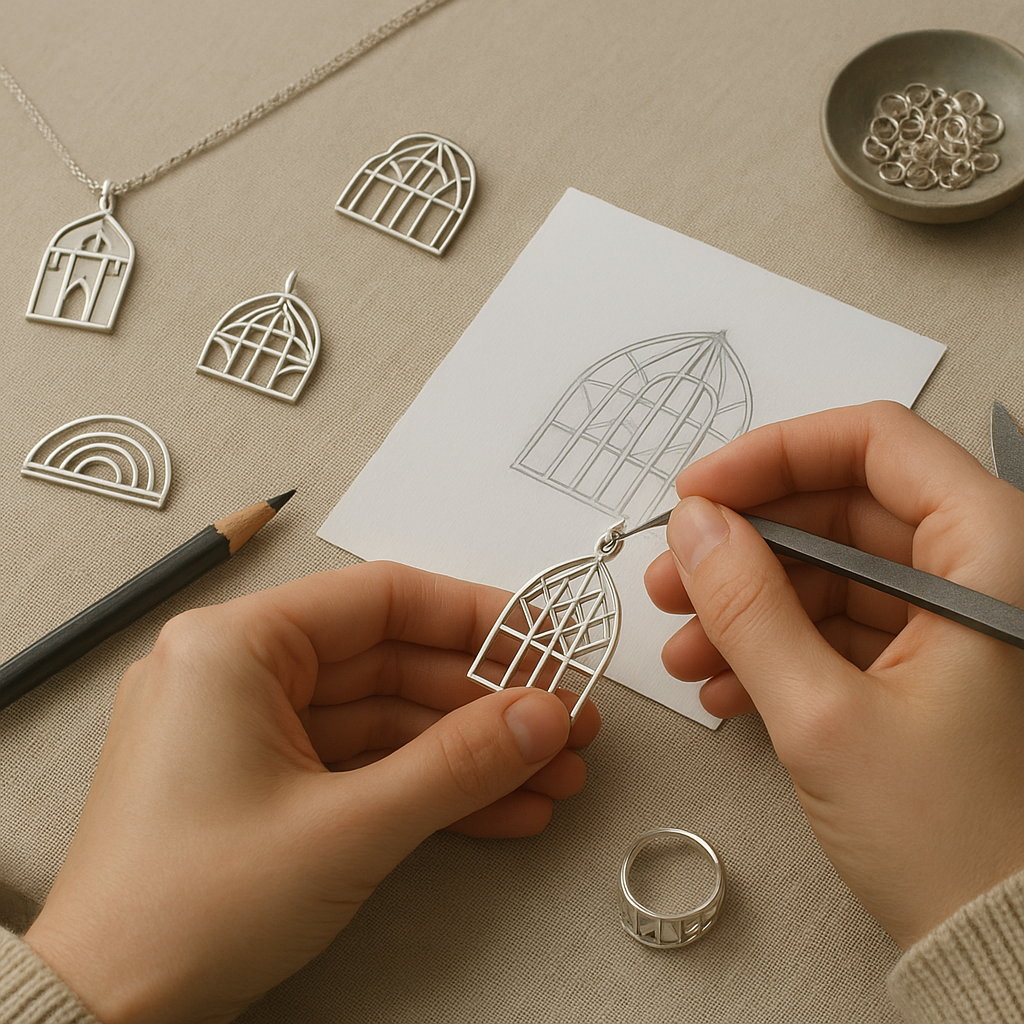
From flying buttresses to cantilevered terraces, the built world offers a treasury of forms that translate beautifully into wearable art. Architectural jewelry is more than miniature skylines; it is a craft of distilling mass, line, shadow, and joint into pieces that live on the body. Whether you’re a metalsmith with a torch or a paper artist with a craft knife, the methods of architecture—mapping, modeling, sectioning, and joining—can guide your hand. The pleasure lies in noticing details most people walk past, then giving them new life in brooches, rings, pendants, and cufflinks that invite touch and spark conversation.
Seeing Architecture with a Maker’s Eyes
Before you pick up a saw frame or a needle file, train your eye. Walk through your city, or comb through photographs of buildings you admire. Notice how a facade is composed: the grid of windows, the play of shadow at noon versus sunset, the way a stair curls in plan and section. Squint to simplify. Look for the fundamental geometry—triangles in trusses, circles in oculi, rectangles in fenestration. Sketch quickly and often, not to perfect drawings, but to harvest motifs: an arch repeated, a lintel line stepped, a spiral dome unrolled.
Create a compact field kit: a small sketchbook, a 2B pencil, a fine-tip marker, and a phone for snapshots. Add tracing paper to isolate rhythms and masses from clutter. Annotate colors in words, not swatches; the studio is where you’ll decide if bronze best matches stained limestone, or polished steel evokes a glass curtain wall. Keep your notes sensory: how cool marble reflects light, how brick edges catch dust, how a sunshade mediates glare. These observations become design prompts in the benchroom.
Collect samples. Architectural salvage shops and hardware stores offer clues: perforated metal, wire mesh, tile fragments, roofing copper. Place them in a materials box. Even if you don’t use them directly, they guide your hands toward tactile decisions and help you think through scale and spacing on the body.
Translating Elements: From Facade to Form
Buildings offer modules to recombine. A Gothic arch suggests a ring bezel or pendant outline; a brise-soleil becomes a layered earring; a column capital informs a bead cap. Look for repetition and counterpoint. Turn plans into silhouettes, sections into profiles, and elevations into layered sheets of metal or paper. Consider proportion as your constant companion: a broad cuff can echo the lofty mass of a hall, while a delicate chain may mirror clerestory tracery better than any thick bar.
Ask which aspects of a building are essential. Is it the load path, the joinery, the articulation of corner and cornice? Reduce to a set of rules for your piece: “All angles 60°,” “Openings always taller than wide,” “No two modules identical.” Choosing constraints makes invention easier and gives your collection coherence.
Play with negative space. The voids between columns, the slot of a skylight, or the perforations of a screen can be as compelling as the solids. Pierce and saw inside your shapes; leave windows that frame skin and light. The dance of shadow on wearers changes with movement, much like the light across a facade shifts during the day.
Materials Palette: Metal, Stone, Glass, and Beyond
Metals serve architecture well because they remember hammer blows, folds, and joins. Brass and bronze suggest historic ornament; sterling silver carries modern clarity; copper offers warmth and ages with character. You can also incorporate small stones that reference masonry, or vitreous enamel in panels to evoke stained glass. Concrete, once a humble builder’s medium, can be cast thin for pendants or inlays, giving a Brutalist nod without excess weight. Wood brings warmth and reference to timber framing, while acrylic or polycarbonate hints at glazing.
Each material has its voice. Brass takes on deep, golden warmth with oxidation; silver can be oxidized to near-black for contrast; copper evolves a living patina that tells a story over months and years. Combine materials to mirror real buildings: wood and steel, stone and glass, metal and textile. Keep weight in mind; a brooch inspired by a concrete shell must not feel like one.
- Metals: copper, brass, bronze, sterling silver, gold-filled, steel (blued or stainless)
- Stone and ceramic: slate slivers, porcelain shards, architectural tile remnants
- Glass: lampworked elements, enamels, fused glass panels
- Composites: polymer clay with architectural stamps, fine concrete mixes
- Unconventional: wire mesh, perforated sheets, recycled roofing materials
Essential Tools and a Thoughtful Bench Setup
Jewelry inspired by buildings often involves precise cutting, crisp edges, and repeat modules. A jeweler’s saw with assorted blades, quality files, and needle files are musts. For sheet work, invest in a bench pin, layout tools (scribe, divider, ruler), and a steel block. If you’ll solder, a small torch, solder in different flow grades, a firebrick or charcoal block, flux, pickle solution, and copper tongs are essential. For cold connections, keep rivet-making tools and a micro-drill ready.
If you cast, you might explore wax carving tools and lost-wax techniques, or use two-part silicone molds for repeated elements. A rolling mill with texture plates lets you impress facades or mesh into metal, capturing the grit of stucco or the striation of stone. For safer indoor work, a good fume extractor and eye protection are non-negotiable. Organize your bench so measuring and test-fitting are frictionless; architectural jewelry rewards accuracy.
Techniques That Echo Building Craft
Joinery is central to architecture and jewelry alike. Soldering is your mortar; design your seams to hide within layers or celebrate them as seams and reveals. If soldering feels daunting, embrace cold connections: tube rivets that mimic bolts, prongs that echo clamps, and hinges reminiscent of operable louvers. Build frames and set panels into them like glazing; allow light to pass through, and secure with discreet clips.
Forming techniques conjure domes, shells, and vaults. Dome a disk to suggest an oculus; fold-form metal to mimic standing seams of roofs; chase and repoussé to articulate relief as if carving ornament in stone. Use a dapping block for curves, a stake for bending crisp cornices. Anneal metals to soften, shape, then harden again with planishing and strategic work-hardening. In casting, carve wax like an architect sculpts a massing model, subtracting and adding until it reads from multiple viewpoints.
Surface development matters. Roll-print metal with architectural mesh, sandpaper, or lace to create tactile panels. Etch lines to mimic expansion joints or coursed brick. Apply enamel in translucent layers to evoke colored glass. Patinate selectively so details stand out, or polish edges to a bright line that reads like sun on a window mullion. In all, let handwork remain visible; the small irregularities are the human counterpart to industrial perfection.
Designing for the Body: Scale, Balance, Comfort
Buildings don’t have to move, but jewelry must. Study the pivot points of the body. Earrings need to balance and swing; brooches must sit without tilting or snagging fabric; rings should not snag or splay fingers; necklaces must ride comfortably on collarbones. Test with cardboard maquettes to see how far an element can project. Keep edges softened and consider skin contact; sand and burnish the inside of rings, the back of pendants, and the clasp interface.
Because architecture often carries grandeur, translate it thoughtfully. A city skyline ring might compress too many details; choose three silhouettes and leave air between them. A stair-inspired earring becomes wearable by reducing tread depth and adding a pivot point. Make articulated segments wherever stiffness would catch. The human body is the site plan for your work; its curves and hinges guide your designs’ ergonomics.
Step-by-Step: An Arch Ring and a Skyline Pendant
Project A: The Arch Ring. Start by sketching three arch variants—round, pointed, and flattened. Choose a band width that suits your wearer; 4–6 mm is versatile. In 18-gauge sterling sheet, lay out a rectangle for the shank and a second rectangle for the arch panel. Saw the arch opening with your saw frame; file the inner curve smooth. Anneal the shank blank, bend around a mandrel, and true the circle. Solder the seam with easy solder. Prepare the arch panel’s base to match the ring’s width; add a slight curve by doming it gently, so it echoes the finger. Solder the arch to the ring’s top at two tabs or a full seam; quench, pickle, and neutralize. Scotch-brite the whole piece, polish edges, and apply a light patination to bring out the piercework. The result is crisp but forgiving, and the negative space reads as depth on the hand.
Project B: The Skyline Pendant. Select five building profiles from a city you love. Reduce them to silhouettes of different heights. Cut each from thin brass or silver sheet. Solder or rivet the layers onto a backplate, staggering slightly to create an implied street. Drill tiny holes to act as windows in one layer; pierce larger openings in another. Solder a bail that hides behind the tallest profile. Finish with a brushed surface on most layers and a high polish on one roofline to catch light. Hang from a chain whose link shape echoes window mullions. This project teaches layering, low-relief spacing, and the power of restraint.
Surface Stories: Finishes that Age with Grace
A building’s skin tells its history. So can your jewelry. Subtle scratches, matte brushing, and edge burnishing make pieces read as well-loved. For deliberate coloration, liver of sulfur on silver yields blues and blacks that settle in recesses. Brass and bronze respond to ammonia vapors and salt to produce greens and browns. Seal where needed with microcrystalline wax, but allow some areas to breathe; a living surface develops over time to reflect its wearer’s life. This thoughtful aging deepens form and enhances tactile texture.
Consider contrast. Pair a mirror-bright chamfer with a satin field; juxtapose rough sandblasting with a polished inner curve. The play of light and shadow will make shallow relief pop and keep pieces visually active under shifting illumination. Think of the golden hour on a facade; aim for that on a pendant’s edge.
Color, Light, and Negative Space
Architects choreograph light; jewelers can too. Openwork invites brightness through a piece, casting miniature shadows on the wearer. Transparent and translucent elements—thin enamel, resin windows, sliced agate—glow as if backlit clerestories. Even opaque materials can feel luminous when framed by reflective bevels or when facets bounce light inside a form. Keep your palette simple: two metals, one accent color, and purposeful voids. Too many hues muddy the reading; clarity is queen.
Shadow matters as much as color. Saw narrow slits that fall into darkness when worn; carve chamfers that accept soft gray; leave tiny overhangs for self-shading. As with louvers and light shelves, a millimeter can change everything in miniature.
Historical Styles as Design Wells
Mining history expands your language of form. Art Deco offers stepped ziggurats, sunbursts, and chevrons that become bangles and cufflinks. Gothic points and tracery birth lacy silverwork. Bauhaus campaigns for honest joins and elemental shapes. Islamic patterns provide infinite tessellations for pierced pendants. Japanese Metabolist thinking inspires modular, reconfigurable pieces that reinvent themselves on the body. Each tradition offers rules you can quote, remix, or resist.
When drawing from cultural motifs, study deeply and respectfully. Learn the meanings behind patterns and avoid pastiche. Credit your inspirations in product notes or exhibition statements. Depth of research shines through, enriching the story your piece tells.
Planning, Prototyping, and Scale Studies
Architects iterate at multiple scales. Do the same. Begin with thumbnail sketches, then paper maquettes. Translate into cardstock to test thickness. Move to thin brass or plastic sheet to see how edges behave. Only then cut precious metal. This staged approach prevents costly mistakes and invites discoveries, like needing a hinge where you expected a seam. Keep your prototypes; they document your thinking and teach future you.
Adopt a consistent measurement language: millimeters for thickness and spacing, degrees for angles, radii for curves. Make templates so repeated modules truly match. Jigs—simple wooden blocks, pins on a board, magnetic fixtures—speed consistent bending and soldering. Accuracy is not cold; it’s the scaffolding that supports poetry in metal.
Wearable Modularity and Reconfiguration
Buildings reconfigure; your jewelry can too. Consider magnetic clasps that allow swapping panels; pin-back brooches that slide onto necklaces to become pendants; earrings composed of stackable elements. This spirit of modularity invites play and keeps a small collection feeling vast. It also echoes architectural systems thinking: parts that combine to create many forms.
Design for maintenance and upgrade. Screwed connections that let a panel be replaced; hidden rivets that can be drilled out; spaces to add a new charm after a journey—these details turn jewelry into a long-term companion, not a fixed object.
Working Responsibly: Sourcing and Studio Practice
Materials carry stories beyond style. Seek recycled precious metals or traceable supply chains where possible. Reuse reclaimed copper or brass from interiors; it often bears marks you can honor in your work. When pickling and patinating, keep solutions labeled and dispose of them responsibly. Ventilation is a gift to your lungs and your future. Buy fewer tools but better ones; sharpen and maintain them to reduce waste.
Ethics infuse beauty. The gleam of silver set against oxidized recesses is richer when you know it was sourced with care. Quietly center sustainability in your process; your clients will feel it in the stories you share, and your bench will be a better place to spend your days.
Safety Notes for Torch and Chemicals
Respect heat and chemistry. Tie hair back, wear safety glasses, and keep a quench bowl within arm’s reach. Work on fireproof surfaces. Keep a small fire extinguisher close. Label pickle containers and never mix acids. Use nitrile gloves when handling patinas. If you etch, neutralize thoroughly and manage waste according to local guidelines. Safe practice isn’t fussy; it’s a creative enabler that frees you to focus on detail.
Bringing Digital Tools into Handicraft
Architects draw with software, but the wrist still holds the pen. In jewelry, vector drawings (for laser cutting) or simple 3D models (for wax printing) can prototype precise modules quickly. Use them as collaborators, not dictators. A laser-cut brass stencil can guide hand-piercing; a 3D-printed wax lets you cast a complex lattice, which you then refine by file and burnisher. Digital speed paired with hand finishing yields pieces that feel crisp yet alive—industrial clarity enlivened by bench-born nuance.
Finishing Touches: Findings, Clasps, and Backs
Architectural elegance often hides in what you don’t see. The back of a brooch needs as much care as its face; a neat catch and smooth plate tell the wearer you honor their clothes. Clasps should echo the piece’s language: a slide catch for a modern bar pendant, a box clasp with a stepped deco lid for a bracelet, a handmade S-hook shaped like an arch. Design these components rather than defaulting to catalog parts; they’re opportunities to deepen coherence.
Photography and Presentation in Context
Show your work against architectural backdrops to connect it with its muse. Photograph a vault-inspired cuff beside ribbed shadows on a wall; place a window-grid pendant near a sun-dappled lattice. Use raking light to highlight relief. For flat lay shots, include your sketches, material samples, or a small blueprint fragment. Display stands can echo columns or beams. Packaging can borrow from plan drawing: layered paper compartments, grid-stamped wraps, or a schematic of your process on a card.
Care, Repair, and Longevity
Wearers become co-authors. Include care notes: avoid snagging screens on knitwear, store oxidized pieces in zip pouches, wipe fingerprints with a soft cloth. Offer refresh services: re-brush surfaces, re-blacken recesses, re-harden bent ear wires. Thoughtful policies make clients comfortable wearing their jewelry often—the highest compliment to a maker of wearable architecture.
Common Pitfalls and How to Avoid Them
- Over-detailing: choose a few elements and amplify them rather than miniaturizing entire buildings.
- Sharp edges: break and burnish every edge that might meet skin or cloth.
- Poor balance: test brooches on multiple fabrics; adjust pin placement until they sit squarely.
- Dead weight: hollow when possible; opt for thinner sheet backed by structural ribs rather than solid slabs.
- Unclear story: write a one-sentence brief for each piece so decisions align with intent.
Cultivating a Personal Architectural Language
Architecture is a vast library. Build a small, personal one: a set of proportions you return to, a favorite joint, a recurring cornice curve. Let a city or a building teach you a grammar, then write variations. Keep a materials log like an architect’s specification sheet: metal gauge, finish, solder used, findings choices. Over time you’ll notice patterns and refine decisions with increasing clarity.
Invite feedback. Wear your prototypes. Ask friends to handle them. Listen to how pieces feel in motion. Adjust. This iterative cycle, in which making and thinking feed one another, is the heart of studio practice and the surest way to produce work that feels inevitable.
From Studio Bench to Street: The Joy of Wearing Space
When your pendant catches morning sun or your ring casts a tiny arch on a tabletop, you’ll feel the profound alignment between building and jewel. Both are about creating spaces—some large enough to walk through, others small enough to hold. As you chase lines with a file or watch solder flash, remember the parallels: design, craft, and patience. With each piece, you learn anew how solids and voids converse, how edges lead the eye, how a simple curve can shelter light.
Let your work carry the cadences of cities you love. Allow a dome to become a stud earring; let a stair become a ladder of chain; reimagine a buttress as a supportive side wall for a stone setting. In this way, architecture becomes intimate: not just a sight you pass, but a companion on your wrist, a secret at your collarbone, a story you can touch. The vocabulary you build—rooted in structure, guided by fabrication, tuned by rhythm—will help you craft jewelry that feels both timeless and distinctly your own.
