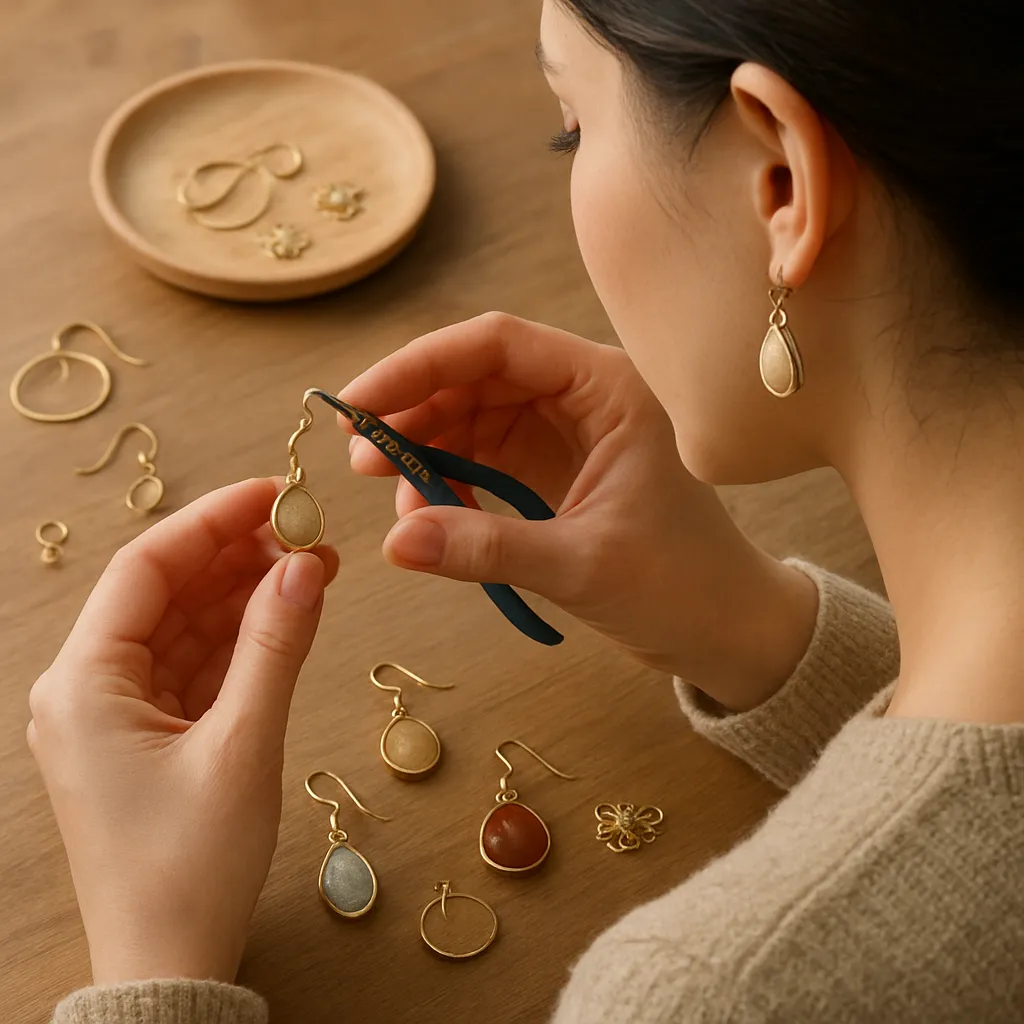
From the moment a face is framed by hair, earrings become more than ornament; they become a small architecture that converses with line, movement, shine, and shadow. This article offers a maker’s framework for crafting earrings that look intentional with every hairstyle—from shaved fades and pixies to braids, coils, bobs, lobs, and sweeping updos—without designing anew each time. We will blend studio-tested methods with a stylist’s eye, cover materials and techniques that travel across fashions, and share buildable patterns for modular, futureproof jewelry. Think of it as a tool kit for thoughtful design, sensitive to proportion and balance, alive to texture and silhouette, tuned for versatility, respectful of ergonomics, grounded in sustainability, engineered for durability, and created to gracefully harmonize with whatever hair the day invites.
Understanding Hairstyles as Frameworks for Earring Craft
Hair behaves like a dynamic stage set, altering the negative space around the jawline, neck, and ears. When you map earrings to this changing stage, you design for clarity under cover (thick curls, low buns, protective styles), and for subtlety in the open (pixies, buzz cuts, slicked-back hair). Begin by studying three variables:
- Exposure: How visible is the ear? Fully exposed (pixie, buzz, tight bun), partially visible (tucked bob, side part), or intermittently visible (long loose waves, layered curls).
- Motion: Does the hair swing, coil, or stay put? High-motion styles demand forms that read from multiple angles—contrast edges, facet sparkles, or planar shifts—so they don’t disappear in movement.
- Volume: Big afros, box braids, locs, or teased manes reduce negative space; sleek, close-to-head styles enlarge it. Volume suggests scale and surface strategy.
Group hairstyles into working families:
- Open-ear: fades, buzz cuts, close pixies, tight high buns.
- Framed-ear: tucked bob, behind-the-ear styles, side-swept lobs, half-up/half-down.
- Covered-ear: voluminous curls, protective braids, natural coils, low messy buns, scarves and headwraps.
Each family suggests a primary reading distance (close-up details vs. bold silhouette), a preferred depth (flat vs. dimensional), and an attachment strategy (post, hoop, ear cuff, threader). The goal is not to fix a single choice per family, but to note how changes in hair transform the context, so your earrings can reach clarity regardless.
Materials and Tools for Versatile Earrings
Versatility begins with materials that adapt to weight, finish, and color demands. Build a studio palette that includes at least one light, one hard, one soft, and one sustainable material.
- Metals: Sterling silver (925) for workability and luminous cool tone; Argentium for anti-tarnish properties; 14k gold-filled for warm highlights at lower cost; brass for patina-friendly warmth; stainless for strength and hypoallergenic options (316L). Keep a small stock of 20–16 gauge wire for hooks and frames, and 24–28 gauge for fine wraps.
- Natural fibers: Linen, silk, cotton, and raffia for lightweight volume and soft color gradients. Waxed linen is strong for micro-macramé motifs that read softly against hair.
- Wood: Olive, walnut, ebony, and bamboo give warm matte tones; stabilize thin slices with resin or cyanoacrylate to prevent splitting. Laser-cut veneers allow precise silhouettes that hold their own near voluminous hair.
- Clay and resin: Polymer clay offers color blending and featherweight scale; epoxy resin encapsulates botanicals or metallic flakes and can be cast thin for translucency—excellent for reading through hair.
- Glass and ceramic: Lampwork beads and glazed porcelain bring saturated color and gloss, but mind weight. Use as accents or in small-scale forms balanced with light findings.
- Found and upcycled: Pressed metal from tins, vintage buttons, and textile remnants become signature elements. Sand edges smooth and seal surfaces for skin safety.
Tools that serve a multi-hairstyle philosophy:
- Flush cutters, chain-nose, round-nose, and nylon-jaw pliers for shaping and finishing wire with minimal marring.
- Mini files, needle files, and micro-mesh for de-burring posts and smoothing resin/wood edges.
- Mandrels (round and oval) for consistent hoop sizes that can be scaled across hairstyles.
- Rotary tool with polishing wheels for controlled shine or satin finishes that read differently in various lighting conditions.
- Soft-jaw bending tools and forming blocks to create repeatable arcs that form the backbone of modular designs.
- Hypoallergenic findings: Niobium and titanium posts, silicone backs, lever-backs for security under scarves or thick hair.
Core Principles That Bridge Hair and Ornament
When earrings must succeed across changing hair, principles matter more than trends. Treat the following as levers you can nudge to keep a design in equilibrium.
- Scale and proportion: Keep visual mass coordinated with expected negative space. A good start: in open-ear looks, the longest line may approach the midpoint of the neck; with covered-ear looks, the longest line should eclipse the hairline edge by at least 10–15 mm to be seen. Thin, extended silhouettes feel elegant with slick styles; thicker profiles or high-contrast shapes land better against curls or braids.
- Weight and comfort: Target 3–7 grams per earring for all-day wear. Avoid point loading; spread weight across a wider support (flat-disc backings or ear-climbers) for sensitive lobes.
- Surface and texture: Matteness reads from afar; high polish twinkles through moving hair. Mix one matte plane with one glossy accent for readability in both quiet and busy contexts.
- Color and value: Use contrast thoughtfully. Dark hair loves light metals and translucent elements; light hair favors darker oxides, antiqued brass, or saturated stones. For salt-and-pepper or highlighted hair, variegated surfaces (hammered, brushed) echo natural shifts.
- Movement control: A single pivot point yields swing; two pivot points introduce dance; hinged structures create orchestrated movement. Too much motion can vanish in curly hair; too little can feel static in slicked-back looks. Tune the pivot count to hairstyle motion.
- Attachment logic: Posts for precise placement under short hair; hoops and lever-backs for security around scarves and braids; threaders to pierce through hair curtains and reappear at the neckline.
Techniques: From Wirework to Textile and Metal
Wire Architecture That Reads in Any Hair
Wire hoops and frames offer infinite scale control. Use 18–20 gauge for hoop frames, work-harden by lightly hammering on a steel block, and burnish to reduce snagging. Form elongated ovals or softly squared “rounded rectangles” that echo jawlines and collars. Add a single planar charm (disc, triangle) that can flip to show texture—this duality keeps the design legible whether hair covers the inner or outer edge.
Textile and Fiber Accents
Micro-macramé with waxed linen builds featherweight volume. Create slim chevrons or leaf forms on a fine metal frame. Edge-seal natural fibers with diluted PVA to prevent fraying while preserving drape. Use color-blocked knots to add stripes that read through hair without adding weight.
Sheet Metal and Negative Space
Thin (0.5–0.8 mm) brass or silver sheet can be sawn into graphic profiles. Drill lightening holes and cut internal windows to play with transparency; piercings read like sparks behind loose hair. Deburr carefully and add a sandblasted finish so the shape stays visible in glare and shadow.
Resin and Translucence
Cast shallow domes (5–10 mm) or thin bars with embedded fibers, leaf skeletons, or metallic foil. Translucence glows at the hairline and reveals different layers as hair moves. Ensure hypoallergenic earwires and post bases; fully cure resin to prevent skin sensitivity.
Cold Connections and Modularity
Rivets, miniature screws, and clever jump-ring choreography let components detach and reattach. Design “jackets” that slip behind the lobe for open-ear days and remove for minimal hair-up looks. A tiny inventory of interlocking parts multiplies variations without extra weight.
Matching Earrings to Specific Hairstyles Without Losing Universality
Instead of designing per hairstyle, design per visual problem. Here are strategies mapped to common styles, with a modular tweak that keeps the piece universal.
- Pixie, buzz, slick-back: Prioritize contour and fine detail. Use post studs with micro-engraving or hammered facets. Modular tweak: add a thin drop charm for evening or when hair grows out.
- Bob and lob (tucked or side-swept): Ear appears and disappears. Choose small to medium hoops with a reversible charm (matte on one side, polished on the other). Modular tweak: include a removable extender link to lengthen the drop under a scarf.
- Long straight or wavy: Hair creates vertical lines. Break monotony with gentle arcs or angled planes. Modular tweak: threader chains with stoppers so the drop length can pass below the hair edge.
- Curls, coils, and afros: Volume compresses negative space. Choose bolder silhouettes, textured surfaces, and higher-contrast materials. Modular tweak: a bright or light-toned backplate behind a darker charm to lift the form into view.
- Protective styles (braids, twists, locs): Structural hair invites secure closures. Use lever-backs and solid hinges. Modular tweak: add ear cuffs that echo the braid rhythm without requiring piercings.
- Buns and updos: Neckline exposed; elegance invites length with a fine endpoint. Employ graduated links that taper. Modular tweak: shorten by removing the bottom link for daytime wear.
- Headwraps and scarves: Fabric can rub and obscure shapes. Opt for snag-free, low-relief edges and firm closures. Modular tweak: choose high-contrast colors or reflective elements to peek beyond the wrap edge.
Comfort, Safety, and Wearability
Earrings that match any hairstyle must be easy to forget while wearing. Test weight, edge finish, and stability as seriously as aesthetics.
- Weight audit: Weigh components during prototyping. If a design crosses 7 grams, add structural lightening: hollow forms, pierced sheet, or switching to polymer/resin for the largest pieces.
- Edge discipline: Every skin-facing edge should be at least 600-grit smooth, ideally buffed with micro-mesh to a satin. On posts, break sharp corners with a fine file and polish to reduce irritation.
- Snag tests: Drag a silk scarf and a cotton knit lightly over the piece. If threads catch, revisit burrs or protrusions. For wire-wrapped work, tuck tails and compress coils with nylon-jaw pliers.
- Allergy map: Offer titanium or niobium options by default; gold-filled for luxury; avoid bare brass on posts. Clear silicone or disc backs distribute pressure and help balance front-heavy designs.
Finishings, Maintenance, and Longevity
Finish controls how a piece reads in different hair and lighting, and maintenance keeps it consistent over time. Mix finishes intentionally:
- Brushed satin on broad planes to resist fingerprint glare and improve legibility under strong salon or daylight.
- High polish on edges and small beads to create glints that escape from behind hair.
- Selective oxidation (liver of sulfur on silver, antiquing on brass) to deepen recesses and outline forms. Seal with microcrystalline wax to slow tarnish.
- Resin dome coats over paper or fabric inlays to lock color and add light-catching curvature.
Care guidance you can include with each sale or gift:
- Wipe metals with untreated microfiber after wear; store pairs in separate pouches to prevent abrasions.
- Avoid hairspray and perfume contact; apply before putting on earrings, especially with pearls or porous stones.
- For matte finishes, use a satin-finish cleaning pad lightly, moving with the original grain.
Color Play: Hair Color, Skin Undertone, and Metal Choice
Color is a fast route to universality. If you can tune color to read across hair changes, a single pair will feel intentional every day.
- Dark hair (brown/black): Prioritize high-value contrast—silver, pale stone, translucent resin, and abalone shell. Warm highlights (gold-filled accents) add depth against near-black hair.
- Light hair (blonde/white/gray): Use deeper metals (patinated brass, oxidized silver), jewel tones (garnet, lapis), and textured planes to avoid washout.
- Red and copper hair: Cool metals (silver, rhodium) calm heat; greens, teals, and cool grays flatter without competing.
- Highlights and multitone hair: Mixed finishes mirror complexity—hammered plus polished, matte plus translucent, dual-metal bimetal sheets.
Consider skin undertone: neutral metals (silver, white gold) flatter cool undertones; warm metals (brass, gold-filled) suit warm undertones; rose tones bridge both. In a universal pair, a duo-metal strategy (e.g., silver frame with brass inlay) broadens compatibility.
Modularity: Systems That Adapt to Hairstyles
Modularity is the craftsperson’s superpower. It lets one earring act differently with a quick change of component or orientation.
- Convertible drops: A base stud accepts a drop charm via a hidden jump ring behind the lobe. Wear stud alone for hair-up minimalism; add charm for coverage days.
- Earring jackets: A decorative element slides onto the post behind the lobe, framing the ear whether hair is present or not.
- Threaders with stops: A fine chain with a soldered midpoint loop prevents the earring from pulling through. Adjust on the fly to clear hair edges.
- Reversible charms: Two finishes in one—satin/polish or light/dark—flip based on the day’s hair and outfit.
- Clip-on accents and cuffs: Hug the helix or conch to repeat motifs higher on the ear, increasing visibility when lobes are covered.
Case Studies and Buildable Recipes
Recipe 1: The Reversible Arc (Lightweight All-Rounder)
Materials: 18-gauge sterling wire (pair: 160 mm total), 0.6 mm brass sheet (20×30 mm), 24-gauge sterling for jump rings, sterling posts, epoxy, liver of sulfur, micro-mesh pads.
Steps:
- Form two 40 mm ovals from 18-gauge wire; hammer lightly along the outer arc to work-harden and create a bright edge.
- Saw two brass teardrops (20×30 mm). Sand both faces; oxidize one face to a deep bronze, leave the other face brushed satin.
- Drill a 1.2 mm hole at the top of each teardrop; attach to the oval with a 24-gauge jump ring, allowing free flip.
- Solder or epoxy sterling posts to the top of wire ovals. Finish edges to 1200 grit; polish only the arc edge for a glint line.
How it adapts: With hair up, wear the satin side out for quiet elegance. With hair down, flip to the darker face so the silhouette pops. The arc’s bright edge flashes through strands.
Recipe 2: Threader with Translucent Bar
Materials: 0.8 mm sterling chain (2×150 mm), 0.8 mm sterling wire (2×70 mm), thin resin bars (5×35 mm) with embedded metallic flakes, silicone stoppers.
Steps:
- Make a U-shaped threader by soldering wire to chain; round and polish the wire for gentle pass-through.
- Drill tiny holes at one end of each resin bar; attach via micro jump ring to the chain end.
- Add silicone stoppers to lock the chain at any length.
How it adapts: For dense curls, drop the bar below hair. For open-ear days, shorten to create a whisper of translucence hugging the jawline.
Recipe 3: Textile Leaf on Metal Spine
Materials: Waxed linen in two tones, 0.8 mm brass sheet spine (5×40 mm), 20-gauge niobium earwires, diluted PVA, micro files.
Steps:
- Cut a narrow brass spine, file edges silky smooth, and brush to satin.
- Macramé a leaf form around the spine using square knots and diagonal double half hitches; graduate color from light at the tip to dark near the ear.
- Seal the final knot with tiny dots of diluted PVA; trim tightly and burnish.
How it adapts: Featherweight volume stands out against straight hair without heaviness, while the matte fiber texture remains readable through curly frames.
Recipe 4: Hoop with Detachable Geometry
Materials: 18-gauge gold-filled wire for 30–35 mm hoops, sterling or brass geometric charms (triangle, circle, bar) with 1.5 mm top holes, lever-back findings.
Steps:
- Form hoops on a mandrel; create a simple catch or attach to lever-backs for security under scarves.
- Rivet or ring-attach charms so they can be swapped. Offer a matte triangle for hair-down contrast, a polished circle for hair-up sparkle, and a long bar for braids.
How it adapts: One base, many faces. Clients can switch charms as hair evolves week to week.
Measuring Success: A Maker’s Checklist
Use this at the bench and before delivery:
- Visibility: Does the piece read at 0.5 m and 2 m against both dark and light backgrounds?
- Weight: Total mass per earring under 7 g? If not, what can be hollowed or lightened?
- Comfort: Edges smooth to 600+ grit; posts polished; backings stable; no snag points.
- Modularity: At least one reversible or detachable element to adapt to hair changes.
- Finish: Intentional contrast (matte vs. gloss), protected patina, sealed fibers.
- Hardware: Hypoallergenic options, secure closures for high-friction scenarios (scarves, collars).
- Story: Materials and technique choices that support function and meaning (e.g., upcycled brass that pairs with both warm hair and cool metals).
Ethics and Storytelling in Handcrafted Earrings
When an object must serve many contexts, its story helps it travel. Share the origin of metals, your finishing choices, how modularity reduces consumption by turning one pair into many looks. Source recycled silver and gold when possible, reclaimed wood, and deadstock textiles. Packaging can double as storage—a soft pouch that separates a base stud from its jacket avoids scratches and supports long life.
Troubleshooting and Refinement
- Vanishing act in curls: Increase planar contrast—switch to a brushed light backplate or add a thin bright edge. Lengthen by 10–15 mm until the form breaks the hairline.
- Overbearing with short hair: Reduce width before length; narrow profiles feel lighter visually. Soften edges with a beveled polish and shift the center of mass closer to the lobe.
- Snagging on knits: Replace open spirals and unclosed wraps with soldered or fully closed forms. Tuck wire tails under wraps; consider textile-safe coatings.
- Uneven swing: Check jump ring orientation; files can flatten rings—replace with round, soldered rings or rotate the axis to reduce wobble.
- Color washout: Add mixed metal elements or a single saturated bead near the focal. Test under multiple lighting temps (2700K warm, 4000K neutral, 5600K daylight).
Studio Practices That Build Universal Results
Prototype on forms with hair. Keep a wig rack or hair swatches—straight, wavy, curly, black to platinum—to test visibility and motion. Photograph each prototype against contrasting backdrops and at several head angles. Maintain a weight ledger to spot creeping heaviness across a collection. Batch-finish edges to a consistent standard and record chain lengths, hoop diameters, and charm sizes that consistently pass the hair tests.
Bringing It All Together
Earrings that match any hairstyle share the same quiet engineering: careful scale, readable surfaces, tuned motion, comfortable hardware, and the option to reconfigure when hair evolves. You do not need an infinite collection; you need a compact vocabulary of forms—a few arcs and angles, some light and dark, matte and gloss, stillness and swing—arranged to speak clearly whether the ear is open, framed, or covered. With a modular mindset and disciplined finishing, your work earns a kind of everyday permission: clients reach for it first, no matter the plan for their hair.
In the studio, that permission is built one decision at a time—choosing a silhouette that holds space, a closure that respects the wearer, a surface that reads in motion, and a system that bends without breaking as styles change. When those choices align, a single pair can navigate a month of hair experiments and a year of seasons, always arriving where it shines best: poised between head and heart, functional and beautiful, utterly at ease.
