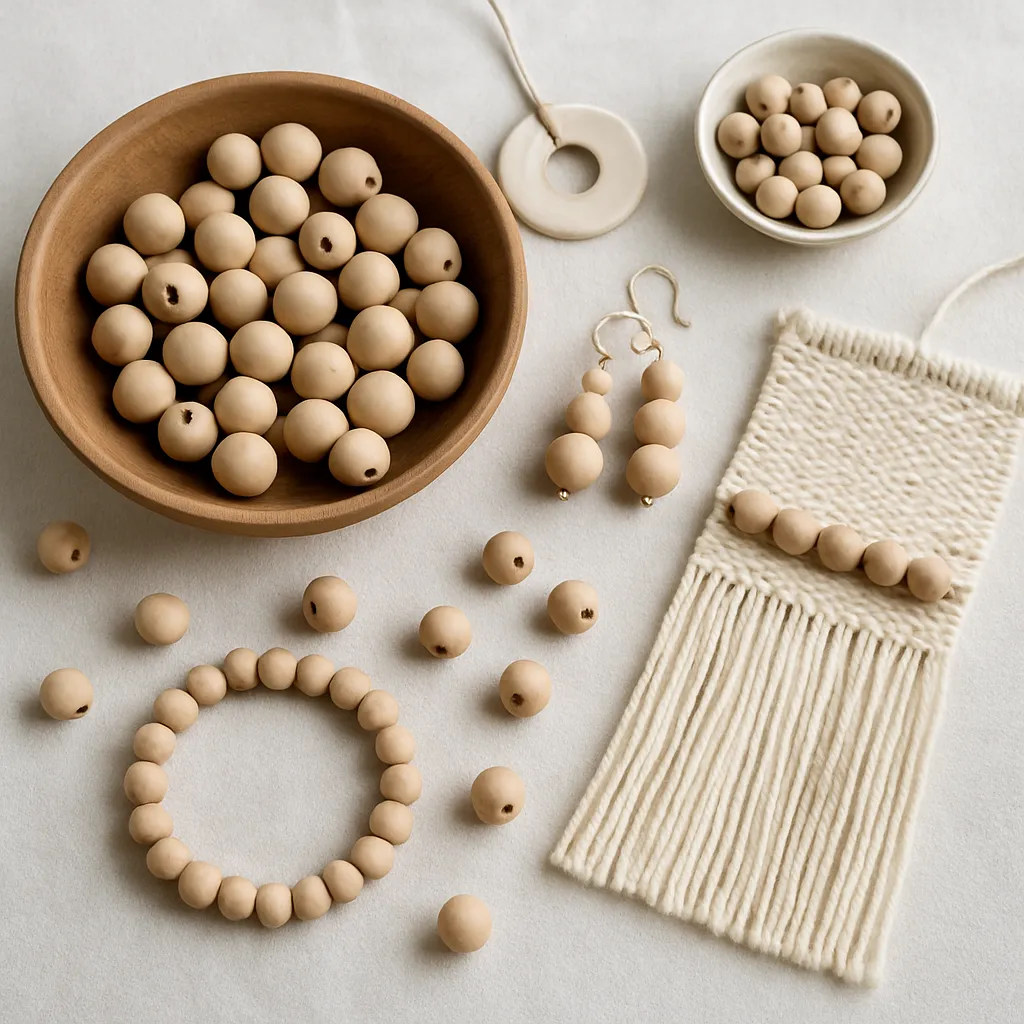
Wooden beads are small, reliable building blocks for contemporary handicraft, bridging the tactile warmth of timber with clean, modern lines. They can be structural or purely decorative, neutral or vividly colored, rustic or exacting. Because they carry the memory of the tree through grain, smell, and weight, they add a human note to projects that might otherwise feel overly industrial. The following guide explores methods, materials, and aesthetics that help you integrate wooden beads into confident, forward-looking designs for wearable pieces, interiors, and product details that age gracefully and function beautifully.
Why Wooden Beads Belong in Contemporary Design
Unlike trend-sensitive synthetics, wooden beads wear time well. Their subtle grain complements matte ceramics and powder-coated steel, softens glass and concrete, and brings a calming balance to digital-saturated environments. They accept dye and paint, yet can be left raw to reveal the story of the wood. That duality—between control and natural variation—makes beads valuable for contemporary makers who want to signal craft integrity without sacrificing precision.
Designers gravitate to wood for its renewable character and lower embodied energy compared to metal or plastics. Responsible sourcing through community mills and certified forests supports local economies and meaningful supply chains. When beads show the tree’s annual rings, pores, and tone shifts, they characteristically invite touch rather than simply stare back as objects; that relationship of hand to material is central to modern craft.
Minimal forms—spheres, discs, cylinders—read as quietly architectural when repeated and scaled with intention. Alternating bead diameters creates rhythm. Grouping by color establishes pattern without excessive ornament. When you cross-pollinate woodworking with textile and jewelry techniques, beads become connectors across disciplines, useful as spacers, hinges, counterweights, toggles, and sculptural accents. They also serve as sampling units: a single bead is fast to modify, making larger explorations feasible through iterative arrays.
Materials and Sourcing Essentials
Species and Their Behavior
Common hardwoods like maple, birch, and beech turn into uniform beads that take paint cleanly. Oak and ash show open pores and dramatic grain, suiting projects that welcome texture. Walnut offers chocolate depth that pairs naturally with brass, while cherry warms to a coppery brown over time. Softwoods such as pine can be lightweight and aromatic but dent easily. Alternative fibers—bamboo, rattan, and palm—expand the palette with linear grain and unique densities. Each species differs in hardness, oil content, and pore structure, which affects drilling, sanding, and finishing.
- Maple: fine, even grain; sands to a satin feel; takes stain evenly.
- Birch: pale base tone; accepts bright dyes; good for crisp edges.
- Beech: hard and resilient; minimal grain distraction for color-blocking.
- Oak: strong, ring-porous; responds well to ebonizing; visible medullary rays.
- Walnut: rich natural tone; pairs elegantly with matte black and gold findings.
- Bamboo: technically a grass; stable and light; pronounced linear grain.
Moisture content should hover around 6–8 percent for indoor use. Too-wet beads may shrink and crack after assembly; too-dry beads might swell in humid climates and bind against cords. Sizing consistency matters as well: hole diameters vary by maker, so measure with calipers before committing to a production run.
Ethical and Practical Sourcing
Work with suppliers who publish species, origin, and finishing details. Seek certifications from stewarding bodies and small mills that use salvaged or storm-felled logs. Vintage stock—drawer pulls, abacus parts, or deadstock beads—can be reconditioned, expanding choice while reducing waste. Favor dry, dust-free packaging to avoid mold and cough-inducing residue. When ordering custom runs, specify hole location, chamfer or countersink preferences, and exact tolerances for repeatability in assembly jigs.
Core Design Principles for Bead-Driven Work
Scale, Balance, and Rhythm
Contemporary compositions rely on restraint and clarity. Think of beads as pixels you can physically touch: change their size, spacing, or color to build form. Anchor a piece with one large bead to establish scale, then create cadence using smaller units. The ratio between diameters should feel intentional; choosing a dominant bead that is 1.6 times the support bead often produces a natural flow. Good proportion eliminates guesswork and turns even simple strings into poised statements.
Ergonomics and Tactility
Hands and bodies interact continuously with beads in jewelry, garment toggles, handles, and objects. Consider weight, temperature, and edge radius at contact points. Sanded chamfers or soft radii reduce hotspots where skin meets bead. Light species minimize neck fatigue on long necklaces; heavier species work as intentional counterweights or curtain pull stabilizers. Broad holes and flexible cords prevent pinching. Smart ergonomics transform a pretty idea into a daily companion. The irresistible urge to roll, rotate, and click beads also leverages tactility as a design goal for calming objects on desks and wearable fidgets that don’t read as toys.
Modularity and Adaptability
Because beads are discrete units, you can compose systems. Slip-knot closures allow length changes. Threaded inserts inside oversized beads host machine screws for swappable handles. Magnetic clasps become hidden joints. Consider modularity early: design families of compatible hole sizes, standard spacers, and adapters so that clients reconfigure pieces over time instead of discarding them.
Techniques, Tools, and Surface Treatments
Shaping and Drilling
Pre-made beads simplify production, but custom turning unlocks form beyond spheres and discs. A wood lathe with a beading tool or skew chisel yields repeatable profiles. For drilling, a drill press and V-block jig maintain perpendicular holes; brad-point bits reduce tear-out. Start with a pilot hole 0.5 mm smaller than final size, then ream incrementally for accuracy. Slightly chamfer hole entries with a countersink to protect cords from abrasion. Finish sand through 180–400 grit; burnish with shavings for a compacted sheen that resists grime.
Color, Texture, and Protective Layers
Surface finishing does more than decorate—it stabilizes fibers, resists sweat and dirt, and controls reflection. Natural oils such as tung or polymerized linseed penetrate and accentuate grain; hardwax blends add a low-luster glow. Water-based sealers keep tones pale; shellac lends warmth and is repairable. Milk paint creates a velvety matte with historical depth, while acrylics enable precise color blocking. Dyes penetrate more deeply than stains and can be layered for ombré effects. Simple chemical tricks expand options: vinegar and steel wool ebonize tannin-rich woods like oak, and a strong tea pretreatment amplifies the reaction. Whatever you choose, test finishes on sample beads strung the same way as your final piece so you observe wicking, drips, and drying behavior in context.
Texture can be carved or burned. Light cross-hatching improves grip on toggles. Pyrography outlines motifs without adding thickness. Laser engraving personalizes batches with serial numbers or brand marks. Inlay—resin, brass wire, crushed stone—excels on oversized statement beads, though remember added mass and thermal feel when worn.
Stringing, Hardware, and Assembly
- Cords: cotton and linen are breathable and easy to knot; leather reads premium; polyester resists sweat; hemp complements earthy palettes; micro macramé cords enable detailed nets.
- Wire: multi-strand beading wire (e.g., 49-strand) balances flexibility with kink resistance for necklaces; for structured forms, consider memory wire or stainless cable with swaged crimps.
- Knots: surgeon’s knots lock elastic cords; constrictor knots secure toggles; sliding knots enable adjustability without metal hardware.
- Adhesives: PVA bonds unfinished wood-to-wood; epoxy bridges gaps and seals metal inserts; cyanoacrylate locks knots but test for bloom on dark finishes.
- Closures: magnetic clasps offer one-hand operation; wooden barrel clasps blend seamlessly; button-and-loop closures keep a material-honest look.
Safety note: measure hole-to-edge distance on small beads; if it is under 1.5 mm, edges may fracture under tension. Round sharp transitions and let oil-based coats cure fully before skin contact to avoid irritation.
Project Ideas Across Disciplines
Jewelry: Minimal, Sculptural, and Kinetic
For a stark pendant, string one 30–35 mm walnut sphere on matte black cord, add two 8 mm maple spacers above, and finish with a sliding knot. The mass of the center bead grounds the composition while spacers prevent neck rub. For a color-study bracelet, alternate eight 12 mm birch beads dyed in a gradient with raw 10 mm beech to create breathing room; elastic cord keeps it casual. Kinetic earrings can use stacked discs separated by micro spacers so the assembly pivots and catches light; keep total length within comfort by using balsa or paulownia for larger forms.
Consider algorithmic patterns for series work. A 1–1–2–3 grouping (repeating one small, one medium, two small, three medium) produces movement without feeling busy. Use one accent bead—ebonized oak, for example—to anchor each series, then change supporting beads seasonally for continuity.
Textiles and Wearables
Macramé and weaving welcome wooden beads as nodes and weights. In a plant hanger, place heavy species lower to keep the pot centered. Integrate oversized beads with offset holes to create gentle twists that cradle the pot without extra knots. On garments, wood pairs with linen ties for jacket closures; test for dryer heat and wash cycles by pre-oiling and buffing to reduce fiber lift. Beaded edges on scarves bring swing and structure to soft fabrics. For bags, stacked discs make comfortable handles that don’t bite into palms.
Interior Objects
Beaded chains introduce rhythm on window pulls, ceiling-fan cords, and curtain tiebacks. For lighting, wooden beads can sheath a cord as a sculptural chain; maintain minimum clearances from hot bulbs and seal surfaces to reduce dust adherence. Room dividers built from bead strands create semi-transparent partitions; alternating spherical and cylindrical beads reduces visual moiré and steadies the curtain under drafts. Oversized trivet grids protect tables and add graphic presence; finish them with heat-tolerant oils and wide spacing for airflow.
Small furniture details—drawer pulls, hanging rails with beaded stops, foot glides—bring warmth to austere carcasses. A bead can also serve as a hidden bumper beneath floating shelves, keeping walls scuff-free while offering a visually quiet solution.
Packaging, Branding, and Gifting
A single bead tied into a hangtag becomes a keepable token, encouraging brand touchpoints that live past unboxing. Limited-run colorways branded via laser marking can commemorate collaborations or events. Scented species like cedar subtly perfume packaging while signaling care and restraint. Repeatable bead motifs on bags, menu edges, or napkin rings unify a pop-up or exhibit identity.
Styling Your Work for Contemporary Aesthetics
Design languages vary, but wood adapts:
- Scandinavian minimal: pale birch, tight grain, desaturated palettes, linear repetition, and breathable spacing.
- Japandi and wabi-sabi: asymmetry, matte finishes, visible tool marks, acceptance of wear and evolving patina.
- Industrial softening: walnut or ebonized oak against blackened steel; beads as gentle interruptions along cable lines.
- Bohemian modern: saturated dyes, mixed species, tassels, fringe; controlled exuberance through repeating color anchors.
- Memphis-inspired: geometric beads in bold primaries; high-contrast stripes and checkerboard drilling.
Photograph pieces on textured backdrops—linen, cast concrete, and glazed tiles—so the grain reads clearly. Style with daylight or diffused LEDs to avoid specular hotspots on varnishes. Use negative space to let silhouettes speak and show scale with hands, coins, or ruler marks subtly included in the frame.
Engineering Details and Longevity
Wood breathes with the environment; it is hygroscopic, so plan for movement. If your bead strand lives near a kitchen or bathroom, expect seasonal slack or tightening. Knots with some elasticity and larger hole clearances reduce squeaks and abrasion. For installations spanning meters, insert periodic swivels or flexible couplers to prevent twist accumulation.
Mechanical considerations matter. In bracelets, repeated flexing concentrates stress near end beads; switch to tougher species there or add metal cups. In home goods, ensure bead-and-cord assemblies exceed expected loads by at least a factor of four. If beads meet food surfaces, choose finishes classified for incidental contact and avoid lingering fragrances. UV fades dyes; keep strong blues and reds away from direct sunlight or seal with UV-inhibiting topcoats. For lighting, maintain safe distance from heat sources and consider ceramic spacers near sockets.
Workflow: From Sketch to Repetition
Fast Exploration and Prototyping
Start with paper or clay maquettes to judge scale in space, then move to trial strings assembled with temporary knots. Document bead counts, diameters, and spacings right on the test strand with small tags. Digital tools help—simple parametric spreadsheets can output layouts by desired total length, distributing sizes based on ratios. Rapid prototyping also includes cutting reference boards with drilled holes that simulate different spacings, letting you drag beads around until the rhythm clicks.
Batching and Quality Control
When moving into small production, create jigs: V-blocks for drilling, depth stops for countersinks, and length boards with pins for consistent knot placement. Use go/no-go gauges for hole diameters and maintain a defect bin for chipped beads to rework later as smaller sizes. Keep finish logs—batch number, coat type, cure times—to detect and eliminate variables. Package strands slightly loose to avoid imprinting kinks during shipping; tuck a care card detailing cleaning and re-oiling steps.
Color Strategy and Sensory Direction
Contemporary palettes lean toward muted earths with occasional jolts of saturated color. Warm woods harmonize with clay pinks and olive greens; cool woods such as pale maple accept deep indigo and charcoal. Ombré sequences read modern when stretched across generous negative space. Consider temperature and mood: cool hues calm, warm hues invite, and high-value contrast punctuates. Matte surfaces feel gentler and photograph well; gloss can appear luxe but reveals dust faster.
Sustainability and Circular Thinking
Use offcuts to make beads and reduce landfill pressure. Small, beautiful parts elevate scraps into intentional inventory. Design for repair: choose knots you can untie and closures that accept replacement cords. Clients will appreciate re-stringing services, which deepen loyalty. Plan for disassembly so different materials separate cleanly at end of life. Material-wise, emphasize sustainability with responsibly sourced woods, low-VOC coatings, and mindful shipping. Celebrate upcycling by converting skateboards, wine barrel staves, or piano keys into limited-edition beads with provenance notes that tell a story.
Maintenance, Aging, and Afterlife
Wood improves with care. Wipe with a barely damp cloth and mild soap, then buff dry. Refresh oil-waxed beads with a thin coat, let it set, and polish with a soft cloth. Avoid soaking cords; instead, spot-clean. Expect tiny scratches and gloss shifts to accumulate; rather than flaws, they are the narrative of use. If a piece outlives its format, salvage the beads and recompose. That open-ended cycle is a powerful argument for wooden beads in modern craft, where permanence is less prized than adaptability, honesty, and sensory connection.
Advanced Methods for Precision and Expression
Custom Profiles and Joinery
Beyond spheres and discs lie lentils, toroids, and polygonal beads. Flat facets catch light and minimize rolling on desks. For furniture or architectural trim, consider beads with internal threads or cross dowels so wood meets machine hardware without slippage. Use brass or stainless inserts epoxied into oversized beads to create durable handles and hang points. Split beads with concealed magnets can clamp textiles or wires cleanly for displays and photoshoots.
Hybrid Materials and Informed Contrast
Pair wood with ceramic beads for thermal contrast, or slip silicone rings among wood for shock absorption in wearables. Combine cork beads to reduce weight in large installations. Glass or recycled acrylic spacers can flash color without competing with grain. If using metal, echo its finish elsewhere—satin brass clasp with walnut, brushed nickel with maple, blackened steel with ebonized oak—to maintain cohesion.
Pattern Systems and Visual Grammar
Define a signature by constraining variables. Perhaps you always keep two-thirds of a strand in a single species, using the remaining third for seasonal experimentation. Or you restrict yourself to three diameters and one accent geometry. Build families that can nest: pendants that convert to bag charms, room dividers that reassemble as table runners, or necklaces that become curtain ties. With consistent parts, you scale from one-off art pieces to small-batch production smoothly.
Health, Comfort, and Responsible Practice
Ventilate when sanding or finishing. Wood dust from species like oak can irritate sensitive users; clean thoroughly between batches and label species on care cards. Avoid finishes that off-gas strongly. Where children are involved, mind bead size to reduce choking risk and use non-toxic coatings only. Document your material choices so customers understand what touches their skin or enters their home.
From Concept to Commerce
For market-ready work, prototype pricing alongside form. Track minutes per step, finish consumption, and failure rate to set realistic wholesale and retail. Photograph consistent colorways under a standardized light tent. Offer customization within pre-defined constraints—cord color, clasp metal, bead order—so buyers feel agency while you maintain throughput. Provide spare beads and micro repair kits with instructions, reinforcing a service mindset and building long-term relationships.
Closing Thoughts on Craft and Future-Proofing
Wooden beads encourage calm decisions made by hand: choosing a grain that aligns with a curve, selecting a hue that listens to daylight, tying a knot that sits right against the wrist. They invite both control and surprise, allowing the maker to converse with material rather than coerce it. In modern handicraft, that conversation is the product as much as the object itself. Develop systems rooted in modularity, respect the slow burn of patina, consider human ergonomics and tactility, and let tested finishes support daily use. Attend to sustainability, keep room for prototyping, embrace upcycling, trust tuned proportion, and account for the hygroscopic nature of wood. With these tenets, wooden beads become not just components, but a language you can write fluently across jewelry, interiors, and the thoughtful objects people reach for every day.
