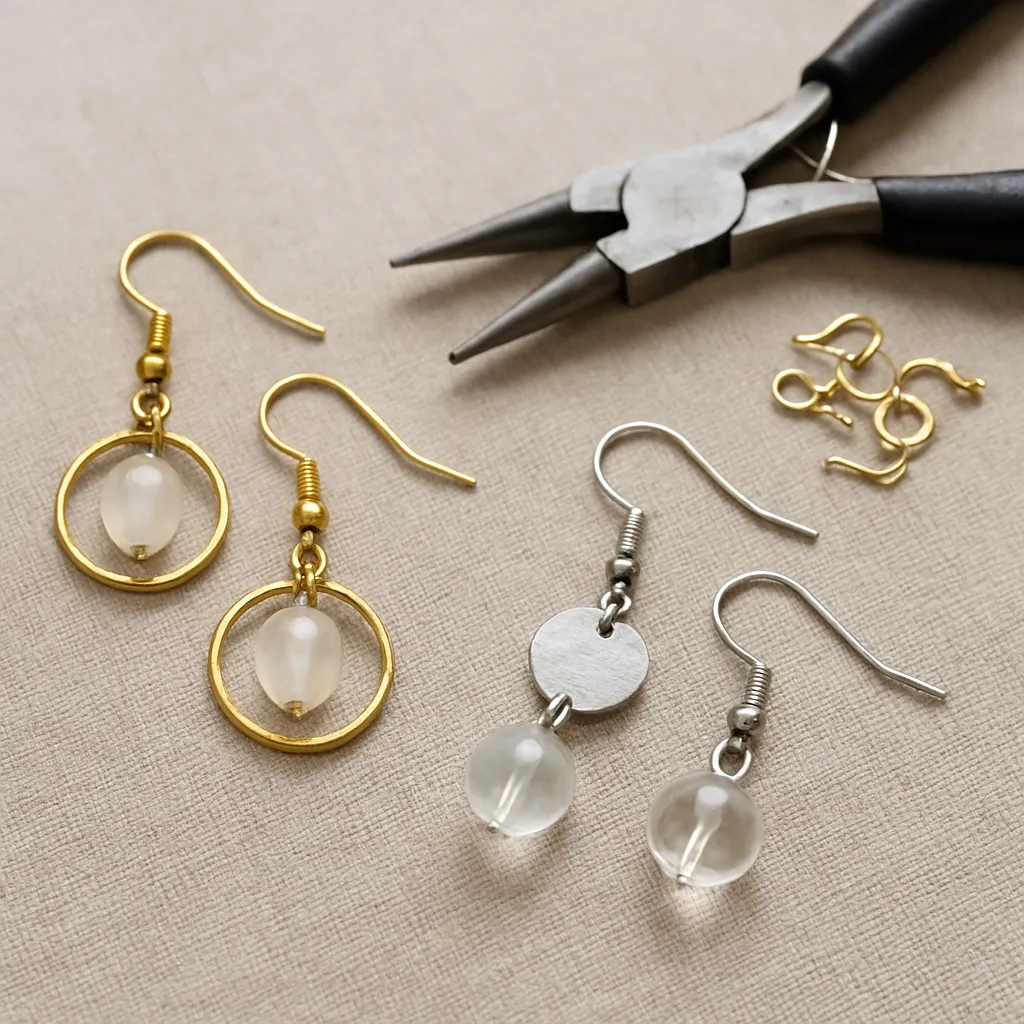
There is a special kind of satisfaction in making earrings that feel like nothing and look like everything: airy shapes that don’t pull on your lobes, materials that breathe, and findings that keep reactive skin calm. For crafters with tender ears, the pursuit is equal parts science and art—understanding metals and coatings, experimenting with featherlight substrates, and refining joinery so each pair swings freely without strain. This guide distills practical knowledge from the workbench: how to select truly hypoallergenic findings, how to craft lightweight bodies from unexpected materials, and how to finish them so they endure daily wear while preserving that weightless feel.
Understanding Sensitive Ears: What Really Causes Irritation
Skin reactions from earrings usually trace back to metal ions dissolving in moisture (sweat, water, or even humidity) and interacting with skin proteins. Nickel is the most notorious culprit, but cobalt and chromium can also provoke dermatitis. Even “nickel-free” labels sometimes allow trace levels, and plating wears—exposing base metals. If you’ve ever developed redness or itchiness after a few hours of wear, you already know the cycle: irritation leads to micro-abrasions that increase reactivity, which accelerates more irritation.
Preventing the cycle begins with inert, corrosion-resistant materials at the skin interface. The safest mainstream options are commercially pure titanium (Grades 1–2), implant-grade titanium (Ti-6Al-4V ELI, Grade 23), and niobium, which forms a stable oxide layer that’s exceptionally skin-friendly. Many can also wear 14k–18k high-gold alloys or platinum, but because these frequently include alloying metals, reactions still occur for a subset of people. Surgical stainless steel (ASTM F138 or 316L) works for many, but not all, because it contains nickel bound within the structure; the safer bet for severe sensitivities is titanium or niobium. Beyond metal, inert plastics like PTFE and PEEK can be used for posts or threaders when metal contact must be minimized.
A second driver of discomfort is mass. Even non-reactive earrings can fatigue piercings if they’re heavy or long enough to act as levers. The sweet spot for comfort is typically 0.8–2.5 grams per earring and under 60 mm in drop, though this varies with lobe thickness and lifestyle. The lighter the body, the more freedom you have to experiment with scale and movement without compromising the ear.
Choosing Findings and Core Materials That Honor the Ear
Findings—the parts that actually touch the piercing—are where quality matters most. Look for these specifics:
- Hooks and ear wires: Commercially pure titanium or niobium. Anodized niobium adds color without plating. Avoid base metal plated hooks; the plating wears off quickly.
- Posts and backs: Titanium or niobium posts with “comfort clutch” backs disperse pressure. For ultra-sensitive wearers, PTFE posts with titanium backs are an option.
- Jump rings and connectors: If they do not touch skin directly, aluminum (anodized), titanium, or stainless can work. For very sensitive wearers, keep all exposed metal titanium or niobium throughout.
- Chains and threaders: Titanium micro-chain is superb and rare; otherwise, niobium links or PTFE threaders keep contact gentle.
For the earring bodies, prioritize materials with high strength-to-weight ratios and controllable textures:
- Polymer clay (e.g., Soufflé or Premo) for sculpted, sanded, and baked forms that are surprisingly light when rolled thin.
- Sealed paper and fiber: watercolor paper, origami, quilling, washi laminated with acrylic medium, silk or bamboo tassels.
- Wood veneer, balsa, basswood, cork, or stabilized burl for organic warmth with negligible mass.
- Resin (UV or epoxy) used sparingly in thin pours or as a sealant over lightweight inclusions like dried petals or mica flakes.
- Recycled synthetics: bicycle inner tube, PET bottle heat-formed petals, shrink plastic—when sealed and finished, they can be elegant and featherlight.
Adhesives and coatings also matter. Two-part epoxy offers strong bonds for posts to clay or wood; UV resin doubles as a quick, clear topcoat but must be used with ventilation and gloves to prevent sensitization. Avoid cyanoacrylate fumes near porous materials that can frost. For finishes, micro-mesh sanding and buffing are often preferable to thick varnish, which adds weight and can chip.
Tools and Techniques for Featherweight Construction
For precision and repeatability, modest tools go a long way:
- Jeweler’s pliers set: round-nose, chain-nose, and flush cutters; nylon-jaw pliers for kinks without marring.
- Micro drill bits (0.8–1.2 mm) and pin vise or rotary tool for accurate holes in wood, polymer clay, and resin.
- Scalpel or craft knives plus self-healing mat; fine needle files for edges; micro-mesh pads (up to 12,000 grit) for glassy finishes without lacquer.
- Digital kitchen scale reading to 0.1 g to “budget” weight during prototyping.
- Silicone mats, nitrile gloves, and a UV lamp for resin; clay blades, pasta machine or acrylic roller for uniform sheets.
Core techniques include laminating thin layers for strength, creating negative space to reduce mass without sacrificing perceived size, and distributing weight toward the piercing so the center of gravity sits close to the lobe. Where jump rings connect, orient them so the earring swings naturally without twisting; this protects the hole from torque. For fibers, use anti-fray treatments sparingly and comb tassels after trimming to maintain crisp edges.
Five Lightweight Projects: Step-by-Step Builds
1) Ultra-Soft Polymer Clay Arches with Titanium Posts (≈1.6 g each)
Materials: Soufflé polymer clay (noted for its velvety lightness), tissue blade, oval/arch cutters, needle tool, 600–2000 grit wet/dry sandpaper, two-part epoxy, titanium posts and backs, 0.8 mm titanium jump rings.
Steps:
- Condition clay and roll to 1.8–2.0 mm thickness. Cut two arches per earring for a double-layer laminate that remains slim.
- Texture one layer lightly with 800-grit for a matte surface; leave the other smooth. Stack with a whisper-thin clay layer as adhesive and compress gently.
- Pierce holes pre-bake with a 1 mm needle; this preserves clean edges.
- Bake per manufacturer’s guidance on a tile with cardstock buffer to minimize shine. Allow to cool fully.
- Sand edges under water, moving to 2000 grit for silkiness. Buff with a muslin wheel if desired—no topcoat needed.
- Epoxy titanium posts to the back near the arch’s apex to keep weight close to the lobe. Cure 24 hours.
- Add a single jump ring to join a tiny contrasting charm, ensuring the hinge opens perpendicular to the drop to avoid torque.
Notes: Keep the arches hollow and consider cutouts to reduce mass further. Soufflé’s micro-bubbles help with buoyancy, while sanding avoids heavy varnishes.
2) Paper Quill Petals Sealed with Acrylic Medium (≈0.9 g each)
Materials: Quilling paper strips (3–5 mm), pH-neutral PVA, matte acrylic medium, micro brush, titanium ear wires, 0.8 mm niobium jump rings.
Steps:
- Form marquise shapes by rolling and pinching quilling strips; build a three-petal cluster per earring. Glue only where needed to preserve spring and air.
- Brush on two ultra-thin coats of acrylic medium, front and back, allowing full cure between coats to stiffen and seal.
- Pierce a pilot hole with an awl through a glue node, reinforce with a micro drop of medium, and insert a tiny jump ring after drying.
- Attach to titanium ear wires. Optional: Edge-gild with transfer foil for a gleam that adds negligible weight.
Notes: Paper’s strength depends on fiber direction and curvature. Sealing turns it into a lightweight composite that resists humidity while retaining delicacy.
3) Open-Frame Botanical UV Resin Ovals with Niobium Hooks (≈1.4 g each)
Materials: Thin brass or titanium open bezels (titanium preferred for direct contact), pressed flowers, UV resin (low-viscosity), blacklight-safe pigments (tiny amounts), niobium hooks, isopropyl alcohol.
Steps:
- Clean bezels. Place them on a silicone mat and lay a whisper-thin layer of resin; gently set pressed petals to float within negative space.
- Flood just enough to dome to the bezel’s edge without overflow; cure under UV in short bursts to minimize heat.
- Flip and seal the back with a skim coat to encase edges. Wipe tacky residue with isopropyl if your resin requires.
- Connect to niobium hooks with titanium jump rings to avoid mixed-metal corrosion paths.
Notes: Use the smallest feasible volume of resin; the goal is translucency and stiffness with minimal weight. Always wear gloves—uncured resin can cause sensitization over time.
4) Cross-Laminated Wood Veneer Teardrops (≈1.2 g each)
Materials: Two contrasting wood veneers (0.5–0.8 mm), wood glue (pH-neutral, flexible), clamps, craft knife, micro drill bits, tung oil or hardwax oil, titanium leverbacks.
Steps:
- Laminate two layers with grains at 90 degrees; press flat between plastic and boards to prevent adhesion and warping.
- Trace teardrop templates and cut in several light passes with a fresh blade. Round edges with fine files.
- Drill a 1 mm hole; seal with two thin coats of tung oil (fully cured) or a non-plasticizing hardwax oil for a natural, breathable finish.
- Attach to titanium leverbacks. The cross-laminate resists splitting while remaining ultra-light.
Notes: Avoid heavy film finishes; they add mass and chip. Oils keep a tactile, warm surface that’s easy to refresh.
5) Micro-Tassel Silk Drops with Titanium Threaders (≈0.8 g each)
Materials: Mulberry silk thread, cardboard jig, Fray Check (sparingly), fine titanium chain threaders or PTFE threaders, tiny titanium caps, epoxy.
Steps:
- Wind silk around a jig, tie the head, and cut the tail. Bind the neck with a few secure wraps.
- Apply a pinhead of Fray Check only to the neck; comb and trim the tassel for crispness.
- Seat tassel into a micro-cap with a droplet of epoxy; let cure upright.
- Connect to titanium threaders. The movement and sheen feel luxurious at near-zero weight.
Notes: Natural fibers breathe and move. Keep metal contact points titanium to avoid hidden irritants.
Finish, Seal, and Surface: Durable Without Bulk
Finishing choices affect longevity and comfort as much as appearance. Thick coatings look glossy on day one but can yellow or crack; thin, well-sanded surfaces age gracefully. For polymer clay, progressive wet sanding and buffing produce a satin or glass finish without varnish. For wood, polymerized oils penetrate and harden within fibers—wipe on, wait, wipe off, and allow full cure. Paper composites benefit from matte acrylic medium or archival varnish in atomized coats rather than brush heaps to avoid ridges. Resin pieces need only a final dome or polish; if tackiness remains, a post-cure in sunlight or a thin sealing coat solves it.
Where posts bond to a porous substrate, lightly roughen both surfaces and clean with isopropyl before two-part epoxy. Position posts to align the earring’s center of gravity above the piercing; this reduces visible droop. For big silhouettes, consider “monster backs” to distribute load across a larger lobe area.
Comfort Engineering: Balance, Movement, and Wearability
Comfort is engineered, not luck. Treat each earring like a tiny mobile:
- Center of gravity close to the ear: Heavier elements should sit near the top, with airy dangles below.
- Controlled articulation: Use one or two pivot points—more than that can twist and torque the hole.
- Edge management: Break or bevel sharp corners; even a light piece can irritate if it snags hair or skin.
- Length vs. leverage: Long, ultra-light dangles can still “feel” heavy because of leverage and motion. Counter this with a slim counterweight near the lobe or by using threaders that distribute movement along the canal.
Measure—don’t guess. Keep a log of finished weight and wearer feedback. Many artisans find that 1.2–1.8 g is a universal comfort zone for day-long wear, with special-occasion pieces topping out around 2.5 g.
Design Language: Big Looks, Small Mass
Visual volume without physical weight comes from negative space, layered thin planes, and directional texture. Consider:
- Silhouettes with cutouts: Lattice, pierced motifs, and open frames maximize perceived scale.
- Color and contrast: Light-catching metallic leaf on paper or clay delivers drama without heft. Mica powders buffed into polymer clay add depth at virtually zero mass.
- Material juxtapositions: Pair matte wood with glossy resin windows; combine translucent paper with anodized niobium color.
- Sustainable character: Reclaimed veneers, recycled PET petals, or repurposed textiles tell a story and keep things light.
Test compositions with cardstock mockups, wearing them with temporary adhesive dots to sense swing, poke points, and proportions before committing in premium material.
Troubleshooting: Common Pitfalls and Proven Fixes
- Itchiness after a few hours: Verify the actual metal of posts and backs; swap to certified implant-grade titanium or pure niobium. Replace backs if they’re stainless or plated.
- Drooping earrings: Move the post upward on the back, use larger clutch backs, or shift mass upward in the design.
- Resin yellowing: Choose UV-stabilized resin and avoid heat spikes during cure. For clear longevity, use bio-based epoxies formulated for art, applied in minimalist coats.
- Clay delamination: Laminate with slight pressure and score interfaces lightly before baking; avoid over-thick plasticizers.
- Paper warping: Seal both sides equally and allow full dry between coats. Store under light weight during curing.
- Metal discoloration: Keep mixed metals from direct contact or add nylon washers; galvanic pairs in sweat can tarnish faster.
Care, Cleaning, and Everyday Habits
Good habits keep sensitive ears happy. Put earrings on last—after hair spray and perfume—to avoid chemical deposition. Remove before workouts and showers. Clean titanium and niobium findings with mild soap and water; dry thoroughly. Avoid ultrasonic cleaners for composites or resin. For wood and paper pieces, spot-clean gently and recondition oiled wood annually.
Storage matters: hang dangles so fibers don’t crimp, and keep resin out of prolonged direct sunlight. Use silica gel to reduce moisture in storage boxes, helpful both for metals and natural materials.
Sustainability and Safe Studio Practices
Lightweight often goes hand-in-hand with low material use—a sustainability win. Favor FSC-certified veneers, recycled fibers, and water-based sealants where performance allows. Collect resin drips on silicone mats so cured waste peels off as a single piece for safer disposal. Ventilate when using resin, solvent-based paints, or aerosol finishes; gloves protect you from contact sensitization—crucial if you craft often.
Waste thoughtfully: offcuts from clay become terrazzo chips for future designs; paper trimmings can be pulped into beads; tiny wood scraps make inlay dots. By designing for disassembly (e.g., open jump rings you can replace), you can rescue findings and refresh worn elements rather than discarding the whole earring.
Scaling Up: From Personal Pairs to Micro-Batch Craft
If you plan to sell, standardize on a small set of trusted findings (e.g., Grade 1–2 titanium posts, niobium hooks) and print material specifics on care cards. Offer optional PTFE posts for extreme sensitivities. Track the gram weight of each SKU and list it—sensitive-ear customers love this transparency. Develop fixtures that hold pieces upright while epoxy cures, and batch your sanding and finishing to keep consistency high.
Packaging should protect without crushing: a foam slit that supports the post and a breathable pouch prevents trapped humidity. Include spare “comfort backs” and a tiny cleaning wipe. Most importantly, invite feedback; iterative tweaks to post placement or jump-ring orientation often turn a nice earring into a go-to daily favorite.
A Maker’s Notes on Aesthetics and Feeling
When you chase lightness, you begin to notice how materials want to move. Paper sighs with air currents; silk keeps time with a heartbeat; thin wood clicks softly when two layers kiss. These micro-gestures create intimacy without strain. The goal is a union of comfort and presence: earrings that announce themselves with shimmer, color, and design, yet vanish from your awareness the moment you put them on. It’s handicraft at its most considerate—crafted not just for eyes, but for skin.
Material Reference Quicklist
- Safest skin-contact metals: titanium (Grade 1–2 or 23), niobium, platinum.
- Often tolerated but variable: 316L surgical steel, 14k–18k gold (check alloy), 950 palladium.
- Ultra-light bodies: polymer clay, sealed paper, thin wood veneer, cork, shrink plastic, recycled PET.
- Adhesives: Two-part epoxy for structural bonds; PVA for paper; UV resin for encapsulation/topcoat (with ventilation).
- Backs and supports: Comfort clutches, silicone stoppers on hooks, split rings where extra security is needed without solder.
However you approach it—sculpting polymer clay into negative-space arches, laminating wood into rippling teardrops, floating petals in clear resin, or shaping sealed paper into dimensional florals—the discipline remains the same: reduce mass, refine edges, respect the skin. Sensitive ears aren’t a constraint; they’re a design brief. Meet it with considered materials, smart engineering, and a devotion to lightness, and you’ll create earrings that people forget they’re wearing—until the compliments begin.
