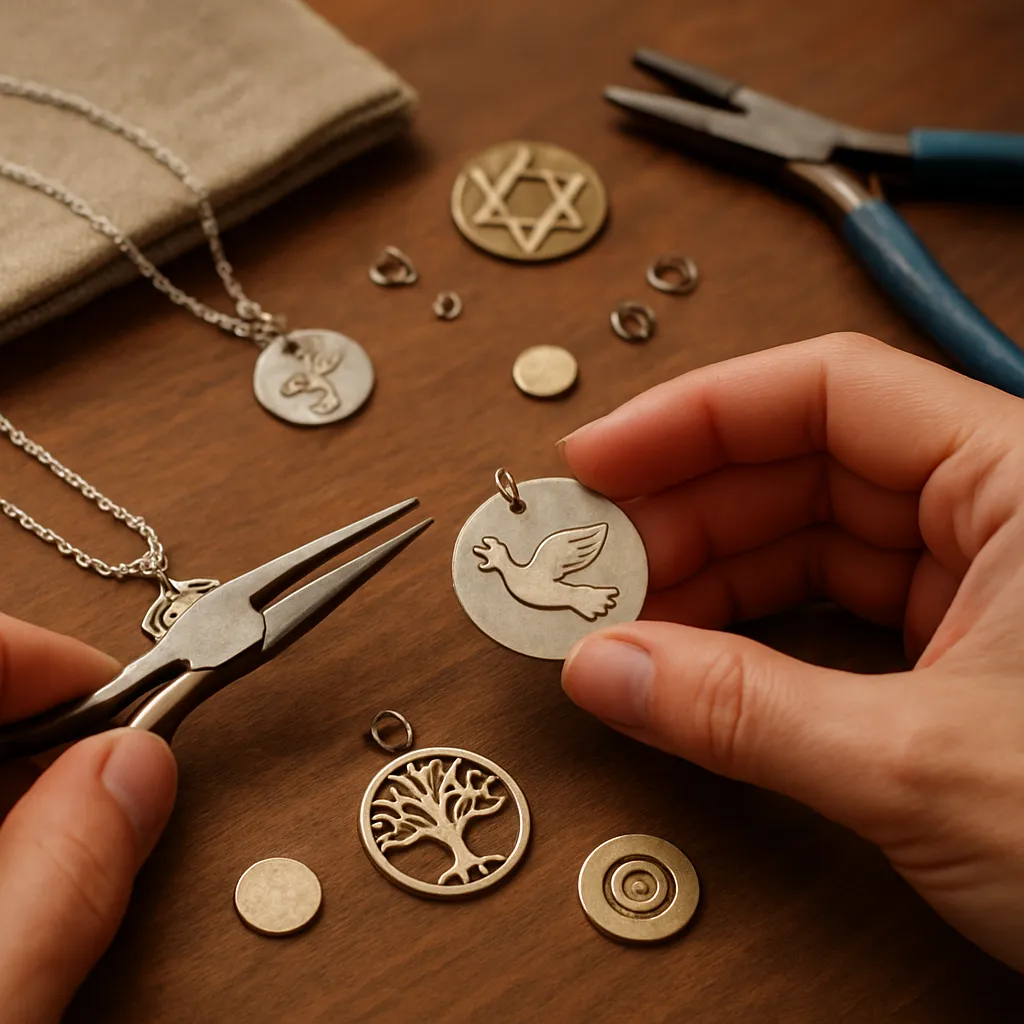
Jewelry can carry stories the way books carry chapters: through signs, textures, and tiny decisions made by a maker’s hands. When you turn memories, beliefs, and places into symbols you can touch, you create a wearable narrative that invites conversation and becomes an heirloom. This guide unpacks how to design and craft pieces that speak in images and patterns rather than sentences, with practical steps for concepting, prototyping, finishing, and caring for story-rich adornment. It also addresses ethics, cultural research, and durability, so that your work honors its sources while aging beautifully on the body.
The power of symbols in a handmade language
A symbol distills a large idea into a small form. A sun for hope, a knot for devotion, a seed for beginnings—these icons travel well across generations and geographies. Jewelry magnifies this power because it is intimate: it sits against skin, it warms to body temperature, it makes a soft sound when it moves. Over time, a pendant brightens at the places it is touched most; a bracelet develops darker recesses in seldom-worn months. These traces are not flaws but evidence of use—the biography of the object written as it is lived.
To craft with symbolism is to think like a poet and a builder at once. You select parts that speak (motifs, metals, stones) and you join them with rivets, solder, stitches, and hinges to form a grammar. The result can be a single, distilled icon—a ring engraved with a compass—or a sequence, like a charm bracelet arranged as a map of a life. Either way, you orchestrate clarity, legibility, and surprise so the wearer can tell the tale out loud or keep it quietly to themselves.
Designing your story: from moment to motif
Before you draw or saw, collect the narrative threads. These can be life milestones, family lore, travels, a cause, a poem, or daily rituals like brewing tea at dawn. Write an inventory in a sketchbook; let images and words mix freely. Use index cards or sticky notes so you can rearrange the sequence and test what belongs, what distracts, and what needs a counterpoint.
- Map the core message: Is your piece a vow, a memorial, a celebration, or a talisman for courage? Give the project a brief, one clear sentence long.
- Choose a narrative shape: Linear (a timeline on a chain), cyclical (a wreath, a circle pendant), or radial (a brooch with radiating branches).
- Create a symbol lexicon: Sketch 10–20 candidate icons; keep them simple enough to read at jewelry scale.
- Test legibility: Reduce your sketches to thumbnail size. If the drawing blurs, the metal version will too; simplify.
- Assign roles: Primary symbol (the central motif), supporting symbols (small accents), and connectors (links, knots, negative space).
- Plan reveals: Hidden engravings, secret hinges, or reversible panels can hold private chapters of the story.
Develop a mood board of textures and surfaces—weathered wood, river stones, woven straw—to inform tactile choices. This board helps you design not just what the piece depicts, but how it feels to the fingers, which is often how the wearer “reads” it each day.
Choosing a respectful lexicon of symbols
Some symbols cross cultures—a star, a heart, a spiral—while others carry specific, sacred meanings within particular communities. Research diligently before adopting imagery like the Hamsa, Nazar, lotus, Celtic knotwork, or Adinkra. Ask: What does this mean where it comes from? Who uses it, and how? Are there versions meant only for initiates? Could I collaborate with or credit an artist from that tradition?
Alternatives include designing personal icons inspired by nature and daily life: a local seedpod for perseverance, a mountain silhouette for steadiness, a sail for adaptability. If you reference known motifs, adjust the line quality, scale, or composition to create your own voice while acknowledging origins. Keep a notebook of sources and links; documenting your research is part of ethical making and becomes a valuable story for clients.
When working on commissions, incorporate client-specific emblems—birth flowers, favorite constellations, childhood house numbers, sheet-music fragments—so the language remains personal rather than generic. With each added sign, ask whether it supports or clutters the message. Editing is an act of respect for the story.
Materials as message
Every medium carries history and sensory cues. Selecting materials is not just an engineering choice; it shapes the voice of your story.
- Gold: Joy, commitment, warmth. Choose recycled or Fairmined for transparency. Nine karat has a quiet, utilitarian glow; 18k sings in saturated yellow; 22k feels ancient, perfect for talismanic gravitas.
- Silver: Clarity, moonlight, reflection. It tarnishes in air, which lets you highlight details with deliberate oxidation. Argentium resists tarnish better; sterling is classic and forgiving to work.
- Copper and brass: Earthiness, hearth, industry. Copper’s rosy warmth suggests vitality; brass carries an antique timbre. Both develop rich surface changes and can be sealed or left to breathe.
- Iron and steel: Fortitude, labor, guardianship. Blackened steel reads modern and protective; pattern-welded steel evokes saga and craft lineage.
- Titanium and niobium: Lightweight strength, vivid anodized colors. A good choice for color-coded narratives or for wearers sensitive to other metals.
- Gemstones: Sapphire for wisdom and loyalty, emerald for growth, ruby for ardor. Moonstone’s glow suits stories of intuition; garnet speaks to devotion; onyx to resolve. Let color psychology guide mood: blues calm, reds energize, greens restore.
- Organic media: Wood, horn, shell, and seeds bring scent, warmth, and worldly texture. Stabilized woods resist swelling; tagua nut offers ivory-like surfaces without harm to animals.
- Textiles and paper: Silk threads, linen cords, or Japanese washi laminated in resin can hold written words or maps close to the skin.
The finish also tells a tale: brushed surfaces feel humble and lived-in, while mirror polishes perform like ceremony. A controlled patina—sulfur on silver, heat on copper, liver-of-sulfur on bronze—adds age and contrast, spotlighting carved lines and low-relief patterns. Patinas can be sealed with microcrystalline wax or left to evolve with the wearer’s life.
Techniques to encode a story
Technique is the alphabet of your jewelry language. Some methods draw; others carve, build volume, trap light, or invite motion. Skill grows by repetition, but even a beginner can say a lot with simple processes applied thoughtfully. Prioritize clear narrative goals, then choose techniques that serve them.
Mark making: engraving, stamping, and chasing
Hand engraving incises lines that catch light at every tilt; it excels at script, dates, constellations, and botanical veining. Steel stamps press letters or icons quickly and consistently—useful for coordinates, initials, or Morse code dots and dashes. Chasing and repoussé model metal from front and back to create relief: perfect for topographic maps, waves, leaves, clouds. These techniques give texture that fingers recognize instantly, adding nonverbal resonance.
Cutwork and silhouette: saw piercing
Jeweler’s saws allow intricate silhouettes: birds in flight, city skylines, woven lattices. Pierced backs behind cabochons can hide symbols that glow by transmitted light. For legibility, avoid fussy outlines; refine inside curves, and back your design with contrasting metal or patina to heighten clarity.
Enameling, inlay, and color fields
Vitreous enamel fuses glass to metal in cloisonné cells or painted washes. It preserves delicate drawings (a leaf vein, a handwriting stroke) in brilliant, durable color. Resin inlay suspends tiny keepsakes—sand from a beach, a shred of ticket stub—within transparent planes. Crushed stone or wood dust inlaid with epoxy creates tactile constellations for star maps or riverbeds.
Wirework, filigree, and granulation
Wire bends into arabesques that breathe between lines, suggesting vines, constellations, or calligraphy. Filigree spins lace from fine wire; granulation places pinhead spheres in constellations of texture. Both read as time-rich labor, ideal for themes of devotion, patience, and continuity.
Casting and repetition
Lost-wax casting captures organic textures—twigs, linen weave, fingertip ridges—and permits multiples. Repeating a single element (like a seed form) across a necklace narrates growth and iteration. Carve wax with blunt tools to keep forms strong and readable, especially in small scales.
Composition and visual grammar
Layout determines how a viewer’s eye travels and what they notice first. A balanced composition anchors the story while allowing discovery.
- Hierarchy: Assign focal points and supporting roles. Scale, contrast, and color create priority.
- Rhythm: Repeat elements with variation—three leaves with one inverted—to suggest time passing or seasons turning.
- Symmetry vs. asymmetry: Symmetry reads ceremonial and formal; asymmetry feels lively and conversational. Choose to match the tale.
- Negative space: Gaps function like punctuation. A pause between charms allows breath and reflection.
- Motion: Hinges, swivels, and chains animate motifs so they “speak” as the wearer moves.
Sketch arrangements at full size. Pin paper dummies to a mannequin or your shirt to test swing, tangle, and visibility. On bracelets, anchor the central episode opposite the clasp to keep it on top of the wrist; on necklaces, consider collarbone contours and the reach of a pendant. On earrings, remember the mirror-image rule: teardrops that “face” the face feel more intentional than those that face outward.
Making the piece: a practical workflow
Process discipline protects both artistry and durability. Build a repeatable path from idea to object so the story survives wear.
- Brief and sketches: Write the project’s one-sentence purpose; make 10 quick thumbnails; choose three to prototype.
- Material tests: Try three metals or finishes side by side to confirm mood and legibility.
- Paper and plastic mockups: Cut silhouettes from cardstock or 0.5 mm plastic to test scale on the body.
- Technical drawings: Note gauges, joint types, stone settings, and clearances for hinges or inlays.
- Fabrication: Cut, file, and fit pieces before soldering. Work clean; solder wants tidy joints.
- Pre-finish: Sand to 600–1200 grit before setting stones; add textures and preparatory patinas.
- Set and secure: Seat stones firmly; test clasps, rivets, and hinges 50 times to simulate daily use.
- Final finish: Oxidize, polish, or matte as planned; seal patinas where needed.
- Documentation: Photograph key details; write a story card with symbols explained.
Keep a bench log: dates, solders used, alloys, patina recipes, client sizes. This record supports repairs and future editions, and it reinforces your professional craftsmanship.
Advanced narrative devices
Like a novelist’s plot twist, jewelry can hide chapters that appear only when invited.
- Lockets and reliquaries: House micro scrolls, map shreds, or pressed petals. Add a magnet or bayonet catch for secure closure.
- Reversible panels: Two faces for two moods—public emblem outside, private engraving inside. Swivels let the wearer choose the chapter.
- Morse and cipher: Beads or granules spaced as dots and dashes spell names or vows. Color sequences encode dates (1–12 for months, 1–31 for days).
- Kinetic tales: Compass needles, tiny hourglasses, or spinning disks show time, direction, or choice. Keep moving parts over-engineered and serviceable.
- Scent and sound: Porous lava beads hold essential oils linked to memory; small chimes or bells whisper ritual.
- Geography and sky: Engrave coordinates, skyline cutouts, or the night sky from a meaningful date. Stones can mark planets; inlays can trace rivers.
When incorporating organic keepsakes—locks of hair, ashes, fabric—obtain clear consent, discuss longevity, and offer sealed settings. Provide a maintenance plan and a respectful handover.
Finishes and aging the tale
Surface is voice. High polish communicates ceremony; satin finish suggests calm; hammered facets speak of labor and light. Controlled oxidation in recesses increases legibility of linework. Heat coloring on titanium and niobium assigns hues to themes—violet for introspection, gold for celebration, teal for calm seas. Layered finishes (matte background, polished edges) deliver depth and make icons pop from afar and up close.
Think ahead to maintenance: provide cloths for silver, instructions for re-waxing bronze, and clarity about what will change naturally. Some stories want to brighten with touch; others want to darken at the edges like a well-read page. Offer refinishing services and note expected intervals based on wear.
Documenting and presenting the story
Packaging can extend the narrative. A small booklet or card maps each symbol to its chapter. Hand-drawn diagrams or a short maker’s note give context without prescribing a single reading; leave room for the wearer’s own layers. If a piece includes a cultural reference, cite your research and collaborators in the card.
Photograph the jewelry on and off the body. Show scale, movement, and details—hinges, engravings, the back of settings. Use natural light angled to reveal textures. For online listings or portfolios, pair images with concise copy that explains the idea, the techniques, and the care required. This transparency builds trust and preserves the chain of heritage as the piece moves into the world.
Care, comfort, and longevity
Story jewelry should be worn. Design for comfort as fiercely as you design for beauty.
- Edges: Break sharp lines; a 0.3–0.5 mm bevel saves skin and fabric.
- Weight: Heavy pendants need broad chains; large earrings need balanced ear wires or hinged clip backs to distribute load.
- Allergies: Offer hypoallergenic options and disclose alloys. Titanium ear wires can accompany silver bodies.
- Clasps: Choose closures that match dexterity. Magnetic clasps help arthritic hands; safety catches protect heirloom brooches.
- Care: Provide storage tips, cleaning kits, and a re-string schedule for beaded narratives (typically every 1–2 years for daily wear).
A repair and refresh pathway—re-polish, re-oxidize, replace cords—keeps the tale legible for decades. Encourage periodic checkups; tiny fixes prevent big losses.
From personal talisman to commissions
If you sell or accept commissions, your process becomes a collaborative storytelling practice. Start with a questionnaire: key memories, places, dates, songs, textures, and the client’s daily life (office, studio, ocean) to define durability needs. Sketch together; explain pros and cons of each technique in plain language.
Price with integrity: account for materials, bench time, design iteration, admin, overhead, and future support. Offer tiers—core design in silver, elevated version in gold with enamel—to widen access while preserving value. Put research time in your estimate when cultural symbols are involved. Present a timeline with milestones (design approval, wax approval, metalwork, finish) and require sign-offs so the story stays aligned.
For authenticity, show your hand: leave faint file lines inside a clasp, sign with a maker’s mark, include process photos in the delivery packet. Clients are not just buying an object; they’re commissioning evidence of care. That care holds the piece’s meaning even when words fade.
Inspirational project ideas to try
- Journey Map Pendant: Saw-pierce the outline of a meaningful path—first-day-of-school walk, a pilgrimage, a migration route—into a silver disk. Engrave waypoints on the back. Oxidize the recesses and polish the rim bright to frame the voyage.
- Family Tree Brooch: Repoussé a branching form from copper, then rivet small brass leaves stamped with initials. Add a hidden seed under a leaf to honor future generations. Seal with wax to keep the warm glow.
- Recovery Milestone Ring Stack: Create thin bands in mixed metals—each with a single granule or engraved date. Wearers add a band as they cross milestones. A matte finish dampens glare, focusing attention on the quiet progress.
- Constellation Locket: A two-panel locket holds a night sky from a significant date. Drill micro-holes; set tiny diamonds or silver balls from behind so stars dome outward. Inside, engrave the date and place coordinates.
- Language-of-Flowers Earrings: Cloisonné enamel petals encode traits—violet for faithfulness, rosemary for remembrance. Backplates carry pierced initials visible only in strong light, like a whisper of identity.
Editing: the art of restraint
Every symbol added must earn its place. Overcrowding confuses; clarity invites connection. Ask of each element: Does it move the story forward? Does it repeat what is already said? Could negative space say it better? Wear the prototype for a day. If a charm snags sleeves or a texture irritates skin, the body is telling you to revise. Good editing is a kindness to your future self and to the wearer.
Ethics, sourcing, and footprint
Stories cannot shine over harm. Whenever possible, use recycled or certified metals, transparent gemstones, and reputable suppliers. Disclose treatments and origins. If you cast from found organic materials, harvest thoughtfully and legally. When invoking cultural motifs, credit and compensate source communities or choose to create adjacent, original symbols instead. Your bench practices—ventilation for fumes, safe pickle disposal, dust collection—protect both you and the world your work enters.
Building a personal vocabulary
Over time, you’ll recognize signatures in your own work: a particular curve of leaf, a way you taper wire, a palette of finishes. Lean into these as a language that regular collectors understand at a glance. Keep a swatch library of textures, test plates of patinas, and a stone tray organized by mood. Revisit old pieces to see which ideas still hum; retire those that no longer serve. Consistency does not mean repetition without growth; it means growing branches from a healthy trunk.
Why story jewelry matters
Objects travel with us through illness and celebration, across borders and kitchens, from day shifts to first dances. A locket can hold a grandmother’s laugh, a ring can mark a hard-won boundary, a bracelet can tick off days of sobriety. In making these markers by hand, we slow time long enough to listen. We also extend a quiet bridge between maker and wearer: a bond formed by metal, fire, patience, and intention. In that bond lives the small miracle of ornament that does more than adorn—it remembers.
Starter toolkit and bench tips
Begin with a reliable saw frame, 2/0–4/0 blades, a bench pin, needle files, sandpapers up to 1200 grit, a flex shaft or rotary tool, a butane torch (for small silver and brass projects), third-hand tweezers, a charcoal block, safety pickle, brass brush, steel bench block, chasing hammer, letter and dot stamps, and basic settings burs. Add a diaphragm mask, eye protection, and ventilation. For patina play, collect liver-of-sulfur, ammonia fuming for copper greens (used outdoors, carefully), and microcrystalline wax. Keep fine wool for gentle matte, and rouge for bright polish.
Mark joints with Sharpie to watch heat flow; the line disappears when you reach soldering temperature. Pre-plan solder grades (hard, medium, easy) to sequence joins without melting earlier ones. Back up delicate engravings with pitch or shellac for control. For repeatable charm layouts, jig a workboard with toothpicks and museum putty to rehearse spacing and balance.
Inviting the wearer into the tale
No story is finished at delivery. Invite the wearer to add charms at milestones, to return for engraving a date inside a ring, to let the surface age with them. Suggest rituals: touching a pendant before speaking in public, turning a spinner ring before sleep, renewing a protective patina on anniversaries. These acts give the piece a role, not just a place, in daily life.
Closing encouragement
Start with one true thing you want to carry on your body, then render it simply and well. Let your hands learn by doing; let your eyes learn by editing. Over time, you will build a fluent vocabulary that can hold love, grief, courage, and joy without shouting. In the end, story jewelry is not only about what others see—it is about what the wearer knows when their fingers find the small, steady shape that reminds them who they are.
As you step to the bench, pack the following ten guiding words into your pocket—clarity, courage, listening, patience, honesty, respect, curiosity, repair, presence, and stillness. They will carry you from raw sheet and wire to a finished piece whose quiet voice speaks in the universal tongue of techniques, touch, and time.
