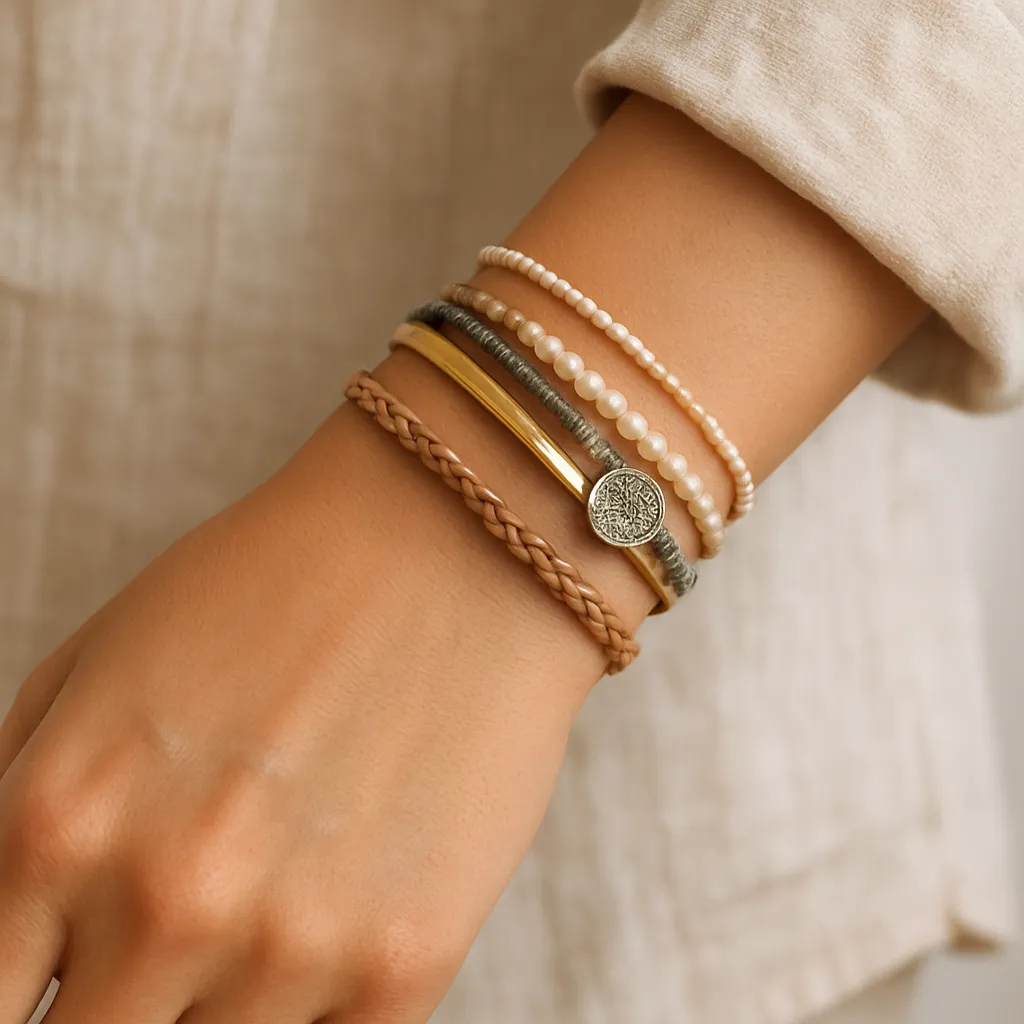
Layered bracelets are a small stage where the hand becomes a curator. They tell stories of places traveled, skills learned, and friendships forged at the workbench. In the language of handicraft, a thoughtfully stacked wrist is not just decoration; it is a portable archive of craftsmanship and memory. Whether you weave your own cords, hammer your own metal blanks, or pair a favorite heirloom with a market find, learning how to style layered bracelets transforms everyday dressing into a tactile, expressive ritual. The pleasure lies in mixing fibers and metals, blending heirloom patina with new finishes, and letting your essentials—thread, wire, bead, leather—converse. With a few grounded principles and a maker’s curiosity, you can build stacks that sit comfortably, move beautifully, and age with grace.
The language of layers: guiding principles for a confident stack
Bracelet layering rewards observation. Before reaching for the bead tray or jewelry roll, start with a simple set of ideas you can reuse in any situation.
- Anchor and orbit: Choose one anchor bracelet—often thicker, textural, or emotionally significant—and let other pieces orbit around it. An anchor might be a narrow cuff, a macramé band with a gemstone, or a beaded strand with a distinctive clasp.
- Rhythm: Alternate visual weights: slim, slim, chunky, slim. This cadence prevents visual fatigue and enhances movement.
- Breath: Leave small slivers of skin between bracelets or use at least one very thin spacer to create negative space. Your stack will read as lighter and more dynamic.
- Focal point: Decide where the eye should land—a stamped charm, a braided section, a hammered plate. Aim to have one clear focal, not three competing ones.
- Tactility: The wrist is kinetic. Choose surfaces that feel pleasing against the skin and do not snag knitwear.
These ideas orbit a handful of core concepts: visual balance so the stack doesn’t tilt heavy on one side, nuanced texture to keep the eye traveling, and mindful proportion so your stack relates to the hand’s scale and your sleeve’s cut. The goal is harmony, not uniformity. Allow a gentle unevenness; a slightly off-center charm or one bracelet longer than the others creates a human, handmade signature. Finally, be aware of your wrist’s silhouette: tall stacks can shorten the perceived length of the forearm, while a lower, tighter stack can sharpen a cuffed shirt’s line.
Materials and textures in the craftsperson’s toolbox
The joy of layering begins with choosing the right materials. Each substrate offers a different voice, weight, and behavior on the arm.
Metals: from bright to burnished
Metals are structural and reflective. Sterling silver brings cool sheen; brass and bronze supply warm glow; copper adds earthy fire. Hammered, brushed, or matte finishes reduce glare and add hand-wrought character, while high-polish surfaces bounce light dramatically. Mixed metals—silver with a whisper of brass—feel lived-in and modern. If you smith your own components, experiment with texturing hammers, chasing tools, and subtle patination. Liver of sulfur can tease out charcoal shadows on silver; ammonia fuming can coax greens and browns on copper and brass. A narrow cuff or slender forged bangle becomes a reliable anchor because it stabilizes softer elements and aligns the bracelets in a neat track.
Fibers and cords: the language of knots
Textiles bring pliancy and warmth. Waxed cotton, linen, hemp, and silk cord accept dyes beautifully and hold knots. Leather lacing adds body and edge; suede feels velvety and quiet. Techniques worth exploring:
- Square-knot macramé with sliding closure for a self-adjusting fit.
- Kumihimo braids for rounded, supple strands that play well between metal pieces.
- Micro-macramé with seed beads for fine, lace-like bands that fill visual gaps.
- Wrapped leather with coin or button closures for a rustic rhythm and a satisfying click when fastened.
Beads: voice, color, and cadence
Beads are syllables in your bracelet sentence. Gemstones (e.g., labradorite, onyx, carnelian), Czech glass, wood, horn, bone, and ceramic each contribute distinct weight and sound. Faceted stones sparkle, matte stones whisper; heishi beads create tight geometry; irregular nuggets feel primal. Vary bead shapes along the stack: rondelles beside discs, cubes near rounds. Interleave metal spacers to brighten darker sequences and to punctuate phrases—three beads, spacer, five beads, spacer. This punctuation prevents monotone stretches and invites the eye to pause.
Charms and talismans
Small pendants—hand-stamped coins, cast leaves, carved bone fish—introduce narrative and movement. Place them slightly off-center to avoid bulk on the wrist’s underside. When crafting, drill or wire-wrap with care so the charm swivels without chafing the thread. Light charms can be stacked; heavier ones deserve solitary display on a single strand for clean swing.
Surface dialogue
Think of the stack as a conversation among surfaces: burnished metal beside braided fiber; frosted gemstone next to carved wood; glossy glass tempered by matte horn. The more you contrast surface qualities, the more nuanced the whole composition becomes.
Color stories and symbolic resonance
Color animates the structure you built with materials. Start by observing your wardrobe: if your daily palette is indigo, charcoal, and white, choose a restrained bracelet color story with an occasional accent. Neutrals like black, espresso, stone, and soft gray behave as glue—use them to knit disparate pieces into a whole. Then select one accent color to carry through one or two bracelets for coherence.
- Analogous: Navy, teal, and forest form a calm, moody stack.
- Complementary: Sand and rust become vivid against blue denim.
- Monochrome: All blacks with varied textures read architectural and sleek.
Symbolism deepens color choices. Carnelian suggests warmth and courage; lapis evokes insight; jade implies protection. A brass charm stamped with stars can remember a night hike; a sliver of beachglass can recall a coastline. You can assemble a stack as a day’s intention: grounding stones for nerve-wracking meetings, luminous glass for celebrations. Allow one piece to carry the story while others support quietly.
Fit, measurement, and long-wear comfort
Fit is the difference between a stack that sings and one that clatters. Measure your wrist at the bone with a soft tape, then add 1.3–2.0 cm (0.5–0.75 in) for most beaded and corded bracelets. Cuffs should spring gently without pinching; bangles need enough interior diameter to glide over the hand but not so much that they collide loudly with each step. Alternate snug bracelets with slightly looser ones to create a stable ladder that doesn’t ride up the forearm. If you wear a watch, place one very slim cord between the watch and the nearest bracelet to prevent abrasion and to create visual separation.
Consider sleeves: for rolled cuffs, keep stacks low and tight. For knitwear, avoid textured prongs or rough solder joints that could snag yarn. In active settings—workshops, cycling, kitchen prep—choose low profile strands with secure closures.
Hardware, closures, and quiet engineering
Closures are the hidden architecture of a successful stack. Lobster clasps are secure but can twist strands; toggles are elegant and easy to fasten with one hand; magnetic clasps make quick work of daily wear but require robust magnets and safety chains for heavy beads. Slide knots on waxed cord are ideal for adjustable bands; button-and-loop closures made with vintage coins or carved wood add charm and reliability.
- Load paths: Heavier elements should sit on strands with stronger cord or cable wire. Keep glass or ceramic away from edges where they may chip against metal cuffs.
- Noise control: Place a soft cord bracelet between two bangles to dampen clink. Choose matte-finished beads where quiet is preferred.
- Breakaway ethics: In settings where snagging is a risk, build at least one strand with a weaker link or magnetic clasp as a safety release.
Signature styles for different days
Everyday ease
Start with a narrow forged cuff as anchor, add a matte onyx strand, then a slim macramé cord in deep navy. Slip in one brass spacer bracelet to lift the palette. The result is calm, tactile, and office-friendly.
Market-morning boho
Layer a wide leather wrap, a mixed heishi strand of wood and bone, two fine seed-bead cords with turquoise accents, and a coin-charm bracelet. Let the leather’s volume ground the lighter pieces so the stack feels generous yet controlled.
Evening minimal
Place a sleek, high-polish bangle beside a barely-there silk cord with a single freshwater pearl. Negative space becomes your sparkle, letting fabrics and skin do the talking.
Workbench or studio
Low profile is the brief. A snug paracord braid with slide knot, a flat leather strap with riveted closure, and one thin rubber or silicone band for shock absorption. No dangling charms. Hands are free to carve, solder, type, and sketch.
Travel stack
Two cords with secure knots, one oxidized bangle that looks intentional even when scuffed, and a tiny talisman tucked under the cuff. Choose pieces you can sleep in and that pass quickly through security checks.
DIY: build a layered stack from the bench up
Supplies at a glance
- Waxed cotton or nylon cord (0.5–1 mm), leather lace (3–5 mm), silk thread for finer work.
- Beads: a mix of gemstone rondelles, matte glass, wood heishi, and a handful of metal spacers.
- Findings: crimp beads, wire guardians, jump rings, lobster clasps, toggles, buttons for loops.
- Tools: flat-nose pliers, round-nose pliers, flush cutters, bead awl, ruler or tape, lighter for sealing synthetic cord.
Bracelet A: macramé anchor with gemstone
Cut two base cords to wrist size plus 10 cm. Cut a working cord 1 m long. Create a lark’s head knot around the base cords and tie square knots for 3–5 cm. Slide a focal gemstone bead onto the base, continue knots symmetrically. Finish with a sliding closure: create a 1.5–2 cm macramé barrel connecting the tail ends; trim and melt tips lightly to secure. This strand becomes your flexible anchor.
Bracelet B: mixed heishi rhythm
String alternating wood and bone discs with a brass spacer every five beads. End with wire guardians and a small toggle for easy handling. Keep the strand intentionally short so it floats near the wrist bone, adding structure to the set.
Bracelet C: fine silk with a single charm
Use doubled silk, tie an overhand knot, add one tiny charm via a 3–4 mm jump ring, tie another knot to lock the charm in place, then finish with a button-and-loop. This whisper-thin line introduces motion and a hint of shine without crowding.
Bracelet D: thin forged bangle
If metalsmithing is in your skill set, forge a 1.5–2 mm wire bangle from brass or silver. Round, harden, and lightly hammer the outer surface for shimmer. If not, source a handcrafted bangle from a local maker; the tactile irregularities often look better than machine-perfect circles.
Assemble the stack
Order them: bangle (structure), heishi (rhythm), macramé (focal and adjustability), silk charm (air). If the stack migrates too much, add a slim cord between metal pieces as a friction brake. Step back, rotate your wrist, and check how the bracelets sit under different angles of light.
Editing, evolution, and the art of restraint
Great stacks are edited. Lay out all candidates on a table and build in silence. Add one, remove one. Photograph your wrist in natural light and squint; do you see a single volume or distinct bands with relief? Reduce duplication: if you have three glossy strands, swap one for a matte element. Over time, your stack will shift with seasons and mood—let it evolve. Keep a tray where “resting” bracelets live; cycling them back in keeps the composition fresh.
Common pitfalls and how to solve them
- Too loud: If your stack clacks, insert a textile bracelet between hard edges, or choose peened/matte finishes.
- Too tight or too loose: Re-measure, restring, or add a removable extender. Mixed fits stabilize the whole.
- Competing focals: Pick one star. Relocate others to a necklace or another day’s stack.
- Color chaos: Introduce a repeating neutral—black cord, brass spacers—to unite disparate hues.
- Snag risk: File rough solder joins, bury wire ends properly, or switch to smooth charms.
Care, storage, and longevity for daily wear
A layered set endures with routine maintenance, preserving both beauty and durability. Wipe metal with a soft cloth after wear to remove skin oils. Store silver in anti-tarnish pouches or with silica gel in a lidded box. Keep leather away from prolonged moisture; if it gets wet, reshape gently and dry away from heat. For corded pieces, inspect knots and filled crimps monthly; tiny frays multiply under movement. When restringing gemstone strands, integrate wire guardians to prevent abrasion at the clasp. Avoid perfumes and hairsprays after dressing your wrist—apply them first, wait, then don bracelets. On travel, roll bracelets in soft cloth and nestle them in a zip pouch to prevent abrasion.
Ethics, sourcing, and maker-to-maker exchange
Layered bracelets are personal; their backstory matters. Source beads from small-batch lampworkers, lapidaries, and community co-ops where possible. Upcycle old chains, buttons, and family trinkets as subtle anchors of memory. If you sell your work, label origin where known—wood species, stone provenance, metal content—and default to conflict-free suppliers. Consider plant-dyed fibers and vegetable-tanned leather for gentler processing. Choices like these strengthen the integrity of your stack and reinforce a culture of sustainability within the craft.
Training the eye: quick exercises
- One-minute build: Give yourself sixty seconds to stack with what’s on hand. Photograph, then rebuild slowly. Compare instinct to intention.
- Texture swap: Replace every glossy element with a matte counterpart, and vice versa. Observe shifts in mood.
- Monochrome challenge: Build only in blacks and grays using three different materials. Notice how structure replaces color as the driver.
- Story arc: Select pieces that represent morning, noon, and night. Arrange them left to right across the wrist from the thumb side outward.
Seasonal shifts and wardrobe integration
In warm months, sweat and sunscreen suggest lighter, washable cords and matte stones that won’t show fingertip prints. Winter invites metal glint against wool, but mind snagging. For tailored blazers, tight low-profile stacks sharpen the cuff break; with oversized knits, a taller stack can provide needed scale. When color-blocking outfits, echo a single garment hue in one understated bracelet to knit the look together without shouting.
Beyond the wrist: echo and restraint
Layered bracelets need not compete with rings, necklaces, or earrings. Use echo rather than duplication: if your wrist features hammered brass, let your ring be brushed bronze, not the same texture and width. Maintain a singular focal point per zone: wrist, neck, ear. This creates a composed field where each element breathes.
Personalization as a lifelong practice
Ultimately, layering bracelets is slow style. It honors your hand’s labor, your eye’s evolution, and your day’s demands. Treat your set as a living toolkit—sometimes purely ornamental, often practical, and always a map of where you’ve been. Through patient iteration and joyful personalization, you will discover that the most compelling stacks aren’t the most expensive; they are the most considered, the most felt, the most connected to the work of your hands.
Quick recipes to spark your next stack
- Quiet power: Oxidized silver bangle + matte black onyx strand + ink-blue cord with sliding knot.
- Sunlit earth: Raw brass cuff + carnelian rondelles with brass spacers + tan leather wrap with coin button.
- Harbor evening: Brushed steel cuff + labradorite micro-faceted bracelet + gray silk cord with tiny anchor charm.
- Studio day: Flat leather strap + paracord braid + slim silicone dampener.
Closing reflection
When you stack bracelets with intention, you compose in three dimensions: weight, light, and sound. You balance sheen against grain, line against curve, stillness against sway. The method is simple—select an anchor, build rhythm, create breath, edit—but the results are richly individual. With time, your wrist becomes a gallery where experiments in surface, color, and proportion quietly succeed. Keep learning new knots, filing cleaner solder, and listening to how pieces move on skin. In that attentive practice, layered bracelets stop being accessories and start becoming companions—objects of daily use that record work, rest, celebration, and the motion between them.
