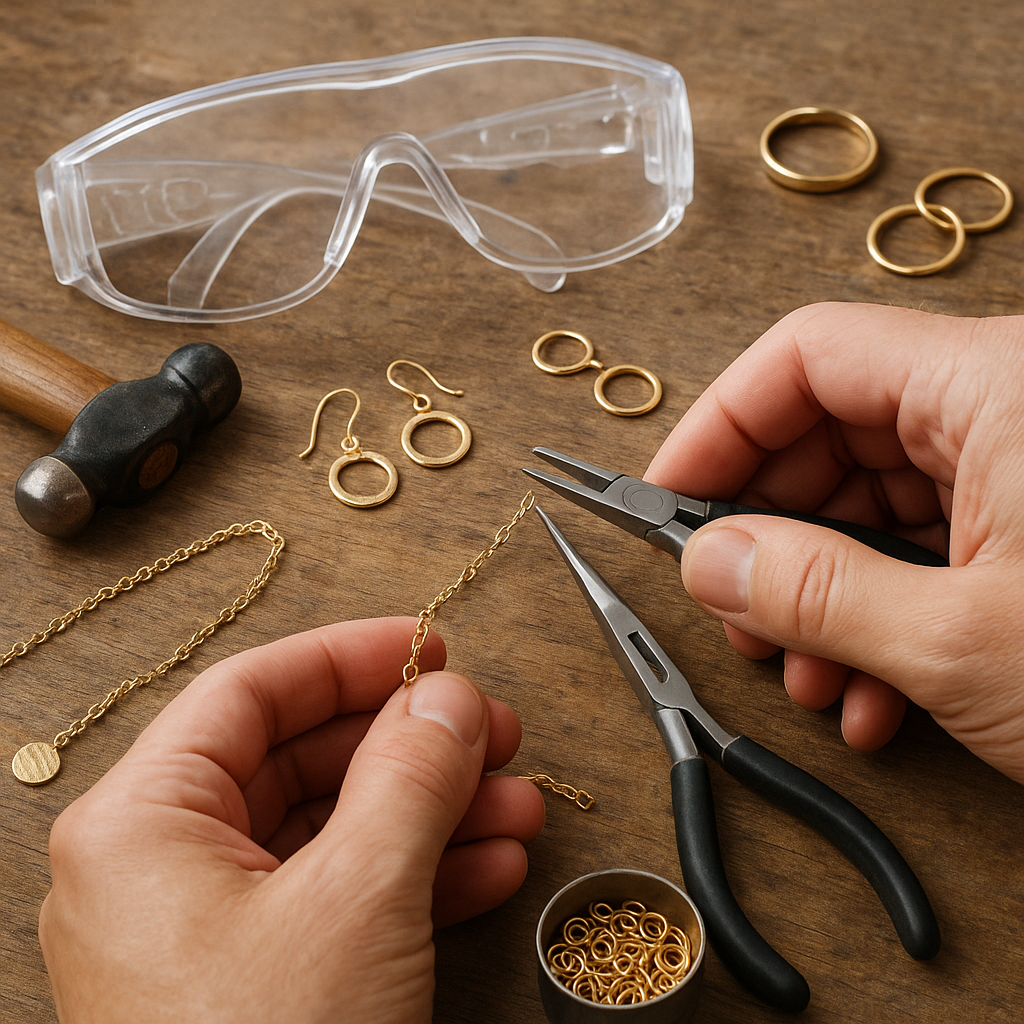
Making jewelry by hand is joyful, absorbing, and deeply satisfying. It also involves blades, heat, chemicals, dust, and repetitive motions—all of which ask for thoughtful prevention. This guide gathers practical, workshop-tested advice that helps you build sustainable habits, protect your health, and keep your studio productive. Whether you torch-solder silver, cast resin pendants, carve wax, or wire-wrap stones, a few proven practices will reduce risk without diluting creativity. You will find guidance on studio setup and ventilation, choosing and using PPE, safe handling of metals and chemicals, mindful tool use, and compliance for sellers. The goal is not perfection; it is steady, confident craft with safety woven into each step.
Design your space for safer making
Safety starts with the room. A considered layout keeps clean tasks (design, packaging, photography) separate from dirty tasks (sawing, sanding, polishing, torch work). A heavy bench placed against a non-flammable wall creates an anchor for filing and hammering. Keep clear paths between the bench, sink, and exit; mount a small whiteboard or clipboard near the door for emergency numbers and a quick daily safety checklist.
Good air management matters more than almost any other precaution for jewelers who heat, glue, or sand. Local exhaust—capturing fumes and dust at the source—beats general room fans. A simple, effective setup includes a hood or nozzle 10–20 cm from the work, ducting that minimizes bends, and an in-line fan sized for 100–250 CFM at the hood. Charcoal filters help with organic vapors from flux and resins; HEPA filtration is needed for fine particulates from polishing or lapidary. Avoid positioning yourself between the source and the hood so that the airflow moves away from your face. Remember that an open window is not a substitute for engineered ventilation.
Lighting and visibility affect both quality and safety. Combine broad, diffuse overhead light with a focused bench lamp rated 500–1,000 lux at the work surface. High-CRI (90+) LEDs reveal color shifts in heat and oxidation and help you evaluate solder flow and surface finish. Magnification through an Optivisor or lamp loupe reduces eye strain and allows precise tool control—less slipping means fewer injuries.
Noise control reduces fatigue and preserves hearing. Polishing motors and tumblers can exceed 85 dB; place loud equipment on vibration-damping mats, add enclosures where practical, and wear hearing protection when exposure exceeds a few minutes. Keep cords managed with clips along the bench edge; add a GFCI (RCD) outlet near sinks and unplug tools before changing accessories.
Personal protection that actually gets used
The best safety gear is comfortable enough to wear every time. Start with impact-rated eye protection; add a face shield for grinding and polishing to protect against wire bristles and buffing compound. Keep safety glasses at each risky station to reduce excuses. Choose a respirator with replaceable cartridges suited to your tasks: P100 for particulates (metal and stone dust), OV/P100 for organic vapors (solvents and resins). Fit matters—perform a seal check each time, and store clean respirators in a sealed bag.
Use gloves strategically. Nitrile offers better chemical resistance than latex for resins and solvents and reduces allergy risk. Thin, tight-fitting nitrile is ideal for finishing and adhesive tasks; thicker nitrile or neoprene suits aggressive chemicals. Avoid glove use near rotating machinery (polishers, rotary tools) where fabric can catch and pull your hand into the tool. For sheet metal handling, keep a pair of cut-resistant gloves at the shear and guillotine; remove them before drilling or polishing.
Clothing should be non-melting and snug. Natural fibers like cotton and wool char rather than melt when struck by sparks. An apron—cloth for general tasks, leather for hot work—adds a protective layer and pockets for tongs and tweezers. Tie hair back, secure long sleeves, and remove dangling jewelry when using rotary tools. Keep closed-toe shoes in the studio; your toes will thank you when a mandrel slips or a bur drops.
Hand comfort and ergonomics influence longevity in the craft. Choose handles that fit your grip; add foam sleeves to slim tools to reduce pinch force. Raise the bench pin so you can keep your shoulders down and wrists neutral while sawing. Alternate tasks—cut, then assemble, then finish—to avoid repetitive-strain injuries. A 20-20-20 break (every 20 minutes, look 20 feet away for 20 seconds) resets the eyes; micro-stretches reset the hands and neck.
Know your metals, know your skin
Metals differ in reactivity, fumes, and allergy potential. Sterling silver and gold alloys are stable in use, but fluxes, solder, and polishing compounds can add exposures. Nickel allergy is common; even trace release can cause dermatitis for sensitive wearers. The EU Nickel Directive limits release to 0.5 μg/cm²/week for items in prolonged skin contact and 0.2 μg/cm²/week for pierced parts. Choose alloys and findings labeled “nickel-safe” and request release-test documentation when possible, especially for earring posts and backs. Avoid plating solutions at home unless you have training and proper containment; cyanide-based baths are incompatible with small studios. If you outsource plating, specify low-release nickel-free stacks.
Lead has no place in jewelry intended for children and is tightly restricted in many regions even for adults. It lurks in some base-metal castings, solders, and vintage components. U.S. limits for children’s jewelry under ASTM F2923 and CPSIA are stringent; check local rules if you sell internationally. Avoid low-melting hobby solders marketed for stained glass, which often contain lead. For silver, choose cadmium-free solders and verify MSDS/SDS sheets; cadmium fumes are hazardous during heating. The same goes for base metals; cadmium may be present in some imported solder and plating. Treat cadmium as a hard stop—if a product is not clearly cadmium-free, don’t bring it into the studio.
For hypoallergenic marketing claims, be precise. “Hypoallergenic” is not a regulated term in many places; prefer clear descriptions: “Ti-6Al-4V titanium post,” “316L surgical steel,” “14k gold with no nickel plating.” Keep supplier certificates or assay results on file; they protect both customers and your brand.
Heat, torch work, and pickle
Open flame, hot metal, and chemical baths create several overlapping hazards. Butane microtorches, air-acetylene, and oxy-propane all work well in small studios when handled deliberately.
- Fuel safety: Store cylinders upright, away from heat, and cap valves when not in use. Check hoses and fittings with soapy water; never with flame. Keep a Class ABC fire extinguisher within reach and know how to use it. Separate fuel and oxidizer cylinders by distance or a barrier if you use oxy-fuel.
- Work surface: Firebrick or a ceramic soldering board on a metal tray provides a defined zone for heating. Clear combustibles within a meter. Keep a quench cup to the side you naturally move toward; label it and use a mesh basket for small parts.
- Flux and fumes: Flux decomposes into particulates and acid vapors when heated. Capture fumes with a local exhaust hood. Dry lungs and irritated eyes are signs your ventilation is falling short.
soldering techniques also influence safety. Pre-fit joints to reduce heat time, and keep fingertips out of the flame cone. Use third hands and locking tweezers to minimize direct handling. Heat evenly to draw solder through the joint rather than chasing it with the torch tip. Park the torch in a designated, tip-up rest whenever it leaves your hand.
Pickling cleans oxides after heating. Safer pickle choices include sodium bisulfate solutions or warm citric acid. Never add water to acid; add acid to water. Use a dedicated crock pot or beaker warmer to maintain temperature—never a food appliance. Place a lid over your pickle pot to reduce evaporation and accidental splashes. Use copper tongs; steel contaminates the bath and can cause copper to plate onto your work. Never, ever mix pickle with household bleach; the reaction can release chlorine gas. Label containers clearly, store away from bases like ammonia and baking soda, and keep neutralizer (sodium bicarbonate) for small spills.
Resins, adhesives, and polymer clays
Resin jewelry and modern adhesives open creative paths and new safety considerations. Epoxy systems are common; their base resins and hardeners can cause skin and respiratory sensitization. Work with the smallest practical volumes; for larger castings, watch exotherm—the heat produced as resin cures—which can burn skin or melt molds. Mix in a well-ventilated area, wear nitrile gloves, protect skin, and use an OV/P100 respirator if odors are noticeable. Wipe uncured drips with isopropyl alcohol on disposable towels, not bare hands. Once fully cured, many systems are relatively inert; uncured waste should be mixed and allowed to harden before disposal according to local rules.
epoxy alternatives include UV-cure resins; they cure quickly but still emit vapors and can trigger allergies. Use UV-blocking glasses, shield the lamp, and cure in a covered chamber to control stray light. Sand cured resins wet to keep dust down; resin dust is a respiratory and environmental irritant. Collect slurry with towels, let it dry, and dispose of it as solid waste rather than washing it down the drain.
Cyanoacrylate (CA) glues bond skin instantly and release irritant fumes. Ventilate and avoid leaning over the joint; acetone loosens CA but can irritate skin and eyes. Keep debonder on hand for accidents, and never pinch stuck skin apart—soak and roll it free.
Polymer clays require accurate temperature control. Bake at the manufacturer’s specified range using a dedicated craft oven or a tray-and-thermometer setup inside a household oven to prevent cross-contamination with food. Overheating can release irritating fumes; vent the area, and avoid inhaling the warm air when you open the door. Cool pieces before handling to reduce prints and prevent distortion.
Grinding, polishing, and lapidary dust
A smooth finish hides hours of gritty work. That grit—metal filings, compound, and stone—becomes airborne easily.
- Capture dust: Use a downdraft box at the bench pin or a hood behind the wheel. Supplement with a shop vacuum fitted with a true HEPA filter or a wet separator.
- Stay out of the line of fire: Polishing wheels throw parts. Stand slightly off to one side, hold small pieces with a split mandrel, shellac stick, or pin vise, and use light pressure.
- Manage wheels: Keep buffs and compounds dedicated by metal. A contaminated wheel scratches and can smear toxic residues across projects. Dress and replace wheels before they get hard or frayed.
- Entanglement: Remove rings and bracelets; tie hair. Never wear gloves near a spinning shaft.
Lapidary introduces silica and other mineral dusts; always cut and sand with water. For dry tasks, wear a P100 respirator and collect dust at the source. Be aware that some gem materials (malachite, chrysocolla) contain copper, and others (variscite) contain aluminum phosphate; their dusts can irritate or harm lungs. Wet clean your bench rather than sweeping to avoid re-suspending fine particulates.
Chemical literacy and housekeeping
Maintain a simple chemical inventory with SDS for each item you use—flux, pickle, oxidizers (liver of sulfur), solvents, adhesives, patinas. Label secondary containers with both contents and hazard pictograms. Store acids low and in tubs; store oxidizers separately; keep flammables in a metal cabinet or safety can. Put a small spill kit within reach: absorbent pads, baking soda, trash bags, nitrile gloves, and a printed sequence of steps for different spill types.
Ultrasonic cleaners and steamers speed finishing, but they demand care. Never run flammable solvents in an ultrasonic; cavitation and heat can ignite vapors. Follow tank-fill lines, and keep lids on. Know which stones cannot go in: porous, fracture-filled, and oil-treated stones (emeralds, turquoise) can be damaged by ultrasonics and heat. Vent steam away from faces and hands, and allow steamers to cool before draining.
Waste handling often separates responsible studios from the rest. Filter your sink drain to capture precious metal fines; the sludge is valuable and keeps metals out of waterways. Cure resin drips and wipes before disposal. Keep solvent waste in a labeled, closed metal can and arrange periodic drop-off at a hazardous-waste facility. Do not pour tumbling slurry or lapidary grit down the drain; let it settle, decant water, and discard the dried solids.
Electrical and machine safety
Rotary tools and polishing motors deserve respect. Inspect mandrels and burs before use; replace bent or chipped tools. Keep speeds within tool ratings, and let the abrasive do the work. Clamp or fixture the workpiece whenever possible: a bench pin notch, a small vise, or a pitch bowl can provide control. For drilling tiny components, use a pin vise or jig to avoid squeezing near the rotating bit—jeweler’s fingers are easily nicked by spinning edges.
For larger tools—belt sanders, drill presses, or small lathes—install shields where possible and keep tool rests close to the work. Unplug before changing bits or belts. Train yourself to reach for the switch without looking. In damp areas, use GFCI outlets. Avoid daisy-chaining power strips, and route cords to prevent trip hazards.
Digital fabrication enters many jewelry studios via laser cutters and 3D printers. Never cut PVC or unknown plastics on a laser; chlorine gas and corrosive HCl can ruin machines and harm lungs. PMMA (acrylic) and wood are typical; both produce irritant smoke—use a dedicated exhaust. For resin 3D printing, handle liquid photopolymer like epoxy: gloves, eye protection, and local exhaust. Post-cure parts in a covered UV chamber and clean with isopropyl alcohol in a closed system to limit vapor release.
From bench to buyer: product responsibility
If you sell, your studio becomes part of a supply chain. Familiarize yourself with the regulations for your market: nickel release (EU REACH Annex XVII), lead and cadmium limits (various jurisdictions), and ASTM F2923 for children’s jewelry in the U.S. California’s Proposition 65 may require warnings if certain chemicals are present in amounts that trigger notification thresholds. Keep purchase records, alloy certifications, and plating specifications for traceability. Test suspect components with a reputable lab or handheld XRF via a local jeweler’s association when in doubt.
Design choices affect safety for wearers. For earrings, choose secure clutch backs and smooth all contact surfaces. Avoid super-strong magnets near pacemakers. For necklaces and bracelets, evaluate clasp strength and the possibility of entanglement for children; if you market to kids, follow toy safety norms where applicable. Packaging should protect jewelry without creating suffocation hazards; use perforated bags or rigid boxes for small items.
Emergency readiness and first aid
Emergencies are rare when you plan, but your response window is short. Mount a small first-aid kit at the bench: adhesive bandages, sterile gauze, disinfectant wipes, burn gel or sterile hydrogel dressings, eye wash ampoules, and tweezers. Keep a 15-minute eyewash option nearby—plumbed or a large bottle—and know how to use it.
- Burns: Cool under running water for 10–20 minutes. Remove rings or tight items before swelling. Do not apply oils, toothpaste, or ice. Cover lightly with a sterile, non-adhesive dressing.
- Cuts: Apply pressure, elevate, and clean when bleeding stops. Use finger cots or gloves to keep work sanitary during healing.
- Eye exposures: Flush immediately, holding lids open; seek medical help for embedded particles or chemical burns.
- Fume exposure: Move to fresh air, loosen tight clothing, and seek medical advice if symptoms persist.
- Fire: Shout, extinguish if small using the right extinguisher, or evacuate. Never turn your back on a fire that is still smoldering.
Conduct a brief monthly drill: locate your extinguisher, verify pressure gauge, check the exit path, and review emergency numbers. Replace expired supplies and cartridges on a schedule.
Daily and weekly checklists
Daily
- Clear the soldering surface; remove combustible scraps within arm’s reach.
- Verify local exhaust is working; feel airflow at the hood with a strip of tissue.
- Put on eye protection before powering any rotary tool.
- Seal chemical containers; wipe spills immediately and neutralize acids.
- Return sharp tools to holders; cap blades when leaving the bench.
- Empty bench sweeps into a dedicated reclaim jar.
- Power down and unplug heat sources at the end of the day.
Weekly
- Inspect torch hoses and connections; check for leaks with soapy water.
- Change or clean dust filters; vacuum with HEPA around polishing areas.
- Review chemical inventory; dispose of expired items appropriately.
- Dress polishing wheels; separate by metal and compound.
- Sharpen gravers and replace dull saw blades to reduce force and slips.
- Wipe lighting diffusers; clearer light improves accuracy and reduces strain.
- Backup design files and update supplier records for traceability.
Studio culture: small habits, big payoff
Safety is a culture, not a collection of scolds. Put reminders where they matter—a respirator hook by the buffing station, a glove dispenser near the resin bench, a copper tongs holder on the pickle pot. Build rituals: glasses on before the switch flips, torch parked tip-up every time, lids closed after use. Teach anyone who shares your space the house rules, and be open to revising them when you learn better methods.
Finally, take care of the maker. Stretch between tasks. Drink water. Schedule uninterrupted “setup time” to clamp, position, and check before you cut or heat. Keep a small notebook for process notes and near-misses; it will become an invaluable, bespoke safety manual for your evolving craft. Responsible practice is not a constraint—it is a stable platform for skill and imagination to grow.
