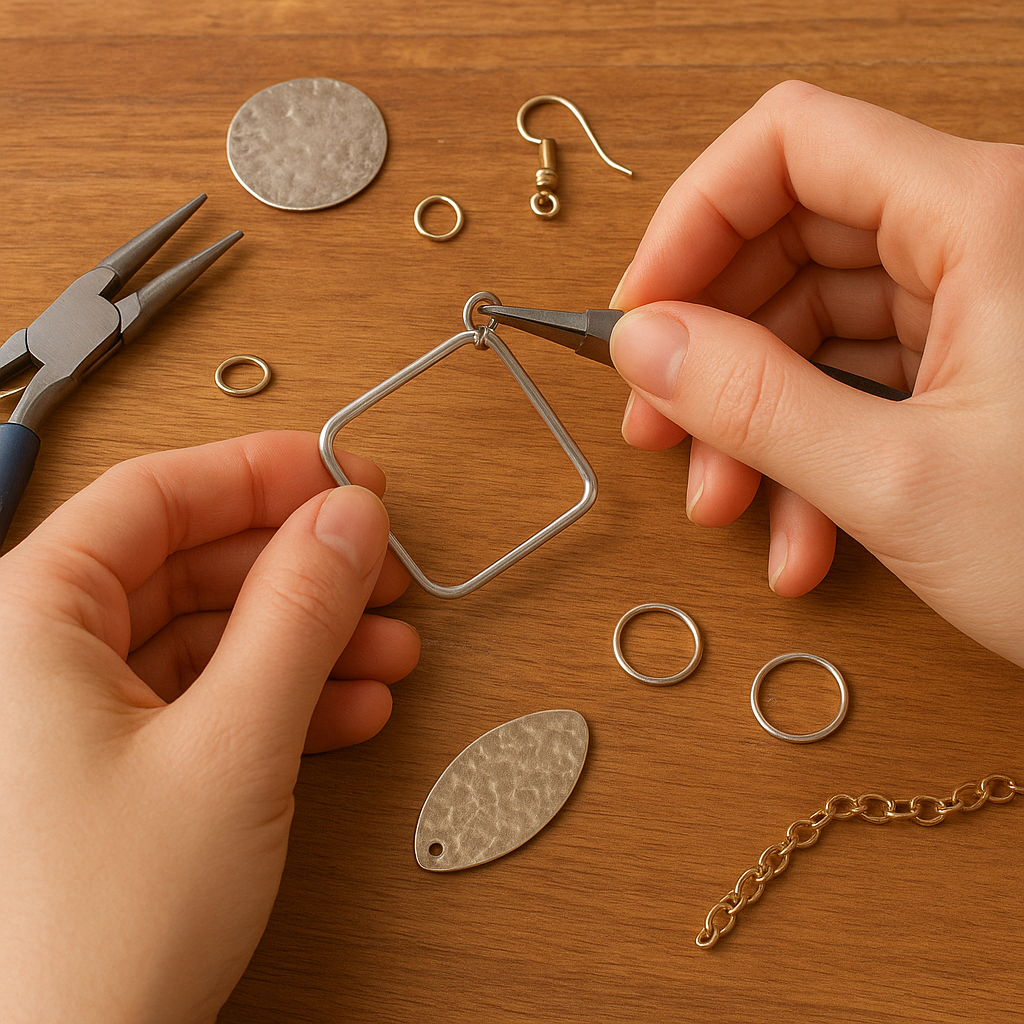
Metal jewelry built without solder celebrates ingenuity: sheets and wires become wearable architecture through pressure, friction, and clever geometry. Whether you work at a kitchen table or a compact bench, solder-free methods—rivets, tabs, prongs, folds, and press-fits—offer a low-barrier gateway to durable adornment with professional polish. This guide gathers practical techniques, design strategies, troubleshooting tips, and project ideas to help you craft expressive pieces that rely on mechanics rather than flame, while still achieving confident structure, refined surfaces, and long-term reliability.
The Foundations: Materials, Tools, and Mindset
Working without solder is not a compromise; it is a distinct language. Instead of bonding surfaces with molten metal, you create joins that grip, expand, wedge, lock, or flex. Learning this language starts with the right materials and a habit of testing connections before adorning them with stones or investing hours in finishing.
Metals and Gauges
For most cold techniques, start with copper, brass, or bronze. They are forgiving, affordable, and take textures well. Sterling silver and Argentium are excellent for advanced work. Mild steel sheet or stainless can be used for industrial looks, but require robust tools. Aluminum is light and easy to shape, though it scratches more readily. Keep sheets between 0.5–1.0 mm (24–20 ga) for earrings and pendants; go thicker (1.0–1.5 mm) for cuffs and structural elements. Round wire in 0.8–1.2 mm (20–18 ga) covers most wrapping, headpins, and jump rings; thicker wire (1.5–2.0 mm) suits frames and hooks.
Essential Tools
- Pliers: chain-nose, round-nose, flat-nose, and nylon-jaw for protecting surfaces.
- Cutting: jeweler’s saw with 3/0–5/0 blades, flush cutters, and a bench pin.
- Shaping: mallets (rawhide/nylon), steel hammer, ring/bangle mandrels, dapping block with punches.
- Holes and riveting: center punch, awl, rotary tool or flex shaft, small twist bits (0.8–2.5 mm), hand punch, ball-peen hammer, and a steel block or anvil.
- Measuring/marking: ruler, dividers, scribe, digital calipers, fine-tip marker.
- Finishing: files (needle set), abrasive papers (400–2000 grit), polishing pads, burnisher, tumble polisher (optional).
- Holding/jigs: bench vise, third-hand tweezers, clamps, masking tape, binding wire.
- Optional but helpful: tube-cutting jig, doming block, letter/shape stamps, small arbor press.
Design Mindset
Think like a cabinetmaker and a tailor: tight tolerances, clean edges, controlled bends, and understanding of spring-back are your allies. Cut a test from scrap, test the joint, then scale up to the finished piece. Develop a habit of measuring twice and scribing lightly. Remember that metal fatigues; design bends broad rather than sharp, and keep stress lines supported with curves, pads, or layered plates where needed. Workpieces benefit from precision, but don’t let measurements crowd out intuition—paper modeling can reveal surprising forms that translate beautifully into metal.
Core Cold Connections You’ll Use Everywhere
The backbone of solder-free metalwork is the family of mechanical connections that lock materials in place. Master a few, and you’ll quickly combine them like verbs in a sentence.
Wire Rivets
Rivets are small metal pins that flare at both ends to hold layers. They are compact, strong, and decorative. To make one, drill aligned holes, insert a slightly oversized wire, trim to an appropriate protrusion (about 0.5–0.8 mm per side for small rivets), then peen and dome both ends.
- Steps: Center punch the spot; drill; deburr; insert wire; clip; support on a steel block; lightly tap with the flat of a hammer to mushroom; round with the ball-peen; flip and repeat; finish with a burnisher.
- Best practice: Use the same metal for rivet and sheet to avoid galvanic corrosion; for contrast, seal the piece or use noble metals for the rivet. Keep rivets away from thin tabs or edges that can tear under pressure.
- Variants: Flush rivets (countersunk for a smooth surface), decorative domed rivets, mixed-metal rivets, and clutch-style rivets that add a removable layer.
Pay attention to hole size. A tight fit maximizes strength. If the wire spins, expand the shank slightly by light hammering before peening. Good rivets give your work a sense of engineered purpose and true mechanical durability.
Tube Rivets
Tube rivets offer a clean, modern look and act as hinge barrels or cord grommets. Use thin-wall tubing; drill the sheet to match the outer diameter; insert a slightly long segment; flare both ends with a doming punch or a tubular flaring tool, then planish. Tube rivets combine structure and function: they can allow movement, accept a jump ring, or emphasize a design dot.
Tabs and Slots
Tabbed connections are invaluable for laminating layers, setting stones, and attaching found objects. Tabs are narrow fingers cut from a sheet that fold over an adjacent layer. Cut them long enough to curve, not kink, over the top piece; deburr and slightly round the corners; bend with parallel pliers or a burnisher.
- Planning: Sketch tab layout on paper templates. Place more small tabs rather than a few large ones to distribute pressure. Leave adequate metal between a tab’s base and the sheet edge.
- Execution: Start with a test bend using scrap. For hard metals, introduce a gentle curve rather than a sharp fold to avoid cracking. Cushion with tape to protect polished surfaces.
- Use cases: Mounting flat stones, intricate cutouts over contrasting backplates, and attaching organic materials (shell, wood) where drilling would weaken the piece.
Tabs leverage friction and geometry, so accuracy matters. Final adjustments with a burnisher can tighten a loose hold. Because tabs raise from the surface, they also become aesthetic elements—shape them intentionally as leaves, gears, or minimalist bars to turn function into ornament.
Prongs and Pressure Fits
Prongs are upright wires or sheet fingers that bend over an object’s edge. They can be riveted or slotted into a base. For stones, use at least three points of contact; for organic objects, add thin pads under prongs to distribute pressure. For a pressure fit, create a seat—a shallow recess or channel—then slightly undersize the object’s cavity so elastic tension holds it. Tension settings require hard temper metal and careful design, but the pay-off is a crisp, modern look without adhesives.
Folded and Hemmed Joints
A fold can be a hinge, frame, or enclosure. Folded hems along sheet edges stiffen lightweight metal and create safe, rounded borders for cuffs. A double-fold can catch a secondary sheet inside—a paper-like crimp that works surprisingly well in metal and can form pockets for enamel decals, textiles, or thin inlays.
Interlocking Seams and Hooks
Interlocking seams rely on geometry: a tongue slides into a groove, or two bent edges snap together. This principle underlies box joints, snap-on bezels, and modular chains. Hooks, S-clasps, and keyhole slots apply the same logic: a protrusion captures a loop under tension. Test tolerances with paper, then cardstock, before metal; add small lead-ins (tapered edges) so parts meet effortlessly in use. The poetry of solder-free design often lies in how parts meet and release in service of everyday wearer comfort.
Wire Work: From Structure to Sparkle
Wire is the most responsive sculptural element at your bench. When you can form tight, consistent curves and closures, you unlock rapid builds and expressive lines without heat.
Jump Rings and Chains
Coil wire on a mandrel, saw the coil into rings, then close meticulously with parallel pliers: close past the joint and spring back for a near-invisible seam. Work-harden the chain by tumbling or light hammering to improve wear resistance. Even delicate chains become robust if the links are closed perfectly and proportioned correctly to wire thickness. Use oval links to resist torque and create lay-friendly drape.
Wire Frames and Cabochon Wraps
Wire frames become stone settings, pendant cages, and earring structures. For a classic cabochon wrap, build a double-rail frame, add binding wire to lock rails, then shape prongs from the rails’ tails and fold them over the stone. Control is everything: plan the number and placement of crossings to secure the stone without bulk. Hammer lightly at strategic sections to create stiff “spines,” leaving other areas springy. This local stiffness guides the wrap and locks forms in place.
Headpins, Ear Wires, and Clasps
Headpins can be cold-formed: flatten and dome one end with a hammer, or create decorative swirls. Ear wires should be smooth, springy, and mirror-matched; tumble or burnish the ends to remove burrs. Build S-hooks or hook-and-eye clasps from 1.5–2.0 mm wire, harden with taps on the anvil, and add a subtle return bend to prevent accidental release. The secret to comfortable wear is consistent radii and polished contact points—details that signal care and craftsmanship.
Adhesives as Allies: When and How to Use Them
Some makers avoid glue; others use it judiciously. In solder-free practice, structural epoxies and UV-curing resins can complement mechanical joins. The key is transparency: use adhesives where access for replacement is possible, and always combine with physical constraints like tabs or recesses so adhesive isn’t the sole point of failure.
- Surface prep: Degrease with isopropyl alcohol, lightly abrade both surfaces, and dry completely.
- Adhesive choice: Two-part epoxies offer high shear strength; UV resins are fast but more brittle. Choose clear, jewelry-grade products.
- Design for failure modes: If adhesive lets go, a lip, pin, or tab should still restrain the component, preventing loss.
- Cleanup: Mask edges before bonding; remove squeeze-out immediately with a swab and solvent recommended by the adhesive manufacturer.
Adhesive color, aging, and flexibility vary. Test a sample and age it under sunlight and humidity if possible. Used thoughtfully, adhesives become a discreet insurance policy rather than a crutch.
Textures, Surfaces, and Finishing Without Flame
Surface is where technique becomes style. Without solder, you still command a full palette: hammer textures, roller prints, stamped motifs, and controlled oxidation. Your finish communicates confidence; it’s worth the extra passes.
Texturing and Pattern
Use cross-peen, ball-peen, and custom-faceted hammers to create textures that stiffen and decorate simultaneously. Roller printing with annealed brass texture sheets or improvised materials (lace, paper with glue, leaves) imprints patterns—use a rolling mill or a vise and patience. Stamps and chasing tools add localized relief; dome over a dapping block to introduce curvature that boosts stiffness and catches light. Strategic texture can cover small surface imperfections and add tactile refinement.
Edges, Deburring, and Shine
Finish edges meticulously: file square, then break the corner with a tiny bevel; sand progressively through grits; burnish or polish. Even a matte satin requires careful groundwork. Move abrasives in alternating directions between grits so you can see when prior scratches are fully removed. Ultrasonic cleaners or warm soapy water lift abrasive residues before final polish.
Coloring and Patina
Copper and silver alloys love controlled darkening. Liver of sulfur produces grays to deep black; ammonia fuming with salt can raise blues and greens on copper; commercial solutions offer predictable results. Always neutralize and seal if the piece will contact skin or clothing. Contrast-driven work—dark recesses, bright edges—gives depth with minimal effort. Think of patina as a final design layer, not an afterthought.
Durability Through Work and Finish
In solder-free builds, the finishing phase also enhances structure: light planishing aligns molecules, edges made round resist dents, and tumbling brings uniform micro-scratches that hide wear. Choose a finish aligned with use: high polish dazzles but shows scratches; satin hides wear and feels luxurious in daily pieces. Smart finishing choices improve comfort and longevity.
Design Strategies: Prototyping and Modularity
Before cutting precious metal, prototype in paper or thin plastic sheets. Score and fold to explore geometry, cut tabs, and test interlocks. Translate winning forms into metal with allowances for thickness, bend radii, and spring-back. Create jigs from hardwood or 3D-printed forms for repeatable bends and consistent sizing.
- Modular thinking: Build components—frames, clasps, stonesettings—that assemble in multiple ways. This speeds production and invites remixing collections.
- Tolerance discipline: Aim for slip fits of 0.05–0.2 mm where parts must interlock; sand or file slowly to the line.
- Ergonomics: Weight, balance, and edges matter in wearables. Use hollow forms, perforations, and tapering to reduce mass while keeping structure.
A small library of reliable modules—prong plates, tabbed bezels, standardized rivet spacings—amplifies your throughput and ensures consistent quality.
Step-by-Step Mini Projects
Layered Riveted Pendant
- Design two shapes: a base plate and a contrasting overlay. Transfer with spray adhesive and cut with a jeweler’s saw.
- Drill three to five evenly spaced holes; deburr.
- Insert matching wire for rivets, clip to length, and peen on a steel block. Slightly dome the rivet heads with a ball-peen.
- Add a tube rivet at the top as a bail: size the tube to accept a jump ring, flare both ends, and burnish.
- Finish edges, add texture, patinate selectively, then polish high spots for contrast.
Tab-Set Cabochon
- Trace the stone on sheet and add a 2–3 mm border; saw and refine.
- Plan six small tabs along the perimeter; cut and round tab tips.
- Lightly dish the base plate so the stone seats in a shallow cradle.
- Tack the stone with removable adhesive putty; fold tabs over sequentially with a burnisher, barely clearing the edge.
- Test security by gentle tapping; adjust with controlled pressure. Final polish without snagging tabs.
Wire-Wrapped Ring with Frame Spine
- Form a ring shank from 1.6 mm wire around a mandrel; leave a small gap.
- Create a double-rail frame across the gap using 0.8 mm wire; bind with thin wrapping wire at two or three points.
- Insert a small cab or bead captured by the frame; lock with additional bindings that seat against hammered “spines.”
- Planish the shank lightly to harden; refine profile and comfort-fit edges.
Interlocking Cuff with Snap Seam
- Cut a cuff blank; bevel edges and apply a subtle cross-peen texture.
- Create a small folded lip on one long edge and a matching undercut on the opposite edge.
- Curve the cuff on a mandrel; test the snap-fit seam; adjust tolerances by filing.
- Work-harden with gentle planishing; apply a patina and wax seal.
Quick S-Hook Clasp and Textured Chain
- Wind and saw jump rings from 1.2 mm wire; close perfectly and tumble.
- Forge an S-hook from 1.8 mm wire; planish the curves and deburr.
- Add a small return at each end for secure capture; harden with light hammering.
- Assemble the chain, test pull strength, and finish as desired.
Troubleshooting: Common Issues and Solutions
- Rivet spins after peening: Hole too large or wire too hard. Upset the shank slightly by tapping before forming the heads, or choose a tighter drill size. Use softer temper wire for the rivet.
- Tabs crack when folded: Corners too sharp or bend too tight. Round tab bases, widen bend radii, and, if needed, thin the last millimeter of the tab underside with a file for an easier fold.
- Prongs loosen over time: Insufficient work-hardening or poor seat. Burnish prong tips after setting to compress metal; add subtle notches/seats before bending; periodically check and retighten during maintenance.
- Jump rings opening in wear: Gaps not aligned or insufficient hardening. Twist closed past the seam, then return; tumble or planish lightly to harden. Consider oval links to resist torque.
- Uneven finish: Skipping grits or inconsistent stroke direction. Return one grit, remove all directional scratches, then proceed. Clean surfaces between grits.
- Adhesive failure: Poor prep or wrong adhesive. Clean, abrade, and use a structural epoxy; design a mechanical backup like a shelf or pin.
- Discoloration on skin: Copper/brass reacting with sweat. Apply durable sealants on skin-contact areas or use silver in those zones; recommend proper care to clients.
Maintenance, Wear, and Repair
Jewelry lives on bodies; sweat, friction, and impact test every joint. Build for serviceability. Use standard wire sizes for rivets and prongs so repairs are straightforward; place rivets where a punch can reach them; design clasps that can be reshaped after a snag. Encourage periodic checks: tighten prongs, replace tired jump rings, and refresh finishes. Clear care instructions—remove before high-impact exercise, store in a dry pouch, wipe after wear—extend life and keep surfaces bright. Maintenance is part of the craft narrative and a mark of professional responsibility.
Sustainability and Studio Practice
Solder-free craft naturally supports low-energy making: fewer torches means fewer consumables and better compatibility with small, shared spaces. Scrap management matters: segregate metals to maximize recycling value; melt only when appropriate; repurpose clean offcuts into test coupons, rivet wire, or texture samples. Non-toxic patinas and water-based sealers reduce studio load. Noise control—rubber mats under anvils, soft mallet choices—protects neighbors and hearing, encouraging sustainable routines every day.
From Technique to Voice: Developing Style
All methods are means, not ends. As you adopt and mix connections, notice which gestures feel like you: the quiet alignment of a flush rivet; the dramatic arc of a wrap; the satisfying click of a snap-fit seam. Keep a swatch library of textures and patinas; record tool angles and drill sizes; maintain a repair log to learn from real use. Repetition begets fluency; fluency frees attention for composition and narrative.
For many makers, a personal vocabulary emerges: perhaps layered plates with minimalist tabs, tactile frames that embrace rough gems, or modular elements that let wearers reconfigure pieces at will. This vocabulary travels well into collections and commissions, where consistency in dimensions and assembly logic builds trust with clients and galleries alike.
Safety, Comfort, and Testing
Respect your materials and your body. Sharp edges and burrs cause snags and discomfort; refine every touchpoint. Pressure test closures and rivets. Perform bend tests on prototype tabs and prongs, measuring deflection and recovery. Wear eye protection when drilling and peening; clamp work to avoid slipped tools. If you experiment with chemical patinas, ventilate and neutralize responsibly. A piece that passes simple home tests—tugging chains, flexing cuffs, rubbing cloth snag checks—earns confidence before it reaches a wearer.
Putting It All Together
Solder-free jewelry thrives on clever mechanics and careful finishing. Start with a simple layered pendant; add a tab-set stone; refine a pronged earring series; build a chain that sings through movement and light. Along the way, train your eye for alignments, your hands for consistent force, and your workflow for clean sequences. Once your core methods settle—secure riveting, confident prongs, crisp folds, elegant clasps—you’ll find that constraints become catalysts. New forms present themselves as you ask how two parts might join, flex, or separate.
The essence of this craft is connection: between metals, between tool and hand, and ultimately between maker and wearer. Let your process remain visible where it serves the story—a proud rivet head, a subtle fold shadow—while refining the rest until it disappears. Your reward is jewelry with structural honesty, tactile delight, and a voice that belongs unmistakably to you.
Glossary of Useful Concepts
- Rivet: A pin of metal mushroomed at both ends to clamp layers.
- Tube rivet: A hollow rivet flared at ends, often used as a bail or hinge barrel.
- Tab: A sheet finger bent over to capture another piece or a stone.
- Prong: An upright wire or sheet finger bent to secure an object at edges.
- Press-fit: A friction-based join where parts are dimensioned to hold under compression.
- Hem: A folded edge that stiffens and softens the feel of a sheet.
- Planish: To smooth and harden metal with controlled hammering.
- Burnish: To polish and compress surfaces with a hard, smooth tool.
- Work hardening: The increase in hardness from deformation that gives a resilient springiness.
- Galling: Adhesive wear that can seize similar metals; mitigated by lubrication when forming.
As you explore solder-free methods, choose a few keystone ideas to practice deliberately: crisp holes and tight fits; proportional rivet heads; predictable prong bends; unified surface language across a piece. Add one variable at a time—an interlock here, a new patina there—so you can trace results. In time, your pieces will showcase the best of both engineering and ornament, speaking in the clear, confident grammar of cold metalwork, where joins are visible, honest, and strong; forms are resolved through interlocking parts; edges and surfaces reveal intentional finishing; and every decision supports wearability, beauty, and enduring precision.
Finally, carry forward a few anchor practices: treat prongs and tabs as design elements, not merely fasteners; celebrate riveting as both structure and punctuation; prioritize durability through proportion and testing; and let texture and patina harmonize the whole. In the space between mechanics and adornment, solder-free jewelry becomes a quietly radical craft—resourceful, portable, and richly expressive.
