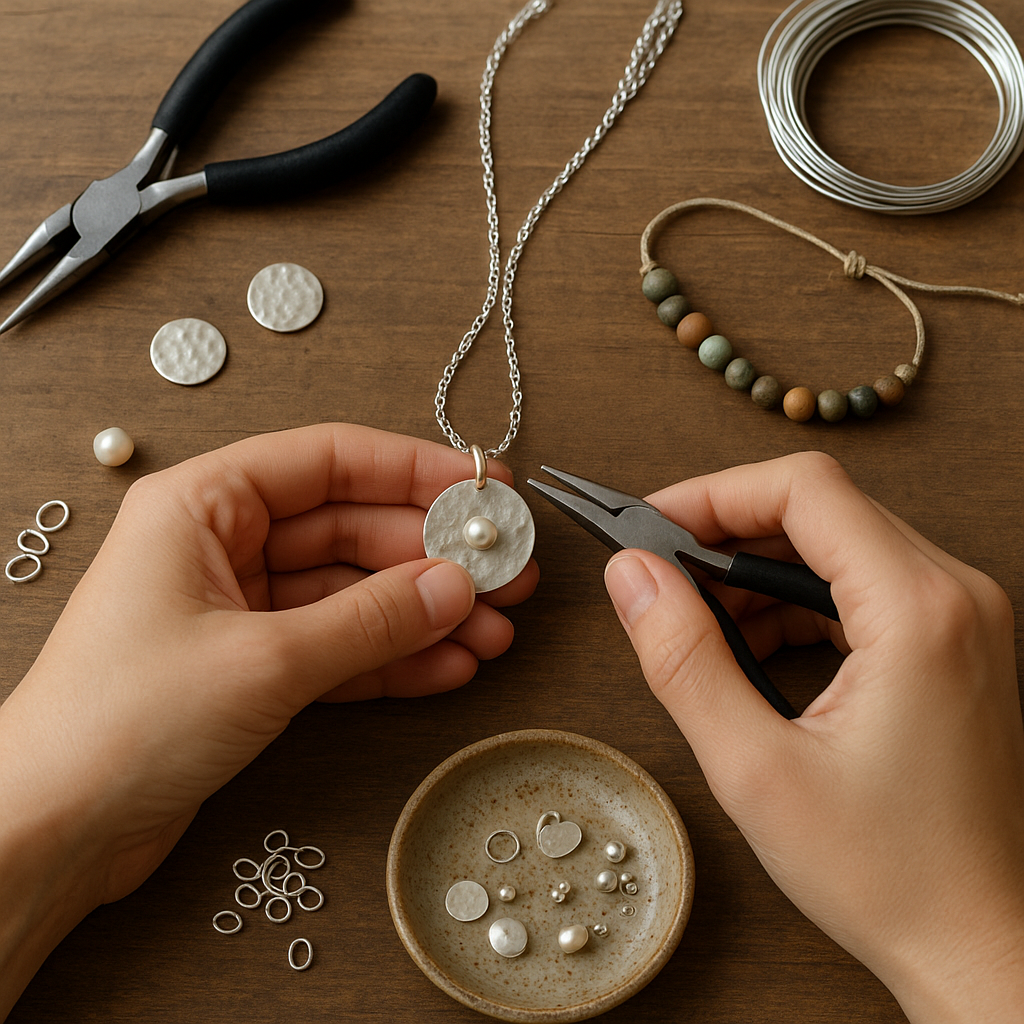
Jewelry can be more than decoration; it can be a small, wearable museum of a life. A handmade pendant that holds a pressed leaf from the street where you first met someone, a bracelet strung with stones gathered on travels, a ring engraved with a phrase that steadied you in a hard season—these pieces do not simply adorn, they speak. This guide explores how to design and craft jewelry that carries a personal story with clarity and care, drawing on the tactile intelligence of handicraft to transform memory into matter.
Why Stories Belong in Jewelry
Stories and adornment have traveled together for as long as humans have shaped metal, fiber, and stone. Individuals have signaled belonging, milestones, and vows by wearing objects close to the body. The intimacy of jewelry—resting against skin, warmed by movement—makes it a powerful vessel for memory. A maker who understands story is not just composing shapes, but arranging moments, values, and relationships into a form that can be felt.
When you commit to storytelling in your work, you commit to clarity of theme, economy of detail, and harmony between material and meaning. You listen for the essential note of a memory and find a form to hold it. This work is both conceptual and tactile: the narrative arc determines the choice of beads, the type of clasp, the scale of metalwork, the finish that will age well. The result is a piece that wears beautifully and whispers who and what matters.
Five elements shape successful story-forward pieces: theme, material, technique, proportion, and ritual. The theme is the core idea you want to transmit; material anchors it; technique determines how it is expressed; proportion ensures balance; ritual makes the wearing or gifting significant. A maker who unites these elements develops a clear personal voice and produces work that feels inevitable, like an object that could not have been made any other way.
Gathering the Threads of a Personal Narrative
Begin by locating the story you want to tell. This might be a single instant, a long relationship, a place, a season of transformation, or a family tradition. Write a few lines about what you remember and why it matters. Map sensory details: the color of the sky, a texture underfoot, a scent you cannot forget. Collect keywords that hint at form and material: wave, hinge, ember, threshold, spine, compass. These words will become anchors for design choices.
Next, define the wearer. Is this for you or someone else? What is their daily life like? What metals do they prefer? Do they have allergies? How do they move? A story told in a large, kinetic earring reads differently on a nurse who lifts patients than on a curator who spends hours in quiet galleries. Choose a format—necklace, ring, brooch, hairpin—that fits both story and life.
- Write three sentences that capture the story’s essence. Reduce them to five words.
- List five textures and five colors that feel connected to the memory.
- Identify a single symbol or object from the story—a leaf, a map line, a tool—that can become a motif.
- Define the intended lifespan: a few seasons, or generations. This informs materials and construction.
- Note practical constraints: budget, time, access to tools, skill level.
Materials with Meaning
Material is the first language a story speaks. Metals, stones, woods, fibers, clays, and found objects each carry histories of use, regional associations, and tactile qualities that elicit feeling. Choosing them with care turns a simple form into a vessel of memory and presence.
Metals
Silver reflects moonlight and is often associated with clarity and companionship; brass has the warmth of sunlight and industry; copper, with its living surface, recalls hearth and hands. Gold marks vows and endurance. Consider recycled metals when the story is about renewal or continuity, and keep an eye on sourcing: the origin of your metal can amplify or undermine your message about place and ethics. Traceable metal adds a layer of provenance that strengthens the story’s credibility.
Gemstones and Minerals
Stones deliver color, hardness, translucency—each a metaphor. Lapis hints at night skies; labradorite flashes like memory itself; clear quartz speaks of focus. Sea glass carries the sea’s patient shaping. If the stone is tied to a location that matters, note it. Pebbles gathered from a childhood riverbed, tumbled and set in a simple bezel, may carry more weight than a costly gem. When the story is about resilience, consider tougher stones and sturdy settings; for delicacy, look to pearls or carved bone.
Organic and Textile Elements
Wood, seeds, shell, and bone connect a piece to living cycles. Linen, silk, and cotton can be braided or embroidered with initials and dates. A lock of hair, a pressed blossom, a scrap of your grandmother’s apron—these require archival approaches, but their emotional charge is undeniable. Textiles excel at warmth and softness; they can absorb essential oils and carry subtle scent ties to memory.
Found and Upcycled Objects
Keys, watch parts, stamps, ticket stubs, fragments of ceramic—humble things become talismans when framed with care. Setting a subway token into a ring can mark the year you arrived in a city; a tiny screw from a first bicycle might fasten a clasp. Use cold connections to avoid damaging ephemera. Upcycling aligns with values of care and resourcefulness and often produces one-of-a-kind textures.
Designing the Story: From Sketch to Mockup
Translate your notes into marks on paper. Sketch without restraint, then edit. A clear silhouette is often stronger than an ornate one for telling. Use rhythm—repetition, variation—to guide the eye across the piece, pausing on motifs that matter most. Consider the choreography of wearing: where will the focal story sit on the body? What will a wearer notice first? What details will reveal themselves slowly?
Build a mood board with fragments: fabric swatches, color chips, photos, lines of handwriting. Then create a low-fidelity mockup using wire, string, cardboard, or clay. Test scale, weight, movement. Check closures and how the piece interacts with clothing. Invite feedback from the intended wearer if appropriate, but protect the core theme from becoming diluted by committee.
Handicraft Techniques That Carry Stories
Technique is how material learns to speak. Some methods lend themselves to embedding text, others to preserving artifacts or evoking textures from memory. Choosing the right craft approach can make your theme legible and your construction durable.
Engraving and Etching
Hand engraving can inscribe names, dates, coordinates, or small drawings. Chemical or saltwater etching allows you to transfer handwriting or maps onto metal. A note written by a loved one, traced into a pendant, becomes a portable letter. Keep line weight consistent with scale; too fine a line can vanish with wear, too heavy can overwhelm.
Casting with Inclusions
Lost-wax casting captures organic forms like twigs, shells, or woven textures. Direct casting preserves surfaces precisely. Use it to immortalize a ring of twine from a childhood kite or the bead pattern from a family garment. For fragile ephemera, consider mold-making materials that won’t harm the original.
Resin and Transparent Settings
Resin offers a way to embed paper words, petals, sand, or cloth while preserving transparency. Work in layers to create depth, and add UV inhibitors to protect colors. Use bezels or open-backed frames with acetate to maintain a crisp edge. Resin thrives on patience; rushed pours often trap bubbles that obscure details.
Wire Wrapping and Cold Connections
Wire allows you to cradle stones from a special trip without drilling them. Rivets and tabs secure objects without heat, which is perfect for fragile finds like antique buttons. Explore tension and curve to echo lines from your story—river bends, mountain ridges, or musical phrases.
Bead Weaving and Loomwork
Patterns on a loom can encode dates, initials, or Morse code. Color sequences can map journeys or seasons. Off-loom stitches—peyote, brick, herringbone—invite rhythm and variation, poetic tools for telling in increments. Thread color subtly influences tone; choose it as carefully as bead hue.
Textile Techniques
Macramé, braiding, and knotwork embody connection and continuity. Embroidery on leather or felt can hold monograms and small icons. Even a hidden line of stitching inside a leather cuff can feel like a secret promise. Seal and back textiles thoughtfully to withstand sweat and friction.
Enameling and Patination
Enamel sets color permanently, ideal for flags of place, flowers of a season, or coded palettes. Chemical patinas on copper and brass can echo landscapes and time. A deliberate, carefully sealed patina can serve as a metaphor for experience without compromising wear.
Symbolism and Visual Language
Some symbols are nearly universal—circles for cycles, knots for bonds—but personal work thrives on specificity. A compass can represent guidance, but the actual angle of a hiking route, etched as a segment of a topographic map, is far more potent. Numbers matter too: three charms for three siblings, five beads for the five years sober. Color evokes seasons and moods: deep blues for night work, pale greens for recovery, ember reds for courage.
- Shapes: circle (continuity), triangle (change), spiral (growth), line (path), square (home).
- Numbers: use counts to mark years, people, or steps in a process.
- Textures: hammered for labor, satin for quiet, faceted for revelation.
- Motion: dangling elements for dances and winds; fixed forms for stillness and roots.
Balance legibility with intrigue. If you rely on widely recognized icons, temper them with unusual materials or arrangements that return the piece to the singular story you are telling.
Ethics, Cultural Respect, and Sustainability
Personal stories live inside broader histories. Take care not to appropriate sacred symbols or designs from living traditions unless you have explicit guidance and permission. When you draw from a culture that is not your own, credit sources and consider collaboration or purchasing components from artisans of that culture. Ethical sourcing is itself a facet of story; your materials can speak of care, repair, and stewardship.
Reduce waste with modular designs and thoughtful cutting plans; recycle scrap metal; choose plant-dyed fibers when possible. Transparent sourcing and repairable construction embody sustainability in practice, turning values into touchable form. Your process then becomes part of the narrative you offer: not only what was made, but how and why.
Finishing Touches: Closures, Wearability, and Comfort
A story falters if it snags hair or pinches skin. File and round all edges, polish interior surfaces, and choose clasps that match dexterity and lifestyle. Magnetic clasps aid arthritic hands; lobster clasps feel secure for active wearers; toggle bars can echo motifs with custom shapes. Consider counterweights for pendants to settle them at the right point on the chest. Test pieces in daily movement: lifting, typing, embracing. Comfort is quiet, but it is a profound expression of craftsmanship.
Finish also includes surface protection. Seal patinas, wax leathers, reinforce threads, and back fragile textiles. Add extender chains for versatile fit. A comfortable piece is worn often, and wear is how the story breathes.
Rituals of Gifting and Wearing
Accompany each piece with a small card that names materials, origin, and care—include the map coordinates of a beach, the species of a leaf, or the year of a coin. Invite a simple ritual: fasten the clasp while repeating a phrase; touch the pendant before a meeting; add a bead for each anniversary. Rituals ensure the story is not trapped in the object but flows through the wearer’s days.
Packaging extends the experience. Wrap in a fabric that relates to the theme, or stitch a pouch from a shirt cuff. Avoid excess plastic; a simple, re-usable box with a linen insert aligns with values of restraint and presence.
Case Studies: Three Story-Forward Pieces
River Map Pendant: A teacher wanted to honor the river she crossed daily growing up. We etched a simplified map line of the river onto a brass oval the size of a thumbprint. A single rivet marked the ferry point, set with a tiny moonstone to reference pre-dawn trips. The chain alternated two textures—smooth and hammered—to echo calm days and flood seasons. On the back, coordinates were hand-stamped. She wears it when she speaks about resilience and public education.
Recovery Bracelet: For five years of sobriety, a minimal silver chain carried five hematite beads grouped near the clasp—visible to the wearer by touch, private from others. Each year, another tiny bead is added with a simple wrap. The clasp is a secure lobster, chosen for active daily life. The piece was accompanied by a short poem stamped on a brass tag tucked into the box. The evolving design keeps the narrative alive year after year.
Grandfather’s Workshop Ring: A ring cast from a wax model pressed with textures from a wooden workbench. We embedded a filed-down screw head from an old tool as a flush-set accent. The inner band was engraved with a phrase the grandfather often said. We chose oxidized silver to emphasize grain and sealed the interior for comfort. The ring carries the scent of beeswax from the final polish, a subtle nod to the workshop’s atmosphere.
Maintaining and Evolving the Story
Stories change as we do. Design pieces to accept additions: a charm-ready link, a clasp that can be reconfigured, a bead pattern with space for new colors. Offer maintenance rituals—annual cleaning, re-knotting of pearls, checking prongs—that become a reason to revisit and reflect. Surface change can be part of the design; intentional aging, or gentle patina, can render a life’s passage visible without ruining structure. Educate the wearer about care so the piece lasts long enough to become an heirloom.
Toolbox and Studio Practices
For metalwork: saw, bench pin, files, torch or micro-flame, solder, flux, pickle, hammers, dapping tools, burnishers, polishing compounds. For textiles: needles, waxed thread, thimbles, frame or loom. For resin: mixing cups, accurate scale, pressure pot (optional), dust-free covers. For engraving: gravers, loupe, pitch or vise, practice plates. Good lighting and magnification protect your body and improve precision. Keep a dedicated journal for each project with sketches, measurements, and notes on process; documentation preserves decisions and aids future repair.
Safety is part of devotion: ventilate when soldering or using chemicals, wear eye protection, and respect heat and sharp edges. Label containers clearly. Clean as you go to avoid accidental contamination that can mar a finish. A calm bench invites careful work; careful work honors the story.
From Hobby to Commissioned Work
If you offer custom storytelling pieces, design a clear intake process. Begin with a conversation that focuses on meaning rather than product. Ask about place, objects, phrases, colors, and events. Invite the client to bring ephemera. Summarize back what you heard in a short proposal that includes drawings, materials, timeline, and price. Define approval checkpoints: concept, prototype, final finish. Retain the right to refuse symbols that conflict with your ethics, and steer clients toward respectful choices when cultural lines are in play.
Photograph finished pieces with detail shots and include a copy of the story card in your archive. This builds a body of work that can educate future clients and track your evolving voice.
Presence, Intention, and the Maker’s Voice
Objects made by hand carry the marks of time and touch. Your pace, your breath, the cadence of your hammering—all of it settles into the piece. Working with mindfulness reduces error and fosters steadiness. Before you begin, set an intention for the session. It might be to hold a person in mind, to move slowly, or to honor a place. The calm that follows can be felt in the finished work. This is not mysticism; it is the practical truth that attention shapes outcome.
Strive for authenticity in both design and process. Avoid forcing symbolism where material alone suffices; avoid over-elaboration when a single clean line says more. Let your own life inform choices judiciously while centering the wearer’s experience. Over time, your vocabulary of forms will thicken, and your pieces will begin to speak in a consistent voice even as each tells a distinct tale.
Exercises to Get Started Today
- Memory Map: Draw the path from your childhood home to a place you loved. Translate its turns into a wire shape for a pendant. Hammer lightly to fix the lines.
- Five-Word Bracelet: Choose five words that define your current season. Assign each a color. String a minimal bracelet in that sequence and wear it daily.
- Handwriting Locket: Ask a loved one to write a short phrase. Transfer it to a small metal plate by etching or stamping and house it in a simple frame.
- Found Object Brooch: Gather three small objects from a walk that resonate. Use tabs or rivets to mount them to a backplate. Note why each was chosen.
- Seasonal Patina Test: Create small copper tiles, apply different patinas, seal and wear them. Record which finishes age beautifully on your skin chemistry.
- Ritual Clasp: Design a closure that requires a deliberate motion—tying, twisting, pressing—so the act of fastening becomes a moment of reflection.
- Provenance Card: Make a template that records materials, sources, dates, and notes. Fill it out for your next piece and store a copy for your archive.
Closing Notes on Meaningful Making
To craft jewelry that tells a personal story is to practice attention, empathy, and skill. You listen first, then choose materials that carry the theme, techniques that honor fragility or strength, proportions that respect the body, and finishes that welcome time. Your work becomes a conversation between memory and matter, a small durable artifact that keeps company with a life. When someone reaches for your piece in a morning rush, or turns it over at night to read a line of script, the loop of story closes and opens again. This is the quiet power of ornaments made with care and worn with purpose: they meet us where we live, and they help us remember why.
Key terms in this craft include narrative, provenance, symbolism, heirloom, craftsmanship, patina, mindfulness, sustainability, authenticity, and intention. Let each guide your hand as you turn stories into forms that can be held, worn, and loved.
