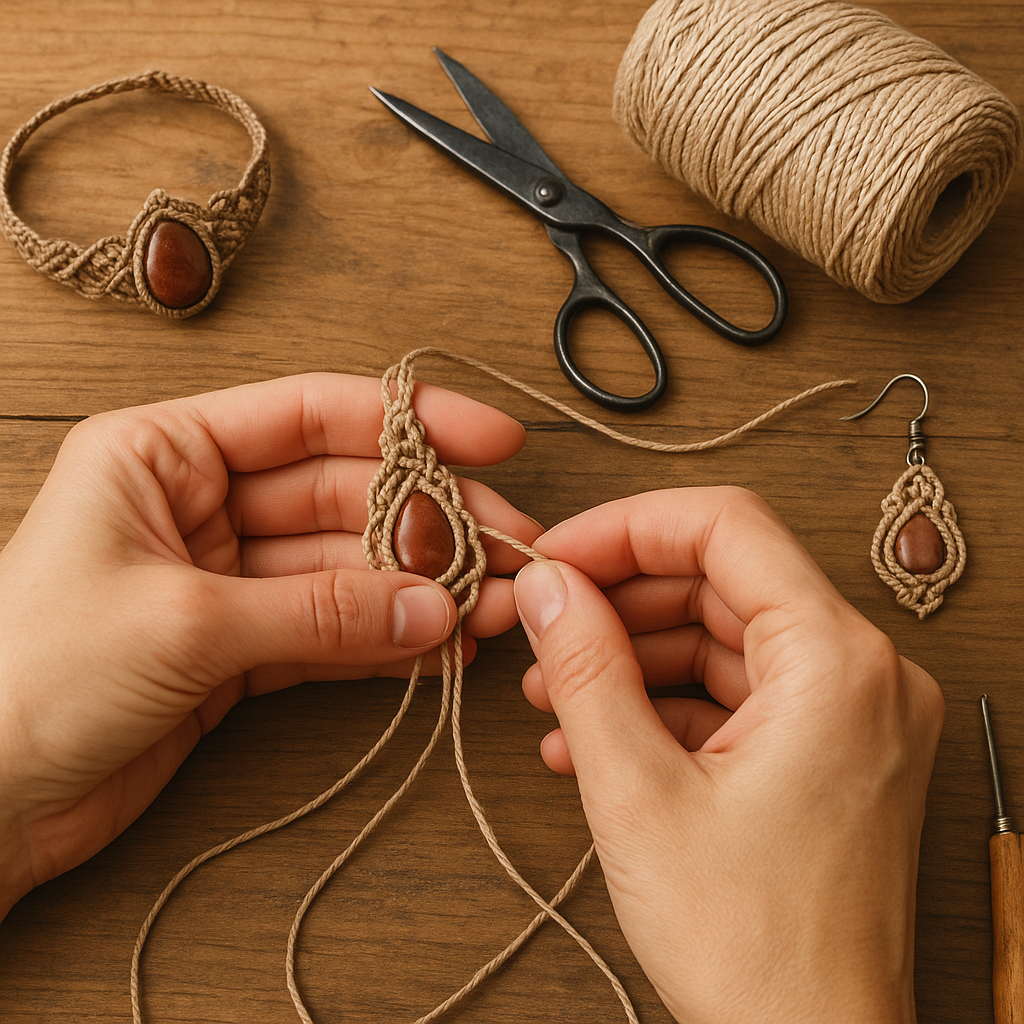
Macramé jewelry turns simple cords into wearable art, inviting beginners to slow down, learn a few dependable knots, and watch patterns bloom under their fingers. Unlike metalwork or lampwork, this craft travels light: a board, a handful of pins, a cord you enjoy touching, and your willingness to experiment. Its roots reach across cultures and centuries, yet the results can look as modern as your favorite minimalist outfit or as lush and bohemian as a festival stage. This guide walks you from first loop to confident projects, demystifying cord choices, bead pairing, closures, and the rhythms that make each piece feel personal. With a small toolkit and a curious mind, you can craft bracelets, necklaces, earrings, and more that celebrate color, texture, and the human hand.
What Makes Macramé Jewelry Unique
Jewelry made from knotting techniques sits at the sweet spot between mindfulness and everyday utility. The repetitive motions encourage focus and calm, while finished pieces are immediately wearable and giftable. You can create fine, micro‑scale lacework with 0.4–0.8 mm cords or sturdy statement strands with 1.2–2 mm cords. You’re not bound by a single style either—sleek geometric chokers, beaded wrap bracelets, leaf pendants, chevron earrings, and anklets all come from the same small family of moves.
Another advantage is accessibility. You can start with inexpensive cotton or nylon and a clipboard; upgrade later to linen, silk, or recycled polyester. The craft also rewards thrift and sustainability—many makers salvage beads from broken necklaces or use offcuts for tassels and spacers. Portability is a delight: slide a small kit in your bag and tie a few rows while waiting for a bus or sipping tea with a friend.
Above all, the appeal lies in your hands’ signature. Even with a written pattern, two people never knot exactly the same. Your natural rhythm, preferred cord, and eye for balance leave a recognizable mark that makes handmade macramé feel warm, intimate, and collectable.
Essential Tools and Materials
Start simple and upgrade with experience. A few well-chosen items will carry you far, and none need to be expensive. Select tools that feel good in your hands and resist tangling.
Core Toolkit
- Board or base: cork board, foam board, a macramé board with grid, or even a firm pillow. You’ll pin cords into it to stabilize your work.
- Pins and clips: T‑pins or sewing pins for holding cord paths steady; binder clips for securing bundles; a simple clipboard also works.
- Measuring: soft tape measure, ruler, and a small notebook for recording cord lengths and project sizes.
- Cord management: bobbins or small clips to keep long cords from tangling; straws or paper tubes can serve as improvised bobbins.
- Cutting and sealing: sharp scissors; a lighter or thread zapper for melting synthetic cord ends; seam sealant or craft glue for natural fibers.
- Optional extras: beading needles (collapsible eye needles are great), tweezers for guiding tight passes, and a small awl to widen curves.
Cord Choices
The cord determines your jewelry’s feel and look. For micro‑macramé beginners, try 0.5–1 mm nylon, polyester, or waxed cotton; they hold shape well and fit most bead holes. Natural cotton is soft and skin‑friendly, ideal for bracelets; nylon is slick and strong for crisp knot definition; polyester resists UV and water; linen and silk bring subtle luster but can be pricier. Start neutral (cream, black, gray) plus one accent color to simplify planning.
Beads and Findings
Choose bead holes that match your cord. Glass seed beads (sizes 6/0, 8/0), metal spacers, lava stone, wood, and gemstone chips all work; just test passage on a scrap cord first. For findings, keep a small assortment: buttons, toggles, lobster clasps, cord ends, crimp covers, and jump rings. You can also avoid metal completely by knotting integrated loops and sliding closures.
Adhesives and Sealants
- For natural cords: flexible fabric glue or a small dab of clear craft glue on trimmed ends.
- For synthetics: careful heat sealing with a lighter or thread burner; touch briefly and roll while warm for a neat cap.
- For strength points (clasps, beads under tension): a tiny dot of glue inside the knot can add reassurance without stiffening the whole piece.
Before investing heavily, sample a few options. Touch is vital: cords should feel pleasant against skin and respond predictably. Your evolving preferences will define your personal kit of materials.
Core Knots and Techniques for Beginners
Macramé relies on a compact vocabulary of moves. Learn them in slow, even rows, and nearly any pattern becomes readable. A knotting surface and even lighting help. Keep cords untwisted and practice consistent tension to avoid wavy edges.
Lark’s Head (Cow Hitch)
Purpose: Attach cords to a holding line, ring, or clasp. Fold a working cord in half to find the bight. Place the loop over the anchor, pull tails through from front to back (or back to front) and snug. Variations include reverse lark’s head and mounting on a cord for decorative headers.
Square Knot (SK)
Purpose: The staple of flat work. With two center cords and two working cords, pass the left working cord over the centers and under the right; pass the right under the centers and up through the left loop; tighten. Repeat mirrored for the second half. Stack SKs for stable straps; alternate SKs to form chevrons and diamond windows.
Half Knot and Spiral
Purpose: Twist and texture. Tie only the first half of a square knot repeatedly; the work spirals naturally. Useful for DNA‑look strands, accent columns, and round cords.
Double Half Hitch (DHH)
Purpose: Draw lines. Anchor cords and tie two half hitches around a holding cord to create precise horizontal or diagonal rails. DHH forms outlines for leaves, arrows, waves, and geometric panels.
Gathering/Wrap Knot
Purpose: Finish bundles neatly. Lay a short loop along the bundle, wrap a long tail several turns, pass the end through the loop, and pull the hidden tail to snug the wrap inside. Trim both ends close.
Overhand and Button Knots
Purpose: Small beads made of cord or stops before fittings. The Chinese button knot forms a handsome closure; an overhand adds a simple stopper or decorative dot.
Commit these knots to muscle memory. Practice strips—ten rows of SK, then a foot of spiral, then diagonal DHH lines—to calibrate your hands and establish a rhythm that remains steady from start to finish.
Design Foundations for Beautiful Results
Design begins long before you pick up a pair of scissors. Clarify the wearer, occasion, and vibe—delicate, bold, geometric, botanical, or eclectic. Identify a focal point (a gemstone, a knot cluster, a color change), and let everything around it support rather than compete.
Color and Texture
Pair a dominant color with one or two supporting hues. Neutrals help colorful beads pop; matte cord can balance glossy beads. Remember that color changes are also structural choices—splicing mid‑row creates lines; switching cords at anchors feels seamless.
Proportion and Balance
Bracelet width should reflect wrist size and comfort. A 5–8 mm width suits most; wider pieces lean bolder. Keep elements distributed: if a pendant is heavy, counter with a stouter neck cord or split strands to stabilize.
Symmetry vs. Intentional Asymmetry
Most beginner pieces benefit from symmetry: mirrored cords and evenly spaced beads produce a calm, readable pattern. Later, explore asymmetry with an offset focal bead or a single spiral column—just ground the design with consistent spacing so the eye knows where to rest.
Measurement Basics
- Bracelets: add 1–2 cm to wrist circumference for ease; account for clasp length.
- Necklaces: standard choker is 35–41 cm, princess 43–48 cm, matinee 50–61 cm.
- Earrings: test weight and swing; keep each piece light enough for all‑day wear.
Sketch rough diagrams and note the number of cords, starting lengths, and where beads enter. This tiny habit makes repeats and adjustments straightforward and keeps your design intentional.
Three Beginner-Friendly Projects
1) The Everyday Lark’s Head Bracelet
Style: minimalist strap with sliding closure. Time: 30–45 minutes.
- Cut two cords at 80–100 cm each. Anchor both to a clipboard with a temporary knot at one end.
- Mount both onto a jump ring or over a temporary dowel using lark’s head. You’ll now have four tails.
- Tie square knots using the outer cords over two center cords until the strap reaches 2 cm short of final length.
- Flip the work; repeat on the other side if you’re building from a central loop.
- For a sliding closure, overlap tail ends, then tie a 2–3 cm wrap knot around both to create an adjustable sleeve.
- Trim tails to 5–8 mm and seal according to cord type.
Variations: add a few beads at the center, switch to spirals for texture, or alternate square knots and DHH to form chevrons.
2) Beaded Square Knot Friendship Band
Style: colorful and stackable. Time: 60–90 minutes.
- Cut one holding cord at wrist circumference plus 8–10 cm; cut two working cords at 120–150 cm each.
- Attach the holding cord to your board tautly. Fold the working cords in half; mount with lark’s head at the midpoint of the holding cord so you have two working tails on each side.
- Work 1–2 cm of square knots for a stable base.
- Thread a bead onto the holding cord(s), snug to the work. Tie one square knot to lock the bead in place. Repeat, spacing beads as desired.
- End with a bead‑free section for symmetry; finish with a button loop (test with your chosen button) or a sliding wrap closure.
- Glue lightly inside the final knot, trim, and seal.
Tips: choose beads with smooth edges to protect cord, and keep placement consistent for a clean rhythm.
3) Micro‑Leaf Pendant with Diagonal Lines
Style: delicate leaf silhouette on a cord. Time: 90–120 minutes.
- Cut one holding cord at 50–60 cm; mount horizontally on your board.
- Cut six cords at 60–70 cm and attach with lark’s head along the holding cord, centered.
- Use the leftmost cord as a guide; tie double half hitches diagonally downward from center to edge, forming one side of the leaf vein. Mirror on the right.
- Create successive interior lines with DHH, shortening runs to taper the shape. For a central vein, run a vertical DHH line down the middle.
- Finish with a compact wrap knot at the leaf stem; trim tips to a gentle point, sealing them neatly.
- Hang the leaf from a jump ring or tie directly onto a neck cord made of spiral or square knots.
Accent: add a tiny gemstone bead at the stem or a dew‑drop bead near the tip for sparkle.
Finishing, Comfort, and Care
The difference between amateur and polished pieces often lies in closures and edges. A clean end secures your work and increases durability, while a comfortable closure invites daily wear.
Closures
- Sliding wrap: adjustable, metal‑free, ideal for bracelets. Ensure the sleeve slides smoothly but grips when tugged.
- Button and loop: select a flat button or bead; make the loop snug to prevent accidental opening.
- Metal findings: fold cord ends into end caps with a pea‑sized glue dot; crimp gently to avoid cutting fibers.
Edge Management
For synthetics, melt ends lightly and roll between fingertips to round. For cotton or hemp, dab glue on trimmed ends and allow to dry fully. Consider tassels or decorative overhand knots to hide cut ends artistically.
Comfort and Wearability
Check that no metal edges or melted nubs contact skin. Keep heavy beads near the center of gravity to reduce flipping. Sand or file any rough metal parts. When in doubt, wear‑test for a day before gifting.
Care
- Wipe with a damp cloth; avoid soaking unless cord is colorfast.
- Lay flat to dry; shape while damp to retain form.
- Store flat or hung to prevent kinks; keep away from perfumes and hairspray that can weaken fibers.
Finishing is an art in itself; a few extra minutes on closures and edge clean‑up make your finishing feel confident and professional.
Troubleshooting and Quality Checklist
Mistakes happen while learning. The key is spotting patterns and correcting early so you don’t carry problems through the piece.
- Uneven width or wavy edges: your tension varies. Slow down; snug each knot to the same reference point (e.g., the pin just above the row). Use a ruler across the width to check consistency every few rows.
- Twist when you wanted flat: you likely tied only one half of the square knot repeatedly. Add alternating halves to stabilize.
- Curling: too tight on one side. Mirror your hand motions and switch the lead side periodically.
- Short cords: pre‑measure generously (3–6× final length depending on knot density). If short, splice in with an overlap and a hidden wrap knot near the back.
- Beads sliding: lock each bead with a knot immediately after seating it; for large‑holed beads, add small stopper beads.
- Fraying: seal promptly after trimming; for natural fibers, twist the strand before cutting to minimize fuzz.
Quality pass before gifting: check knot security, closure function, edge neatness, bead stability, and comfort against skin and hair (earrings and necklaces should not snag).
Going Further: Styles, Influences, and Sustainability
Once basics feel familiar, explore variations. Micro‑macramé can resemble lace, pairing 0.4–0.6 mm cords with tiny seed beads. Shamballa‑inspired bracelets spotlight a row of focal beads locked by square knots. Geometric chokers can map out triangles and diamonds with DHH rails. Bohemian sets mix wood, brass, and tassels; minimalist looks stick to thin cords, negative space, and subtle color shifts.
Draw inspiration from traditional knotting cultures—from Moroccan fringe patterns to Chinese decorative knots—and adapt respectfully. Keep notes on sources and techniques you emulate.
Consider eco‑friendly choices: recycled polyester cords from bottles, plant‑dyed cotton, reclaimed beads from vintage strands, and minimal‑plastic packaging. Sustainability adds story and purpose to your work.
From Hobby to Gifts or a Small Side Business
Handmade jewelry makes personal, memorable gifts, and a small series of repeatable designs can seed a micro‑brand. Build a simple collection: one classic bracelet, one pendant, and one pair of earrings in two or three colorways. Name pieces, write concise care notes, and price fairly—covering time, materials, overhead, and a profit margin.
- Photography: natural light near a window, neutral background, a close‑up of knots, and a wearable context shot.
- Packaging: soft pouches or recycled cardboard boxes; include a size and material card.
- Sales channels: local markets, small boutiques, or online platforms. Keep a repair policy; it builds trust.
- Brand voice: highlight handwork, durability, and the calm, tactile pleasure of your pieces.
Most importantly, craft a positive customer experience: responsive communication, clear timelines, and thoughtful presentation. Word of mouth grows from consistent quality and kindness.
A Beginner’s Practice Plan
Skill blooms from deliberate, enjoyable repetition. This plan builds range and confidence while keeping sessions short.
- Week 1: daily 15‑minute drills—10 square knots, 10 spirals, a diagonal DHH line. Note how many rows equal 1 cm in your preferred cord.
- Week 2: one bracelet with a sliding closure; focus on even widths and clean ends.
- Week 3: introduce beads—place one bead every two square knots, then every four; observe rhythm and spacing.
- Week 4: a pendant with a focal bead or leaf silhouette; experiment with asymmetry gently.
Use a small notebook as a studio log: cord types, bead sizes, starting lengths, and outcomes. This record quickly becomes your personal reference and reduces guesswork the next time you cut cords for a project. Make space for playful creativity: try a new color you wouldn’t normally pick, flip the orientation of a motif, or scale a bracelet pattern up into a choker. Consistent practice builds fluency; fluency frees you to improvise.
Mini Glossary
- Anchor/Holding cord: the cord that others tie around; defines lines in DHH work.
- Working cords: the cords doing the wrapping or knotting.
- Bight: the U‑shaped loop formed when folding a cord.
- Covering cord: the cord wrapping around a bundle in a gathering/ wrap knot.
- Gauge: the thickness of cord; affects bead compatibility and knot scale.
- Finish: the method used to end and secure cords—glue, melt, or wrap.
Mindset and Next Steps
View each piece as a conversation between hands and fiber. Small variations are part of the charm; perfection is less important than coherence and comfort. Test wear, observe how knots settle over a day, and refine your closures. Share your work, ask questions, and collaborate—macramé communities are generous with tips and encouragement. Whether you seek meditation, adornment, or a simple revenue stream, macramé rewards patience with tangible beauty. Master a few moves, keep tension steady, and let your sense of pattern lead. Over time, you’ll develop a recognizable voice in fiber that speaks through macramé—a voice built on structure, intention, and the quiet pleasure of making by hand.
