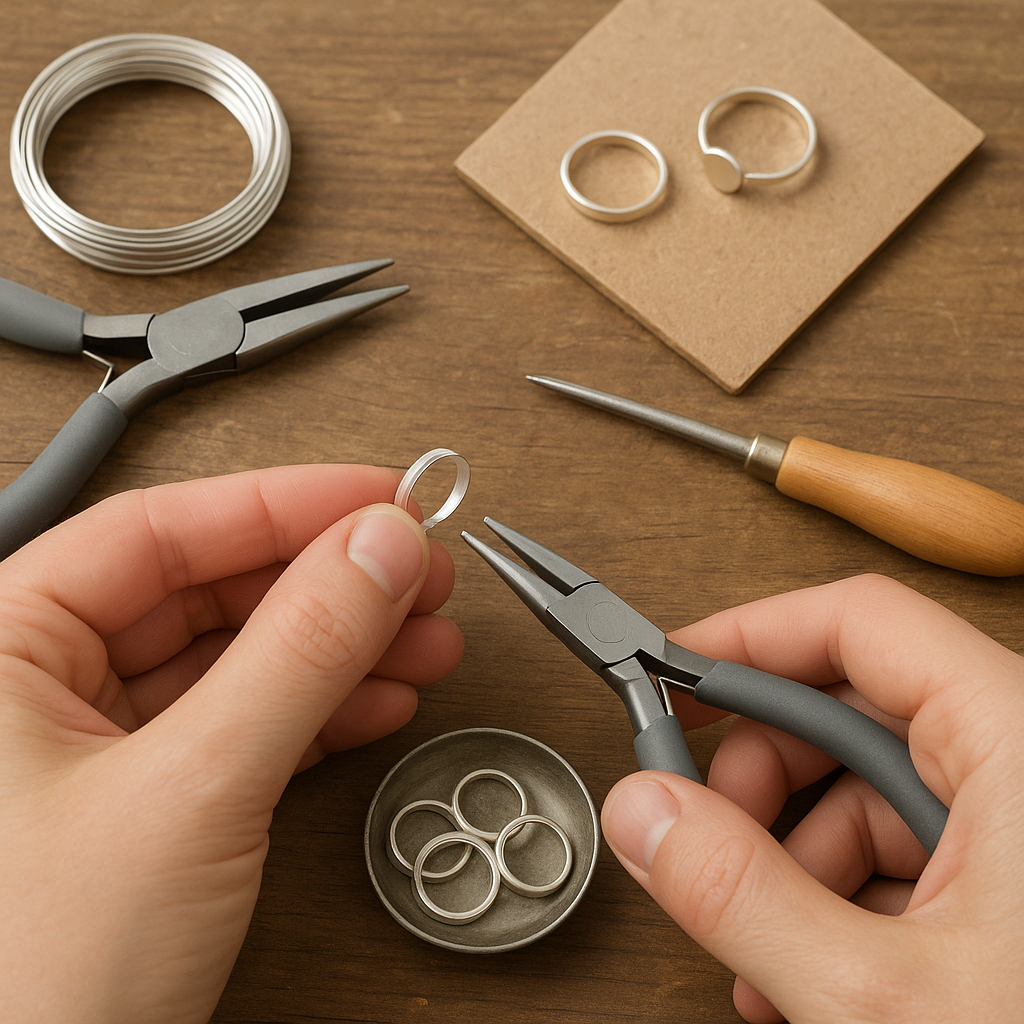
Few handmade objects offer as much satisfaction for such a small investment of time and materials as an adjustable ring. It’s a pocket-sized project that teaches proportion, texture, color, and metal behavior while yielding something personal and wearable. Because the band can gently open or close to fit different fingers, a single design can be gifted without guessing sizes, sold without complex inventory, or swapped between hands to suit the day. The following guide gathers approachable, workshop-tested techniques you can practice at a kitchen table or a shared studio bench—methods that emphasize resourcefulness, creative choices, and the confidence that comes from making something sturdy and beautiful with your own hands.
Why adjustable rings are a maker’s secret weapon
An adjustable ring solves a problem that intimidates many beginners: sizing. Traditional bands demand precise measurement; a quarter size off can make the difference between a tight squeeze and a ring that spins. Adjustable designs reduce that pressure. You can focus on balance, materials, and finish, then fine-tune the fit by gently opening or closing the band. For craft sellers, adjustable rings reduce returns and simplify booth conversations. For gift-givers, they lessen the risk of guessing wrong. And for daily wearers, the ring can adapt to seasonal changes, temperature, and slight swelling—benefits that make adjustability more than a convenience; it’s part of the design intelligence.
Beyond practicality, adjustability invites expressive shapes: bypass bands that swoop past one another, spirals that look kinetic, open shanks that stage stones or beads in a minimal frame. Each style can be textured, darkened, polished, or combined with fiber and wood accents, turning a simple loop into a tiny sculpture that feels alive on the hand.
Essential tools and materials for handcrafting adjustable rings
You do not need a full metalsmithing shop to begin. Start with a small kit; upgrade only if the craft draws you in. A few carefully chosen tools will carry you far and help you work safely.
- Bending and shaping: ring mandrel (metal preferred, wood acceptable), stepped ring cone, round-nose pliers, flat-nose pliers.
- Cutting and trimming: flush cutters for soft metals; jeweler’s saw for sheet; craft knife for pattern templates.
- Smoothing: needle files, sandpaper (400–2000 grit), polishing cloths.
- Texturing: ball-peen hammer, cross-peen hammer, stamps; a leather or rubber bench block to manage noise and rebound.
- Measuring: calipers or ruler, fine-tip marker, ring sizer set (optional), paper sizing strip.
- Holding and safety: bench pin, third hand or clamp, eye protection, dust mask for sanding, finger tape to prevent nicks.
- Finishes: microcrystalline wax, renaissance wax, clear lacquer or jewelry sealant, optional liver of sulfur for darkening.
Materials worth trying include copper, brass, aluminum, and sterling silver. For vegan or mixed-media projects, consider paper cord stiffened with varnish, hand-dyed cotton thread wrapped onto a metal core, or wood veneers laminated onto a flexible band. If you prefer soft starts, aluminum and dead-soft copper are forgiving, shaping easily around tools. Sterling silver offers a sweet spot between ease and longevity. Avoid plating for rings intended for daily wear—plating is thin and wears faster on high-contact surfaces.
Technique 1: No-solder wire-wrapped adjustable ring
This is a classic beginner’s project. It uses minimal tools, avoids heat, and can be adapted endlessly. The band’s flexibility comes from overlapping ends that cross beneath the finger or wrap around a focal bead. The result is strong but kind to skin, especially if you carefully tuck and smooth all cut ends.
Materials and preparation
- Metal wire: 18–20 gauge (1.0–0.8 mm) for a single-band look; 16 gauge (1.3 mm) for a bolder band; 22–24 gauge for wrapping details.
- Optional beads: smooth rondelles or ovals; avoid sharp edges that might fray wrap wires.
- Polishing cloth, fine files, sandpaper.
Steps
- Cut 20–25 cm of your main wire. Deburr both ends with a file so they taper softly.
- Mark the center of the wire with a fine marker. If adding a bead, slide it to the mark.
- Place the marked section on the mandrel one to two sizes larger than your target size to account for spring-back. Wrap both ends around until they cross under the bead or form a clean overlap.
- Switch to flat-nose pliers and coax the ends into a sleek path that hugs the band. Avoid kinks by making small, deliberate bends.
- For a wrapped center, take a finer gauge wire and coil three to five neat turns around the band beneath the focal point. Snug the coil with pliers and trim flush. Smooth with a file.
- Test fit. If too tight, nudge the band up the mandrel; if too loose, slide down and compress slightly. The open overlap grants adjustment range of about one full size either way.
- Finish by smoothing all cut points, then burnish with a polishing cloth. Add wax or sealant if working with copper or brass to slow coloration on skin.
Why it works
The strength of this design comes from continuous fiber-like curves—no sharp corners to concentrate stress. The overlap acts like a spring, allowing incremental adjustments without fatiguing the metal rapidly. If the ring seems too flexible, shift to a heavier gauge or double the band by wrapping the wire around the mandrel twice before forming the overlap.
Technique 2: Sheet-metal open-shank band
An open-shank band looks sleek and modern. The ring begins as a rectangle of sheet metal, then becomes a cuff-like loop with a narrow gap. The edges near the gap can be rounded, flared, or adorned with stamping. This technique introduces two big ideas—softening metal for shaping and then strengthening it for wear.
Cutting and smoothing
- Start with 0.8–1.0 mm sheet for copper or brass; sterling can be a bit thinner. Cut a strip 6–10 mm wide and 55–65 mm long for most adult sizes.
- Round the corners at both ends into gentle ovals, using a file or sanding block. This protects skin and fabric during adjustments.
- Draw a centerline lightly to guide texturing or stamping, if desired.
Shaping the curve
- Place the strip against the mandrel and use a mallet to curve it gradually. Work from the middle outward to avoid creating a kink near the opening.
- Leave a 3–6 mm gap; this is your adjustable zone. Wider gaps give more range, narrower gaps look minimal.
Metal behavior in brief
As you bend and texture, the metal hardens. Gentle heat can soften metal, a process known as annealing, while continued hammering stiffens it through work-hardening. For a beginner-friendly, no-flame approach, keep bends gradual and avoid overworking the same spot; most non-ferrous sheets will shape cleanly without heat if you move deliberately. When the ring is at its final form, reinforce the band with light tap-tap hammering around the circumference on a steel block. These small strikes lock in the curve and improve spring.
Edge finishing, textures, and gap detailing
- File edges smooth, then sand progressively to at least 600 grit for silk-like feel.
- Texture options: light peen for sparkle, cross-peen for linear grain, stamping for dots or triangles. Always texture before final sizing so the ring can still be adjusted.
- Flare the gap ends slightly outward with round-nose pliers to improve comfort and prevent pinching.
Technique 3: Bypass, spiral, and coil designs
These open forms are visually dynamic and exceptionally forgiving for sizing. They excel as stacking pieces and invite mixed metals or color accents.
Bypass ring
Cut and smooth a strip as in Technique 2 but taper both ends into leaf-like points. Curve the strip until the tapered ends sweep past each other on top of the finger. The length of overlap and the stiffness of the metal define your sizing range. A light texture helps disguise small scratches from daily wear.
Spiral ring
Start from round wire or a narrow strip. Form a coil whose inner turn sits under the finger and outer turn displays on top. Coat the inside with wax to reduce friction when adjusting. Spirals offer excellent range but require careful smoothing—any roughness is amplified as the coil slides during adjustments.
Double-coil stacker
Two thin spirals, one in brass and one in copper, interlock as you wrap them on the mandrel. The interplay of colors and lines makes a lightweight, adjustable set that can be worn on different fingers depending on mood.
Technique 4: Stone accents without heat—tabs, baskets, and snap-on elements
Rings become irresistible when they carry a piece of color: a cabochon, sea glass, wood disc, or ceramic button. Traditional stone-setting often uses soldering, but adjustable rings can host cold-connected mounts that avoid heat entirely.
Tabbed settings
- Cut a small oval or circle from 0.5–0.8 mm sheet. Create four to six small tabs around the perimeter like petals.
- Shape the base to fit your stone; sand all edges smooth.
- Attach the base to the ring with a wrap of fine wire or miniature rivets (wire peened through tiny holes). The tabs fold up and over the stone’s edges to capture it.
Basket wraps
For beads with holes, create a “basket” with fine wire: cross two lengths to form a plus sign, set the bead in the center, then bring ends up and around to cradle it. Lash the basket to your band with neat, compact coils. This approach adds volume without much weight.
Modular toppers
Consider a snap-on disc with a soft leather lining that grips the band. Change toppers to match outfits or seasons. Keep the gripping mechanism gentle to preserve the band’s surface.
Sizing, measuring, and ergonomic fit
Even adjustable rings benefit from intentional sizing. Start a size larger than you think you’ll need—most materials spring back slightly after forming. When designing for a market, aim for a base size close to 7 US (54 EU) with a plus/minus one size adjustability range. For wider bands, compensate by forming slightly larger; width increases contact area and can make rings feel tighter.
- Knuckle vs. seat: measure the knuckle and the place where the ring sits. Adjustable rings glide over the knuckle and settle into the seat; design with this difference in mind.
- Openings: flare the ends outward; this prevents digging into adjacent fingers when the ring flexes.
- Stacking: if two adjustable rings will be stacked, keep one minimal and the other sculptural so they nest without clashing.
Textures, color, and finishes that age gracefully
Finishing decisions influence both beauty and maintenance. A glossy mirror can be stunning but shows every scuff; a textured satin can hide months of enthusiastic wear. Decide how the ring should evolve on the hand, then choose a finish to support that story.
Texturing options
- Planish lightly to tighten the grain and add sparkle.
- Use a sandpaper progression to reach a gentle satin that camouflages small marks.
- Stamp patterns along only one edge to create visual rhythm and guide the eye around the open gap.
Adding depth with color
Copper and brass accept controlled darkening beautifully. A classic method uses an oxidizing bath to create a warm gray to near-black finish, often called a patina. After darkening, rub the high points to reveal highlights, letting shadows remain in recesses and textures. Seal with wax or lacquer to slow change, or leave unsealed if you want the piece to develop a living surface that reflects its time on the hand. Sterling silver can be darkened similarly, then brightened selectively for contrast.
Metal care, skin safety, and comfort in daily wear
Rings touch skin constantly; make choices that balance durability and skin friendliness. Some people react to brass or copper; sealing with microcrystalline wax or clear polish, and keeping the interior smooth, helps. If a wearer is sensitive, line the inside of the band with a thin strip of sterling or apply a jewelry-grade barrier lacquer. Smooth transitions and softened edges are crucial for everyday comfort and to prevent snagging fabrics.
Troubleshooting common issues
- Band loses spring: the metal was over-bent in one spot. Evenly re-form on the mandrel, then gently planish the full circumference to restore resilience.
- Ends bite adjacent fingers: flare the tips outward and increase the gap slightly; soften edges more thoroughly.
- Stone wiggles in a tabbed setting: shorten or add tabs; refine the base so it hugs the stone’s curve; tighten the lash wire.
- Uneven texture: re-anneal if using heat-capable setups, then re-texture with lighter, consistent strikes; otherwise, switch to uniform satin finishing to reset the surface.
- Visible file marks: step back to a coarser grit to even the surface, then climb through progressively finer grits without skipping steps.
Understanding durability without overbuilding
An adjustable ring must flex, but only a little. Overly thick bands fight adjustment and can crack if forced; overly thin bands bend too easily and deform. Find your sweet spot by making test strips at different widths and thicknesses. Light planishing strengthens without adding mass; generous edge smoothing reduces stress risers that can lead to cracks over time. If you routinely add heavier stones, step up the core material or widen the band under the stone to distribute load.
Design variations to keep the workbench inspiring
- Negative space: cut or drill windows in a sheet band; the interplay of shadow and skin becomes part of the design.
- Braided or twisted bands: twist two or three wires together for texture, then form the open shank. Twists catch light in a lively way.
- Fiber inlay: carve a shallow channel in a wood veneer cap and inlay colored thread sealed with varnish, then mount to a metal band.
- Kinetic charm: attach a small, freely moving disc or bead near the gap; ensure it does not pinch.
- Seasonal toppers: make a family of snap-on fronts—pressed flower resin cabochon for spring, enamel disc for summer, oxidized leaf for fall, hammered star for winter.
Ergonomics: the small choices that make rings feel “just right”
Great rings disappear until you admire them. That vanishing act comes from invisible details: rounded inner edges, smooth transitions, balanced weight, and a band that flexes in a controlled way. Consider finger anatomy—the soft pad under the finger appreciates a slightly flatter curve, while the top can carry height and drama. Keep any protrusion (stones or elements) anchored low and close so it doesn’t snag pockets or gloves.
Sustainability and ethical material choices
Handicraft is uniquely positioned to model thoughtful consumption. Source metals from recycled suppliers, reuse scrap by melting or riveting into new pieces, and design with replaceable elements so wearers repair rather than discard. Avoid excessive packaging; include a small polishing cloth and a note on care instead. If selling, be transparent about alloys and finishes. A small card that says “recycled copper, sealed interior” builds trust.
From hobby to booth: presenting adjustable rings for sale or gifting
Adjustable rings thrive in markets and gift boxes because they remove the barrier of size. Display them on a range of mandrel sizes so browsers can try different fits. Provide a gentle-adjustment card: “Open or close near the gap using both hands. Do not twist.” Offer a few price tiers—minimal bands at an entry price, stone-accented pieces mid-range, and intricate mixed-media designs at a premium. Keep finish options consistent so customers can imagine building a collection.
Safe adjustments for the wearer
Teach recipients how to adjust: support the band with one hand, press the other side near the opening with the thumb to open or close. Small changes are better than big moves. Avoid torquing across the band; this can introduce a twist that weakens the piece. If a ring is frequently adjusted for multiple wearers, consider a wider gap and thicker material to handle repeated cycles with grace.
Beyond basics: when to add heat and when to stay cold
Many makers eventually explore torch techniques to expand design freedom—joining elements, creating closed bezels, or fusing bimetal. Heat allows permanent joins and neat seams, but adjustable designs still benefit from restraint: keep the adjustment zone free of joins, and reinforce adjacent areas instead. For stone settings, a classic bezel built with soldered wire walls around a cabochon looks refined; for beginners, cold tabs and snap-ons remain excellent alternatives. If you do heat, quench and clean thoroughly, and plan to burnish the interior surfaces for comfort.
Practice plans to build skill quickly
- Week 1: Make three wire wrap rings using different gauges; note how they feel and adjust.
- Week 2: Create two open-shank sheet bands at different widths; texture one, satin-finish the other.
- Week 3: Build a bypass design and a spiral; compare adjustment range and stability.
- Week 4: Add a cold-set stone with tabs; iterate tab size and count until the stone is secure without bulk.
Document each experiment with photos and short notes: where the ring flexes, how the finish changes with wear, and which edge profiles feel best. This log becomes your personal reference, shaving months off the learning curve.
Care and maintenance for long-lived pieces
Encourage periodic checks: are edges still smooth, are coils snug, does the opening remain even? Clean gently with mild soap and a soft brush, dry thoroughly, and refresh wax or sealant as needed. Store rings individually to prevent abrasion. For copper and brass, regular polishing restores glow; many wearers love the mellow tones that develop naturally.
Putting it all together: a repeatable workflow
- Sketch: decide on silhouette, gap placement, and texture.
- Cut and prep: measure carefully, round corners, smooth edges.
- Form: shape on the mandrel, minding spring-back and adjustment range.
- Strengthen: light, even planishing; avoid concentrating force in one spot.
- Adorn: add wraps, tabs, or modular toppers without compromising the opening.
- Finish: texture, darken if desired, polish high points, seal interior.
- Test: adjust small increments, wear for an hour, refine edges again.
A note on confidence and creative voice
Handmade jewelry teaches patience and pays it back with character. The first adjustable ring you complete—however simple—becomes a touchstone for everything to come. You will start to feel how metal moves under the tool, how a planed edge gleams after a few extra passes, and how a small tweak to the gap turns a good ring into one that invites daily wear. As your collection grows, keep one or two prototypes nearby to remind you: ideas do not need permission, just a bench, a few humble tools, and a willingness to iterate.
Glossary of helpful terms
- Anneal: to soften metal for easier shaping using heat (or to avoid excessive strain when working cold).
- Work-harden: to stiffen metal through bending, shaping, and striking.
- Mandrel: a tapered tool used to form and size rings accurately.
- Patina: an intentional surface color change for depth and contrast.
- Planish: smooth and lightly harden by striking with a polished hammer.
Closing encouragement
Adjustable rings reward curiosity. Start with wire and a household dowel if that’s what you have; upgrade to a proper mandrel when you’re ready. Keep your eye on proportion and your hands light. The intersection of technique and imagination is where craft becomes art, and a small band of metal becomes a story you can wear. Whether you gift your rings, sell them, or keep them as a tactile record of your progress, the skills you build—edge control, texture, finish, and fine-tuned fit—will travel with you into every future project.
