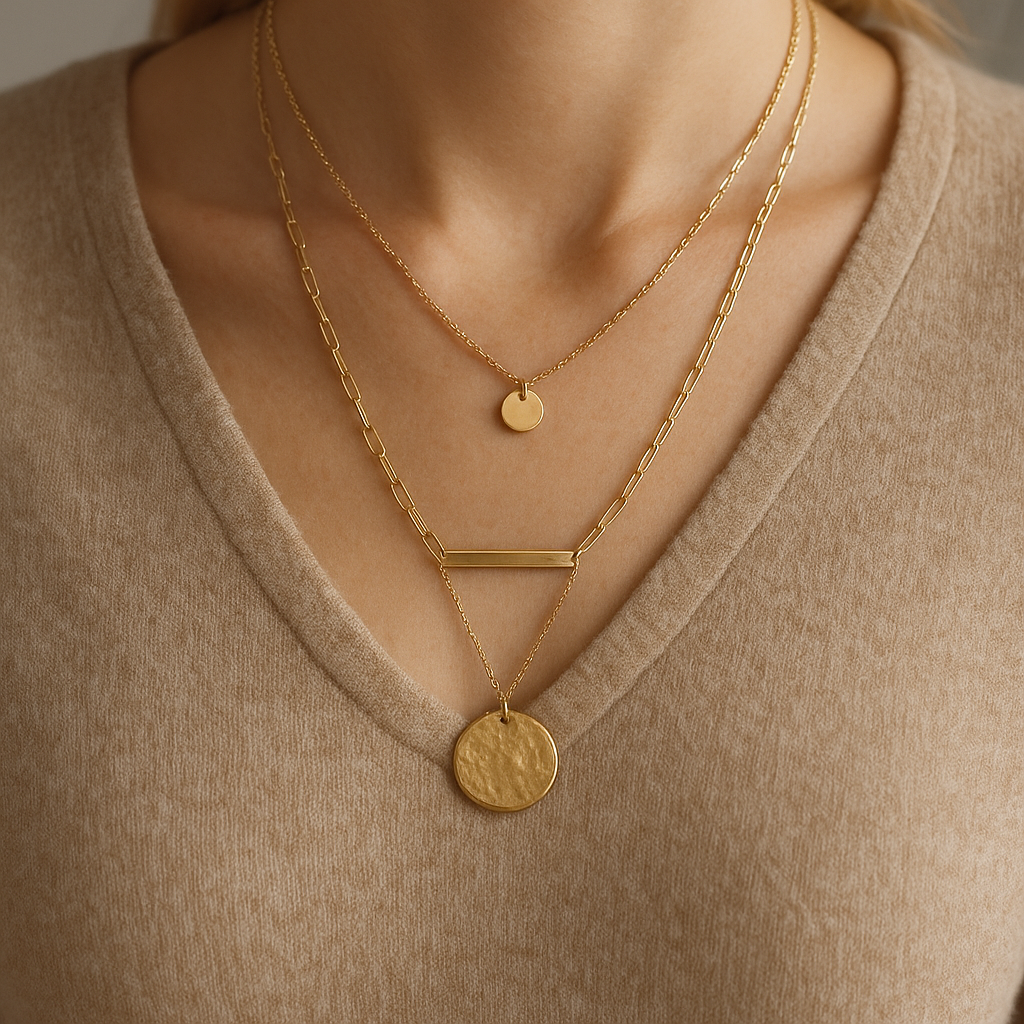
Layered jewelry looks effortless, yet anyone who has tried to wear multiple strands at once knows how quickly the look can devolve into knots. The goal is not only visual harmony but also structural harmony: a set engineered to move with the body without spiraling into chaos. This guide draws on practical handcraft techniques, simple physics, and a bit of design strategy to help you make layered necklaces that actually stay put and feel good to wear.
Understanding Why Layered Necklaces Tangle
Before you reach for pliers, it helps to know what you’re building against. Tangles happen when strands rotate around a common axis (usually your neck), when lengths are too similar, or when surfaces slide against each other too easily. Add hair, collar friction, and head turns, and you have the perfect storm.
Key factors you can control:
- Length differentials: Strands that are too close in length overlap and interlock. Aim for a minimum 2-inch difference between layers; 3–4 inches is safer for three or more layers.
- Mass distribution: Even a tiny pendant acts as a weight that stabilizes a strand. If one necklace has a heavy pendant and the other is feather-light, the lighter one may be pulled along and wrap. Balance the weights across layers.
- Surface texture: Ultra-smooth chains glide and wrap more readily. Mixed textures increase static friction and reduce sliding.
- Shared pivot points: Multiple clasps rubbing at the nape encourage twists. Managing or consolidating connection points can drastically cut rotation.
- Body and garment interaction: High collars push chains forward; open necklines let them fall naturally. Hair can act like a brush, driving rotation as you move.
These principles are the backbone of a layering system that resists motion-induced knots. Think of each strand as part of a mobile that must keep its own path while coexisting with the others.
Tools and Materials You’ll Need
Precision and quality matter. Cheap findings often have burrs that snag fine links or hair.
- Chain nose pliers and round nose pliers
- Flush cutters (fine-tip for delicate chains)
- Ruler or tape measure; optional calipers for bead hole sizing
- Assorted jump rings (1.5–5 mm), preferably soldered for fine chains
- Split rings for high-wear points if you prefer extra security
- Clasp options: lobster, spring ring, magnetic (with safety), multi-strand slide clasp
- Crimp beads and covers; wire guardians (for beaded layers)
- Bead stringing wire (0.012–0.018″), silk or nylon for pearls; beading needles
- Layering connector bar or “anti-tangle” spacer
- Tiny swivels (jewelry-grade or micro fishing swivels) as rotation stoppers
- Files or emery boards to smooth burrs
Choose solid or well-plated metals that wear similarly. Mixing stainless steel with soft brass, for example, can lead to uneven wear. Hypoallergenic options (stainless, titanium, niobium, gold-filled) are ideal for sensitive skin. Selecting the right materials now saves rework later.
Planning the Layered Set
Start on paper or with a mockup on a bust or mirror. Map your lengths to your neckline, face shape, and wardrobe. A well-planned topography of the neck area ensures each strand has its own “lane.”
Length Mapping
- Base increments: 14–15″ choker, 16″ collarbone, 18″ princess, 20–22″ matinee, 24–30″ opera.
- For two layers: 16″ and 20″ is reliable for most necklines.
- For three layers: 15″, 18″, 22″ or 16″, 18.5″, 22″ for smaller frames.
- For four layers: stagger 3–4″ apart and introduce a long anchor (24–30″) to stabilize the whole stack.
Volume and Weight
- Vary chain thickness: a fine base, a medium mid, and a statement bottom helps create stability.
- Add at least one stabilizing pendant. Even 1–3 g of weight focuses the drape.
- Distribute weight: avoid one excessively heavy pendant at the top layer; it will tug and torque others.
Texture Strategy
- Mix textures to increase friction: rolo with cable, faceted satellite with curb, or beaded seed strand with flat cable.
- Avoid stacking multiple ultra-smooth “snake” or herringbone chains; they twist and kink easily.
- Ball and box chains can behave better mid-stack, especially if widths vary.
Anti-Tangle Architecture: How to Build in Stability
Architecture is as important as aesthetics. The following features prevent rotation and keep paths separate.
Consolidate or Control the Clasp Zone
- Use a multi-strand slide clasp to turn several layers into one necklace. All strands fasten to a single hardware piece, so they move together.
- If you prefer independent necklaces, connect them to a removable layering bar. It acts as a spacer, keeping each clasp parked in its own lane.
- Offset clasps by a few millimeters with different jump ring sizes. This prevents a single bulky cluster at the nape.
Swivel and Glide Control
- Insert a micro swivel between the chain and the clasp for at least the top layer. Swivels neutralize torsion from head turns.
- Use wire guardians with beaded strands so line tension doesn’t saw through crimp points and twist the layout.
Length Locks and Extenders
- Add short extenders (0.5–1″) with multiple jump rings at the end of each strand. This gives you fine control over overlap.
- Use “rail” extenders—two parallel rings joined by bars—if you want to keep two layers in fixed formation.
Surface and Edge Finishing
- Deburr jump rings, especially cut ends. Even a micro burr can snag hair and encourage wraparounds.
- Choose rounded lobster clasps; sharp-shouldered ones act like hooks.
Step-by-Step Build: Single-Clasp Layered Necklace
This method integrates all layers into one controlled system, minimizing rotational chaos and keeping a single closure.
Components
- 1 multi-strand slide clasp (2–4 rows)
- Pre-measured chains or beaded strands in chosen lengths
- Jump rings (soldered recommended for fine chains)
- Optional: tiny swivels, crimp beads, wire guardians
Assembly
- Lay strands in order from shortest to longest. Mark center points with removable tape or binder clips for reference.
- Attach the top (shortest) strand to the top row of the slide clasp using a jump ring. If it’s beaded wire, crimp to a small ring with a wire guardian.
- Attach the next strand to the second row, and so on. Keep a consistent left-right orientation to avoid crossing.
- Test on a bust or mirror. If any two layers kiss or overlap, lengthen the lower one by a single jump ring or shorten the upper by swapping a ring for a smaller size.
- Optionally add a swivel between the final jump ring and the clasp for the top layer.
- Close the slide clasp and gently tug each strand to check for elastic give or slack spots. Adjust crimps and ring sizes as needed.
The result is a coordinated set with one clasp, less bulk at the nape, and predictable drape. This setup is the most reliably tangle-free for everyday wear.
Step-by-Step Build: Independent Necklaces with a Layering Adapter
Prefer to keep each necklace separate for versatile wear? Use a removable adapter to align them only when you want to layer.
Components
- 2–4 separate necklaces with their own clasps
- Layering adapter bar with multiple attachment points
- Optional: micro swivels on the topmost one or two pieces
Assembly and Wearing
- Clip each necklace’s clasp to its own eye on the adapter bar. This spreads the clasps across a wider area so they don’t pile up.
- Put the adapter on like a single clasp. Strands hang from their lanes and resist crossovers.
- To wear a necklace solo, detach it from the adapter and use its own clasp as usual.
Adapters are excellent if you rotate pieces often. They also let you ignore length differentials sometimes, because the spacer effect reduces conflict.
Choosing Chains and Beads That Behave
Not all chains are equal in a layered environment. Choose link shapes and textures that discourage clinging.
- Good mixers: cable, rolo, curb, figaro, satellite (with spacers), and box chains.
- Handle with care: snake and herringbone. They’re sleek and beautiful, but they kink and embrace neighbors. If you must include one, place it as the longest or single standalone layer.
- Beaded strands: matte or faceted beads increase surface friction, helping keep lanes distinct. Micro pearls with knotting between beads are especially stable.
- Seed bead strands add color “rails” that lightly grip neighboring chains without matting.
A simple rule: blend at least one textured element with one smooth. The textural contrast improves balance and movement control.
Designing With Pendants and Focal Elements
Pendants are more than decoration; they are stabilizers. The right weight can turn a flighty chain into a well-behaved layer.
- Weight wisely: 1–5 g is enough for most mid layers; heavy medallions belong at the bottom.
- Shape matters: flat coins flip; dimensional drops tend to hang true.
- Bails and connectors: a generous, polished bail reduces squeaks and twists. Consider a hidden bail that aligns with chain geometry.
- Asymmetry is your friend: a small off-center charm can counter-rotate a layer that wants to roll.
Micro-Adjustments: The Art of Drape Control
After the first fitting, tiny tweaks make the difference between “good” and “unflappable.”
- Jump ring shims: use different wire gauges and diameters to adjust by 1–3 mm without obvious visual change.
- Mini extenders: a two-link extender behind the neck is a powerful fine-tuner.
- Hidden anchors: sew a small thread loop inside a collar and hook a strand to it with a safety pin or jewelry clip when you need extra stability for a specific outfit.
- Matte vs polished: swapping one polished ring for a matte or hammered ring subtly increases friction where it matters.
Finishing Techniques That Prevent Problems
- Close jump rings fully; gaps are tangle magnets. With fine chains, consider soldered rings.
- Use crimp covers for a smooth, rounded finish that won’t catch hair or thread.
- Test every contact point for snags by dragging a small piece of silk or fine cotton over it. If it snags the fabric, it will snag hair.
- Polish with a gentle cloth to reduce microscopic burrs. A quick buff reduces long-term hitching.
Wearing Tips That Extend the Anti-Tangle Design
- Put on layers in order from shortest to longest. This nests them correctly from the start.
- After clasping, lift the hair away and give each layer a small outward tug at center. This seats them in their lanes.
- Pair with the right necklines: V-necks and scoops complement multi-layer arcs; high crewnecks can bunch strands unless anchored.
- During the day, reset with one quick motion: hold all pendants together, pull forward gently, and release separately.
Care, Cleaning, and Smart Storage
Good habits keep your set performing. A well-designed piece can still tangle in a drawer. Invest a minute in routine care and storage.
- Hanging boards: keep layered sets on a single hook or card so the spacing stays familiar.
- Travel trick: thread each chain through its own drinking straw or silicone tube; clasp it. Pack all in a small pouch.
- Card method: tape or slit a card with parallel slots and park each strand in its own slot. Fold the card and bag it.
- Avoid tossing with bracelets or earrings; mixed hardware creates micro-knots.
- Wipe after wear to remove oils that increase slip and attract grit.
Cleaning varies by metal: use mild soap and water for most plated pieces, and a polishing cloth for sterling. Avoid harsh dips on glued stones and silk-knotted beads.
Troubleshooting: When Tangles Happen Anyway
Even the best system occasionally needs rescue. Here’s how to untangle without tears.
- Lubricate: a drop of baby oil or unscented lotion reduces friction. Massage gently.
- Two-pin method: place the knot on a flat surface, insert two fine needles or safety pins, and tease the knot apart by alternating tiny wiggles.
- Plastic bag trick: place the knot inside a zip bag and work through the plastic to keep tiny links visible and contained.
- Rinse and reset: wash off lubricant with mild soap, dry thoroughly, then polish and hang to restore drape memory.
- Recurring trouble layer: if one strand always misbehaves, add a small pendant for weight, swap to a higher-texture chain, or shorten/lengthen it by 0.5″.
Design Variations You Can Try
- Minimalist trio: 16″ fine cable, 18.5″ satellite, 22″ box with micro bar pendant at 22″. Clean, daily, stable.
- Bohemian mix: knotted gemstone strand at 18″, thin figaro at 20.5″ with medallion, 26″ rolo with horn. Textures prevent clinging.
- Monochrome metal study: matte, satin, and high-polish finishes in the same metal family to vary behavior without color clash.
- Birthstone stack: tiny bezel charms distributed across layers to balance weight and reduce rotation.
Upcycling and Sustainability
Layering is a perfect way to revive old jewelry. Combine vintage chains with modern findings, but standardize metals where possible to avoid galvanic wear. Replace worn plating with gold-filled or sterling components at high-contact points (clasps, jump rings). Salvage stones into new pendants to act as stabilizers. Handcraft thrives on reinvention, and a thoughtful rebuild can extend the life of sentimental pieces for decades.
Allergy and Comfort Considerations
Skin comfort affects movement. Irritated skin encourages fidgeting, and fidgeting creates tangles.
- Use hypoallergenic metals for nape-area hardware: stainless, titanium, niobium, or gold-filled.
- Seal raw brass or copper with jewelry-safe lacquer to reduce greenish patina transfer.
- Keep edges smooth; swap any scratchy clasp for a rounded one immediately.
Quick Reference Checklist
- Separate lengths by at least 2″ (3–4″ for complex stacks)
- Mix textures to increase friction
- Distribute weight; use pendants as stabilizers
- Consolidate with a slide clasp or use a layering adapter
- Add micro swivels on top layers
- Use extenders and jump ring shims for fine adjustments
- Deburr and polish all contact points
- Put on shortest to longest; seat each strand
- Hang or card for storage; use the straw trick for travel
- Troubleshoot chronic offenders by changing weight, texture, or length
Why This Works: A Handcrafter’s View
What you’re really building is a wearable system with multiple moving parts. The constraints—length differentials, texture contrasts, consolidated connection points, and purposeful mass—channel motion into predictable paths. In practice, that means your necklaces glide instead of grind, settle instead of snare. When you treat the nape as a hub rather than an afterthought, and you give each layer its own lane and purpose, the result is not just pretty—it’s reliable.
With the right materials, smart chain choices, a supportive spacer or adapter, and mindful finishing, you’ll craft layered necklaces that look curated, feel comfortable, and stay remarkably tangle-free from morning to evening. That’s the quiet satisfaction of good handwork: elegance born from small, intentional decisions, held together by an eye for balance and a respect for how adornment actually moves on the body.
