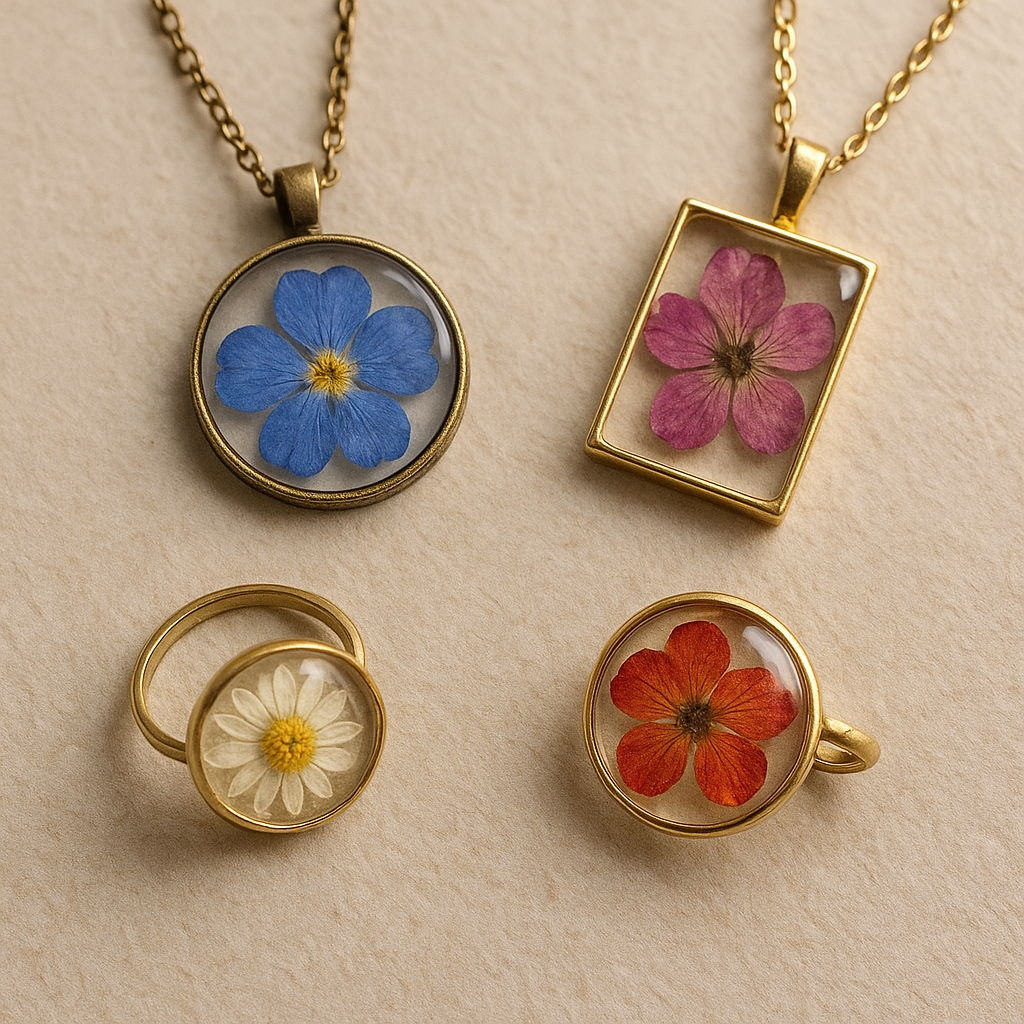
Real blooms have a way of holding seasons in their petals—the warmth of a late-summer dusk, the crispness of spring rain, the quiet hush of winter seedpods. When you translate that fleeting beauty into wearables, you are practicing a form of timekeeping: preserving growth, color, and memory in miniature. Handcrafted jewelry using real flowers invites touch and closeness; it is intimate, tactile, and alive with detail, from a fern’s ribbed veins to the powdery geometry of a poppy’s anthers. The following guide maps the terrain of nature-inspired jewelry, from selecting botanicals and preparing them, to technical methods, design thinking, and care—so that your pieces carry not only petals, but also stories.
Why real flowers belong in jewelry
Flowers carry layers of meaning: personal, ecological, ceremonial. A pendant set with a forget-me-not might commemorate a first garden or a loved one’s favorite pathway; a ring with moss signals patience and place-making. Unlike synthetic motifs, real blooms introduce irregularity—each petal edge and pollen fleck is a one-off. That makes every piece unrepeatable, and that irreproducibility is the heartbeat of fine craftsmanship.
There is also a material intelligence in plants. Even after drying, their forms interact with light in ways plastics cannot: satin reflection on rose petals, glassy translucence on buttercups, suede-like matte on lamb’s ear. When sealed properly, these microtextures remain legible and invite the eye to linger, which in turn expands what jewelry can be: less ornament, more conversation.
Selecting flowers: sourcing, seasonality, and meaning
Good jewelry begins at the garden gate. Choose botanicals for both structure and story. Flat-faced blooms like daisies, violas, and Queen Anne’s lace press cleanly; radiating forms like cosmos and cornflowers maintain shape in silica; thicker specimens (ranunculus, small roses) benefit from partial disassembly before preserving. Tiny volunteers—thyme flowers, alyssum, baby’s breath—are useful for filling negative space.
Seasonality matters. Early spring delivers delicate, thin-petaled forms that cure quickly. Mid-summer provides saturated, sun-fast pigments but also greater humidity risk. Late season offers seedheads, pods, and grasses that translate beautifully into textural contrasts against metal or resin matrices. For narrative work, consider language-of-flowers traditions: yarrow for healing, rosemary for remembrance, clover for luck, fern for sincerity, iris for hope.
Responsible gathering supports sustainability. Forage lightly and legally, avoiding protected species and pesticide-treated areas. Better still, cultivate a small “jeweler’s plot” of reliable performers, and keep records: planting dates, bloom times, pigment stability after drying, and notes on shrinkage. A repeatable horticultural habit becomes part of your studio practice.
Preparing botanicals: cleaning, conditioning, and color care
Preparation sets the stage for lasting color. First, hydrate cut stems in clean water for several hours so petals plump and relax. Then, gently clean surfaces with a soft brush or a misted lint-free cloth to remove dust and insects. Trim away bulky calyxes or damp pith that can brown during curing.
Pigment retention varies. Blues and purples (delphinium, violet) may shift toward magenta as pH changes; yellows (coreopsis, marigold) are usually stable; reds may darken. To minimize color drift, dry quickly and store away from UV before embedding. A light pre-seal with a dedicated botanical fixative can help with delicate petals and pollen; test first to avoid darkening.
Preservation pathways: pressing, silica gel, glycerin, and freeze-drying
Different forms demand different methods. Consider the final silhouette you want, then choose the technique.
- Pressing: Place blooms between absorbent papers under weight or in a ventilated press. Replace papers every 24–48 hours for the first week to prevent moisture buildup. Pressed flowers yield ultrathin profiles ideal for minimal pendants, earrings, and inlay behind glass. Keep petals from overlapping unless you want fused composites.
- Silica gel: Bury flowers in fine silica crystals in an airtight container to desiccate in three to seven days. This keeps more dimensionality than pressing. Use a soft brush to remove crystals afterward. Great for tiny blossoms you want to remain plump.
- Glycerin bath: For leaves and some petals, a glycerin-water solution (typically 1:2) replaces water in plant cells, yielding flexible, long-lived foliage with a subtle luster. Not suitable for all flowers; test on sprigs of eucalyptus, magnolia leaves, or ferns.
- Freeze-drying: Professional equipment sublimates moisture under vacuum, preserving shape and color with minimal shrinkage. Ideal for bridal keepsakes and advanced shops. Proper sealing afterward remains essential.
Store preserved botanicals in labeled, lightproof boxes with desiccant packets. This is your working palette. Over time, you will learn which species retain their lines and saturation best, maturing your material intuition.
Design thinking: form, scale, and color harmony
Treat each flower as an architectural element. Composition begins with silhouette: circles read as soft and devotional; ovals, elegant and elongating; drops, dynamic; irregular free-forms, organic and contemporary. The negative space around a plant can be as eloquent as the plant itself. Consider contrast—lacey Queen Anne’s lace against a deep navy ground, or a solid buttercup floated in clear medium with a line of gold granulation.
Color theory in miniature rewards restraint. Build a limited palette: complementary (violet-yellow), analogous (blue-teal-green), or monochrome (pinks through burgundy). Accent with metallics sparingly so the flowers remain center stage. Balance scale by pairing a statement bloom with micro-florets or seeds, the way a painting anchors a wall and books populate a shelf. When you design sets, echo a motif rather than duplicate it to avoid visual fatigue. All of these choices contribute to your piece’s composition.
Resin work: clarity, casting, and bubble control
Clear casting unlocks suspended botanicals, as if time were a liquid. Choose a jewelry-safe epoxy system with a long open time for deep pours, or a UV-curing formula for speed and thin layers. The key to enduring clarity is careful planning.
- Pre-seal fragile petals: A thin coat of clear artist medium or UV resin brushed onto petals prevents trapped air from outgassing into the casting. Let it cure fully, then embed.
- Humidity discipline: High humidity introduces blush (clouding) and bubbles. Work between 40–55% relative humidity. Warm both resin parts to reduce viscosity, and mix slowly in a wide vessel to minimize microbubbles.
- Layered pours: Build depth with multiple thin layers, tacking elements in place as you go. This prevents float or sink and allows mid-air arrangements: a seed floating above a petal, a stem arcing through space.
- Doming and finishing: After demolding, apply a thin dome coat to restore gloss and magnify botanicals. Sand edges through grits and polish to optical clarity, finishing with a UV-inhibiting topcoat.
Resin makes maintenance straightforward and is a staple technique, but it’s not the only path. Used thoughtfully, resin can be the invisible stage on which your botanicals perform—not the star.
Metal meets flora: electroforming and traditional settings
Pairing metal and plant matter creates friction and fascination: the engineered with the ephemeral. With electroforming, a thin layer of copper (or other metal) is deposited over a conductive surface under low voltage, building a metal “skin.” You can selectively paint conductive paint onto a dried seedpod or leaf edges, protect the remaining plant with resist, and grow metal prongs or bezels organically around the botanical. The result looks grown, not built.
Traditional metalwork offers complementary strategies. Create sterling or brass backplates, saw out windows to frame petals, then sandwich pressed flowers behind mineral glass or rock crystal. For open-backed bezels, use UV glass cement to laminate two panes and trap the botanical in an airtight chamber. Rivets keep adhesives from being the sole structural element, improving longevity.
Patination, texturing, and granulation can echo plant surfaces: stipple to mimic pollen, roll-print with real leaves for vein impressions, hammer dimples for dew. Metal is the chorus that harmonizes with the soloist blossom.
Botanical impressions: castings, metal clay, and natural molds
You can translate ephemeral structure into permanent relief without embedding the plant itself. Press leaves, buds, or bark into two-part silicone to create reusable molds. Cast wax into these molds for lost-wax metal casting; the resulting silver or bronze carries exact vein detail. Alternatively, use fine silver metal clay to capture impressions directly; after firing, burnish edges and oxidize to heighten contrast.
This approach reduces maintenance concerns while honoring form. Consider pairing a silver leaf-impression pendant with a tiny vial charm holding a single seed, tying permanence and memory together.
Alternative formats: glass, wood, textiles, and micro-terrariums
Not everything needs to be cast. Try prong-setting thin slices of rock crystal over layered petals to create a “botanical sandwich” with high scratch resistance. Soldered glass lockets (lead-free solder) protect pressed blooms in a frame that can be opened for periodic refresh.
Wood inlay adds warmth: carve a recess in walnut or olive and seal a pressed fern beneath a crystal-clear eco finish. Textile encapsulation works with sheer organza or silk gauze; stitch petals into pockets, then reinforce edges with bead embroidery. Micro-terrariums—tiny vials with corks—can hold lichen and moss; add a drop of silica to control moisture. Each substrate communicates a different mood, from rustic to modernist.
Project ideas with step-by-step guidance
Viola halo earrings in open bezels
- Dry small violas in silica to keep their faces full.
- Seal petals lightly; cure.
- Place petals in 15–18 mm open bezels; anchor with a whisper of UV resin.
- Add a micro halo of loose gold leaf fragments for reflected light.
- Layer pour to the rim; cure and dome.
- Finish with hand-formed ear wires echoing the petal curve.
Pressed fern and rock crystal pendant
- Press a fern tip until flat and crisp.
- Cut two calibrated rock crystal tablets; polish.
- Laminate the fern between crystals using UV glass adhesive, excluding all air.
- Set the sandwich in a fabricated bezel with an open back to let light through.
- Patinate the bezel dark to push the green forward.
Copper-kissed seedpod ring (electroformed)
- Choose a small, sturdy seedpod; dry thoroughly.
- Seal with clear acrylic; apply conductive paint only where you want copper to grow.
- Mask the pod’s interior cavity for contrast.
- Electroform slowly for fine-grain build-up; rinse and neutralize.
- Solder ring shank to a prepared copper backing; attach pod.
- Seal interior with archival wax for moisture resistance.
Finishing touchpoints: edges, findings, and comfort
Edges should never snag or scratch. After demolding or metal finishing, ease every transition; a jewelry file and micro-mesh pads are your allies. Choose findings proportionate to the piece: delicate chains for small botanical pendants, sturdy but graceful bails for heavier work. Weight distribution matters—especially for statement earrings—so use lightweight materials or hollow forms to prevent droop and lobe strain.
Consider skin contact. Some clients are nickel-sensitive. Use hypoallergenic wires and posts (titanium, niobium, or 14k gold) and barrier-seal copper surfaces where needed. Comfort invites repeated wear, and repeated wear is how your work joins someone’s life.
Longevity and care: thinking in decades
Well-made botanical jewelry ages gracefully when you plan for durability. Shield from prolonged UV, avoid solvents and perfumes, and store in dark, desiccated spaces. Include a small care card: remove before swimming, wipe with a soft cloth, recharge desiccants periodically. Offer servicing—repolishing, topcoat refresh, re-laminating delaminated glass joints—as part of your studio ethos.
For museum-level protection, design pieces as micro-environments: closed systems with edge seals, oxygen scavengers, and UV-absorbing outer layers. Think like an archival framer: every barrier and adhesive is chosen for stability and reversibility where possible.
Safety and studio habits: your health is part of the work
Safe process is invisible in the final piece but fundamental. Wear nitrile gloves and proper respiratory protection when sanding cured plastics or mixing epoxies; capture dust with local extraction. Cure UV systems fully; undercure equals tack, bloom, and skin sensitizers. Store chemicals in labeled, dated containers; keep silica gel off skin and out of lungs; dispose of waste responsibly.
Metalwork safety includes eye protection, ventilation for patinas, and mindful heat control. Solder away from botanical materials and introduce organics only after metal components cool and are neutralized. These habits protect your body and the planet while improving outcomes.
Eco thinking: materials with conscience
Every material choice is a vote. Use recycled metals and ethically sourced stones if you add gems. Reclaim copper from electrical wire for electroforming anodes when appropriate, and filter your baths to extend life. Choose plant-based or low-VOC sealers where they meet performance needs. Offcut management can be creative: incorporate micro-scraps of botanicals into test tiles, tiny studs, or sample charms. Small gestures accumulate into a practice that honors origins.
Storytelling and presentation: the jewel beyond the jewel
What turns a piece into a keepsake is often its story. Include a botanical provenance card: variety, garden or region, date gathered, and any symbolic associations. Package in breathable, light-blocking boxes with a sachet of desiccant and a care guide. Photograph pieces with both macro detail and scale context—a hand, a collarbone—to help clients imagine wear.
If you sell, price transparently: materials, time, overhead, a margin that sustains your studio. Offer repair and refresh services; invite clients to bring their own wedding petals or memorial flowers for custom work. This makes you a keeper of memory, not just a maker of objects.
Colorfastness and light: keeping the bloom alive
Lightfast pigments persist; fugitive ones fade. Test strips are your research lab: prepare swatches of dried petals on cards, expose half to sunlight for six weeks, and compare to covered halves. Note which species stay true. Add UV-absorbing topcoats or frame petals behind UV-filter glazing when transparency is part of the design. These small scientific habits safeguard your work’s long view.
Common pitfalls and how to avoid them
- Trapped moisture: Leads to fogging, mold, or bursts. Dry thoroughly; warm components before sealing; use desiccants during storage.
- Color shift: Pre-test species; neutralize acidic adhesives; keep curing heat low to avoid cooking pigments.
- Bubble trains: Degas viscous mixes by warming, mixing gently, and using pressure or vacuum when available. Pre-seal porous blooms.
- Delamination: Roughen bonding surfaces, clean with isopropyl alcohol, and clamp evenly during adhesive cures.
- Metal staining: Prevent copper salts by sealing interiors and avoiding prolonged moisture exposure.
Advanced ideas: movement, sound, and light
Botanical jewelry can reach beyond static display. Articulate segments with hinges so a pressed grass blade sways like a metronome of wind. Trap a few loose seeds behind crystal so they whisper when the wearer moves. Embed luminescent pigments in backing layers to create twilight glows that softly halo a petal at night. Incorporate micro-LEDs behind translucent pods for installations or runway pieces.
Cultural threads: symbols across places and times
Flowers carry cultural weights: the marigold in Day of the Dead offerings, cherry blossoms marking impermanence in Japan, lotus symbolizing purity across Asia, cornflowers as humble remembrance. Engage with these meanings respectfully; research origins and avoid flattening complex traditions into mere motifs. When a piece draws from a culture, include context in your provenance card.
From hobby to studio practice: rhythms that sustain
Build a yearly calendar: planting and harvesting in spring and summer; preserving and testing in late summer; design development in autumn; fabrication through winter. This cadence turns seasonal abundance into year-round creativity. Track experiments in a studio notebook: resin ratios, curing temperatures, pigment responses, garden notes. Over time, patterns surface, and your practice becomes a dialogue between bench and soil.
A brief taxonomy of botanical elements for jewelry
- Faces: Daisy, viola, cosmos—great for focal points.
- Fillers: Alyssum, baby’s breath, thyme—texture and rhythm.
- Lines: Grasses, wheat, lavender—directional framing.
- Textures: Seedpods, poppy heads, gum nuts—tactile interest.
- Foliage: Ferns, maidenhair, eucalyptus—graphic silhouettes.
The subtle science of translucency
How light travels through a petal is a study in microarchitecture. Thin, waxy petals (anemone, buttercup) glow from within when backlit; velvety petals (tulip, rose) absorb and scatter, producing saturated pools of color. Use this knowledge deliberately: open-backed settings maximize glow; opaque backplates intensify hue and edge definition. Align your lighting strategy with your desired aesthetics.
Material vocabulary: naming the essentials
- Silica desiccant for dimensional drying.
- Ventilated flower press for flat work.
- UV and slow-set epoxies; mixing tools; accurate scales.
- Conductive paint, copper bath, rectifier for electroforming.
- Fine silver or brass sheet and wire; saws, files, solder, flux.
- Two-part silicone for mold-making; waxes or metal clay.
- Mineral glass, rock crystal, UV optical adhesives.
- Sealants, UV inhibitors, micro-mesh abrasives, polishing compounds.
Ethics of memory-keeping
Memorial pieces made from funeral flowers, baby’s first bouquet, or petals from a proposal carry gravity. Communicate clearly about realistic color changes over time, the risks inherent in organic materials, and your protection strategies. Offer test pieces from spare petals when possible. Handle clients’ botanicals with ceremony—label, track, and store separately—and return any unused material with the finished jewel.
The joy of iteration
Iterate. Build small studies: a series of pendants exploring one species across techniques—pressed behind glass, cast in clear, electroformed edges, leaf impression in silver. Lay them out in sequence to understand how form, method, and narrative interplay. Iteration is how intuition becomes skill, and skill becomes voice.
A final note on wonder
At its best, botanical jewelry slows time. A wearer notices a vein, remembers a field, tells a story, and the jewel has done its work. In your hands, flowers become companions to daily life—quiet, precise, and luminous. Protect their color with thoughtful preservation. Elevate their forms with careful metalwork. Let each piece carry a seed of place, and in doing so, make jewelry that is not just pretty, but present.
Mini reference: quick answers to recurring questions
- How do I keep white petals from yellowing? Dry quickly with silica, pre-seal, and avoid heat; add UV inhibitors to topcoats.
- Why do bubbles keep appearing hours after pouring? Outgassing from unsealed botanicals; pre-seal and use slower cures to allow bubbles to rise.
- What glass is safest for lamination? Mineral glass or rock crystal; avoid acrylics for long-term clarity unless weight demands it.
- How can I add scent? Encapsulate a micro bead of solid perfume in a separate chamber; keep botanicals isolated.
- Can I make pieces water-resistant? Yes, but not waterproof. Design for splash safety; avoid full immersion.
Across these methods and choices, the through line is attention. Whether you suspend a single seed in a crystal-clear drop or forge a copper lattice around a tiny pod, you are collaborating with nature. Let the plant lead where possible. Trust your eye, refine your hand, and keep a gardener’s patience. What blossoms from that practice will be jewelry infused with place, light, and quiet delight—a wearable celebration of the deeply botanical world you’ve gathered and transformed.
