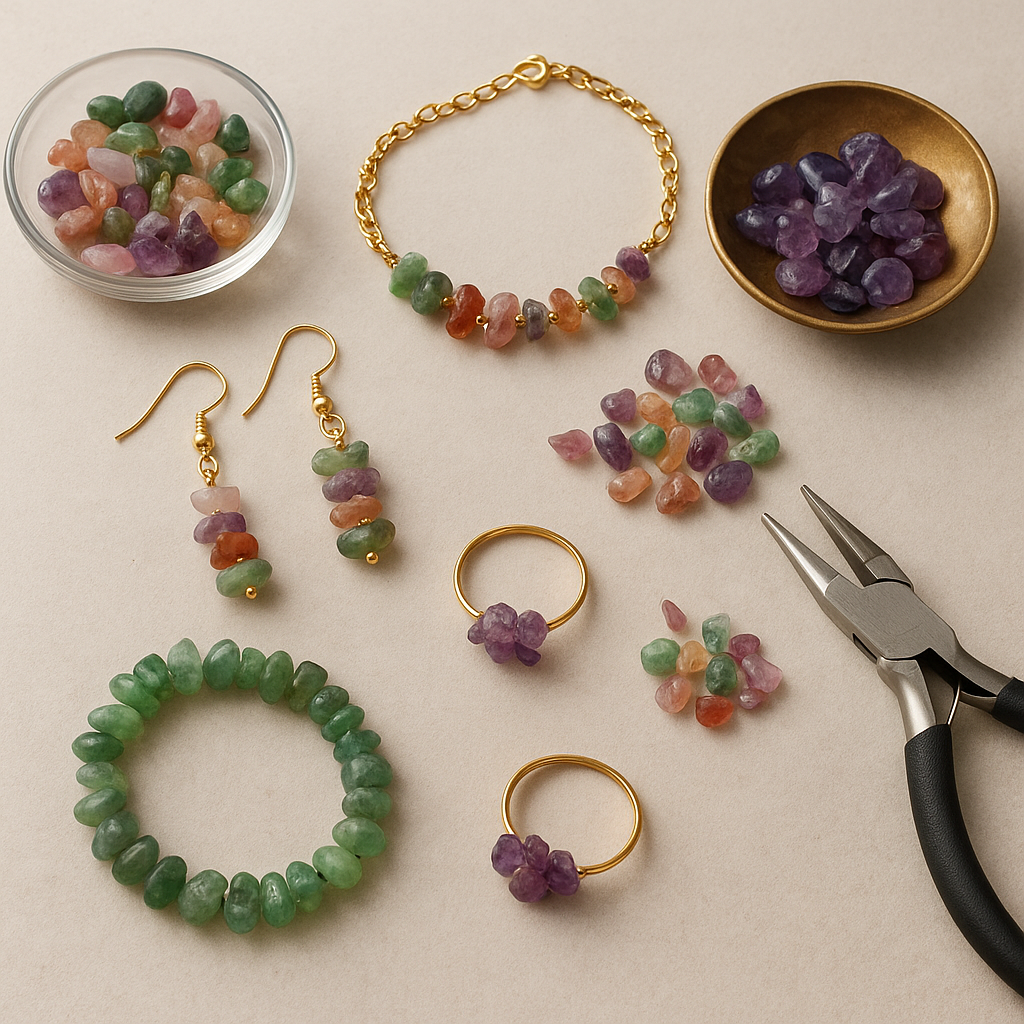
Small, irregular stones can transform humble handmade pieces into objects that look curated and lux. Gemstone chips—those intriguing fragments left after larger stones are cut—offer color, sparkle, and organic texture without the cost of calibrated beads. Whether you’re beading a bracelet, trimming a handbag, or setting accents in hairpins, their asymmetry invites play and rewards patience. This guide draws from studio practice to show how to use these shards with intention, ensuring your work feels elevated and wearable rather than crafty in the amateur sense.
What Makes Gemstone Chips Special
Unlike fully rounded beads, gemstone chips present facets, edges, and translucency that catch light unpredictably. They also come in a wider range of sizes and shapes than standard beads, from slivers and nugget-like shapes to wafer-thin slices. Their irregularity brings visual rhythm; no two adjacent chips look exactly alike. The result is jewelry and fashion details with a refined, organic character—like tiny mineral micro-landscapes.
Because chips are byproducts of cutting, they are often more affordable. Yet affordability does not mean ease; their quirks demand a maker’s eye. Holes may be off-center, edges can be sharp, and size distribution may vary within a strand. Embracing these “imperfections” is part of the appeal: they become the design’s voice rather than obstacles to be hidden.
Terminology helps when planning projects. Chips may be drilled (side-drilled, center-drilled) or undrilled. Slab chips are thin; nugget chips are thicker with softened edges. Look for descriptors like “tumble polished,” “freeform,” or “kennel chips” (very small fragments). Specifying the range (e.g., 4–8 mm) helps in estimating stringing patterns, while knowing the Mohs hardness shapes tool choices and finishing steps.
Selecting and Sourcing Quality Chips
Materials determine the final look and longevity. Choose chips for color stability, hardness, drilling quality, and ethical sourcing. For beginners, start with tougher stones: agate, jasper, quartz, aventurine, garnet. Softer stones (fluorite, malachite) require gentler handling and specialized adhesives. Porous stones (howlite, turquoise) may take dyes; decide if you want authentic or stabilized materials. Check product notes for “dyed,” “stabilized,” or “reconstituted.”
When possible, buy in person to evaluate consistency. Hold strands up to the light; assess translucency and internal patterns. Run your finger along a small sample for sharpness. A good chip strand will have clean holes, minimal chipping around the drill site, and a weight that matches the stone’s type (fakes may feel suspiciously light). If shopping online, order small sample packs before committing, and check the vendor’s return policy.
Beyond suppliers, consider sustainability and traceability. Ask about origin, mine practices, and whether chips are collected from cutting offcuts that would otherwise be discarded. Purchasing from lapidary studios that reclaim offcuts supports circular making. Reusing vintage chip strands is also an excellent way to reduce environmental impact while obtaining unique colors no longer common in the market.
Tools and Materials You’ll Actually Use
Working with chips benefits from a blend of jewelry and textile tools:
- Stringing: nylon-coated stainless wire (0.012–0.019”), silk or nylon thread, beading needles, split-tube crimp beads, crimping pliers, wire guardians, French wire (gimp), and clasps.
- Wirework: round-nose, chain-nose, and flat-nose pliers; flush cutters; soft copper/brass/sterling wire (24–20 gauge); mandrels; ring clamp; bench block; rawhide mallet.
- Surface setting: E6000-like flexible industrial adhesives, UV or two-part epoxy resin, micro-spatulas, toothpicks, lint-free swabs, painter’s tape.
- Textile and leather: waxed linen, cotton sash cord, Kumihimo disk, macramé board, awl, leather punch, edge beveler, contact cement compatible with stone.
- Finishing and care: micro-mesh sanding pads, conical burrs, polishing cloths, cotton swabs, protective wax.
- Safety: magnifying visor, dust mask (N95/FFP2), nitrile gloves, eye protection, fume ventilation, and a non-porous work mat.
While chips look rugged, they can bruise or crack if mishandled. Use a soft tray to catch drops, and keep stones in shallow dishes by color or size. Label bags with size ranges to simplify matching earring pairs and symmetrical layouts.
Design Fundamentals: From Color to Texture
Chips reward designs that work with their natural irregularity. A few guiding ideas:
- Color: Try analogous palettes (e.g., citrine–carnelian–garnet) for calm impact or complementary contrasts (amazonite with coral tones). Use a white background to plan and take photos; these quick snapshots reveal distribution imbalances you may not see by eye.
- Value and translucency: Mix translucent chips with opaques for depth. Place darker stones toward necklace ends to visually frame the face and avoid “heavy center syndrome.”
- Texture: Alternate chips with metal spacers, seed beads, or knotting to create breathing room and reduce tangling hairlines.
- Scale: Vary size across a gradient: small near clasps moving to larger near the focal. This adds flow and prevents bulky clasps.
- Pattern discipline: Because chips are idiosyncratic, establish a rule—like “every third position gets a spacer” or “peaks of three tall chips repeat”—then break it intentionally.
For many makers, a portable reference swatch book helps. Thread a few centimeters of each chip type onto sample loops labeled by stone and size. Keep notes on how each type behaves with specific stringing wires and crimps, as well as which finish (gold, silver, antique brass) complements it.
Underpinning all this is basic color theory. Stones carry subtle undertones—cool greens in moss agate, warm browns in tiger’s eye. Pair warm undertones with warm metals, and reserve bright silver for cool stones. If your piece feels visually “muddy,” add a high-value spacer—like hematite or gold-plated beads—to sharpen contrast.
Techniques: Stringing and Beyond
Secure Stringing on Beading Wire
For bracelets and necklaces meant for regular wear, nylon-coated beading wire offers strength. Choose wire diameter to match the chip’s holes; err on the thinner side to avoid breakage at sharp edges. String chips in small batches, clearing debris from holes with a beading awl if needed. Add seed beads between sharp chips to reduce friction, especially near curves like wrist bends.
At ends, use a wire guardian and either French wire or a small jump ring to avoid metal-on-metal fatigue at the clasp. Double-crimp when maximum security is vital—first a small crimp to anchor, then a decorative crimp cover. Test by pulling firmly; if it slips, re-crimp or switch to a slightly larger crimp with a correct jaw profile.
Knotting with Silk or Nylon
Silk adds drape and a touch of luxury; nylon offers better abrasion resistance. With chips, uneven hole edges can cut thread, so consider alternating with tiny seed beads where knots will land. Use a twisted wire needle or gimp to reinforce loop ends. Tension consistency is essential; aim for knots that “seat” without squashing the chips. For long necklaces, place periodic knots to create movement and reduce tangles rather than knotting every single chip.
Introducing Metalwork: Prongs and Cold Connections
Undrilled chips can be captured using prongs soldered on a small plate, or with cold connections like tabs and rivets. For a contemporary look, arrange three to five chips as a cluster and create simple prongs that wrap their edges. Use a ring clamp and burnisher to gently push prongs without chipping stones. When riveting onto leather or wood, countersink holes lightly and add a soft backing (thin suede) to cushion the chips.
Wirework Settings and Embellishments
Freeform stones sing in wire-wrapping. Create a basic frame with 20–22 gauge wire, then add 24–26 gauge binding wire to lash chips along the perimeter, like a garland. Because chips vary, pre-sort them by length to place gracefully around corners. Chevrons and spirals can anchor tips. If a chip has a naturally flat side, orient it to rest against the frame for stability. Combine metals—copper for warmth, oxidized silver for depth—and lightly work-harden by burnishing.
For pendants, a miniature bezel frame can be improvisational: shape strip wire into irregular walls that echo the cluster’s silhouette. Solder if metallurgical work is in your repertoire; otherwise, mimic a faux bezel with wrapped wire lips that overlap chip edges just enough to secure without obscuring too much stone.
Bead Embroidery and Micro-Mosaic
Stitch chips to a backing like stiff felt, ultrasuede, or leather. Use a beading needle and strong thread (Nymo, FireLine). Start with a secure anchor stitch, then couch chips in place with tiny seed beads that act like prong surrogates. Fill gaps with size 15/11 seed beads for a smooth gradient. This technique excels for brooches, statement collars, and shoe clips. For a micro-mosaic effect, seat very small chips into a thin bed of adhesive and stitch around them to lock in place.
Resin and Surface Inlays
Chips shine when suspended in clear resin within bezels, hair combs, or bag hardware. Seal porous stones with a thin layer of clear-drying medium to prevent micro-bubbles. Mix resin gently to reduce entrapped air, then dome a first coat and allow it to level before adding chips. Nudge pieces with a toothpick until aesthetically balanced, then add a final thin coat to cap. Warm the resin surface with brief passes of a heat source to pop bubbles—avoid overheating near delicate stones like opals.
Accessory Applications: From Everyday to Statement
Necklaces That Layer Well
Choker-length chip strands look refined when interspersed with micro-tubes in a repeating cadence. For opera-length strands, consider a multi-strand torsade: twist two or three chip strands gently and attach to a bar clasp; add seed bead “breather” rows along the back of the neck for comfort. Creating a focal pendant? Cluster a bouquet of chips around a central drop using wire; leave negative space above the cluster for wearability.
Bracelets Built to Last
Bracelets take more abuse than necklaces, so plan for durability. Use stronger wire (0.018–0.019”), add seed beads at the wrist hinge, and avoid low-hardness stones for everyday wear. Memory wire bracelets with chips and metal heishi give structure without closures; finish ends with secure loops or end caps. For a cuff, rivet chips onto a thin metal sheet backed by leather, spacing them so edges don’t gouge skin.
Earrings with Intentional Asymmetry
Chips make natural clusters. Build tiny branches: three to five chips wired onto fine chain lengths, staggered in 2–3 cm differences. Balance asymmetry by keeping total visual mass consistent between ears. For threader earrings, wire-wrap a tidy “berry” of chips near the end to weight the chain tastefully.
Hair Accessories and Millinery
Metal combs, barrettes, and headbands can be transformed by stitching or wiring chips along a base. Sandwich wire under ribbon for comfort, and finish with a lining. In bridal millinery, a scattering of moonstone or opal chips along silk leaves adds glimmer without heaviness. For hats, stitch chips onto felt with reinforced backer patches to distribute weight.
Handbags, Footwear, and Apparel
On soft goods, keep practicality in mind. Use secure stitching plus adhesive when embellishing bag flaps or denim jackets. Edge-guard chips on high-friction areas with a line of seed beads or cord. For sandals, mount chips on hardware components rather than directly on straps to prevent chafing. Always test flexibility after setting; fabric should still fold naturally without popping stones.
Project Walkthroughs
Minimalist Chip Arc Necklace
- Materials: 2–3 g of tiny amethyst chips (3–5 mm), 1 mm gold-filled micro-tubes, 0.015” beading wire, wire guardians, lobster clasp, crimps.
- Process: Cut wire to desired length plus 10 cm. String 5 cm of alternating chip and micro-tube, center it, then fill remaining length with size 11 seed beads to keep the arc stationary. Crimp ends with guardians and clasp. The result is a gentle arc of chips that floats at collarbone height.
Clustered Button Earrings
- Materials: 14 mm flat pad posts, thin felt circles, small carnelian and citrine chips, hypoallergenic adhesive, size 15 seed beads, strong beading thread.
- Process: Adhere felt to post pad. Dot adhesive and arrange chips densely, then stitch around and between chips with seed beads to lock everything in place. Edge the circle with bead embroidery for a finished, couture look.
Resin-Domed Hair Slide
- Materials: Brass oval slide setting, sealed paper or textile background, sealed tiny chips of labradorite, two-part resin, toothpick, lighter torch.
- Process: Fix background in the tray, add a thin resin coat, place chips carefully, level, and dome a final layer. De-bubble with quick heat passes. Cure fully before attaching to hair tool.
Advanced Tips for Professional Results
Pre-sort chips into “flat,” “slender,” and “chunky” trays. This speeds up composition and reduces frustration. Consider graduating thicknesses: place flatter chips near clasps and thicker toward the theater of the piece. Photograph your layout before stringing to maintain pattern fidelity.
When blending multiple chip types, keep their hardness and edge character in mind. Place harder chips near softer ones with a cushioning spacer. If a chip’s hole edge is sharp, lightly countersink with a conical burr and protect with a seed bead buffer. Light polishing of metal components after assembly lifts the entire piece visually without overworking the stones.
For structural wirework, pre-anneal certain wires or choose half-hard for framework and dead-soft for binding. Work-harden by burnishing or gentle hammering on a bench block—just enough to hold shape without transmitting shock to the stones. In bead embroidery, back finished pieces with ultrasuede glued and stitched; trim carefully to a clean contour.
Care, Maintenance, and Repairs
Inform wearers that stone hardness varies. Advise removing chip accessories during vigorous activity, bathing, and sleep. For cleaning, a soft dry cloth is usually sufficient; avoid ultrasonic cleaners for porous or glued settings. Replace frayed cords early—schedule a maintenance check for frequently worn bracelets after six months. Keep spares of clasps and standard crimps to facilitate quick repairs.
Storage matters. Lay necklaces flat; store earrings in small pouches. Avoid leaving resin pieces in direct sun for long periods. For leather-backed items, condition the leather lightly once or twice a year to prevent desiccation around stitch holes.
Safety and Workflow
Set up a clean, segmented workspace. Wear eye protection when cutting wire and a mask when light-sanding chip edges or cleaning holes. Use adhesives in ventilated areas and avoid skin contact. Keep beverages covered to prevent accidental contamination. Dispose of resin and adhesive waste responsibly; never pour unmixed components down the drain.
Adopt a session rhythm: design and dry-fit, secure bonding, then mechanical reinforcement (stitching or wrapping). Build curing and rest time into your schedule; rushing adhesive or resin processes leads to failures that can be avoided.
Pricing, Presentation, and Provenance
Pricing should account for material quality, labor time, and finishing. Chips may be affordable, but their assembly is labor-intensive. Track minutes per stage; consistent records protect your margin. Photograph pieces on simple backgrounds with raking light to emphasize texture. Provide cards that name the stones, origin when known, and care tips—buyers love learning about their piece’s story.
When selling online, include close-ups that show how chips are secured. Mention comfort features—seed bead buffers, curved profiles, lightweight backings. If your chips are reclaimed offcuts, highlight this ecological benefit. Ethical narratives add perceived value and differentiate your work from mass-market products.
Common Pitfalls and How to Avoid Them
- Overcrowding: Leaving no breathing room flattens the design. Use spacers or vary chip sizes to recover rhythm.
- Weak endpoints: Most failures occur at clasps. Reinforce with wire guardians and double crimping.
- Mismatched chip weights in earrings: Use a scale to match pairs within 0.1–0.2 g.
- Stiff drape: If a necklace kinks, switch to a more flexible wire or add micro spacers.
- Surface scratches: Pre-test friction points; cushion with seed beads where chips pivot.
- Adhesive fogging: With resins or fast cyanoacrylates, seal porous stones and control humidity to prevent bloom.
Experimentation: Hybrids and Textiles
Combine chips with fiber arts for modern textures. A Kumihimo braid with embedded chips along two opposing cords produces an undulating ridge. Macramé with waxed linen can hold chips as “berries” on half-square knot nets; plan beads every third knot for consistent spacing. In embroidery on denim, scatter chips like confetti and outline with contrast thread to keep them legible from a distance.
Leather and suede offer warm backdrops. Glue-and-stitch methods yield the best bond: rough the leather surface with sandpaper, use contact adhesive sparingly, then saddle stitch around chip bases. For belts and collars, place chips in low-stress areas away from buckles and edges; finish the leather with edge paint to protect both stone and skin.
Material Pairings That Always Work
- Hematite chips with matte black seed beads: urban minimalism.
- Rose quartz chips with silk ribbon: soft romance, ideal for bridesmaids’ gifts.
- Turquoise chips with antique brass: bohemian warmth; mind the stone’s porosity.
- Citrine chips with sterling: luminous clarity that photographs beautifully.
- Mixed quartz chips with leather cord: rustic-luxe for unisex designs.
For a tonal masterclass, choose one stone type and vary translucency and size only. The eye reads unity first, then discovers nuance up close—perfect for chic pieces that reward attention.
Quality Control Checklist
- Edges: Are there sharp points near skin contact? Round with a burr or buffer bead.
- Endpoints: Do crimped ends pass a pull test? If unsure, re-do.
- Symmetry (when intended): Do pairs match weight and length? Adjust with micro spacers.
- Movement: Does the piece drape naturally on a form? Fix kinks with smaller spacers.
- Finish: Are metal parts free from tool marks? Give a final wipe and light buff.
- Comfort: Try on for five minutes; note pinches or snags and correct.
Aesthetics: Editing and Signature Style
Chic often means restraint. Treat chips as punctuation rather than paragraphs: a restrained cluster on a clean chain, a handful along a hatband, a delicate trail across a collar. Decide what your signature will be—unexpected negative space, a favorite metal finish, or a particular chip scale—and revisit it intentionally across pieces. Over time, customers will recognize your touch at a glance.
When and Why to Break the Rules
Rules keep designs coherent, but chips reward the occasional swerve. Try staging dramatic asymmetry on a single earring or using chips in unconventional color families—say, smoky quartz with neon cord. Swapping precious metal for powder-coated wire can push pieces toward art jewelry territory. If you break a guideline, do it decisively and with repetition somewhere in the piece so it reads as design, not error.
Sourcing Notes and Material Ethics
Develop relationships with lapidaries who sell offcuts. You’ll gain access to unusual materials—like dendritic agate chips with tree-like inclusions—or slices from the same parent stone that match naturally. When possible, request pictures of your exact lot under neutral light. Log suppliers, lot numbers, and any stabilization info. Including this in your product notes adds confidence for buyers and keeps your own records tidy.
From Hobby to Micro-Business
If the craft compels you toward sales, establish a simple bill of materials template and a time log for each piece. Capture studio shots and finished glamor photos. Build a small spare-parts library for quick repairs and customer service. Most importantly, protect your time by batching processes—sort and design on day one, assemble on day two, do finishing and photography on day three. Consistency produces better work and reduces stress.
Glossary of Useful Concepts
- French wire (gimp): A coiled metal tube that protects thread at clasp loops.
- Drape: The way a strand hangs on the body; affected by wire stiffness and chip spacing.
- Work-hardening: Strengthening metal by bending and burnishing.
- Stabilization: Impregnating porous stones to improve structure and color.
- Doming: Creating a convex resin surface that magnifies chips beneath.
Bringing It All Together
Using gemstone chips in chic accessories is less about masking irregularities and more about showcasing them. Think of each chip as a syllable; the maker’s job is to arrange them into poetry. Combine mindful material selection with disciplined technique, then add the right edit. Protect comfort, invest in secure endpoints, and cultivate a personal rhythm in composition. With patience and tested workflows, chips deliver pieces that feel artisanal yet elevated—objects worthy of heirloom status even when their ingredients began as humble offcuts.
Strive for consistent craftsmanship, honor the stones through appropriate settings from wire-wrapping to improvised bezel frames, lean on time-tested color theory, choose the correct epoxy resin when needed, engineer for durability, attend to polishing and comfort, and keep sustainability in view. Done with intention, chips become not just fillers but the heart of modern adornment—tiny geologic voices arranged into wearable design.
