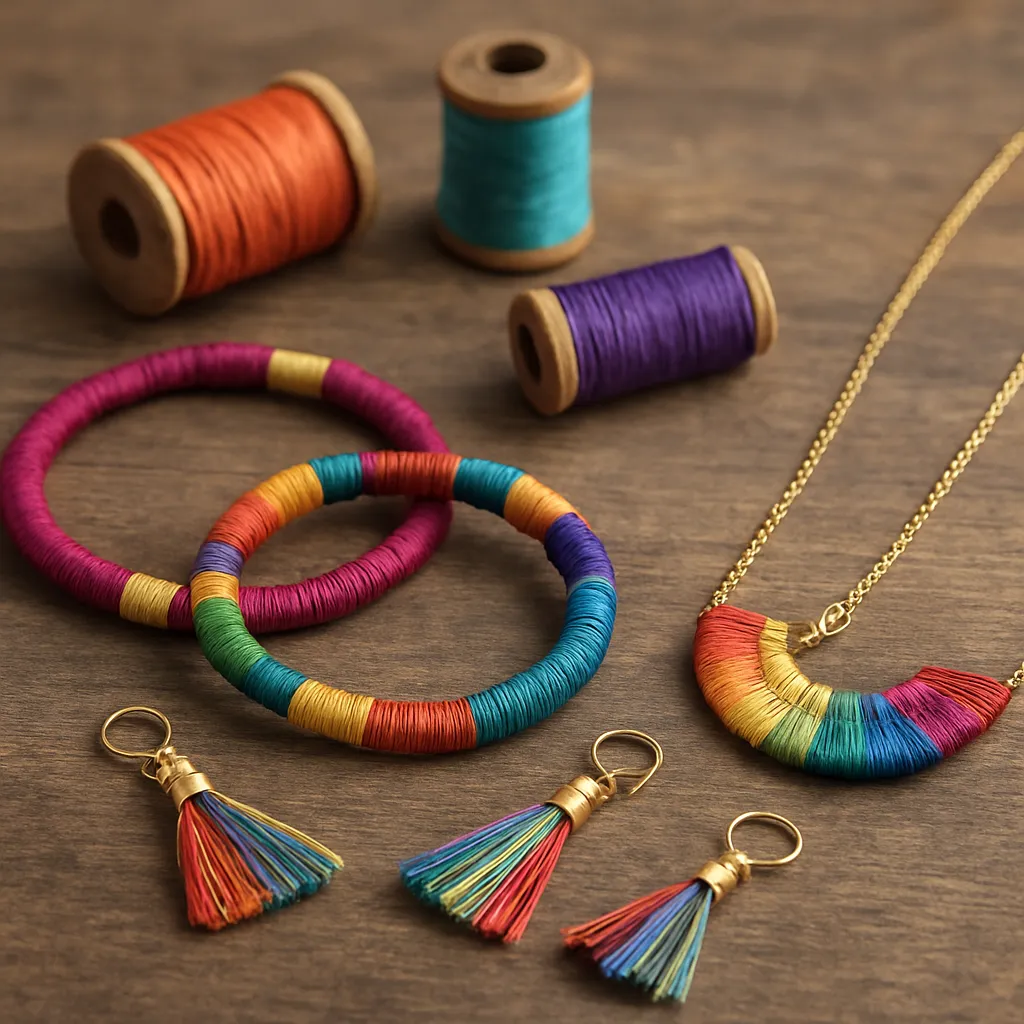
Colorful threads are more than mere carriers of hue; they are structural partners in jewelry that shape form, pattern, and texture with an agility metal alone cannot match. When threaded work is worn on the body, it moves differently—softly flexing with every gesture—producing a gentle tactility and a quiet sound that beadwork and metal often mute. From tightly knotted cords to painterly embroidery wrapped around a pendant, threads invite experimentation at the scale of millimeters while keeping the craft portable and accessible. They encourage patient, visible craftsmanship, and they make room for improvisation, cultural storytelling, and clever problem-solving with simple tools. Whether you come from weaving, beadwork, or metalsmithing, threads can add a fresh language to your jewelry vocabulary: gradients that ripple, micro-stripes that shimmer, and edges that blur into cloth-like silhouettes. With thoughtful choices of fiber and color palette, thread-based jewelry can be as refined as heirloom silk or as rugged as waxed linen that only improves with wear.
Materials, Fibers, and a Living Language of Color
Choosing threads for jewelry starts with understanding fiber behavior at small scale—strength, stretch, abrasion resistance, sheen, and how a thread holds or releases twist. These qualities determine not just look and feel, but also the longevity of knots, braids, and wrappings under real-life stress: clasps being tugged, pendants swinging, sleeves brushing against a bracelet. Below is a practical map of common fibers and why they matter.
- Cotton (embroidery floss, pearl cotton): Soft, matte or lightly lustrous. Excellent for tassels, wrapping, and micro-weaves. Absorbs dye beautifully but can fuzz with heavy abrasion. Double-waxed or varnish-sealed finishes reduce fray.
- Silk (buttonhole twist, filament silk): Strong for its fineness, with a luminous sheen that elevates even basic knots. Wonderful for couched embroidery, soutache, and wrapped beads. Requires mindful handling to avoid snags.
- Linen: Crisp, with high tensile strength and a slight slub for organic texture. Ideal for macramé and binding where structure is essential. Softens with wear without losing backbone.
- Hemp and bamboo: Plant-based alternatives offering varied textures. Hemp brings rustic character; bamboo offers silky hand with good drape. Both suit casual designs and eco-focused narratives.
- Nylon and polyester (micro-cord, bonded thread): High strength and abrasion resistance with minimal stretch. Great for bead-embroidery foundations and tension-intensive braids. Bonded synthetics resist fray and are easy to melt-seal.
- Metallics and rayon: Add shimmer or graphic highlights. Use sparingly for accents because some metallic wraps are scratchy or prone to splitting. Pair with smoother carriers for comfort.
- Waxed threads (linen, poly): The micro-layer of wax increases grip and knot security. Excellent for beginners learning knot paths and for secure closures in bracelets and anklets.
Dye behavior is critical. Test for colorfastness before combining threads with porous beads or wrapping around pale components. A simple method: dampen a white cotton swab, rub the thread vigorously, and check for color transfer. In humid climates or near skin, dyes can migrate; pre-rinse highly saturated threads with a mild soap and air-dry flat. When you need the colors to sing sharply, consider pearl cotton or filament silk for crisp light reflection. When you aim for a soft shadow, matte cottons in low-saturation hues can create the visual equivalent of pencil shading.
Color in thread jewelry behaves like miniature tapestry. Because threads run in lines, spirals, or interlaced cells, they can optically blend at the viewing distance of the wrist or neck. A slate blue working with cinnamon and mustard reads as weathered bronze from afar; up close it reveals stripes or chevrons. Use classic schemes—complementary for energy, analogous for calm, triadic for lively balance—but also deconstruct them at thread scale: combine two near-neutrals with a shot of electric coral, or let one saturated color anchor a chain of grays. Variegated threads offer effortless transitions, but control is key; align color changes symmetrically in earrings or intentionally offset them in a necklace to lead the eye. Texture also dyes the color: twisted cords darken perception, while flat satin stitches lighten it. Keep swatches of your favorite combinations stitched or braided onto a ring for quick reference during design development.
Core Techniques That Unlock Expressive Form
There is no single way to “thread” jewelry. Instead, there is a toolkit of interlocking techniques, each with a distinctive surface, drape, and structural logic. Mixing them lets you dial from graphic minimalism to baroque ornament without changing materials—only how you deploy them.
Knots and macramé for Architecture
Macramé transforms simple cords into architecture. The square knot yields flat, balanced bands; the half-hitch spirals into ropes; lark’s head and reverse lark’s head establish stable anchors on rings and bars. A macramé cuff in linen feels like fabric; in silk it reads as jewelry ribbon. To achieve crisp geometry, maintain consistent tension and count knots like stitches, advancing color changes at planned intervals. For delicate pieces, micro-macramé with 0.5–0.8 mm cord produces lace-like density that pairs well with seed beads or gemstone chips captured within the knots.
Braids and kumihimo for Continuous Flow
Japanese kumihimo braiding, performed on a marudai stand or portable foam disk, yields round, square, and flat cords with mesmerizing rhythm. By assigning colors to specific slots and mirroring sequences, you can chart spirals, chevrons, or bursts that read like pixels along the braid. When a section is meant to cradle a pendant, switch to a flat braid to prevent rolling; when a segment must pass through a narrow bail, taper cord counts. Braids excel at gradient blends; they blur transitions organically—especially with silk—and can hold internal memory wire or a hidden chain for extra structure.
Micro-Weaving and Loomed Bands
Warp and weft at jewelry scale transform threads into micro-textiles. On a tiny frame loom or even a pair of rigid bars, you can weave narrow tapes that become bracelets or choker elements. Use higher-twist warps (nylon, linen) for strength and low-hair wefts (silk, cotton) for color clarity. Insert beads like weft floats or in-lay motifs for sparkle. Finishing is everything: plan selvedges that fold into themselves so the edges are soft on the skin. A weft-faced weave packs color densely; a balanced weave shows rhythm between warp stripes and weft hues.
Embroidery, Couching, and Wrapped Components
Embroidery folds painterly color into jewelry. A simple split stitch on felt-backed metal blanks creates a soft, luminous field; satin stitch turns ovals into jewel-toned cabochons. Couching—laying a thread on the surface and tacking it down—lets you draw precise lines and spirals; pair a matte base with a metallic couched line for contrast. Wrapping is embroidery without a needle: bind thread tightly around bangles, rings, hoops, or large-gauge wire frames, creating stripes, micro-checks, or gradients. Use a figure-eight pattern on hoops to prevent gaps, and secure each color change with a hidden half-hitch under the previous wrap.
Soutache and Ornamental Layering
Soutache braids, stitched edge-to-edge around stones or beads, build baroque swirls that look complex yet rely on repetition. Pick cords with a firm core so curves remain crisp. Keep stitch lengths small and consistent, always catching both adjacent cords to avoid spreading. Layer colors in pairs so outlines echo like topographic lines, and remember that negative space—small windows of plain cord—lets the eye rest between embellished zones.
Crochet, Tatting, and Lace Structures
Thread crochet around a fine wire frame creates fixed shapes like petals and leaves. Without wire, cotton crochet yields supple ribbons that can be beaded on-the-fly. Tatting produces rings and chains perfect for airy earrings that seem to float. These lace structures love subtle shadows; try tone-on-tone colors so the pattern, not the pigment, does the talking, then accent with a single contrasting bead to punctuate rhythm.
Project Blueprints: From Try-It-Today to Collector-Grade
The following project outlines focus on repeatable building blocks. Adjust dimensions, colors, or materials to suit your voice and the needs of your wearer.
1. Color-Block Macramé Cuff with Hidden Clasp
- Materials: 0.8 mm linen cord in three colors; low-profile magnetic clasp; end caps; fabric glue; beeswax or thread conditioner; flat and tapered pliers.
- Plan: Sketch three rectangles for color blocks, assigning knot counts to each. Choose a neutral center to calm the composition.
- Method: Mount cords with lark’s heads onto a holding bar. Work square knots with impeccable tension. Switch colors by splicing new cords: run 2–3 knots with both old and new tails hidden within the knot core, then trim and dot with a trace of glue.
- Finish: Compress ends into cord ends with tiny drops of glue. Attach magnetic clasp via jump rings oriented so the cuff lies flat. Burnish lightly with wax to reduce fuzz.
2. Ombré Kumihimo Necklace with Suspended Focal
- Materials: Silk cords gradating from charcoal to pale silver; kumihimo foam disk; 8-warp pattern; slim end caps; focal pendant with wide bail.
- Plan: Arrange cords on the disk so the darkest hues begin at the nape and fade toward the front. Leave a central unbraided section to switch briefly to a flat braid under the pendant.
- Method: Braid to the chest point; park cords; reconfigure for a flat braid across the pendant region; slide the bail on; return to the round braid. Maintain beadless mass for a pure thread look.
- Finish: Glue and cap both ends; ensure the transition between round and flat is snug. Optional: add a silk-wrapped slider bead above the pendant as a movable accent.
3. Thread-Wrapped Hoops with Chevron Micro-Pattern
- Materials: 30–40 mm metal hoops; cotton embroidery floss in two high-contrast colors; fray-preventing liquid; fine needle.
- Plan: Mark the hoop in eighths. Assign alternating color segments for chevrons that meet at precise angles.
- Method: Wrap each segment tightly, reversing direction at segment boundaries to form chevrons. Lock each section with a hidden half-hitch pulled under previous wraps using the needle.
- Finish: Seal the final turns with a micro-dot of fray preventer. File any rough metal edges before wrapping to protect the thread.
4. Embroidered Bezel Pendant on Felt-Backed Brass
- Materials: Brass blank; wool felt; silk thread; cabochon or flat-backed bead; beading needle; strong adhesive; edge-bead trim.
- Plan: Adhere felt to brass; glue cab at center; mark concentric rings for decorative stitches (satin, couching, seed-bead outlines).
- Method: Stitch outwards from the stone, using gradually lengthened satin stitches to create a gentle halo. Couch a metallic thread just beyond the satin field to sharpen the perimeter.
- Finish: Bind the edge of felt to brass with blanket stitch, then cover with a delicate bead trim for protection and sparkle.
5. Soutache Drop Earrings with Monochrome Depth
- Materials: Three shades of gray soutache; 6–8 mm pearls or stones; fine beading thread; ear wires; small backing of ultrasuede.
- Plan: Stack cords light-to-dark around the pearl to mimic shadow. Mirror the layout precisely for the pair.
- Method: Stitch cords together with tiny bites, nestling the pearl centrally. Add small seed beads in the valleys for measured highlights.
- Finish: Back with ultrasuede for comfort, trim cleanly, and edge-stitch all the way around to lock layers.
6. Wrapped Bangles with Inlayed Beads
- Materials: Solid bangles (wood, metal, or resin); cotton or linen thread; small beads; PVA or flexible jewelry adhesive.
- Plan: Lay out a repeating rhythm: four threads of color A, two of color B, inlay a bead, repeat.
- Method: Paint a thin adhesive film around 2–3 cm sections and wrap tightly. To inlay, wrap a crossing figure-eight that traps a bead at the outer curve; continue wraps to lock it.
- Finish: Sand seams lightly and overwrap with a final color to create a continuous skin. Cure fully before wear.
Engineering for Comfort and Longevity
Thread jewelry must feel good against skin and withstand friction, sweat, and sunlight. Plan structural decisions early. If a necklace’s heaviest point is the pendant, distribute load through a braid that transitions to a wider shoulder section. Anticipate snag zones—shirt collars, seatbelts—and soften edges there. Tips that pay off long-term:
- Endings and connectors: Use glue-lined end caps or satin cord ends sized to the braid. For synthetic threads, a micro-melt seal within the cap (done cautiously) locks fibers before glue.
- Adhesives: PVA remains flexible but may not hold on slick synthetics; cyanoacrylate (CA) is crisp but can frost; two-part epoxy excels on metal-to-thread bonds but adds weight. Test on scraps and allow full cure.
- Hardware alignment: Orient clasps so they lie with the braid’s twist; a misaligned jump ring will torque threads and fatigue knots over time.
- Edge management: On wrapped components, cover cut metal edges with a silk or leather underwrap before final threads to prevent abrasion.
- Conditioning: Light beeswax or commercial conditioner improves handling and knot grip. Avoid over-waxing silk, which can dull its shine.
For heirloom-grade durability, assume handling errors will occur: pulls, quick tugs, drops. Overbuild critical joints—stitch through loops twice, add a discreet binding wrap at stress points, and test each piece by gentle but deliberate flexing before release. If a thread intersects a bead with a sharp edge, buffer it with a seed bead or a tiny metal guard. Where metal meets thread, reduce edges and burrs religiously.
Designing with Intention: Narratives, Motifs, and Scale
Thread lets you write with color and line. Consider narrative devices: a gradient mapping sunrise to dusk around the neck; a pair of earrings that mirror riverbanks with a tiny stone “island”; a bracelet whose chevrons code a favorite poem’s meter. Scale matters too: micro-patterns read as solids at distance, so slip in surprises that reward up-close inspection—an unexpected stripe on the inside curve, a stitched monogram just under the clasp. Texture also speaks. A glossy couched line whispers formality; a nubby linen wrap says earthbound. Combine structures—braid to wrap, wrap to couch—to articulate different chapters within one piece.
When working in series, build a controlled vocabulary: three stitch types, four colors, one metal tone. This constraint heightens subtlety and creates a recognizable signature. Keep swatch boards and process notes; your future self will bless the documentation when reproducing or iterating a design months later.
Sustainable Making: Materials, Methods, and Meaning
Threads invite eco-conscious practice. Many fibers are plant-based, and even small leftovers can be repurposed. Embrace sustainability as an aesthetic and operational choice:
- Material sourcing: Favor certified organic cottons, peace silk, or recycled polyester. Seek suppliers who disclose dye processes and labor standards.
- Natural dyeing: Experiment with avocado pits, onion skins, indigo, and madder. Use safe mordants; document ratios for repeatability. Expect softer, living color—perfect for botanical narratives.
- Scrap strategy: Keep a jar of 10–30 cm tails. These become tassel cores, marled wraps, or color-blip accents. Label bundles by fiber so you can match finishing methods.
- Packaging: Paper wraps and uncoated boxes protect thread surfaces while aligning with a reduced-plastic studio.
Beyond materials, upcycling adds story. Vintage threads inherited from a relative, deconstructed silk ties rewoven into braids, or cloth selvedges turned into wrapped bangles carry memory. Document provenance on a small card; collectors cherish the lineage as much as the look.
Care, Wear, and Repair
Educate your wearers. Thread jewelry thrives with mindful handling but should not be precious to the point of fear. Offer a simple care card:
- Storage: Lay flat or hang to prevent kinks. Keep away from open-zip teeth and Velcro. Store away from direct sun to reduce fading.
- Cleaning: Spot clean with a barely damp cloth; avoid soaking. For metal-thread combos, dry immediately and polish metal parts carefully to avoid catching the threads.
- Refresh: Trim micro-fuzz with a new razor gently, in one direction. Re-wax dry-looking cords with a light pass.
- Repairability: Design intentionally for serviceability—use visible knots at ends that can be redone, or modular sections that can be swapped without disassembling the whole piece.
Troubleshooting and Advanced Tips
The line between amateurish and professional often lies in small technical habits. Common challenges and remedies:
- Uneven width in macramé bands: Count knots and mark milestones on the holding cord. If switching colors, overlap transitions within the densest knot zones to maintain thickness.
- Fraying at high-wear points: Pre-coat just those centimeters with diluted flexible varnish. For synthetics, lightly heat-seal, then overwrap to hide the join.
- Twist memory in cotton braids: Hang finished braids with a small weight overnight; steam gently to relax. Recondition with a light wax touch.
- Color bleeding on hot days: Pre-rinse suspect threads; line sweat-prone surfaces (nape, inner wrist) with a hidden pale wrap layer to buffer.
- Beads cutting thread: Ream bead holes to remove sharp glass dust; add a seed bead buffer; switch to a bonded thread for the path through risky beads.
- Hoop wraps drifting: Establish a tiny underlay of double-sided tape or a wash of rubber cement to create tack before wrapping.
- Kumihimo cords bulking at caps: Taper by switching to fewer strands or finer substitutes for the last centimeters before the end cap.
For ambitious surfaces, explore marling (holding two different colors together as one) to create speckled optical blends, or micro-ikat by pre-dyeing short segments so a pattern emerges as you wrap or weave. On embroidered pieces, vary stitch direction to control light: perpendicular stitches next to parallel ones catch light differently, giving dimensionality without added thickness.
Ethical Inspiration and Cultural Lineages
Thread traditions are living archives: Andean braids with coded narratives, West African strip-weaving scaled down to wrist tapes, Japanese kumihimo cords historically used in samurai armor and tea ceremonial knots, Eastern European counted embroidery motifs mapped to micro-bead embroidery in earrings. Learn respectfully—study sources, credit teachers and regions, and adapt through your own lens rather than copy wholesale. When you incorporate historical motifs, explain the lineage to clients. The piece becomes not just adornment but a conversation linking hands across time.
Studio Workflow and Selling Considerations
Because threads are light and inexpensive relative to metals and stones, it is tempting to underprice. Don’t. Price for design time, sampling, and the invisible hours testing finishes. Track material consumption by length; a meter counter or simple notebook entry per piece builds accurate costing over time. Photograph on neutral backgrounds that honor texture—side light reveals wraps and stitches beautifully. Offer a size service: many thread-based bracelets can be remade to fit precisely. For custom work, mail color rings or digital palettes and confirm on-skin photos; flesh undertones shift perceived colors dramatically.
In-person markets benefit from touch. Provide a “please handle” tray of sample swatches—macramé squares, braided cords, embroidered tiles—so visitors feel weight and drape without risking finished pieces. This tactile introduction often converts curiosity into commissions.
A Closing Invitation to Experiment
Thread is honest material—humble, flexible, and infinitely variable. It can whisper in pewter gray and fog-silk, or shout in citrus and cobalt stripes. It thrives when you listen: how a fiber wants to curve, how a braid asks to thicken under a pendant, how a stitch changes voice as the light turns. With only a few tools—a disk, a needle, a clamp—you can build a studio practice that travels in a small pouch yet yields a body of work with breadth and depth. As you explore, attend to your palette, your hand’s natural tension, the durability you engineer into joins, and the sustainability you cultivate across materials and methods. Whether you are wrapping a simple hoop or composing a gallery-grade embroidered pendant, colorful threads offer a boundless field where line becomes structure and color becomes story—woven, knotted, braided, and stitched into jewelry that feels alive on the body, day after day, year after year.
