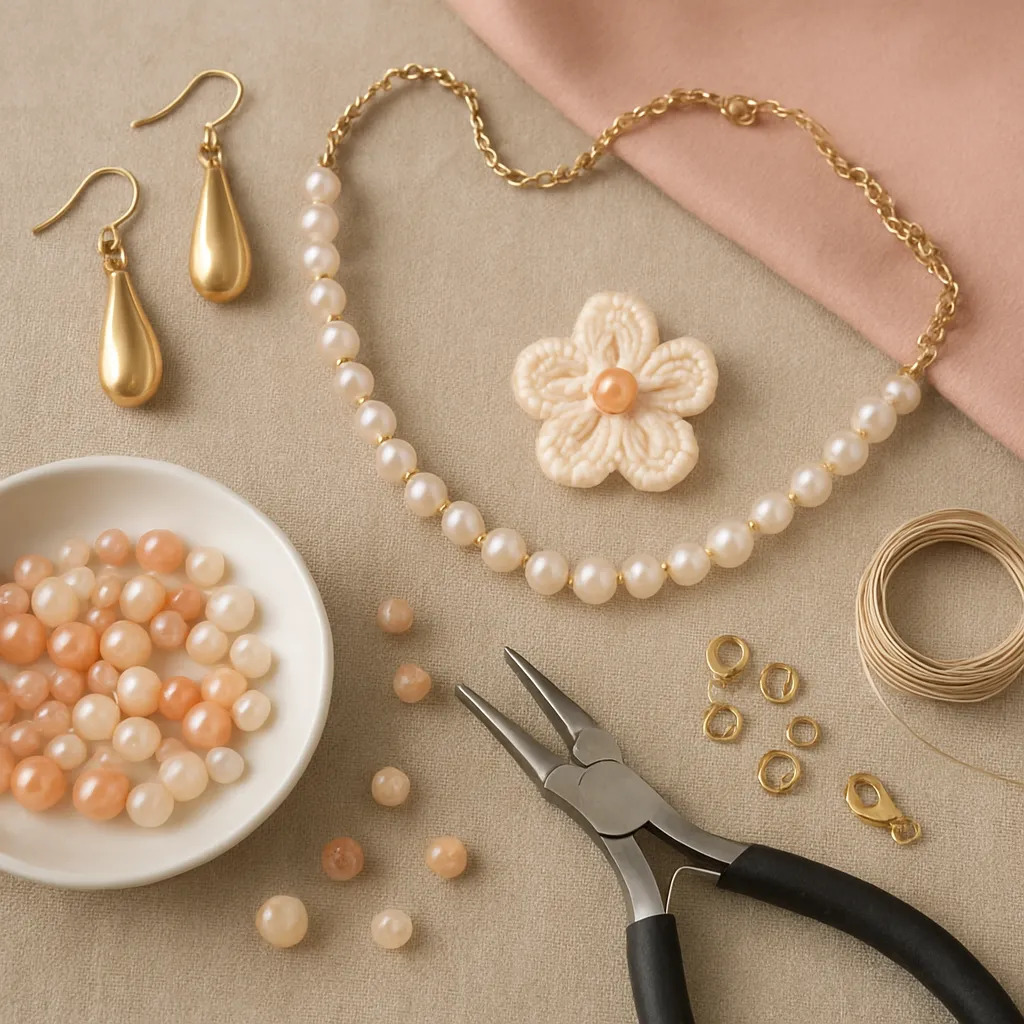
Spring wardrobes ask for jewelry that feels sunlit, lighthearted, and full of small details that move when you move. Handicraft answers that call beautifully: it slows us down, honors craftsmanship, and turns ordinary supplies into little keepsakes with personality. Whether you prefer soft pastels or garden-bright pigments, making your own accessories allows you to echo the season’s blossoms, breezes, and textures right on your neckline and wrists. The joy is doubled when each piece carries your story—where the bead came from, which plant inspired the motif, why a certain clasp feels just right—so your outfits read as thoughtful rather than merely trendy.
The spring mood: color, light, and playful movement
Spring design is an invitation to trade heavy layers for air, to let jewelry breathe and sway. Consider the way dappled light hits a dewdrop; think of tulip petals cupping shadows; watch how a cotton dress ripples when you walk. These observations translate directly into choices of gemstone translucency, chain fineness, charm spacing, and motif scale. In handicraft, we borrow from the natural world without imitating it too literally—stylized leaves, hammered raindrops, ribbon-like wire curlicues. The result should look effortless, as if it simply grew there.
Choose a palette that pairs with most of your clothes. Pastels like primrose yellow, hydrangea blue, lilac, and tea-rose pink are obvious friends, yet olives, fern greens, and cinnamon-warm neutrals keep things grounded. When you design, imagine your jewelry at arm’s length against your favorite blouse or trench; spring loves clarity. On the materials side, a mix of glass, freshwater pearl, brass, plated gold, and hand-dyed fibers yields variety without visual noise. Avoid making everything shiny—mix in soft-matte beads, brushed metal, and carved surfaces to deepen texture.
Color and form that flatter spring outfits
A successful spring accessory often balances crisp edges with gentle transparency. Here are quick pairings:
- Sheer chiffon blouse: petite pearls on ultra-fine chain; frosted glass droplets that catch just enough light.
- Denim jacket: hammered brass hoops with chalky ceramic beads; botanical charms to soften the rugged weave.
- Linen dress: long pendant with a single rose quartz briolette; woven cord bracelet in flax and sage.
- Striped tee: asymmetric studs in citrus tones; beaded choker that echoes the stripe width for harmony.
As you plan, look for rhythm—repeated shapes, subtle color echoes, and consistent metal tone—so the total outfit doesn’t feel busy. Spring jewelry can be whimsical, but keep one anchor idea per piece: perhaps a leaf silhouette repeated, or three tones of one hue, or chain links of graduated size. Simplicity heightens the poetic side of handmade design and keeps the eye where it belongs: your face and the garment’s silhouette.
Tools, materials, and a tidy workspace
A compact, well-organized kit supports flow and avoids frustration. Gather the basics and take five minutes to arrange them before each session—this small ritual protects your focus and the integrity of delicate components.
- Cutting and shaping: flush cutters for clean wire ends; round-nose pliers for loops; chain-nose pliers for gripping; nylon-jaw pliers to avoid marring soft metals.
- Measuring and support: a soft tape measure; steel ruler; bead mat to stop runaway beads; mini bench block and chasing hammer for gentle texturing.
- Findings and metals: jump rings in multiple diameters, head pins and eye pins, lobster and toggle clasps, earring hooks, crimps and crimp covers; 24–20 gauge wire for wire-wrapping and 18–16 for structure.
- Threads and cords: nylon-coated beading wire for function, silk or nylon thread for elegance, waxed cotton or linen for rustic pieces, elastic for stretch bracelets.
- Accents: glass beads, seed beads, freshwater pearls, ceramic, wood, shell, gemstones, polymer clay elements; lightweight chain in consistent metal tone.
When possible, choose supplies that reflect sustainability—salvaged beads, recycled glass, responsibly sourced pearls, deadstock chain from old ateliers. Try upcycling vintage buttons or orphaned earrings; not only does this keep materials in use, it injects history into your work. A spring piece often benefits from visible time-worn nuance, a gentle patina that softens glare and invites touch. If you prefer brightness, reserve patina for a single focal charm and keep the rest gleaming for contrast.
Five spring-ready DIY projects
The following projects range from beginner-friendly to intermediate, all wearable with breezy outfits. Adapt lengths, colors, and motifs to your wardrobe and skin tone.
1. Pressed-flower resin pendant
Level: Beginner to intermediate. Vibe: cottagecore meets minimal. Wear with: linen shirtdress, open cardigan, soft trench.
- Supplies: small bezel or open-backed frame, UV resin, pressed petals or tiny leaves, toothpick, doming tray, fine chain, jump rings, clasp.
- Steps:
- Seal your pressed botanicals with a mist of archival spray or brush of clear-drying glue; this prevents bleed.
- Place a thin resin layer in the bezel, arrange petals with a toothpick, then add a top layer to slightly dome.
- Cure under UV lamp as directed; pop bubbles by nudging them to the surface quickly before curing.
- Attach to chain with a jump ring, keeping the pendant centered. Add clasp and a 5 cm extender for layering options.
Tip: Keep color soft—cornflower blue petals over pale gold look fresh. Resin loves light; a teeny highlight line across the dome adds visual sparkle beside a matte blouse.
2. Wire-wrapped gemstone dew-drop earrings
Level: Intermediate. Vibe: luminous, airy elegance. Wear with: silk cami and blazer, wrap dress.
- Supplies: two briolette gemstones (rose quartz, aquamarine), 26–24 gauge wire, French hook ear wires, tiny accent beads, jump rings.
- Steps:
- Cut 10–12 cm of fine wire; secure around the briolette neck with a tight coil, forming a neat wrap up toward a simple loop.
- Slide on a micro bead before the final wrap if you want a delicate collar at the stone’s neck.
- Attach to ear wire with a small jump ring so the drop swings freely; repeat for the pair.
Tip: Maintain consistent wraps—count turns on the first earring and match on the second. If the stones are translucent, the metal’s warmth will subtly tint them, so match your wire color to your skin’s undertone for a flattering glow.
3. Macramé meadow bracelet with seed beads
Level: Beginner. Vibe: grounded boho. Wear with: denim jacket, knit tee, cotton skirt.
- Supplies: waxed cotton cord or linen, size 8 or 11 seed beads, sliding knot bead or button, scissors, glue.
- Steps:
- Cut two long cords; secure to a clipboard. Begin square knots for a flat band, feeding in seed beads every two or three knots.
- Keep tension even. End with a loop or sliding knot closure for adjustability.
- Touch a tiny drop of glue to the cord ends to prevent fray; hide ends under the final knot.
This bracelet loves tone-on-tone palettes. Try a field of greens: moss, fern, and chartreuse beads scattered like wildflowers across flax-colored cord. The handwoven feel amplifies spring’s soft choreography whenever your wrist turns.
4. Polymer-clay botanical stud set
Level: Beginner to intermediate. Vibe: playful minimal. Wear with: striped tee, cropped trousers, sunhat.
- Supplies: polymer clay in 2–3 colors, blade, needle tool, texture sheets or a foraged leaf, earring posts, strong adhesive, fine sandpaper.
- Steps:
- Condition clay and roll to 2–3 mm; press a leaf or texture sheet to imprint vein lines.
- Cut tiny petal or leaf shapes; poke a micro hole if you wish to add a dangle later.
- Bake per manufacturer’s instructions; sand edges lightly for a refined profile.
- Adhere posts; cure adhesive fully before wearing.
Use restrained motifs—a single debossed vein, a dot of paint to suggest pollen—so the set mixes well across outfits. Little stud sets are practical travel companions and a perfect canvas for seasonal color experiments.
5. Upcycled charm necklace from vintage buttons
Level: All levels. Vibe: heirloom-poetic. Wear with: cotton shirtdress, light trench, cardigan.
- Supplies: assorted vintage buttons, head pins, chain, jump rings, clasp, optional pearl or crystal accents, metal file.
- Steps:
- File button shanks smooth if needed; insert a head pin through each hole, forming a wrapped loop on top for a dangle.
- Stagger charms along chain at irregular intervals; cluster three near the collarbone for a focal grouping.
- Blend eras—mother-of-pearl with bakelite, carved wood with glass—to tell a quiet story of reuse.
An upcycled piece becomes conversation-ready. It enshrines memory and makes spring layering feel personal, not generic. This is where upcycling becomes more than a buzzword—it’s a design language.
Technique essentials for confident making
Opening and closing jump rings
Hold with two pliers and twist front-to-back, never side-to-side. This keeps the ring round and strong. If a piece catches hair or threads, inspect the ring for a microscopic gap and realign.
Neat loops and wraps
For consistent loops, mark your round-nose pliers with a fine line where you prefer the loop diameter. Cut wire with a flush side toward the piece for a clean butt joint before wrapping. Practice on scrap until your muscle memory sets; spring jewelry magnifies small imperfections because components are lightweight.
Crimping with grace
Use quality crimps that match your beading wire. Flatten first, then fold with a crimping tool; hide with a crimp cover for a bead-like finish. Proper crimping is the difference between a bracelet that lasts and one that fails at brunch.
Taming oxidation and finishing metal
If you like gentle oxidation for depth, patinate brass or copper, then seal with microcrystalline wax or jewelry-grade lacquer to protect skin and clothing. Otherwise, keep polish satin with a 3,000–12,000 grit polishing pad; mirror finishes can feel too formal for daywear unless used sparingly. A whisper of sealed patina reads as lived-in spring calm, a nod to garden gates and weathered trowels.
Knot knowledge
For silk stringing with pearls or glass, use a double overhand knot clipped snug against each bead—this protects them from rubbing and adds light bounce. When finishing cords, a surgeon’s knot followed by clear-drying glue provides low-profile security.
Style play: pairing pieces with spring staples
- With a floral dress: choose jewelry that mirrors one color from the print rather than competing with the whole bouquet. A single pendant or delicate hoops prevent visual overload.
- With a trench coat: a longer pendant peeks from the lapel break; consider matte gold with milky quartz for mellow glow.
- With a white shirt: go for structure—paperclip chain with one garden-charm cluster at the sternum. The negative space keeps it modern.
- With wide-leg trousers and a knit: emphasize verticals—threader earrings that skim the jawline; a slender lariat with a pearl drop.
Spring is also hat season. Balance brim drama with compact earrings that won’t tangle. And remember skin tone shifts with sun: slightly warmer metals may flatter as your complexion brightens. When in doubt, test pieces in natural light near a window; jewelry has a conversation with daylight that indoor bulbs cannot replicate.
Comfort, allergies, and inclusivity
Beautiful pieces must also be wearable for everyone. Consider metal sensitivity and weight distribution early in design. Select hypoallergenic findings—niobium, titanium, high-quality stainless steel—to avoid irritations. Keep earrings under 7 grams per ear for daily wear. If a design needs drama, shift weight closer to the lobe with compact dangles, or distribute bulk across multiple small elements rather than one heavy focal. For bracelets, add a 1–2 cm comfort fit and a small extender; hands swell subtly with warm weather. Large lobster clasps or magnetic closures help those with limited dexterity, turning adornment into an accessible ritual rather than a struggle.
Tool comfort matters, too. Padded handles, spring-loaded pliers, and a neutral wrist position support hand health; that’s ergonomics in practice. Take regular stretch breaks—shake out wrists, roll shoulders, refocus eyes to a middle distance—to preserve fine-motor control and keep lines smooth.
Sourcing ethically and telling material stories
Spring is a season of beginnings, a fine time to examine where components originate. Work with suppliers who can speak to provenance—recycled glass, repurposed chain, fair-trade gemstones—so your choices embody sustainability rather than perform it. When you salvage beads from a thrifted necklace, log the story. When you buy freshwater pearls, note the farm region. These details become part of the piece’s charm and help customers or recipients value the quiet labor behind it. Even at hobby scale, tracking sources fosters responsible habits and raises the standard of home studio craftsmanship.
Design thinking: from sketch to wearable poetry
Great jewelry begins in the senses. Start with a mood trigger: the peach fuzz on a petal, rain on pavement, a willow’s silhouette. Translate that into shape and movement. If your prompt is rain, perhaps chain tassels with micro beads act like droplets; if willow, a long, thin marquise leaf repeats along a necklace. Limit your palette to two or three hues and one metal tone. Decide on finish early—high polish, matte, brushed—because finish and color shape the piece’s voice as much as form. Pin your ideas on a board: fabric swatch, pencil sketch, bead samples. Then prototype with lower-cost materials, testing proportion on the body in front of a mirror. Jewelry is kinetic; it must perform while walking, hugging, toasting, taking a photo. Iterate quickly; spring’s charm lies in lightness, not fuss.
Common pitfalls and easy fixes
- Pieces feel busy: remove one design idea. If you have botanical charms, bright gemstones, and layered chains, pick two and let one rest for another project.
- Colors fight the outfit: pick a bridge bead—something that contains both hues, like a variegated glass—that harmonizes the scheme.
- Necklace doesn’t sit flat: re-space components, add tiny wire guards at string exits, or swap to a slightly heavier chain for better drape.
- Earrings twist oddly: ensure loops are aligned in the same plane; add a micro jump ring between charm and hook to restore freedom of movement.
- Clasp creeps to the front: balance weight by adding a small counter-charm near the clasp or shortening the chain a centimeter.
Care, storage, and longevity
Spring’s humidity and sunscreen can cloud finishes. Wipe pieces with a soft cloth after wear. Store metals separately from raw wood or leather, which can off-gas and tarnish nearby items. Tiny silica packets in your jewelry box tame moisture swings. For pearls and porous stones, avoid harsh chemicals; a quick breath of warm air and soft cloth is enough. Refresh satin finishes with an ultrafine pad; keep a log of each piece’s care notes, especially if you gift or sell it. Well-kept handmade jewelry develops gentle patina that narrates time rather than neglect.
Finishing touches that read professional
Small upgrades elevate handmade work to heirloom territory:
- Use wire guardians where beading wire meets a clasp to prevent abrasion.
- Hide knots under a bead tip or crimp cover for a clean line.
- Match metal tones exactly across findings; near-miss golds can cheapen an otherwise elegant piece.
- Test every closure five times; the hand knows what the eye can’t see.
- Add a 4–5 cm extender with a tiny charm at the tail for movement and versatility.
Professional isn’t about price; it’s about intention in the unseen places—the back of a pendant, the quiet underside of a clasp, the little choices that contribute to long-term wear.
Photography and gifting
Spring light is diffuse and forgiving. Photograph your pieces near a window on matte surfaces—linen napkins, watercolor paper, a page from a worn botanical book. Include a sprig of greenery to signal scale and season. When gifting, add a handwritten card that explains the motif or materials: pressed forget-me-nots from last April’s walk, chain sourced from a retired watchmaker’s stash, or a recycled-glass bead born from melted bottles. Packaging can be minimal—kraft box, unbleached tissue, cotton ribbon—yet still feel romantic.
From hobby to micro-studio
If friends start asking for their own, set simple systems. Track time per piece, component costs, and a small overhead for tools and packaging. A basic formula—materials plus time at your chosen rate plus 10–20% for overhead—keeps pricing fair. Photograph against consistent backdrops; name each design; write a sentence about its inspiration. When listing, include size ranges and metal types up front to support those with sensitive skin—note which parts are titanium or stainless, which are plated, and which are solid. Emphasize hypoallergenic options and provide alternative closures on request. Your story—why you chose these botanicals, why this bead color mirrors your morning walk—matters as much as the piece itself. People buy the feeling of spring you captured and the values—reuse, sustainability, respect for materials—that shine through.
Seasonal capsule: plan a small collection
Design a five-piece capsule that mixes freely:
- One long pendant with a single translucent stone.
- One pair of dew-drop earrings in a neutral hue.
- One charm bracelet with two or three small motifs—leaf, raindrop, seed.
- One choker or short necklace with pearls spaced on fine chain.
- One ring or ear cuff with a hammered finish to catch light.
Keep metals consistent, vary scale, and repeat one bead type across at least two pieces to unify the set. Prepare it in two palettes: pastels for soft days, and herb-garden greens with a cinnamon accent for earthier looks. Capsules simplify dressing; everything plays together, and the story feels intentional.
Mindful making rituals
Handicraft can be meditative if you give it a rhythm. Open the window, let a breeze stir your bead labels, sip tea. Begin each session by arranging components in a small dish, touching them into place like seeds on soil. Pause to look out at moving branches. Each knot you set and loop you form is a mark of attention. This slowness shows in the jewelry—the quiet symmetry, the unforced balance of elements, the way a charm knows just when to catch the light. Spring returns every year, yet never the same; so too your pieces evolve, fresh but rooted in practice.
Troubleshooting toolkit
- Bead holes too small: ream gently with a bead reamer; protect delicate stones with water to reduce heat.
- Wire work looks messy: anneal dead-soft wire with friction (run through nylon-jaw pliers several times) and slow your pace; tension is everything.
- Resin remains tacky: check UV lamp strength and resin shelf life; finish with a thin top coat and full cure, or switch to two-part resin with accurate mixing.
- Elastic bracelets snap: use thicker elastic than you think, pre-stretch gently, knot securely, and hide the knot inside a large-hole bead.
Beyond the obvious: textures and finishes for depth
Light defines spring, but shadow writes the poetry. Consider mixing matte ceramic with gloss glass, brushed brass with satin pearl, cord with chain. Think of the language of finishes: frosted equals morning fog; hammered equals rain splatter; high polish equals sun glare. A single contrasting surface can focus a piece better than adding more beads. Use texture strategically to complement the garment’s weave—sharper texture against smooth poplin, softer texture against nubby linen—so the whole outfit reads as intentional texture play rather than competition.
Seasonal maintenance and wardrobe integration
Rotate pieces with the weather. When rain threatens, opt for polymer and cord rather than porous stones or fragile coatings. As temperatures rise, necklaces contact sunscreen more often; wipe them after wear to preserve finish. Refresh your capsule at the season’s midpoint—swap in a brighter accent bead, change out a pendant for a pearl—so the collection stays alive without a full rebuild. Track which items you reach for most; these teach you about comfort, proportion, and the colors that wake your complexion. Refine with those lessons, and your spring jewelry will become a second nature extension of your wardrobe.
Closing thought: the gentle power of handmade adornment
DIY jewelry for spring outfits is more than decoration. It is kinship with materials, with memory, with the weather outside your door. When you choose a pearl for its soft glow or seat a pressed petal under resin, you compose a small wearable poem. With attention to color, fit, finish, and the quiet ethics of reuse, each piece speaks to the season without shouting. Let your hands listen to what the day is asking for; let your tools serve; let your finds and foraged textures guide you. The result is jewelry that feels inevitable—comfortable, tender, alive—ready to greet the morning as you are.
