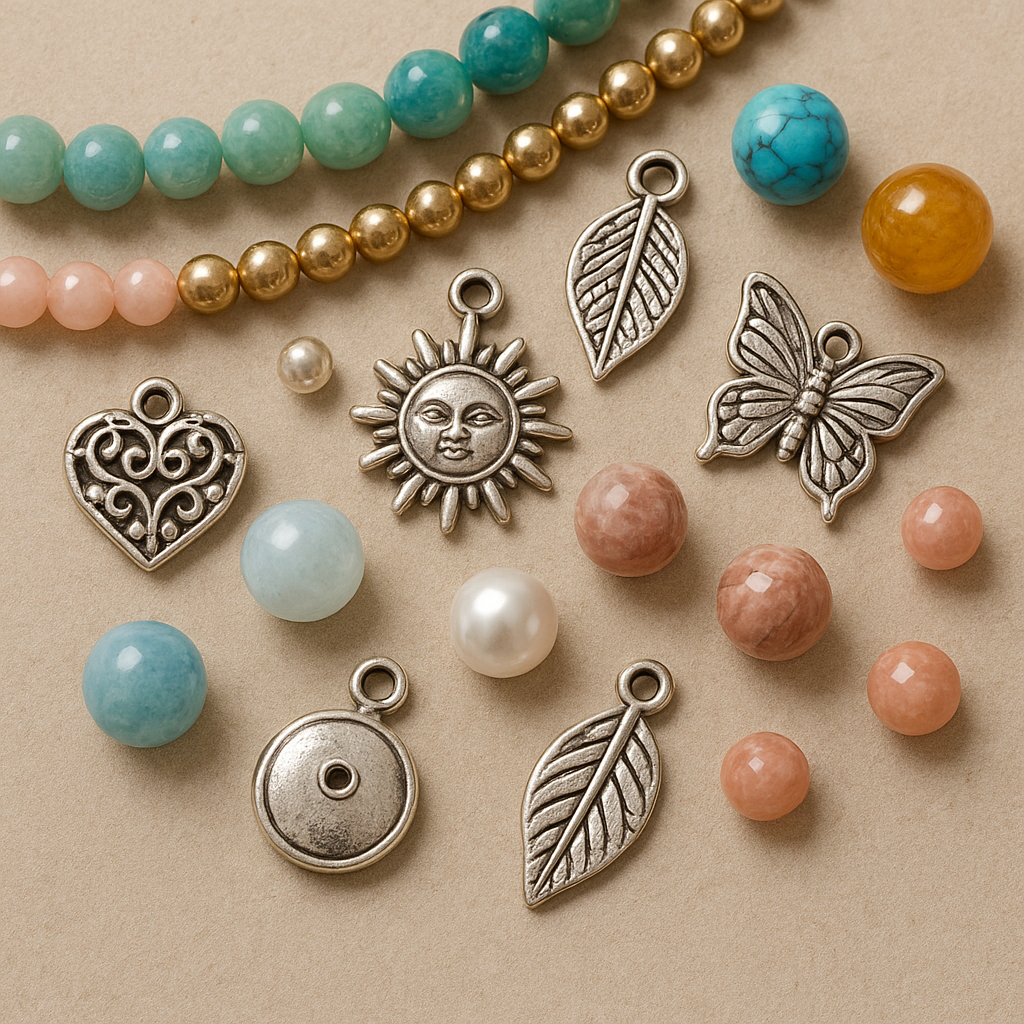
A string of glass, a pendant shaped by a silversmith, and a story waiting to be worn. Combining beads and charms is a small act of design that brings tactile delight and personal meaning to the world of handicraft. Whether you’re threading your first bracelet or refining a signature collection, the union of materials, shapes, and small talismans offers limitless avenues for expression. What follows is a practical and imaginative guide to pairing beads and charms so your pieces feel intentional, wearable, and alive with detail.
The Foundation: Understanding Beads, Charms, and Their Roles
Beads are the rhythm of a piece; charms are the punctuation. Beads create continuity, establish color and weight, and anchor the eye along a path. Charms interrupt that path on purpose, drawing attention, adding meaning, and inviting touch. When you understand each element’s function, you can orchestrate them with greater confidence and creative freedom.
Beads come in countless materials: glass, gemstone, metal, ceramic, clay, shell, wood, resin, polymer, bone, and recycled composites. Each has personality—gems feel refined, wood feels earthy, glass feels luminous. Charms often carry imagery, symbolism, or engraving: moons, leaves, initials, protective eyes, tools, animals, abstract geometry. Some charms move freely; others are fixed as drops, links, or connectors. Think of beads as your melody and charms as soloists that step into the spotlight.
In practical terms, a charm can be a focal or a supporting accent. A single charm anchored by a symmetrical array of beads creates a classical look. A cluster of small charms woven into a textured bead sequence reads more bohemian or playful. When in doubt, decide which element is the protagonist. If a detailed charm is the star, keep beads quieter. If your bead strand is intricate, choose a simple charm that amplifies, rather than competes with, the strand’s voice.
Materials and Finishes: How to Match and Contrast
The interaction of surface and sheen is crucial. Matte beads with satin-finish charms create a soft, modern feel; bright-cut metal charms against faceted crystals yield a glamorous sparkle. Set up intentional contrasts or smooth continuities. The key is to develop a palette: a limited set of materials that reinforce one another instead of scattering attention.
Common pairings that rarely fail:
- Polished gemstone beads with brushed brass or antiqued bronze charms for warmth and depth.
- Wood or coconut shell beads with hammered sterling charms for a rustic-elegant blend.
- Opaque Czech glass with stainless steel charms for crisp, modern clarity.
- Seed bead ropes with enamel charms for color layering and playful accents.
If you mix metals, do it on purpose. Repeat each metal at least three times across the piece so it feels like a choice, not an accident. For instance, combine a gold-tone charm, two gold spacer beads, and a gold clasp even if the chain is silver. Repetition is visual glue.
Consider weight and movement: a heavy charm requires sturdier beads and stringing, while a delicate charm can get lost among chunky beads. Match weight with intention so the piece wears comfortably and sits correctly on the body.
Color, Scale, and Form: Principles for Cohesive Designs
Color is emotion in beadwork. Choose a dominant hue and a supporting partner, then add one unexpected pop to keep the eye awake. Use a color wheel if you like: complementary pairs (blue–orange), analogous runs (teal–green–chartreuse), or split complements (blue with red-orange and yellow-orange). Let charms echo or challenge these choices: a teal enamel charm can knit a palette together, while a copper charm can add warmth to cool blues.
Scale and form carry as much weight as color. Mix sizes deliberately—seed beads next to medium rounds, then a larger accent bead near a charm—to create a visual crescendo. A single oversize charm looks elegant when surrounded by smaller beads in a repeating cadence. Conversely, multiple small charms are best balanced with mid-size beads that don’t dwarf them or make the piece look busy.
Two design guides help every maker:
- composition: the way elements are arranged to direct the eye.
- harmony: the sense that parts belong together without monotony.
Keep an eye on balance—not just left-to-right symmetry, but visual weight distribution across the entire design. A charm cluster on one side can be balanced by a color block or a secondary charm on the other. Embrace texture by mixing smooth beads with faceted, matte with glossy, tight coils with open links. And mind proportion: a charm should relate to the beads around it like a headline relates to paragraph text—noticeable but not shouting.
Techniques for Combining Beads and Charms
Stringing and Spacing
Use bead caps and spacer beads to frame a charm. Tiny rondelles on either side of a charm loop add breathing room and prevent abrasion. Add crimp covers near focal areas so hardware doesn’t distract from your design. For bracelets, space charms so they don’t collide uncomfortably on the wrist, especially around the underside where they can snag.
Wire Wrapping and Connectors
Wire-wrapped loops offer both function and ornament. A neatly wrapped loop—with consistent coils and trimmed tails—elevates the look and improves strength. Add pre-made connectors, such as figure-eight links or small geometric frames, to introduce air into dense bead runs. For multi-charm drops, use varying chain lengths to create a cascading silhouette that moves naturally.
Bead Weaving and Loom Work
In bead weaving, charms can be anchored to picots, fringe, or as centerpieces framed by bezels. In loom work, leave a thread path or metal bar segment to attach charms symmetrically. Consider the drape: flat woven panels pair nicely with a single charm at the bottom edge to emphasize length and movement.
Knotting and Macramé
Silk-knotting between beads amplifies elegance and protects gemstones. In macramé, leave intentional gaps to dangle charms from lark’s-head or cow hitch knots. Cord thickness changes the mood: fine cord with tiny charms reads minimal; thicker cord with big charms feels bold and tactile.
Chain and Charm Stations
Chain allows modularity. Create stations by interspersing short bead segments along a chain, then hang charms from jump rings at preplanned intervals. Use soldered rings or double rings for security. Vary chain gauge so the necklace feels unified rather than segmented.
Design Frameworks You Can Trust
Consider these compositional archetypes when mixing beads and charms. They’re easy to adapt and hard to get wrong.
- Center Focal: A classic strand of beads leading to one charm at center. Works for gemstones and pendants; adjust bead size to “step down” as you move away from the middle.
- Scattered Charms: Evenly spaced small charms across a bead strand. Keep spacing consistent to avoid visual clutter and maintain rhythm.
- Asymmetrical Pairing: One side hosts a small charm cluster; the other balances with a color block or unique bead. Asymmetry feels modern and curated.
- Lariat Logic: A long strand with no clasp; the charm acts as a functional weight that threads through a ring or loop.
- Layered Set: Multiple necklaces—one bead-heavy, one charm-forward—worn together. Design them to interlock visually without tangling.
Project Blueprints: From Concept to Wrist, Neck, and Ear
Necklace Ideas
Try a gemstone rondelle strand in cool grays with a single hammered disc charm. Add micro spacers every five beads to create breathing room. For a storytelling piece, choose three small charms that represent milestones and separate them with sections of different bead families—wood for growth, shell for travel, and hematite for grounding.
Bracelet Ideas
Wrap bracelets with alternating bead textures make ideal charm hosts. Place a main charm at the top and two smaller charms off-center for motion. For stretch bracelets, keep charm weight low and attach via a bail that doesn’t stress the elastic; reinforce the knot with a dab of flexible adhesive and hide it in a larger bead.
Earrings and Ear Climbers
Use petite charms to add personality to bead drops; keep overall weight in mind. Repeat materials from a matching necklace, but avoid perfect duplication. Ear climbers benefit from linear beads (bugles or bars) and a tiny charm at the tail for subtle swing.
Anklets and Bag Charms
Anklets demand comfort and abrasion resistance—use smooth beads where the chain meets skin and attach a small charm that won’t snag on shoes. Bag charms invite scale: oversized beads and bold charms are welcome. Reinforce jump rings and consider swivel clasps to prevent twisted strands.
Advanced Concepts: Layering, Narrative, and Mixed Media
Layering is about controlled abundance. Choose one dense bead strand, one airy chain with a charm, and one mid-weight piece. Repeat a single defining element—color, metal finish, or motif—across all layers so they speak the same language. Stagger lengths by at least 2–3 cm to minimize overlap and tangling.
Narrative design turns jewelry into a wearable diary. A charm of a compass can pair with blue-green beads to suggest sea voyages; a tiny leaf with wood beads whispers forest walks. Lean into symbolism that resonates with the wearer—a moon for cycles, a key for thresholds, a bee for diligence. Group charms by theme and punctuate with beads that echo the story’s tone.
Mixed media opens the door to fabric, leather, ceramic shards, resin inlays, and found objects. Keep your editing strict. If you include a textile element, relate its color or pattern to your beads. If a found object is the charm, upgrade surrounding components to honor it—a vintage button deserves a carefully chosen chain and precision wrapping.
Troubleshooting, Adjustments, and Design Rescues
If a piece feels “off,” test one variable at a time:
- Too busy: Remove one charm or simplify bead patterns near focal points.
- Flat or dull: Add a contrasting finish—matte next to gloss—or a faceted accent near the charm.
- Unbalanced: Mirror a motif, shift a charm station, or introduce a counterweight with color or form.
- Awkward drape: Lighten the charm, shorten the chain, or distribute weight with additional bead stations.
- Color clash: Insert neutral buffers—hematite, smoky quartz, black spinel, shell, or metal spacers.
Photograph your piece and view it in grayscale. This reveals value contrast, showing whether your charm disappears or dominates too strongly. Rotate the piece on a bust or wrist to check how gravity repositions elements during wear.
Care, Wearability, and Longevity
Every design choice should respect the piece’s lifespan. Choose cords, wires, and findings to match expected use. Silk is elegant but fragile; nylon-coated cable is robust; flexible beading thread works for weaving; leather adds character but needs gentle care. Test jump rings for gaps and use the correct plier technique to twist, not pry, rings open and closed.
Finish quality is part of craftsmanship. Tuck wire tails cleanly, match coil counts on wrapped loops, and align bead caps. Consider skin contact: avoid rough or overly pointy charms where they may rub. When designing for everyday wear, prioritize comfort and durability as highly as aesthetics.
Sourcing Ethically and Responsibly
Materials carry stories beyond the studio. Seek suppliers who disclose origin and treatment of gemstones, metal content, and labor practices. Reuse and upcycle where possible: vintage charms, reclaimed metal, and repurposed beads lend soul and lighten environmental impact. Treat sustainability as a core design constraint, not an afterthought, and your work gains integrity along with beauty.
For metals, look for recycled sterling or brass and lead-free alloys. For beads, consider fair trade glass, responsibly mined stones, and local artisans. Document sources in your shop notes—transparency builds trust with clients and deepens your own relationship with the piece.
Personal Style, Market Fit, and Signature Details
Developing a personal style starts with consistent choices: a favored metal finish, a recurring motif, a specific color family, or a recognizable way you attach charms. Maybe you always frame a focal charm with tiny seed bead halos, or you finish every piece with a hidden tag. These micro-decisions become your signature and help customers recognize your work.
If you sell your jewelry, think in collections. Curate a set around a theme (lunar phases, botanical line drawings, oceanic blues) and vary scale and price points within it. Tell the story of your materials. Sign your pieces discreetly and package them with care instructions.
Workflow: From Sketch to Showcase
A simple, repeatable process elevates results:
- Define intent: one-sentence summary of mood, wearer, and occasion.
- Create a palette tray: 3–5 bead types, 1–2 metal finishes, 1–3 charms.
- Mock up on a bead board: test spacing, count beads, adjust stations.
- Build in stages: focal assembly, side strands, clasp area.
- Quality check: tug tests, loop inspection, surface cleaning.
- Photograph in natural light: show scale, movement, and detail.
Document measurements and sources. Note what worked and what didn’t. Iteration is the quiet teacher behind refined jewelry.
Color Stories and Seasonal Rotations
Seasonality can inspire combinations without trapping your style. Spring invites translucent glass, soft greens, and small botanical charms. Summer supports saturated beads and nautical motifs. Autumn welcomes warm metals and wood with leaf or harvest charms. Winter suits cool crystals, hematite, and minimal geometric drops. Rotate not just colors but also bead sizes and densities, keeping your catalog lively.
Durable Mechanisms and Security
Strong attachment points keep charms safe. Use split rings for high-movement charms, soldered jump rings for heirloom pieces, and locking clasps for bracelets. Test knots with staged tension; if a knot creeps, switch material or knot style. For heavier charms, anchor to a bead link rather than directly to a thread path, reducing stress on fibers.
Ergonomics: How a Piece Feels in Motion
Consider how the body moves. On necklaces, place the heaviest elements near the sternum. On bracelets, avoid bulky charms near the keyboard side of the wrist. For earrings, keep the center of mass close to the lobe to reduce torque. Practice-tilting your bust and hand forms can reveal pinch points before your customer discovers them.
Developing an Eye: Critique and Refinement
Train your eye through mini-experiments. Build three variations of the same design using different charm placements; photograph them side by side; note which directs the eye best. Study museum jewelry and vintage pieces; sketch their structures. Notice how masters use repetition, contrast, and negative space to orchestrate calm and surprise.
Keep a swatch book of bead-and-charm pairings you love. Glue a few beads and a duplicate charm to a card, jot down sources, finishes, and thread types. This toolkit of references speeds up future projects and helps you maintain consistency across collections.
Common Pitfalls and How to Avoid Them
- Under-supporting a focal charm with too-thin thread or an open jump ring. Solution: upsize threads, use closed or soldered rings, or add a bail.
- Unclear hierarchy among elements. Solution: pick one focal, reduce competing textures nearby, and reinforce it with subtle repeats.
- Over-reliance on one material. Solution: add a secondary finish or a contrast bead to create depth.
- Neglecting skin tone interaction. Solution: test warm vs. cool metals and adjust saturation for flattering wear.
- Ignoring maintenance realities. Solution: provide care advice and choose finishes that age gracefully.
Exercises to Spark Originality
- Limit Challenge: Use only three bead types and one charm. Explore seven arrangements.
- Scale Swap: Design the same piece in micro (seed beads, tiny charms) and macro (large beads, oversized charm).
- Monochrome Mood: One color family, multiple finishes—matte, gloss, faceted, enamel—to study surface interplay.
- Story Seed: Choose a single word—harbor, orchard, eclipse—and build a palette and charm set around it.
- Material Echo: Start with a charm finish and echo it three times in beads or findings for cohesion.
Glossary of Useful Ideas
versatility helps a design move from day to night; quick-change charms on lever-back earrings or a convertible necklace-to-wrap-bracelet are customer favorites. If you’re tempted to add “just one more” element, test the piece without it; subtraction often reveals clarity. Mind negative space: areas of rest let detailed charms breathe and shine.
From Hobbyist to Artisan
As your skills grow, your choices become more deliberate. Keep records of your costs, time, and methods so you can price honestly. Consider limited editions around rare charms or handmade beads. Collaborate with other makers—ceramicists, woodworkers, or metal artists—to co-create unique elements and expand your creative vocabulary.
The Quiet Rules That Keep Designs Strong
- Repeat a key element three times for cohesion.
- Contrast one major aspect at a time: color or scale or finish—rarely all three simultaneously.
- Check sightlines and movement; gravity is part of your toolkit.
- Finish cleanly; visible workmanship becomes part of the aesthetic.
Trust your eye, but also trust prototypes. Wear-test your own pieces to learn how they age, sound, and feel through a day. Comfort and reliability are silent compliments your customers will feel even if they can’t articulate why.
Closing Perspective: Your Voice in Small Artifacts
A bead strand is a corridor; a charm is a door that opens onto meaning. Curate your materials, respect your wearer, and let intent guide detail. When your methods, materials, and motifs align, you get more than a pretty object—you get a small, wearable narrative. Aim for enduring harmony, clean composition, and faithful balance, guided by sensitive proportion and engaging texture. Let your craftsmanship affirm your care, your symbolism carry the story, and your choices around durability and sustainability honor both the wearer and the world that provides the materials. With this approach, beads and charms become more than parts—they become a language only your hands can speak.
