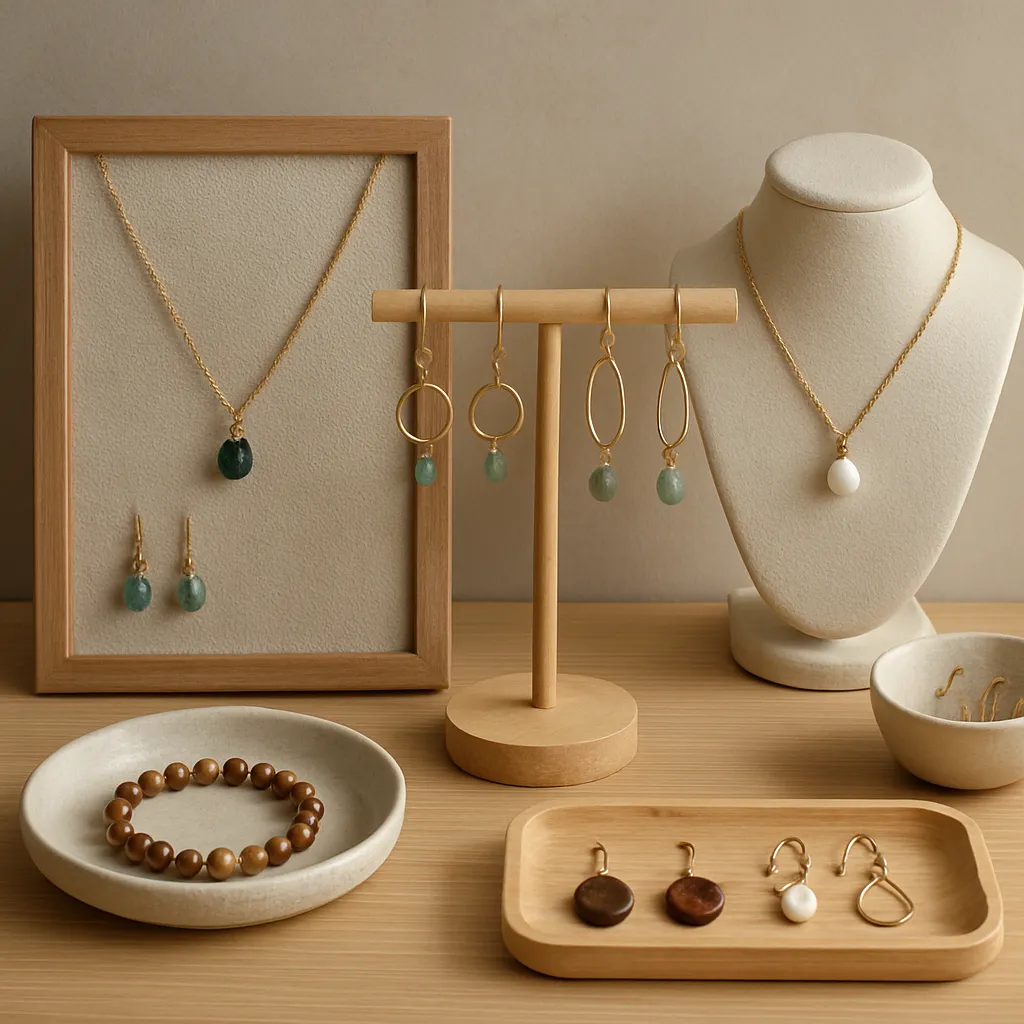
Jewelry made by hand carries memory, patience, and tactile intelligence. Set in the right context at home, each piece becomes a small sculpture that reflects who you are and how you like to live. Instead of hiding earrings in tins and necklaces in drawers, think of your walls, shelves, and dressers as stages where metal, beads, fiber, and stones perform. A thoughtful handcrafted arrangement not only protects and organizes but also energizes a room, easing your morning routine and inviting conversation. The following ideas blend studio know-how with interior design, so you can create a personal display that looks intentional and feels effortless.
Principles That Make Jewelry Look Exceptional at Home
Before you pick up a nail or a glue gun, it helps to understand a few visual rules that apply across mediums, from painting to pottery. They will serve you every time you refresh your setup, add new work, or move to a different space.
First, consider curation. This is the art of choosing what shows together and what waits its turn. In practical terms, that means grouping by metal tone, finish, or theme to avoid visual chaos. Gold, brass, and warm wood often sing as a set; oxidized silver, patinated copper, and cool linen have a quieter conversation. If you love eclectic mixes, set limits within your mix—maybe one dominant metal, one accent color, and one natural material—so the eye has a home base.
Next, practice composition. Imagine an invisible triangle over your arrangement. Place the tallest stand or the lengthiest necklace at one point, the densest cluster of rings or brooches at another, and a negative space at the third. This triangle guides the gaze in a loop, making your collection feel deliberate. Vary height and mass: thin bangles look richer against a broad cuff; a delicate chain becomes more legible draped near a matte ceramic dish.
Respect proportion. Small studs get lost on a large board unless they are grouped; statement pendants can overwhelm a petite tray. Match the scale of the support to the jewelry: narrow velvet ribbons for fine chains, 10–12 mm wooden dowels for bangles, shallow dishes for rings. If you are using frames or shadow boxes, let the jewelry occupy roughly two-thirds of the usable space and keep one-third open; the breathing room dignifies each piece.
Lean into texture. Jewelry is tactile, and so should be its background. Linen mat board, unfinished wood, raw clay, and soft felt each cast light differently and alter the mood of metal and stone. Slick acrylic reflects sparkle; chalky plaster gentles it. When in doubt, set shiny against matte and smooth against fibrous surfaces. The textural counterpoint prevents glare and keeps smaller details legible.
Balance color temperatures in your finishes and environment. Warm brass on a cool-gray wall stands out; rose-gold sings against off-white plaster; bright silver prefers mid-tone backdrops over stark white, which can wash it out. If your jewelry includes vivid enamel or beads, limit surrounding hues to neutrals so that color remains the star.
Finally, embrace rhythm. Repetition—three ring cones in ascending height, five hooks at even spacing—creates order. Add a playful syncopation by altering one unit’s height or finish. The repeat calms; the variation intrigues.
Wall-Mounted Ideas That Save Space and Add Drama
Walls are underused, especially in small homes. A vertical arrangement keeps surfaces clear and turns jewelry into art. Consider load, reach, and ease of cleaning when choosing a solution.
Pegboard, Elevated
A wooden or metal pegboard transforms into a customizable gallery. Spray it a soft matte color that complements your metals. Use short pegs for necklaces to keep them front-facing and longer pegs for stacks of bangles. Add mini shelves for brooches and hairpins laid flat. Map out a grid on kraft paper first; tape it to the wall, test positions with painter’s tape and paper cutouts of your largest pieces, then commit. For a refined look, cap pegs with rubber stoppers to prevent scratches and to keep items from slipping off when you dust.
Framed Textile Panels
Stretch linen, cotton duck, or cork behind a shadow-box frame. Upholstery pins, tiny brass cup hooks, and T-pins become attachment points. Because fabric fibers grip gently, chains do not slide as easily as on wood. If you prefer velvet, choose a low-pile rayon or cotton velvet to avoid shedding onto delicate chains. Mount the frame with French cleats for stability and ease of removal when you want to rearrange. For depth, add 1–2 cm spacers so the glass never touches the jewelry; remove the glass entirely for daily-use frames to improve access and airflow.
Branch or Driftwood Rail
Find a straight, dry branch about 2–3 cm thick. Sand lightly, seal with a clear matte varnish or shellac, and suspend it with leather cords or jute twine from brass ceiling hooks. Screw in tiny cup hooks along the underside at 4–6 cm intervals for necklaces and 8–10 cm for bracelets. The organic profile flatters hammered metals and beadwork. Place it near a wall corner so long pieces hang without tangling in door drafts.
Ceramic and Clay Hooks
If you enjoy clay work, roll coils and shape shallow hooks, then fire and glaze. Space them in a stepped pattern on a narrow board and mount with wall anchors rated for at least 10–15 kg. Ceramic’s hardness resists wear from chain links, and its glaze offers a color accent. For renters, epoxy alternative: affix hooks to a wood plank and hang the plank with removable picture strips, distributing weight across several strips to protect paint.
Magnetic Bars for Brooches and Pins
Repurpose knife-safe magnetic bars by covering them in leather or felt sleeves. Magnet strength varies; test with your heaviest pin before final install. This setup keeps pin mechanisms closed and ready while showing the front design clearly. Keep a small tray beneath to catch any clutch backs if you switch pieces in a hurry.
Tabletop and Dresser Displays That Invite Daily Use
Horizontal surfaces make it simple to put things away at day’s end, which reduces tangling and lost mates. Think in zones: arrival, edit, and archive.
Trays and Lipped Boards
A shallow tray, 2–3 cm deep with a felt or linen base, corrals daily favorites. Choose a tray size that fits the furniture footprint—leave at least 5 cm around its perimeter so the vignette can breathe. Panels of suede or cork keep pieces from sliding; avoid synthetic foams that off-gas and may discolor metals over time. Add a small dish within for studs and earring backs so they do not migrate.
Ring Cones and Micro Stands
Ring cones from ceramic, wood, or cast jesmonite display profile and make selection quick. For variety, cluster three cones of different heights on a coaster-sized stone slab. If you craft stands, drill shallow 2–3 mm holes into a hardwood block and set in brass rods angled slightly backward for drop earrings; cap ends with silicone tubing to prevent scratches.
Busts, Bars, and T-Stands
Necklace busts are classic but can dominate a surface. To keep them elegant, choose matte finishes and keep their scale proportionate to the jewelry. T-stands are efficient for bracelets and hoop earrings; pick a bar diameter similar to the inner curve of your smallest bracelet to avoid stretching. If you use metal bars, wrap them in linen tape where jewelry rests, then secure with clear heat-shrink tubing for a clean look.
Domes and Cloches
Glass domes protect delicate filigree from dust while creating a museum feel. Lift the piece slightly on a small acrylic puck or a slice of unfinished wood to cast a soft shadow and increase presence. Vent periodically; trapped humidity can accelerate tarnish in coastal climates.
Upcycled Materials and Eco-Friendly Approaches
Resourcefulness is a craftsperson’s signature. You can create functional, beautiful fixtures with cast-offs and natural finds while honoring sustainability.
- Shutter slats: Old wooden shutters become earring walls. Clean, sand, and paint them; slot earring hooks over slats. Add small eye screws to the frame’s sides for necklaces.
- Books with broken spines: Hollow a rectangle inside a vintage book, glue pages together, and line the cavity with velvet for a ring casket. Seal edges with matte medium to prevent paper dust.
- Wine cork grid: Slice corks lengthwise, glue flat sides onto a board, then press T-pins between cork cells. The compressibility grips pin stems without bending.
- Textile selvedges: Staple robust selvedges across a frame; they act as soft rails for clip-on earrings and barrettes, and their woven reinforcement resists fray.
- Metal cooling racks: These make instant earring grids. Spray-coat with clear enamel to prevent black rub-off, then mount on standoffs so hooks can pass freely behind.
Build with future change in mind. Embrace modularity: panels that can add, subtract, or swap positions as your collection grows. Use standardized hole spacing and interchangeable hooks. If you move often, design in modules no wider than your narrowest doorway and no taller than you can carry comfortably without tipping a loaded board.
Light, Shadow, and Surface: Making Metals and Stones Come Alive
How you light jewelry determines how it reads—sparkle versus glow, crisp edges versus soft shape. Many homes rely on overhead fixtures that flatten detail. Supplement them intelligently for drama and clarity. A dedicated track with adjustable heads above a dresser, or a pair of clamp lamps fitted with diffusers, changes everything. Prioritize high color rendering so gemstones and patinas appear true. A Color Rendering Index (CRI) of 90 or higher preserves subtle greens in peridot and the deep blues of lapis. Warm 2700–3000 K lamps flatter gold; neutral 3500–4000 K keeps silver bright but not sterile. Control glare with diffusers or bounced light off a white card behind your arrangement.
Position angles to avoid casting long shadows that tangle with hanging chains. Aim one light nearly parallel to the surface to emphasize engraving, and another at 30–45 degrees to lift facets in stones. Consider accenting one area with a slightly brighter beam to draw the eye, like a spotlight over a favorite pendant. When you add mirrors, place lights diagonally, not directly behind you, to avoid reflections in your face as you try things on. A dimmer lets you shift from morning prep to evening mood. Above all, plan lighting like part of the composition, not an afterthought.
Care, Materials, and Protective Practices
Display should never jeopardize longevity. Metals react with air, moisture, sulfur, and even dyes in fabrics. Keep these protection tips in mind as you choose supports and finishes.
- Anti-tarnish aids: Store silver near activated carbon cloths or silica gel packs. Replace or recharge desiccants regularly. Line drawers with acid-free paper; avoid wood surfaces finished with oil that off-gas.
- Fabric choices: Some felts contain sulfur that accelerates tarnish; pick wool felts labeled acid-free or use archival polyester felt. Pre-wash natural fabrics to remove sizing.
- Leather and adhesives: Vegetable-tanned leather can be mildly acidic; seal its surface where jewelry rests. Use low-VOC adhesives and allow full cure times before hanging pieces.
- Gem sensitivities: Pearls and opals need humidity; do not place under hot lights or in sealed domes for long periods. Dyed stones and fabric-wrapped components fade in direct sun; locate them away from windows or use UV-filtering film.
- Spacing: Allow at least 2–3 cm between necklace hang points to avoid collisions when you remove one. For bracelets, leave a finger’s width between stacks to prevent rubbing.
Clean supports as you would furniture: dust weekly, deep-clean seasonally. Remove jewelry before applying cleaners. Check hooks and anchors quarterly, especially in plaster walls, where repeated handling can loosen fixtures.
Small Spaces and Renter-Friendly Strategies
When drilling is off-limits, ingenuity steps in. Over-door racks with S-hooks hold chains without creasing them. Tension rods inside wardrobes become bracelet bars; wrap with linen tape for grip. Slim ladder shelves that lean, rather than mount, provide multiple levels for trays, ring cones, and busts without a single screw. Removable picture strips hold light frames; distribute load across many small strips and keep to weight limits. Narrow hallways can host vertical strips of cork with pinned brooches, creating a gallery that doubles as a last-minute styling checkpoint before you leave.
Workflow: Designing for Everyday Ease
Beautiful is only half the goal; convenient is the other half. Create a landing zone where you naturally take off jewelry. For most, it is by the bedroom door or bathroom sink. Place a small tray and dish there. Next, an edit zone at your main mirror: this is where most pieces live, grouped by frequency. Finally, an archive zone—less accessible boxes or drawers for heirlooms and seasonal items. Rotate monthly: touch everything, wipe fingerprints with a soft cloth, and move forgotten items forward to encourage wear. Assign a tiny brush and microfiber cloth to the edit zone, so cleaning becomes a thirty-second habit, not a chore.
Wall Grids and Shadow Boxes: From Flat to Dimensional
If your collection includes sculptural cuffs or textile jewelry, a deep shadow box gives depth without dust. Mount cuffs on curved acrylic forms attached to the backing with threaded standoffs. For textiles, sew unobtrusive loops to the back and hang from T-pins or tiny hooks; direct light across the weave to enhance relief. On open grids, use small binder clips wrapped in linen tape to hold tags or notes about materials and care—this is especially helpful if you sell or gift pieces and want to remember their stories.
Advanced Approaches: Turning a Nook into a Mini Exhibition
Borrow from gallery practice to elevate a corner into a compelling, personal show. Start with a theme—botanical motifs, travel souvenirs, one maker’s work—and write a single-sentence wall label for yourself. This focuses selections and sequencing. Vary sightlines: place a fine chain at eye level, drop bold pieces lower to meet the torso line when you try them, and keep rings and studs within hand reach. Use small risers under trays to add altitude changes. A narrow shelf can host a flip book of sketches or design notes beside the jewelry, linking process to piece. Add a discreet plinth—a stack of two books wrapped in neutral paper can suffice—to isolate a hero item. This is where storytelling turns ornaments into art.
DIY Tutorials: Four Projects with Steps and Options
Linen-Covered Necklace Rail
- Materials: 50–60 cm hardwood strip, 10–12 brass cup hooks, linen tape, wood screws, anchors, beeswax.
- Steps: Sand the strip; rub with beeswax; wrap front edge in linen tape for a soft contact surface. Pre-drill holes every 4–5 cm; screw in hooks; mount with two screws into anchors or studs. Option: Add a second strip below for bracelets.
- Why it works: Narrow profile keeps focus on the jewelry, and linen reduces micro-scratches on clasps.
Shadow Box with Swap-Friendly Backing
- Materials: Ready-made shadow box, 5 mm foam board, linen fabric, spray adhesive, T-pins, standoffs.
- Steps: Wrap foam board in linen; insert as the box’s backing. Mount standoffs to hold pins away from backing, allowing hooks to pass behind. To rearrange, pull the panel out and re-pin on a table.
- Tip: Mark a faint grid on the foam board’s back for quick alignment without visible lines on the front.
Tiered Tray with Acrylic Risers
- Materials: Two shallow trays, four acrylic cubes or cylinders, museum putty.
- Steps: Place risers at tray corners; set the second tray on top, offset slightly. Secure with museum putty. Arrange ring cones and dishes on the top tier; place cuffs and bangles below.
- Advantage: Compact footprint with varied levels improves visibility and reduces tangles.
Magnetized Brooch Panel
- Materials: Thin sheet steel, frame, linen, strong neodymium magnets, felt pads.
- Steps: Wrap steel in linen; place in frame. Position brooches with their pins closed; capture them with magnets from behind, adding felt pads to prevent scuffing. This avoids repeated pinning through fabric.
- Safety: Keep magnets away from devices and small children.
Color and Material Pairings That Always Work
Some combinations consistently flatter jewelry and echo handicraft heritage. Oxidized silver with ecru linen is timeless; brass against indigo-dyed cotton nods to traditional dye vats while warming the metal; polished copper set on charcoal felt intensifies its glow. Bone and horn sit beautifully on honey-stained wood. If your work features fiber—kumihimo cords, tablet-woven bands—mount on smooth boards or matte papers that contrast the weave so threads read cleanly. For bead embroidery, avoid patterned backdrops that compete with the stitch rhythm.
For Collectors Who Also Make: Studio Crossover
Many who wear handmade jewelry also craft it. Let your tools and materials inform your home arrangements. A spare mandrel becomes a bracelet tower; sanding blocks wrapped in paper become risers; a small bench pin mounted on a wall showcases a favorite pendant-in-progress. Keep a side dish for experimental components—test how a new patina or cord color looks in the mix; your room will guide your next series as much as your bench will. Reserve an empty hook labeled Next so new pieces have a place waiting and the transition from studio to wardrobe feels seamless.
Seasonal Rotation Without Clutter
Different seasons ask for different surfaces and colors. In winter, bring out dark woods and velvet pads that make metals glow. In summer, swap to pale linen, open grids, and airy spacing to echo light clothing. Store off-season items in breathable pouches within boxes lined with acid-free tissue. Keep a simple inventory card taped under a tray: a short list of what is in storage versus on view prevents duplicate purchases and encourages rediscovery. At the changeover, inspect cords for wear, re-knot where needed, and photograph arrangements; pictures help rebuild a favorite setup after a deep clean.
Safety and Longevity in Busy Homes
Pets and toddlers explore with paws and fingers. Place fragile supports higher than 1.5 m; avoid dangly lures near bed edges. Secure heavy frames with two points of contact and a safety cable. In earthquake-prone regions, use museum putty or gel on stands and domes. For bathrooms, assume high humidity: limit permanent storage there to non-porous materials and rotate frequently worn pieces to drier rooms overnight. If you share spaces, add a discreet lockable drawer or box within your main arrangement for heirlooms; out of sight lowers temptation for casual visitors and protects from accidents.
Troubleshooting and Common Pitfalls
- Tangles persist: Increase hook spacing; assign each necklace its own anchor; add a small bead near the clasp to weigh down fine chains.
- Dull-looking metals: Reassess backdrop; try softer, mid-tone neutrals and shift light angle. Avoid harsh overhead-only light that flattens facets.
- Everything looks busy: Remove 30 percent of items; group by metal tone; introduce a coherent line of horizontals or verticals to calm the scene.
- Pieces gather dust: Cover rarely worn items with breathable cloth caps; use domes for filigree; dust weekly with a soft brush.
- Backing stains appear: Switch to archival fabrics and seal raw wood; test materials with a sacrificial charm for a week before full deployment.
Curated Corners: Ideas for Every Room
Bedroom: A dresser-top system with a mirror, tiered tray, and a narrow rail for daily necklaces. Living room: A framed textile panel as wall art that doubles on party nights as a try-on bar for friends. Hallway: A slim earring grid near the exit for last-minute swaps. Studio: A pegboard hybrid that holds both tools and finished pieces, signaling the arc from making to wearing. Even the kitchen can host a small magnetized panel inside a cabinet door for brooches, away from steam and splash. Let each placement respond to how you move through the home; the best setups feel inevitable once installed.
From Storage to Stage: Making It Personal
The most successful arrangements are specific to you—your colors, your habits, your history. Pair a pendant picked up on a trip with a postcard from the same city; rest a grandmother’s cameo against the silk from a dress she loved; tuck a tiny sketch beside a sculptural cuff to honor the idea that sparked it. Rotate a single standout to a solitary plinth or hook now and then; absence elsewhere can refresh your eye. Above all, update without hesitation. Your taste will evolve, your skills will grow, and your home can reflect that evolution with grace. With a handful of principles, material sensitivity, and playful experiments, your jewelry becomes part of the architecture of daily life—quiet in the morning, celebratory in the evening, and always, unmistakably yours.
