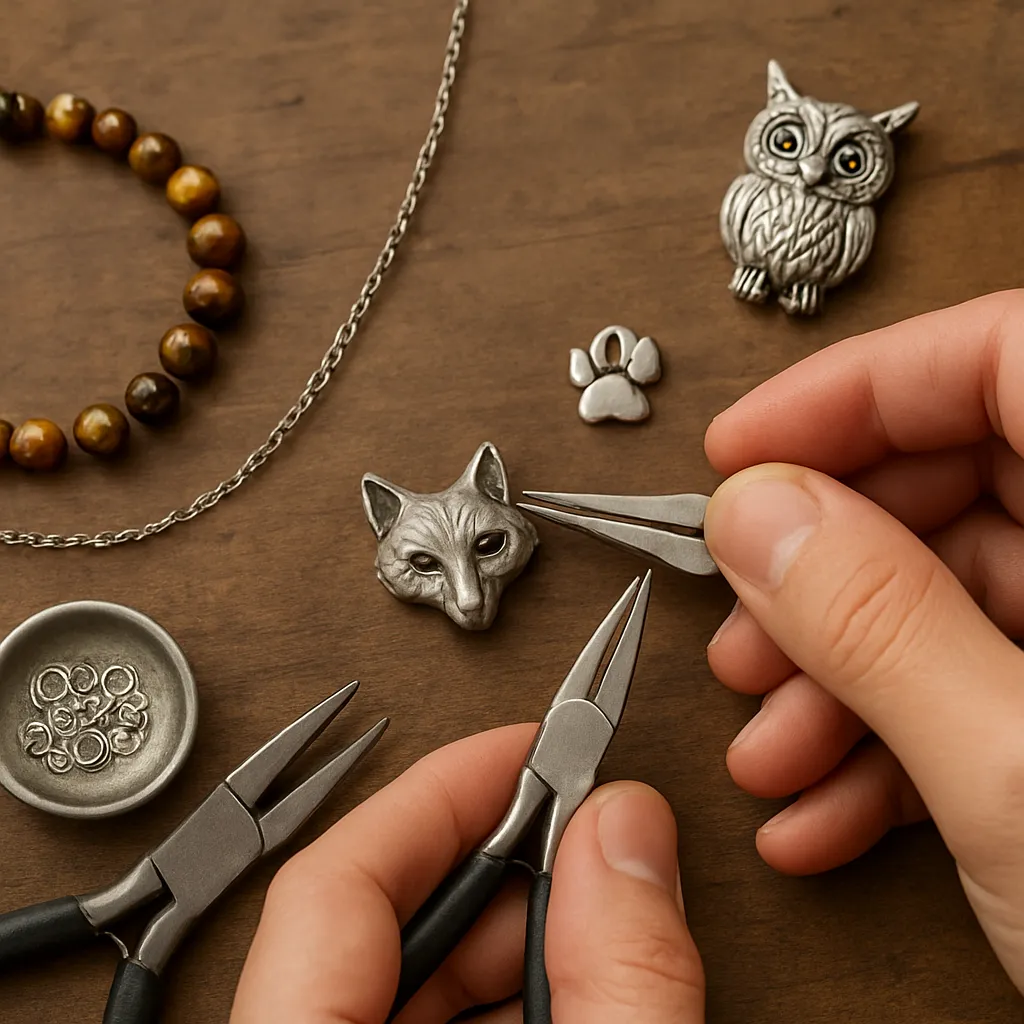
Animal-inspired jewelry brings a living spark to wearable art, translating motion, pattern, and character into metal, clay, fiber, and glass. Whether you’re drawn to the geometry of a bee’s honeycomb, the flow of a koi’s fins, or the quiet poise of a fox, crafting pieces that echo the animal world is a deeply satisfying pursuit. This guide walks you through observation, design, materials, and techniques, then moves into practical project blueprints and advanced finishing approaches that elevate your work from charming to unforgettable. Along the way, it balances aesthetics with ethics, shared traditions with personal voice, and studio craft with daily wearability—so your ideas move gracefully from sketchbook to skin.
The appeal and ethics of animal-inspired jewelry
Across cultures and centuries, animal motifs have symbolized protection, luck, transformation, and kinship with nature. Egyptian scarabs, Norse ravens, Mesoamerican jaguars, and Japanese carp each carry layered meanings—a beautiful reminder that your pieces can speak in more than color and line. Use that power thoughtfully. If your work explores guardianship, migration, or metamorphosis, say so; your collectors may be drawn as much to the story as to the shimmer. Consider adding a card describing the piece’s symbolism to help wearers share its intent with others.
Responsibility is integral to modern studio practice. Avoid real animal parts unless you can verify legality and ethical sourcing; many countries strictly regulate feathers, bones, shells, and protected species. Choose recycled precious metals or certified small-mine options; opt for lab-grown stones or reclaimed gems. For natural textures, try molds from silicone impressions of leaves, pebbles, or ethically sourced fossils rather than wildlife remains. Transparent sourcing strengthens your brand’s integrity and signals real sustainability to your clients.
Finally, think about cultural respect. If you borrow a motif with sacred meaning in a tradition not your own, attribute it clearly and collaborate or seek permission when appropriate. Animal-inspired jewelry can celebrate kinship with the wild; it shouldn’t trample on it.
Observing nature: from creature to concept
Field notes and references
Good animal work begins with seeing. Build a reference library: your own photographs, quick field sketches, museum visits, and reputable image archives. Watch how a creature sits, curls, blinks, or dives—gesture drawings often reveal more truth than a polished portrait. Take notes on proportions: head to body, limb placement, tail taper, and eye size. These ratios become your scaffolding for earrings, pendants, and rings that read instantly as a specific species.
Abstract, stylize, or render realistically
Choose where your work will sit on the spectrum. Abstraction might emphasize a whale’s sweeping arc as a single curve cut from brass. Stylization can simplify a fox’s muzzle into angular planes that catch light. Realism invites fine engraving for fur and feathers. Try three thumbnail series—one abstract, one stylized, one realistic—to evaluate which approach best matches your technical skills, your brand’s voice, and your audience’s preferences.
Silhouette and negative space
Most wearers decide at a glance; your first job is clarity. Distill the animal to a recognizable silhouette before worrying about surface details. Punchy negative spaces—like the crescent between wing and body of a swallow—help the form breathe and reduce weight without weakening the piece. Keep a paper punch-out of your design; if it reads from across the room, your metal version will sing.
Materials and tools for animal forms
Every material offers distinct personality and technique pathways. Metals such as silver, copper, brass, and bronze are versatile for cutting, texturing, and patination; titanium and niobium add vivid anodized color. Polymer clay is excellent for sculptural miniatures and complex color canes that mimic feathers or scales. Metal clay (fine silver, bronze, copper) allows you to sculpt, texture, then sinter into solid metal—perfect for small, detailed creatures. Enamel brings luminous color; glass cabochons evoke beetle sheens or fish eyes; wood adds warmth and organic grain.
For adhesives and encapsulation, UV-cured or two-part resin can preserve tiny illustrative scenes—think a bee suspended over gold-leaf honeycomb—or magnify textures. Ethically sourced horn or bone lookalikes, such as plant-based biopolymers, can replace restricted materials while maintaining a natural aesthetic.
Core tools include jeweler’s saw, bench pin, pliers (round, chain-nose, flat), files, needle files, sandpapers, burnishers, chasing tools, texturing hammers, dapping blocks, ring mandrels, bezel pushers, and a sturdy vise. For metalwork, add a torch, soldering station, pickle pot, and ventilation. Power assists like a flex shaft or micro-motor speed up drilling and polishing. For clay and resin, stock sculpting tools, silicone texture mats, and molds. Always pair tools with sensible PPE: safety glasses, particulate mask for sanding, and fume extraction for soldering, enameling, and resin.
Keep a notebook of process notes—the order of operations matters. A reliable workflow reduces mistakes and protects surface finishes you’ve worked hard to achieve.
Techniques that evoke fur, feathers, scales, and skin
Fur and hair
Fine burr engraving creates directional fur: vary line density and depth to shape volume around cheeks and shoulders. On metal clay, you can incise fur while greenware is leather-hard, then refine with sanding sponges. For polymer clay, use a needle tool or stiff brush to texture, then backfill with diluted darker paint and wipe back to accent grooves.
Feathers
Feather vanes translate beautifully into cloisonné or champlevé enamel; partition cells for barbs and rachis, then gradate color to mimic iridescence. On sheet metal, chasing and repoussé lift feather quills and breathe life into wings. For simplified motifs, roll-print a feather from a laser-engraved brass plate or a steel screen; the compressed textures remain crisp through patination.
Scales and armor
Granulation and micro-prong dotting can suggest reptilian skin, while punch-and-dome sequences create overlapping fish scales. Light catches the lips of each dome, suggesting movement in water. Alternating matte and polished finishes adds dimensional depth.
Skin and shell
Turtle shells respond well to inlay: recess channels and hammer in contrasting metal (shakudō, shibuichi, brass) to map scutes. Beetle wing effects emerge from color-shift mica powders under resin domes or with foils beneath transparent enamel. For leathery textures, press dried leaves, linen, or fine sandpaper into annealed metal via rolling mill.
Color, shine, and shadow
Selective polishing highlights crests and ridges, while patination deepens recesses. Think like a painter: push contrast to keep forms legible at jewelry scale. Rich patina on copper or silver makes feathers and fur pop; tiny burnished areas read as catchlights in eyes. Enamel or resin tints deliver saturated color for butterflies or poison-dart frogs; titanium anodizing conjures hummingbird throats.
Building forms: settings, structure, and believable motion
A successful animal piece must look alive and also survive a decade of wear. Structure matters. Start with an armature or base plate that defines primary planes—spine curve, wing sweep, belly line. Add elements with solder or cold connections; select which parts need to flex or float.
Settings and eyes
Cabochons, rose cuts, and round brilliants all make expressive eyes. Bezel settings are secure and sleek; tube settings add sparkle. Dark backing foils intensify stone color and keep pupils deep. Micro-pavé along a snake’s back twinkles like scales; a single onyx cab can anchor a raven’s gaze.
Hinges, rivets, and chain
Movement sells the illusion of life. Segment a fish into head, body, and tail with discreet hinges; weight the tail so it sways naturally. Use rivets to let wings quiver or antennae nod. Snake chains naturally suggest slither; multi-strand cable can echo whiskers. This is the craft of articulation—where engineering supports expression.
Hollow forms and weight
To keep earrings comfortable, build hollow forms with two domed halves soldered together, then pierce hidden relief holes to equalize heat during soldering and to reduce vacuum when polishing. Reinforce stress points—jump rings, hinges, bails—with thicker stock. Test closures repeatedly; a secure clasp is invisible until it fails.
Color and finish: from sheen to storm
Surface treatment is the soul of animal motifs. Liver-of-sulfur on silver yields warm greys to inky blacks; ammonia fuming on brass tips toward deep brown. Heat patina on copper gives peacock blues and magentas that pair beautifully with beetle and butterfly themes. Seal patinas with microcrystalline wax unless you want an evolving surface.
Enamel—transparent, translucent, or opaque—lets you layer color like feathers. Counter-enamel backs to balance stress. Try basse-taille over engraved metal for scales that glow from within, or plique-à-jour for dragonfly wings that catch the sun. Resin, carefully mixed and bubble-managed, can suspend glitter, foils, or tiny painted details; UV doming resins are ideal for small eyes and shell segments.
Project blueprints: four animal motifs
Honeybee and honeycomb pendant
Concept: A sculpted bee rests over a geometric honeycomb, blending organic and architectural cues.
- Materials: Sterling silver sheet (0.8–1.0 mm), fine silver bezel wire, small citrine or amber cab (for nectar glow), metal clay for the bee, liver-of-sulfur, hard/medium solder.
- Process:
- Saw a hexagonal honeycomb grid from sterling sheet; file and sand clean.
- Model the bee in metal clay using silicone honeycomb textures for the abdomen; dry, refine, and fire to sinter.
- Solder a bezel cup into one cell for a small stone “drop.”
- Solder jump rings and bail; pickle and clean.
- Patinate, then selectively polish highlights on edges and bee thorax.
- Set the citrine/amber; add a matte finish to the comb to contrast with the polished bee.
Articulated koi earrings
Concept: Three-part hinged koi with scalloped scales that shimmer as the wearer moves.
- Materials: Copper or silver sheet (0.6–0.8 mm), wire for hinge pins, tiny tube settings for eyes, red/orange enamel or resin tints.
- Process:
- Pattern head, body, and tail segments; saw, refine, and dapple scale texture with a round punch.
- Drill hinge knuckles; create staggered barrels; insert and flare wire pins to lock.
- Seat tube settings for small black spinels or onyx eyes; solder and clean.
- Apply enamel or resin gradients on scales; keep hinges free of color media.
- Attach ear wires; test swing and balance for comfort.
Fox signet ring
Concept: A low-relief fox head in profile on a substantial signet—calm, cunning, and timeless.
- Materials: Bronze or sterling silver, carving wax or metal clay, ring mandrel, liver-of-sulfur.
- Process:
- Design a simplified fox with clean planes; carve in wax or sculpt in metal clay.
- For wax: cast via lost-wax; for metal clay: fire and size to fit with a wrapped core during sculpting.
- Engrave fur direction lightly; oxidize and polish high points of ears, muzzle, and cheek to define form.
Scarab glow brooch
Concept: A beetle with iridescent elytra, poised between ancient and futuristic.
- Materials: Brass or silver backplate, domed elytra in copper, transparent enamel or color-shift pigment under resin, stainless pin finding.
- Process:
- Saw the beetle outline; dome wing cases for dimension.
- Champlevé: recess cells in the elytra and fill with transparent enamel; fire and stone back. Alternatively, seal foils and pigments under resin domes.
- Solder pin mechanism; patinate body; leave wing cases glossy for light play.
Designing for comfort and longevity
Wearers judge jewelry not just by sight but by hours on skin. Commit to ergonomics. Keep earrings under a practical weight; move mass closer to the ear by compaction or hollow construction. Smooth every touchpoint—bail interiors, ring shoulders, brooch backs—so clothing and skin aren’t irritated. Use reliable clasps and test them repeatedly. Position bails or pin stems at the balance point to prevent flipping.
Consider seasonal and situational wear: articulated pieces look fabulous at events but may snag on knits; suggest appropriate use in your aftercare note. Build repair pathways into your design—standard jump ring sizes, replaceable pins, accessible bezels—so maintenance is straightforward for you or any bench jeweler years later.
Storytelling, branding, and presentation
Collectors love narratives. Share the moment that sparked the piece: the heron you sketched at dusk, the childhood book with a mysterious fox, the tidepool you revisit each summer. Package with a care card and a short note. Include metal and stone details, finish type, and sourcing statements to provide clear provenance. Photograph work on neutral backgrounds and in context—on a neckline or lapel—to help clients visualize scale and movement.
Price with intention: tally material costs, bench hours, overhead, and a margin that supports reinvestment. Limited series and signed editions can underscore rarity; open editions keep signature motifs accessible. If selling online, short videos of articulated creatures can double conversion rates; motion is the heart of animal pieces—show it.
From bench practice to mastery
Refinement comes from repetition and reflection. Keep a studio journal noting torch temperatures, enamel firings, patina recipes, and what you’d change on the next iteration. Save test swatches of textures and finishes labeled with dates and methods. When a design resonates—say, your barn owl earrings—explore variations: different wingspans, night-sky enamel, moons, or gemstone eyes. Over time, a recognizable language emerges—your personal craftsmanship stamped into every piece.
Invest in skill-building: chasing and repoussé courses for sculptural depth, stone setting workshops for complex pavé, and color theory classes for enamel harmony. Peer critique groups help you see blind spots in anatomy or structural choices. Ask wearers for feedback on clasp usability and comfort after a full day out.
Common pitfalls and how to avoid them
- Over-detailing at micro scale: If you can’t see it at arm’s length, the buyer can’t either. Prioritize shape and contrast.
- Ignoring weight and balance: Heavy pendants on flimsy chains strain jump rings and necks. Match chain and bail size to the pendant’s footprint.
- Weak connections: Cold connections are elegant but only when properly sized; undersized rivets or thin hinge barrels will fail.
- Color without contrast: A riot of enamel hues can flatten form. Use a limited palette with deliberate highlights and shadows.
- Unsealed patinas: Oxides can transfer to skin and clothes. Wax, lacquer, or clear enamel where appropriate.
- Legal missteps: Feathers and bones may be regulated. Substitute aesthetic analogues or documented ethical sources and disclose clearly.
Advanced directions: biomorphic engineering and digital aids
When you’re ready to push boundaries, explore structural biomimicry: shell ribbing for strength-to-weight gains, honeycomb cores for stiffness, or hinge geometries inspired by insect leg joints. 3D modeling and printing can prototype these ideas quickly; you can still finish by hand with files, gravers, and patinas so the final piece retains handmade spirit. Laser engraving offers repeatable micro-textures that become canvases for enamels, while hand chasing restores the touch of the maker. Let digital tools serve your vision, not replace it.
Test wear your prototypes in real life—hours, not minutes—to verify comfort, motion, and durability before releasing a collection. Preserve the improvisational joy of bench work with intentional experiments: swap a standard hinge for a leaf-spring joint on a dragonfly, try a bi-metal lamination for a two-tone wolf, or anodize gradients on niobium hummingbirds.
Care and maintenance: keeping creatures lively
Provide simple care protocols tailored to materials. Advise wearers to remove pieces before swimming, bathing, or heavy exercise; avoid storage in humid bathrooms; keep jewelry in soft pouches or divided boxes. For patinated copper or silver, wipe with a barely damp cloth and dry; avoid commercial dips that strip oxides. Enamel surfaces benefit from gentle soap and water; resin wants microfiber cleaning and careful avoidance of solvents. Offer annual tune-ups: clasp checks, stone tightening, and finish refresh—a chance to reconnect with clients and keep your work gleaming in the world.
A sustainable path forward
Animal-inspired jewelry is an invitation to pay close attention—to creatures, to craft, and to customers. Done well, it honors ecosystems and traditions while opening room for personal myth. By sourcing transparently, designing for longevity, and building pieces that feel good as well as look compelling, you create objects that carry memory and meaning. Each fox, koi, or scarab you send into the world threads another stitch between human hands and the wild, where design, ethics, and wonder meet.
As you continue, refine the essential building blocks—clear silhouette, purposeful texture, and dependable structure—then layer color, motion, and tactile nuance. With practice, your bench notes will evolve into a fluent language: a sweep that says wing, a curve that says spine, a polished pinpoint that says eye. Lean into process discipline—your evolving workflow—and cherish the experiments that surprise you. Over time, your collection becomes a living archive of observation and intention, a testament to the quiet engineering within articulation, the depth-creating alchemy of patina, and the enduring grace of animal forms that feel as if they might leap, swim, or fly at any moment.
Let your practice be an ecology of making: mindful sourcing that signals sustainability, anatomical curiosity that sharpens design, and finishing choices that reward touch as much as sight. When the piece settles onto a wrist or collarbone and the wearer instinctively smiles, you’ll know the elements aligned—the honest craftsmanship, the resonant symbolism, the inviting texture, the balanced ergonomics, and the documented provenance—into one small, luminous whole.
