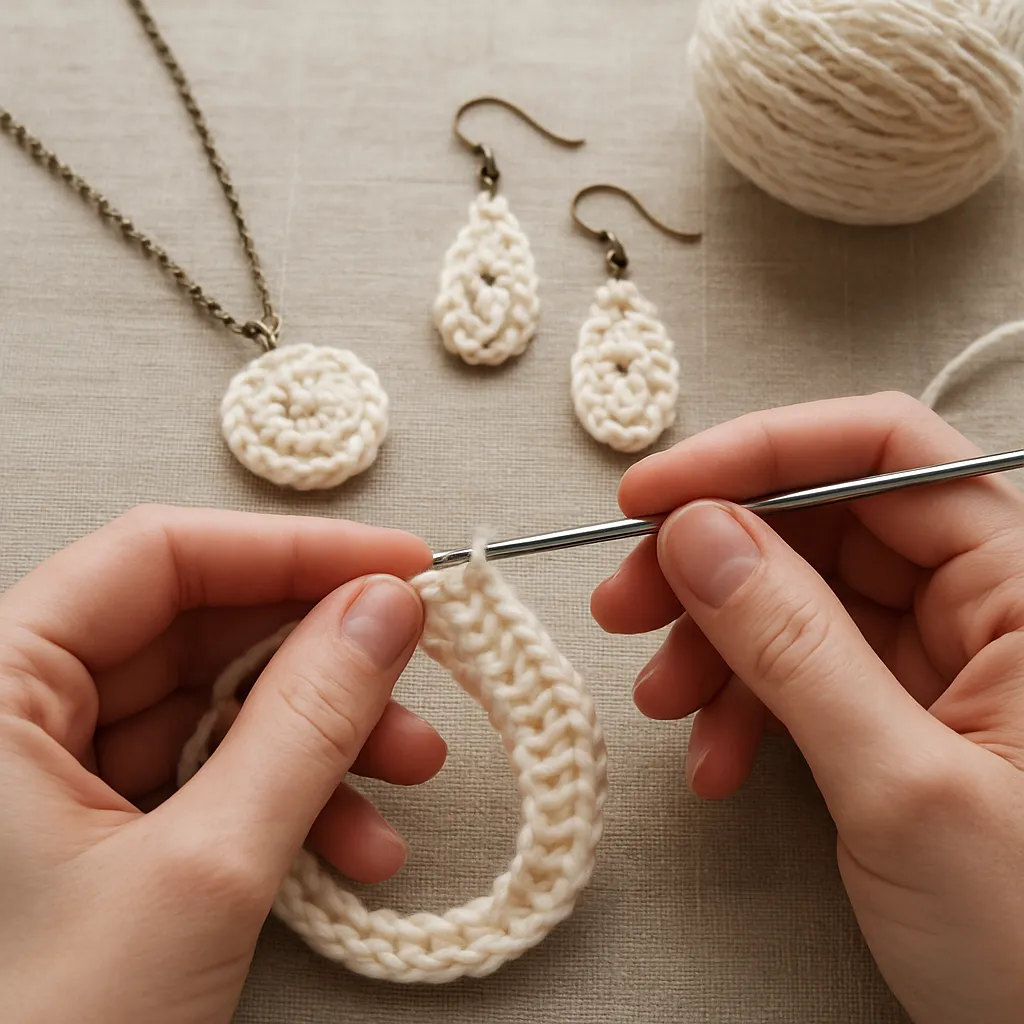
Soft loops of thread can become earrings that sway like petals, cuffs that hug the wrist without clinking, and pendants that seem to float above the collarbone. Crochet jewelry marries the intimacy of handwork with the pleasure of adornment, offering pieces that are light on the body and rich in tactile personality. Whether you’re after boho flourishes, sculptural minimalism, or heirloom lace that looks freshly unearthed from a vintage trunk, this craft gives you control over shape, scale, drape, and surface. With a few spools of thread and a small hook, you can design accessories that travel easily, cost little, and adapt to every wardrobe and season.
Why Crochet Jewelry Feels Different
Unlike rigid metal or clattering glass, crocheted adornments are quiet, warm, and flexible. They rarely snag hair, they compress in a pocket without damage, and they move with the body. Texture is their native language: relief stitches create little hills and shadows that catch light; lace stitches open into air, producing negative space as compelling as the thread itself. Because you’re building each stitch by hand, you can fine-tune every dimension—length, width, thickness, curve—on the fly, as if you were sculpting a tiny, wearable landscape.
There’s also a practical romance to the medium. It’s friendly for travel: one compact hook, a needle, and a card of thread fit inside any pouch. It offers instant iteration: if a curve sits wrong against the neck, you can unravel a few inches and adjust. And it invites storytelling materials—salvaged buttons from a relative’s coat, hand-dyed threads you made from marigolds, or seed beads brought back from a market. Each piece becomes portable biography.
Materials and Tools That Shape the Result
Threads and Yarns
The foundational choice is the strand you stitch with. Mercerized cotton thread (sizes 3–40) yields crisp stitch definition and soft sheen; it’s the classic for lace motifs and precise edges. Linen stands out for cool hand and durability; it softens with wear and becomes comfortably pliant. Silk offers luminous drape and smoothness that elevates even simple stitches. Plant-based blends like bamboo and hemp add earthy appeal and a gentle matte glow. Very fine nylon or polyester micro-cords (such as beading cords) resist stretching and pair well with tiny hooks for intricate micro-motifs. If you love sparkle, look to silk/metallic blends or add a lurex filament held together with your main strand. Natural protein and cellulose fibers each bring unique memory, luster, and strength; sampling is the fastest way to understand how a chosen thread behaves in small, wearable formats.
Hooks, Needles, and Helpful Hands
Steel crochet hooks (0.6–2.5 mm) make tight, jewelry-scale stitches possible. Try several grip styles to avoid hand fatigue; some crafters prefer ergonomic handles, others like the bare-metal feel. Keep a set of fine tapestry needles for weaving ends invisibly and a set of micro-pliers for jump rings and findings. A foam blocking board, rustproof pins, and small measuring tape round out your kit. Good light is essential; a clip-on lamp or head loupe helps for night sessions and dark threads.
Findings and Structural Additions
Jump rings, clasps (lobster, toggle, box, or magnetic), earring wires, and crimp beads allow you to attach crocheted elements securely. Consider hypoallergenic metals like niobium or surgical steel for sensitive ears. Thin craft wire (24–30 gauge) can be crocheted directly or used as armature for petals and geometric forms; in non-wired pieces, rings and stiffeners provide structure without weight. PVA-based fabric stiffener, diluted white glue, or clear, water-based varnish can set lace motifs; always test on a swatch first to ensure the finish doesn’t cloud or yellow.
From Stitches to Sculpture: Building Texture and Form
Foundational Stitches With Big Impact
Simple stitches become architectural when used thoughtfully. Single crochet forms compact fabric perfect for cords and edging. Half double and double crochet open the structure for gentle drape. Slip stitch can create firm i-cord-like tubes and neat, braided edges. Picots add lace-like points, and chains become airy arches.
Texture Makers
Cluster-based stitches—puff, bobble, and popcorn—rise from the surface and throw tiny shadows that make colors read deeper. Front-post and back-post stitches carve ribbing and rings around components, useful for settings that “frame” a bead or cabochon. Solomon’s Knot (Lover’s Knot) yields ethereal netting ideal for lightweight earrings or dramatic necklaces that occupy space but weigh almost nothing. Surface crochet draws lines on top of fabric, adding filigree trails and outlines after the main shape is finished.
Cords, Rings, and Motifs
Romanian Point Lace cord, finger cords, and twisted chains serve as strong necklace bases and bracelet straps. Crochet around rigid rings (metal or resin) to create clean hoops for earrings; use single crochet tightly around the ring to form a tidy bezel. Irish crochet motifs—roses, leaves, shamrocks—shrink beautifully to jewelry scale when worked with thin thread. Combine small motifs into clusters, spacing with small jump rings for fluid movement.
Designing Pieces That Feel and Look Right
The strongest jewelry designs start with the human body. Necklines influence pendant drop; ear lobe shape and hair length determine earring size that reads from a distance; wrist circumference and daily tasks shape bracelet width.
Sketch, Swatch, and Measure
Begin with a small sketch to clarify silhouette and negative space. Follow with a miniature swatch to test stitch density and drape. This is the perfect moment to confirm gauge—even in tiny accessories—because a half-millimeter mismatch compounds across a curved motif. Use the swatch to test color blends and bead placement too.
Wearability and Balance
Plan weight distribution to keep pieces centered. For earrings, position heavier elements lowest and closest to the lobe; stabilize with a small silicone back on ear wires. For necklaces, ensure the heaviest motif sits at the sternum; counterbalance with a short chain extension on the clasp side. Consider ergonomics in every decision: the inner face of a bracelet should be smooth against skin, no wire ends exposed; a pendant’s upper edge shouldn’t scratch the neck; and ear hooks should pass easily through piercings without torque.
Pattern and Iteration
Write a concise working pattern for yourself, even if you’re improvising, so you can reproduce the second earring or expand a necklace symmetrically. Note hook size, thread brand and color, chain counts, and any alterations you make during fitting. Photograph in-progress stages to help reconstruct shaping later.
Project Blueprints You Can Adapt
1) Featherlight Net Necklace
- Materials: fine silk or mercerized cotton thread size 20; 1.25 mm hook; 2 jump rings; lobster clasp; small chain extender; rustproof pins; blocking board; optional seed beads.
- Method: Work a base chain equal to the collar’s length minus 2 cm for clasp mechanics. Row 1: single crochet across for a firm top edge. Row 2: begin Solomon’s Knots, alternating long and short loops to create gentle scallops; pin to board as you go to check arc. Row 3: anchor each long knot with a single crochet into the knot’s center; optional: add a bead into every other knot before anchoring. Finish: add end tabs of single crochet for strength, attach jump rings and clasp, then block to final curve.
- Fit: Try on before finishing to confirm that the deepest scallop sits at or slightly below the collarbone.
2) Beaded Hoop Earrings
- Materials: two 25–35 mm metal rings; size 10 cotton; 1.0–1.25 mm hook; 30–60 size 11 seed beads; earring wires; two 4 mm jump rings.
- Prep: String beads onto thread first; push them down the thread tail as you work.
- Method: Tight single crochet around each ring, sliding a bead up before every third stitch for a dotted perimeter. Join with an invisible finish (needle join) for a seamless edge. Attach a small jump ring at the ring’s top to connect to the ear wire. Make the second earring immediately, mirroring bead spacing.
- Variation: Alternate bead colors every two or four stitches for stripes, or add tiny picots between beaded stitches for a lace halo.
3) Romanian Cord Bracelet With Button Closure
- Materials: linen thread size 10; 1.25 mm hook; a flat button (12–16 mm); tapestry needle.
- Method: Work Romanian Point Lace cord to desired wrist length, minus the button’s diameter. At one end, form a small loop with chain stitches sized to the button, then secure with tight single crochet. At the other end, stitch the button through the cord’s center spine. Weave ends thoroughly.
- Fit: The bracelet should slip one finger under the cord without digging; adjust length in small increments to avoid rotation on the wrist.
4) Picot-Crown Adjustable Ring
- Materials: nylon micro-cord or silk; 0.75–1.0 mm hook; PVA fabric stiffener.
- Method: Crochet a short strip of single crochet, 6–8 stitches wide and long enough to wrap around the finger with a 3–4 mm gap. On one long edge, work picots every other stitch to form a coronet. Overlap the ends slightly and sew together on the underside, leaving a hint of elasticity. Lightly stiffen only the picot edge to maintain shape.
- Tip: Keep the inside seam flat by alternating where you bury ends so no single spot becomes bulky.
Structure, Finishing, and the Art of the Last 10%
Shaping With Wire and Rings
When you need crisp geometry—perfect circles, teardrops, or petals—introduce a thin wire armature. Crochet over the wire with tight single crochet to trap it; leave a 2–3 cm overlap inside the covered section and compress gently with pliers for security. For rings, work around premade metal or resin hoops for speed and uniformity.
Edge Treatments and Closures
Edges transform good work into polished work. A crab stitch (reverse single crochet) frames bracelets and pendants with a tidy rope-like finish. For closures, choose hardware appropriate to scale: a tiny lobster clasp for delicate chains, toggles for midweight necklaces, or magnets for arthritic hands (with caution near pacemakers). For bracelets, button-and-loop remains dependable and graceful.
Blocking and Stiffening
Final shape lives or dies by blocking. Wet block cotton and linen: soak, press out water in a towel, then pin to exact measurements and let dry fully. Steam block silk from a slight distance to avoid water spots. If a motif needs structure, brush a diluted PVA fabric stiffener on the wrong side and pin again; test first to avoid excess rigidity. Always finish metal attachments after wet processes to prevent tarnish or rust.
Color, Light, and Style
Color behaves differently at jewelry scale. Saturated hues can read like gems; low-contrast blends can blur details; high-contrast stripes dramatize edges. Try a limited palette—one dominant, one supporting, and a small accent—to avoid visual clutter. Matte threads absorb light for softness; silk and metallics bounce light for sparkle. Consider skin undertones: cool reds and teals flatter many; warm golds and olives glow on others. When pairing with beads, echo thread hue or choose a deliberate foil; spacing beads rhythmically creates visual tempo across a necklace or hoop.
Comfort, Care, and Long Life
Weight and Wear
Make components hollow where possible; stuff with nothing but air. Use tiny beads or few larger beads rather than many midweights. Distribute metal toward the back of necklaces so fronts hang naturally.
Washing and Storage
Handwash cotton, linen, and silk pieces in lukewarm water with a drop of mild soap; rinse well, roll in a towel, and reshape flat. Keep away from lotions and perfumes that can dull sheen or cloud stiffeners. Store earrings and necklaces flat or hanging to preserve shape; insert anti-tarnish tabs if you include silver findings. Periodically re-tension delicate lace by a quick steam and gentle fingers to refresh shape.
Repairs and Upgrades
Snapped thread at an edge can be reworked by frogging a small section and re-crocheting to the break, then weaving in tails. Replace jump rings that open over time with soldered ones for critical spots. Consider adding a short chain extender to a finished necklace for more versatile layering options.
Test durability before gifting: perform a gentle tug test on joins, simulate clasp use 20–30 times, and brush components lightly to check for snag points. If anything catches on a silk scarf, it will catch on hair—smooth it now.
Sustainable Choices and Material Wisdom
Jewelry is a tactile invitation to think about origins. Choose deadstock threads, repurpose vintage spools, or unravel pristine sections of old lace to reincorporate into new designs. Plant-dyed cotton or linen offers nuanced hues—onion skin gold, indigo blue, madder rose. Salvage beads from broken necklaces and pair them with modern hooks. Packaging can be a stitched pouch made from fabric offcuts. In your making, prioritize sustainability by planning projects that use entire spools, joining short remnants into striped cords, and repairing pieces instead of discarding.
Troubleshooting: From First Loop to Final Shine
- Curling edges: Increase hook size slightly or add an extra stitch in each corner/motif junction.
- Uneven pairs of earrings: Count out loud, make both halves sequentially, and pin to templates for mirror symmetry.
- Beads that hide: Previsualize with a quick mockup on thread; anchor beads on the front loop to force them outward.
- Loose findings: Switch to oval jump rings; orient the seam to the side, not the bottom, to resist pull.
- Color bleeding: Soak a swatch; if dye runs, set with a vinegar or citric acid bath for cellulose/protein threads respectively, then rinse well.
- Fraying tails: Use a longer weave path that crosses directions; in high-friction zones, split the plies with the needle and bury tails along separate routes.
- Allergy concerns: Choose surgical steel, titanium, or niobium ear wires; seal nickel components with jewelry-safe barrier if replacement isn’t possible.
- Stiffener gloss: If too shiny, thin with water and brush lightly on the reverse only; matte fabric mediums can soften shine.
Expanding Skills: Techniques to Explore
Micro-crochet with 0.5–0.75 mm hooks opens the door to miniature botanicals and articulated lace cages. Overlay crochet draws color paths across motifs that mimic inlay or cloisonné. Tapestry techniques build pictorial pendants—tiny landscapes or constellations. Hyperbolic forms, stitched with steady increases, create ruffled coral-like brooches that hold their wave with light stiffener. Blending crochet with macramé, tatting, or bead embroidery multiplies textures in a single piece, inviting contrast between taut knots and open lace.
Style Stories: Building a Wearable Collection
Think in families. A cord technique becomes a bracelet, choker, and eyeglass chain; a leaf motif migrates from earrings to a lariat. Create seasonal capsules: winter silk-and-metallic shimmer; spring pastel lace; summer linen nets; autumn jewel tones with matte seed beads. Document each collection with swatches on a ring binder card—hook size, thread type, bead codes—so future replacements or matching gifts remain consistent.
Ethics, Safety, and Thoughtful Gifting
When gifting or selling, include care cards and metal disclosures. Magnetic clasps are convenient but can interfere with certain medical devices; offer alternatives. For children, avoid small detachable components; sew in findings with redundant stitching and use breakaway safety closures for necklaces. Price your work to reflect design time, finishing, and materials, not just minutes of stitching; craftsmanship lives in the invisible decisions as much as visible loops.
From Loop to Legacy
Handmade adornment thrives at the intersection of technique and intimacy. Crochet miniaturizes architecture into soft geometry that flatters the body and tells a maker’s story. Start small with a pair of hoops or a corded bracelet; learn how threads behave, how light plays across stitches, how tiny decisions at clasp and edge change comfort. As you iterate, your pieces will carry fingerprints of practice—precise tension, confident shapes, considered materials—that set them apart from anything mass-produced. Along the way, let curiosity guide you: test a new fiber, sketch a different curve, translate an architectural arch into lace. The result is not only ornament but also daily companionship—the quiet pleasure of wearing something made loop by deliberate loop, all your own.
With a few hours, a small hook, and an appetite for texture, your worktable becomes a studio for soft brilliance. Keep notes, refine finishes, share patterns with friends, and keep one eye on the body your pieces will grace. That is the enduring promise of crochet jewelry: intimate craft transformed into confident style, stitch by stitch.
