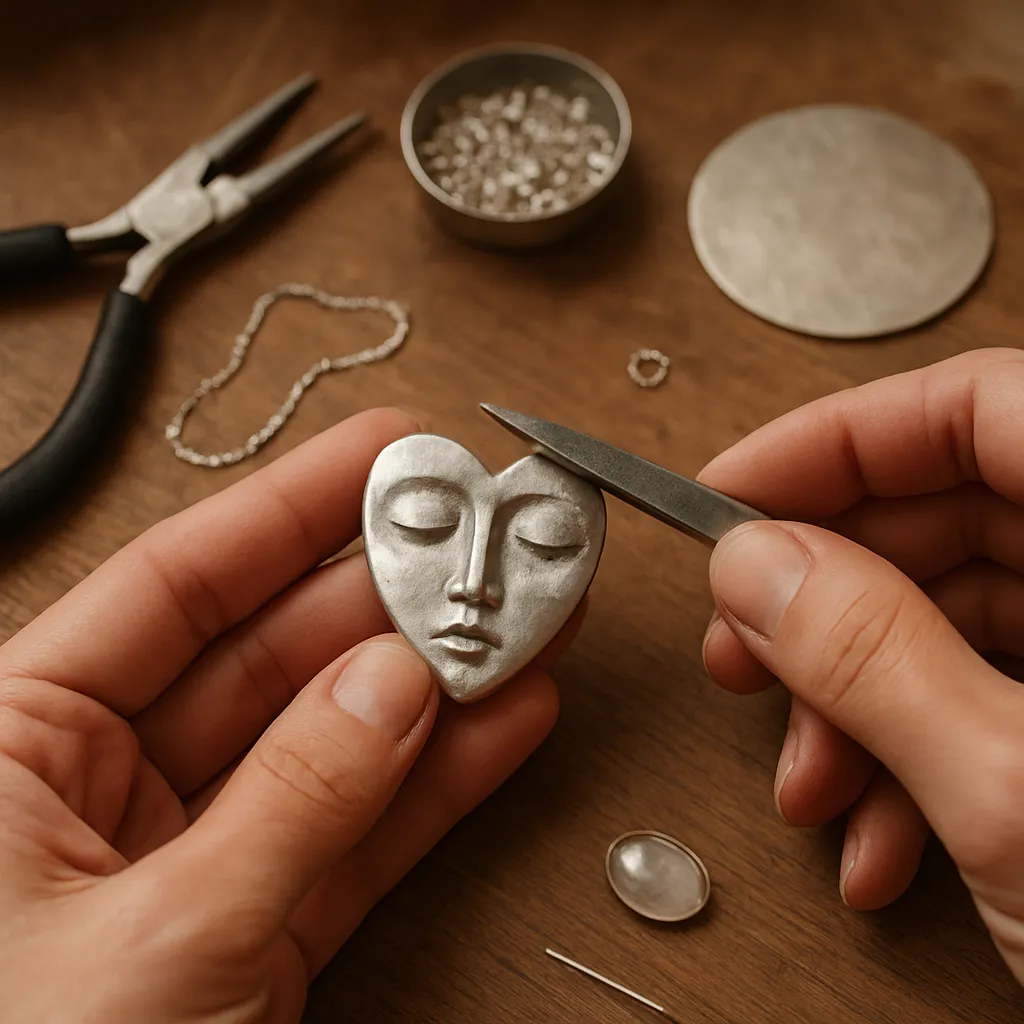
Jewelry can carry what spoken language often cannot: a private sensation of love, absence, courage, or return. Handicraft—by hand, with breath and repetition—lets those sensations settle into metal, fiber, glass, and stone. The goal is not just to decorate a body, but to make a small object capable of recalling a place, a person, or a promise. This article explores how to design and build such objects, focusing on methods that invite emotional depth, from the first spark of a concept to the last stroke of a polishing cloth.
The emotional core of handcrafted jewelry
When people say a piece “speaks” to them, what they often mean is that it stirs a lived experience or a desired self-image. A pendant can feel protective because its edges echo a familiar silhouette; a ring can soothe because it is balanced in weight and temperature. Five pillars help explain why an object can move us:
- Intention: a clear inner purpose transforms technique from a checklist into a vow; makers who articulate their purpose design more decisively and edit more courageously.
- Narrative: the sequence of decisions—why this form, this stone, this clasp—becomes a story your wearer can tell and retell.
- Symbolism: forms, colors, and numbers carry shared cultural meanings that can amplify or complicate a message.
- Memory: materials or motifs connected to a time, place, or person give the piece a bridge into the wearer’s past.
- Tactility: texture, temperature, weight, and movement feed the senses and anchor emotion in the body rather than only in the mind.
There is also resonance, the fit between a maker’s inner world and a wearer’s lived reality. When those rhythms sync, a simple copper bangle can feel like a companion. To build that fit, define the feeling you are after. Is it steadiness? Flight? Shelter? Clarity on the feeling will guide every material and construction choice that follows.
Designing with purpose: from spark to story
Begin with questions, not sketches. Ask what the piece should help someone feel and when they are most likely to reach for it. If the piece is for grief, perhaps it needs a center of weight to hold like a worry stone; if for celebration, maybe it requires sound or shine to catch light at a distance. Design is editing: keep only choices that serve the feeling.
Turn questions into a brief you can refer to throughout the process:
- Emotion and use: what is the core feeling, and how will the piece be worn (daily, ritual, performance)?
- Body map: where does the piece touch skin, and for how long?
- Sensory palette: which textures, temperatures, and movements fit the feeling?
- Time horizon: is this for a specific event or for decades of wear?
- Constraints: budget, allergies, regulations, cultural context.
Translate the brief into form language. Circles soothe; triangles signal direction or defense; spirals suggest growth; knots embody bonds. In this space, reflect on archetype: the deep, cross-cultural patterns that recur in story and symbol, like the guardian (shield forms), the traveler (compass, path motifs), the healer (vessel, leaf, water). The more you understand how an archetype behaves, the easier it is to distill a potent, legible shape.
Materials that speak: metals, stones, and organics
Metals hold feeling in their weight, color, and behavior over time. Fine silver feels soft and luminous, encouraging quiet designs; sterling silver takes detail well and can be blackened for drama; copper warms the skin and suggests humility; brass carries a golden tone without the same cost or malleability as gold. Patination techniques invite planned aging so a piece’s story emerges through wear. A finish that evolves—subtle scratches, deepened low points—can make a talisman feel lived-in, especially if you lean into a designed patina that honors use rather than resisting it.
Stones offer color, light, and geological time compressed into a palm-sized truth. Some stones sparkle, some glow, some have lines like maps. Choose each for optical effect (brilliance, chatoyancy, adularescence) and for how it complements the chosen metal. Ethics matter: learn a stone’s provenance, seek fair-trade sources, and consider lab-grown options when appropriate. Remember that cultural associations vary; a black stone may symbolize power in one context and mourning in another. When in doubt, ask your client what meanings they bring, then let those meanings shape the rest of the design.
Organic materials—wood, horn, bone, seed, shell, silk—offer warmth and gentle wear against skin. Wood can be stabilized or left raw to breathe; shell shimmers like water and pairs beautifully with matte metal; silk remembers the curve of a wrist. Legal and ethical sourcing is vital here too; ensure compliance with local and international regulations before using protected species or artifacts. Combined materials can heighten contrast: rough linen with polished gold, hammered copper with glass enamel, basalt with mirror-finished steel.
Techniques that encode feeling
Technique is language. Each process leaves a trace that can reinforce your concept:
- Forging: directional hammer blows impart energy and line; ideal for strength, movement, and visible labor.
- Chasing and repoussé: sculpt light and shadow from thin sheet for expressive surfaces that can carry stories like relief maps.
- Filigree and granulation: lacy or starry delicacy evokes care and precision; excellent for heirloom-like intimacy.
- Lost-wax carving and casting: build forms with bone-deep curves and undercuts; carve gesture directly into wax for organic emotion.
- Enameling: vitrified color communicates joy, melancholy, or serenity with painterly nuance; translucent layers can echo depth of feeling.
- Keum-boo and gilding: thin gold fused to silver creates a devotional glow without full-gold cost; highlight edges or symbols central to the message.
- Mokume-gane and laminates: wood-grain metals suggest riverbeds and growth rings, hinting at time and change.
- Textile techniques: weaving, braiding, or macramé knit bonds into the structure; fabrics absorb scent and carry intimacy.
Notice how edges and backs matter as much as fronts. The part that touches skin is a private stage: a hidden etching, a small dome for the finger to find in a pocket, a ridge for grounding during anxious moments. Functional details can carry meaning too: a clasp that resembles a hand taking another hand, a pin stem shaped like a path, a bail that rotates to release tension. All these choices incline the piece toward presence rather than mere appearance.
Prototyping, iteration, and wear testing
Emotionally effective jewelry must be kind to the body. Prototype early with paper, leather, wire, and base metals. Check proportion on different body sizes. Verify that volumes do not snag, that weight centers comfortably, and that moving parts do not pinch. A necklace that looks graceful on a bust may tilt awkwardly on a real person; a ring may rotate unless counterweighted or shaped for the knuckle.
Iterate in cycles: adjust, test, document. Develop an internal scale of comfort from one (barely felt) to five (consciously present). Decide where your design should land on that scale. A meditative piece might need a steady weight at three; a celebratory shoulder brooch could sit at four to signal presence at a distance. Photograph prototypes, annotate what changed and why, and save discarded parts as a vocabulary of future options.
Color, light, and motion
Color is fast emotion. Warm metals and stones energize while cool ones calm; faint tints can whisper where saturated colors shout. Light behavior matters too: high-polish planes call attention, while satin or brushed finishes hush and soothe. Consider combining finishes to orchestrate a path for the eye—a glint here to catch attention, a velvety field to rest upon.
Motion can quicken a heartbeat or slow it. Hinges, rivets, and chain articulation let pieces respond to the body’s rhythms. A pendant that rocks subtly can comfort like a cradle; earrings that chime invite celebration. Engineers of feeling study sound as well: soft bells in a locket, lightly sprung elements that click faintly. Small movements turn private rituals—touching the pendant during a pause—into design features rather than afterthoughts.
Personalization, ritual, and co-creation
Emotionally potent jewelry thrives on small secrets. Engrave a date in an inner curve; hide a map coordinate under a hinge; inlay a chip of brick from a childhood home. Invite clients into the process: collect their sketches and stories, and ask them to select from a set of textures or stones crafted to your palette. When clients author parts of the piece, they carry it with pride and tenderness.
You can also design rituals around the work: a bracelet whose beads are added annually, a pendant that shifts chains to mark milestones, a ring that stacks with thin spacers—each element a chapter. Create moments of assembly and transformation: a brooch that becomes a pendant, a pair of earrings that join into a lariat. The more a piece joins a wearer’s calendar and gestures, the more indispensable it becomes.
Ethics, culture, and care
Emotion divorced from ethics rings hollow. Source materials through transparent channels, pay living wages, and document your process for clients who care how a piece came to be. When inspiration travels across cultures, seek consent and collaboration, not extraction. A borrowed motif without context can wound; a shared motif with credit and partnership can heal and educate. Build a habit of asking: who benefits, who is named, who is overlooked?
Care is part of design. Allergies are emotional, not just medical: a green stain can ruin a first date or a job interview. Use nickel-free findings when possible and disclose alloys plainly. Offer maintenance plans and repair paths; design settings that can be tightened without dismantling an heirloom. A promise to care for a piece is a promise to care for the person who wears it.
Finishing, aging, and the long view
A finish is a final sentence, not an afterthought. Decide whether the piece should appear new for a long time or evolve with wear. Micro-abrasions signal use; high polish magnifies them, while soft matte hides them. If you design for evolution, mark the places where time should write: recessed areas that deepen, high ridges that brighten. Pieces built to age gracefully can comfort the wearer as their own life gathers texture and change.
Think modularly about the future. Can a ring be resized without losing engraving? Can a locket accept new inserts? Can a clasp be swapped for arthritic hands? Planning these outcomes in advance honors life’s unfolding chapters and keeps the piece in circulation rather than retired to a box.
Presentation, packaging, and story
Emotion continues beyond the workbench. Packaging is a small stage set for the first encounter. Texture matters: soft paper, quiet fabric, boxes that open slowly. Color should echo the piece. Include a story card that tells the how and why of materials, processes, and choices. Not a lecture—just a handful of sentences that invite the wearer into the studio with you. A care card prevents avoidable heartbreak; a small polishing cloth becomes a token of ongoing relationship.
Photograph the piece in ways that show scale, light behavior, and movement. Include neutral shots for clarity and contextual shots for feeling: a pendant on a collarbone, a ring on a hand at rest, an earring in motion. The right images help a remote viewer feel what it might be like to live with the piece.
Pricing with clarity and heart
Emotional value is not an excuse to obscure price. Transparent pricing builds trust. Track hours, materials, and overhead; add an artist’s margin that reflects experience and scarcity. Offer tiers when possible: a core design in sterling with a lab-grown stone, a limited edition in gold with a natural stone, a one-of-a-kind version with exceptional carving. Certificates of origin, documented processes, and named collaborators add confidence and keep the story legible over time.
Resist racing to the bottom. If your process includes careful fit testing, hand engraving, and ethically sourced materials, name those choices and stand by the price they require. When a client understands what they are paying for, the piece already begins to carry respect.
From bench to bond: a practical workflow
Here is a condensed path you can adapt to your studio, whether you work in a shared makerspace or at a kitchen table:
- Clarify the feeling in a one-sentence brief, then expand into a page of visuals and words.
- Collect materials whose behaviors support the brief: metals, stones, fibers, resins, found fragments.
- Prototype structure in base materials; validate proportion, movement, and comfort on multiple bodies.
- Commit to a primary technique and a secondary accent technique that enhance the message (for example, forged structure with enamel accents).
- Craft the inner surfaces first—edges, backs, and contact points—then complete the visible fronts.
- Test clasps and joins; build in redundancy where failure would be catastrophic (soldered closed jump rings on fine chains, safety catches on brooches).
- Finish surfaces intentionally for either longevity of sheen or beauty of wear; document care recommendations.
- Package with a story card, care guide, and a photograph that captures the intended feeling.
- Offer a follow-up appointment for fit adjustments or engraving once the piece meets the wearer’s body.
Case sketches: three feelings, three builds
Steadiness for daily life
Brief: a pendant for someone beginning a demanding job who seeks composure. Materials: brushed sterling oval, hematite cabochon, fine chain. Technique: forged frame with bezel setting. Hidden detail: a small raised ridge on the back for grounding touch. Surface: satin to mute glare under office lights. Result: understated presence; weight centered under sternum to cue calm breathing.
Remembrance without melancholy
Brief: a ring to honor a grandparent who taught gardening. Materials: rose gold, small shard of sea glass found on shared beach, green enamel inlay. Technique: lost-wax carved shank with low-relief leaves; inlay channel for enamel. Hidden detail: inside-band engraving of the beach’s coordinate. Surface: mixed finishes—polished leaf edges, matte fields. Result: tactile edges echoing leaf veins; the ring catches light gently like dawn over water.
Courage in transition
Brief: a brooch for someone starting anew in another city. Materials: brass and steel laminate, smoky quartz point, silk cord accessory to convert brooch to pendant. Technique: mokume-like laminate with hammered path motif; riveted cage for the quartz. Hidden detail: map fragment sealed inside a flap on the back. Surface: selective bright polish along the “path,” brushed elsewhere. Result: kinetic sparkle when worn on a lapel; quartz points forward, hinting at direction.
Sustainability and emotional durability
To make emotions last, make objects last. Choose joinery that can be serviced, finishes that can be renewed, and designs that can survive small accidents. Offer take-back programs for refurbishment, trade-ins for evolution, and archives of design files to replace a lost mate. Reduce waste by nesting cutting templates, recycling filings, and designing collections that share parts. Emotional sustainability also involves story stewardship: keep records of materials and collaborators so future owners can know the piece’s lineage.
Consider the energy footprint of torches, kilns, tumblers, and ventilation. Simple shifts—daylight benches, efficient annealing, reusing pickles and baths responsibly—lower impact without compromising craft. Clients who value story also value stewardship; invite them into that practice with you.
Teaching, community, and shared making
Community studios, pop-up classes, and repair circles build networks of care around jewelry. Teaching someone to solder their grandmother’s locket chain or to restring a memorial necklace transforms anxiety into agency. Shared making spreads skills and multiplies meaning: pieces become maps of relationship, not just transactions. Document community projects with participant consent; these archives show how craft can hold civic as well as personal feeling.
Testing your piece’s emotional readiness
Before releasing a design, stage a small ritual of evaluation. Place the piece on neutral cloth. Ask: what is the first feeling it gives? Does that match the brief? Handle it with closed eyes: does it guide touch to a meaningful place? Wear it for an hour in everyday tasks: does it irritate, pinch, clang? Invite three people of different body types to try it and describe a feeling in one word. If the words wander from your aim, adjust. If they converge, you have built a vessel for the feeling you named.
Language, naming, and the gift of words
Names matter. Give pieces names that honor action and place—“Harbor,” “North Wind,” “First Light”—so clients can locate themselves in the story without being told what to feel. Short, evocative copy helps: two or three sensory images, a note on process, and one sentence that links object to emotion. Avoid overpromising. The more space you leave for the wearer’s life to complete the piece, the stronger the bond.
When jewelry becomes a companion
At their best, handmade pieces become companions that mark time and steady breath. They learn the heat of the wearer’s skin and the pace of their days; they gather scratches like constellations. The craft behind them—burnishers and files, tumbler grit and annealing colors—fades into the background, leaving only presence. This is where making meets meaning: the small, enduring object that reminds someone who they are, or who they are becoming.
A final note on practice
Building jewelry that evokes feeling is not a single technique but a posture. It is listening with hands, shaping with care, editing with purpose, and releasing with humility. What begins as metal and fiber ends as a meeting between two lives: the maker’s and the wearer’s. To support that meeting, keep returning to the root words that guide good work: patina as time’s handwriting on surfaces, provenance as a chain of responsibility, archetype as a bridge across cultures, and empathy as the craftsperson’s finest tool. When these live in your practice, your pieces will move more than air and light; they will move hearts.
